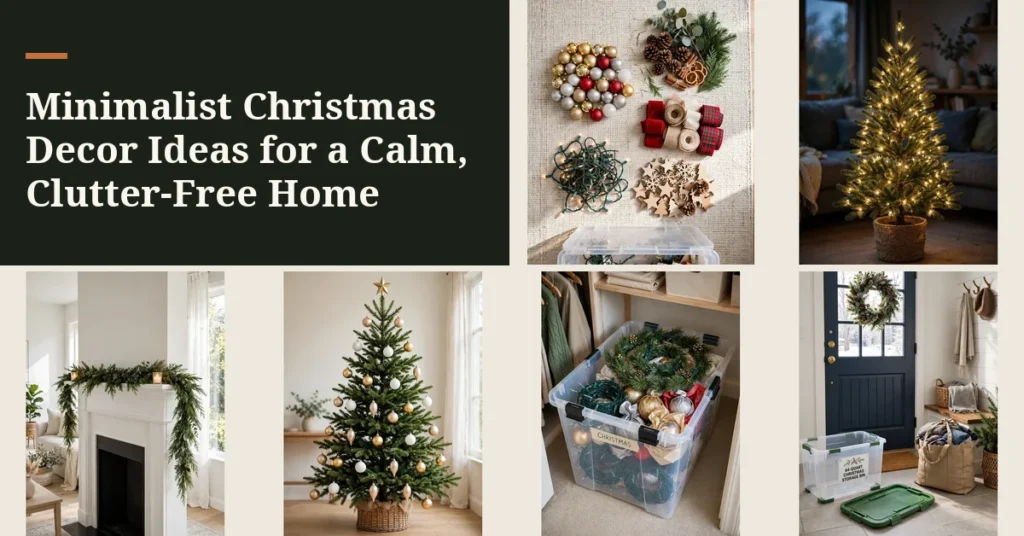
Minimalist Christmas decor starts with what you already own. Before you spend a dollar on new garland, drag last year’s decor box into the living room and sort everything on the floor. Most households find a third of it is broken, dated, or duplicated, and the calm, clutter-free home they want is already hiding under the clutter they own.
You need a smaller plan, not more stuff. These 12 ideas keep one focal point per room, cap every category at a number, and pack the whole season into a single 64-quart bin when January arrives. For the full seasonal spread, browse these Christmas decor ideas, then use this list to edit them down.
Why Minimalist Christmas Decor Feels Calmer
Your eye treats every new color, shape and sparkle as information to process. A tree with 80 multicolored ornaments, two garlands, three stocking styles and a light projector is hundreds of competing focal points, and your brain registers that competition as noise.
Restraint fixes it through sight lines. One 4-foot tree in a corner reads as Christmas because the silhouette does the work. Lights at 100 bulbs per foot make the glow the decoration, so the ornament count can drop to 24 without the tree looking bare.
The storage payoff is built in. A plan capped at numbers always packs into fewer bins, which is why this whole system fits in one 64-quart tote.
Less to buy, less to store, and a house that actually feels calm in December. That is the entire philosophy: fewer decisions in the store, fewer boxes in the garage.
1. Start With the Box You Already Own: Audit Before You Buy
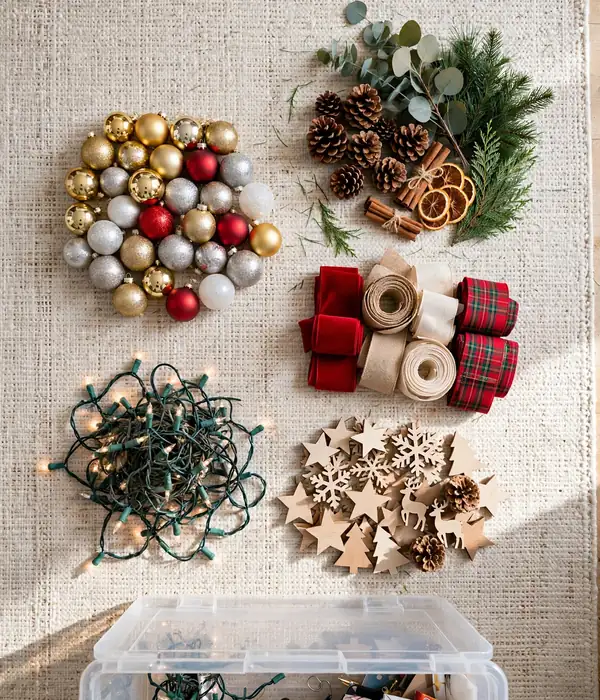
Every cluttered Christmas started as one reasonable box of decor that grew a little each December. A clearance strand of lights, a second garland because the first looked thin, ornaments from the after-Christmas sale. Together they became three bins you dread opening.
An audit reverses that in one afternoon. Spread everything on the floor by category and the duplicates announce themselves: two nearly identical tree skirts, three half-used boxes of hooks, the topper you never liked. From here the only rule is one in, one out.
What to pull out and sort first:
- Lights: plug in every strand and toss the dead ones. A strand with more than a quarter of its bulbs dark is not worth its storage space.
- Ornaments: keep the ones that fit one palette. Box sentimental strays separately instead of letting them scatter the theme.
- Garlands and wreaths: shake them out and check for shedding. If a garland drops needles every time you move it, it is done.
- Stockings and tree skirts: keep one set. Two sets means you are decorating two Christmases.
- Ribbon and gift wrap: keep two rolls you love. A drawer of tangled ribbon from 2021 is not decor.
- Anything still sealed from last year’s clearance sales: if it sat unopened for 12 months, donate it sealed.
2. Downsize the Tree: One Tree at 4 to 6 Feet
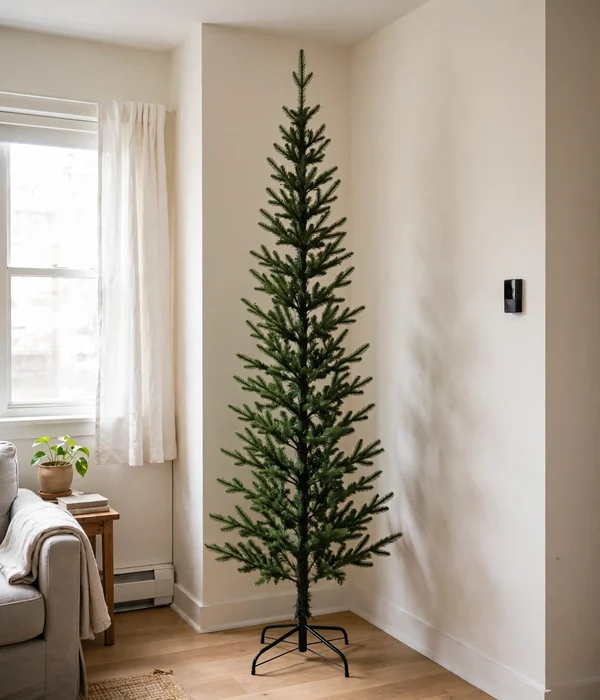
The tree is the biggest object in the room and in storage, so it sets the scale of everything else. A 7.5-foot full tree needs a 30-inch footprint, 750 lights, and a storage bag taller than most closets, while a 4 to 6 foot tree needs a 20 to 24 inch footprint and 400 to 600 lights.
Smaller trees also read calmer because your eye takes in the whole silhouette at once. On a 4-footer every ornament is visible from across the room, which is exactly why 24 of them is plenty.
Tips for best results: choose a slim or pencil profile, 20 to 26 inches at the widest branch, when floor space is the real limit. A 3-foot tabletop tree on a sturdy 18-inch side table gives the same silhouette in a studio. Keep any tree 3 feet from heat vents so the needles last the season.
Watch out: pre-lit small trees often ship with sparse lighting, sometimes just 100 lights on a 6-foot tree, which is a quarter of what you need. Plan on one extra 100-light LED strand per foot of tree, woven in before a single ornament goes on.
3. Light It From the Inside: 100 Bulbs Per Foot, Woven Deep
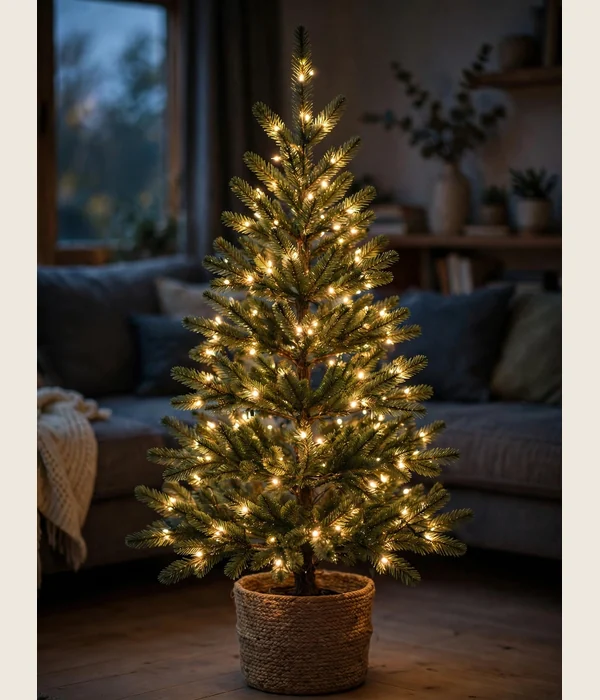
Light count is the difference between a tree that glows and a tree that merely looks decorated. Most sparse-looking trees are not under-ornamented, they are under-lit. The standard is 100 bulbs per vertical foot: 400 on a 4-foot tree, 600 on a 6-foot tree.
How you wind matters as much as how many you use. Lights draped only on the outer branches read flat and leave dark holes in the middle. Strands pushed 6 to 8 inches deep into the branches bounce light off the back of the tree, so the same 400 bulbs look like twice as many.
Wind the lights inside out:
- Test every strand on the floor and retire the dark ones. Plug the working strands together first so only one cord runs to the wall.
- Start at the top with the plug end. Weave each strand 6 to 8 inches deep, then zigzag back out toward the branch tips as you work down.
- Space the zigzags 4 to 6 inches apart vertically. Two 100-light strands finish a 4-foot tree; a 6-footer needs four.
- Step back in a dim room before touching ornaments. Wherever you see a dark wedge, add bulbs there instead of covering it with ornaments.
4. Hang One Wreath: 24 Inches on a Standard Door
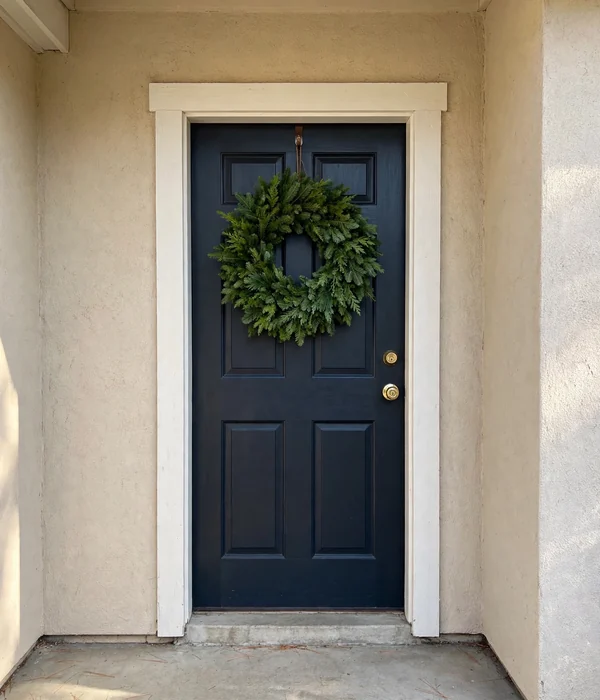
A wreath is the front door’s handshake, and one well-sized wreath says more than a door crowded with signs, swags and bows. Sizing is simple arithmetic: subtract 12 inches from your door’s width. A standard 36-inch door takes a 24-inch wreath, leaving 6 inches of breathing room on each side.
Indoors, the same wreath hung over the mantel or on a bare wall gives you a second focal point without a second theme. Buy it unadorned and it follows whatever palette the tree carries, year after year.
Where one wreath works best:
- Front door: a 24-inch wreath centered at eye level, about 57 to 60 inches from the ground to its middle.
- Above the mantel: 20 to 24 inches wide, with the bottom edge at least 10 inches above the shelf.
- On a window: an 18-inch wreath on suction hooks rated for 3 pounds or more, hung inside the glass where weather never touches it.
- On a bedroom door: a slim 16 to 18 inch wreath that clears the frame when the door swings.
- On double doors: hang one wreath on the active door only. One reads intentional, while two reads like a store display.
5. Run a Single Garland: 6 Feet, Hung Once
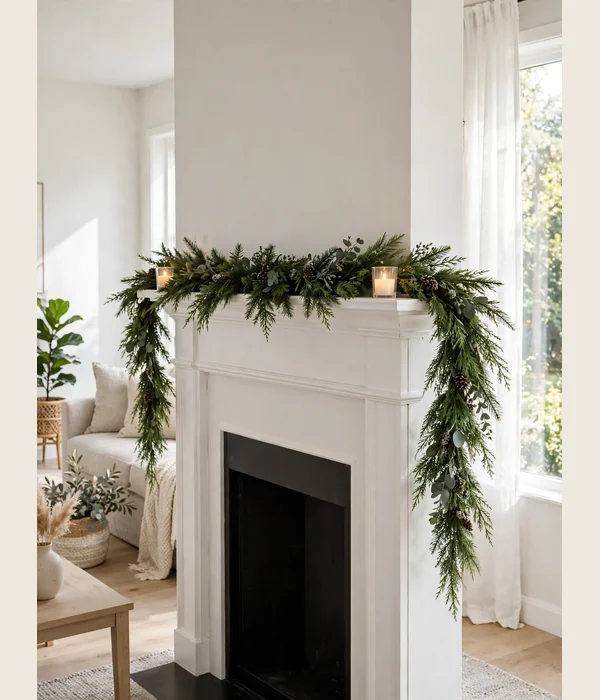
Garland is where minimalist plans die, because one strand never looks as full as the store photo, so people buy a second and a third. Resist that. A single 6-foot garland, fluffed properly, is the standard length for a mantel or doorway, and fullness comes from how you hang it, not how many you stack.
Decorators size garland with one rule: measure the mantel’s width and multiply by 1.5. A 6-foot-wide mantel needs about 9 feet of garland for a draped look with swags, while a 4-foot mantel is perfect with one standard 6-foot strand laid straight and 12-inch drops at each end.
Tips for best results: secure the garland with three to four removable hooks rated for 3 pounds each, not nails. If you want lights, choose a pre-lit 6-foot garland with 50 built-in LEDs and skip separate strands. For a fuller look without buying more, twist a plain green strand with a frosted one.
Watch out: fresh garland sheds and wants misting, which is the opposite of calm. Keep it away from heat vents and expect to replace it after two to three weeks. For more small-space mantel ideas, see these Christmas mantel decor for small living rooms.
6. Go Flameless: LED Candles That Run 200 Hours
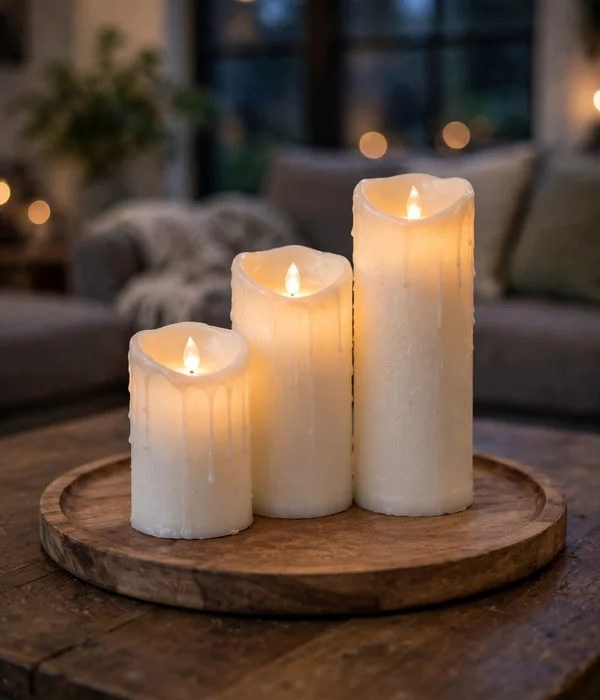
Real candles are the least minimalist decoration in existence: open flame, wax drips, soot, and a rule that says never leave the room. A set of flameless LED pillars gives the same warm flicker with a 6-hour daily timer and zero supervision. Most AA-powered pillars run 200 hours per set of batteries.
The safety math is the real argument. A real candle needs 12 inches of clearance from anything flammable and an adult in the room. An LED pillar can sit inside a garland, on a bookshelf, or in a window beside curtains, places a real flame could never go.
Set up a flameless candle cluster:
- Buy pillars in three heights, 4, 6 and 8 inches, in warm white at 2200K to 2400K. Cool white LEDs read as office lighting, not candlelight.
- Group them in odd numbers, three or five, on a 12-inch tray or inside a lantern. The tray catches nothing, since there is no wax, but it anchors the cluster visually.
- Set the built-in timer for 6 hours starting at dusk. One set of AAs then lasts roughly a month, so you change batteries once all season.
- Keep real candles out of the plan, or limit them to the dinner table where someone is always seated. If you burn real ones, trim wicks to a quarter inch and keep them 12 inches from greenery.
7. Forage the Fillers: Free Texture From Your Yard
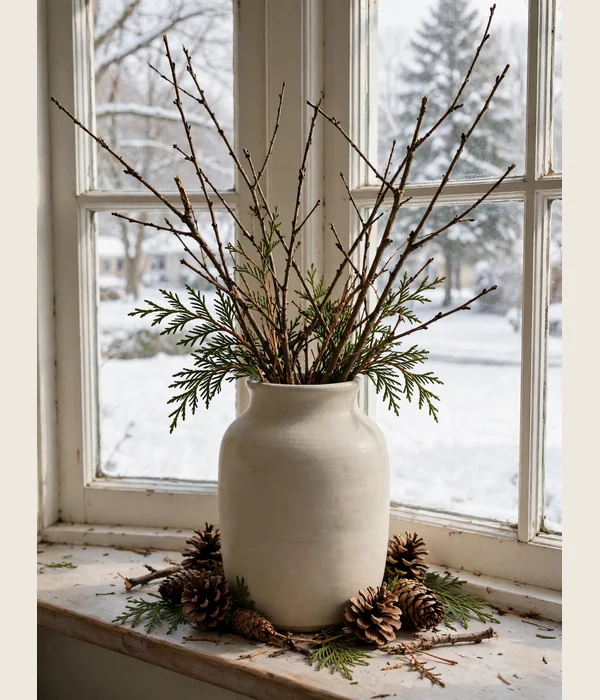
The cheapest minimalist decor is the kind you do not buy. Pinecones, bare branches, cedar clippings and eucalyptus sprigs cost nothing, match every palette, and look expensive in a simple vessel. They also solve the filler problem: those empty spaces between your big pieces that usually trigger another ornament run.
Foraged texture works because it is real. Artificial fillers try to imitate nature and usually fail. The actual twig in a thrifted vase beats a $25 faux arrangement every time, and it composts in January instead of needing a bin.
The 10-minute forage walk:
- After a windy day, walk your yard or a park path with a tote bag and collect pinecones, 8 to 12 inch branches, and fallen evergreen clippings. You need less than you think.
- Spread everything on newspaper for 24 hours so hitchhiking insects leave on their own. Brush off the dirt and let pinecones open fully in the warmth.
- Arrange branches in a 6 to 8 inch vase with the tallest stem around 18 inches high, then tuck pinecones around the base. One vase per room is enough.
- Keep foraged greens 12 inches from any real flame and never inside a lit lantern. With LED candles nearby, there is nothing to worry about.
8. Cap the Ornaments: 24 Per Tree, One Palette
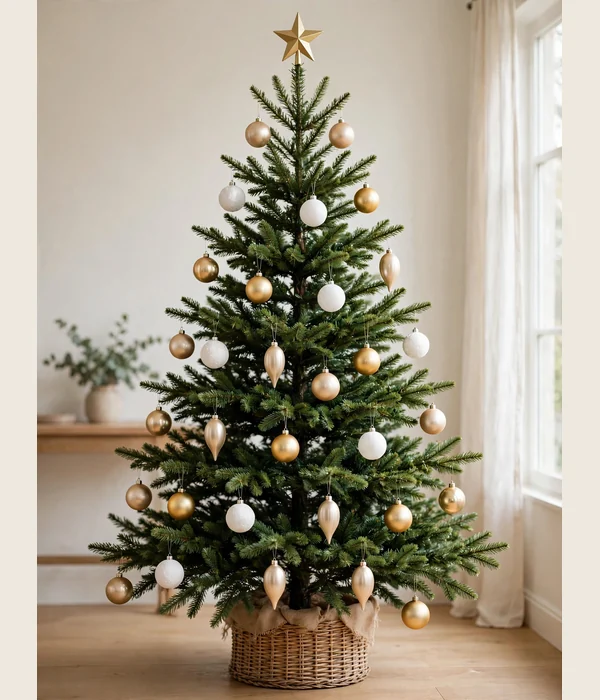
Ornament chaos is the number one reason trees look cluttered: every color family, every vacation souvenir, every handmade relic, all on one tree. Capping the count forces the edit. On a 4 to 6 foot tree, 24 ornaments is the sweet spot where the tree looks dressed but each ornament gets its own space.
One palette does the rest. Two metallics plus one matte color, say gold and champagne with matte white, reads as designed even on a $40 tree. The palette also makes shopping simple: if it is not in the palette, it does not come home.
What to buy for the 24:
- 16 shatterproof baubles, 2.5 to 3 inches across, split between your two metallics. Shatterproof matters when the tree sits where a cat or toddler can reach.
- 6 matte ornaments in your single accent color for contrast against the shine.
- 2 statement pieces at 4 inches for the front-facing branches, to anchor the eye.
- 1 tree topper in the palette. A simple star or a bow of 2-inch-wide ribbon is enough.
- 1 box of wire ornament hooks, 100 count. It costs a few dollars and lasts a decade.
Count them onto the tree in layers: metallics deep inside first for depth, matte ornaments on the mid branches, and the two statement pieces at eye level facing the room. Step back twice while you work. Ornaments look different from the sofa than from six inches away.
9. Hang Stockings Without a Fireplace: One Holder
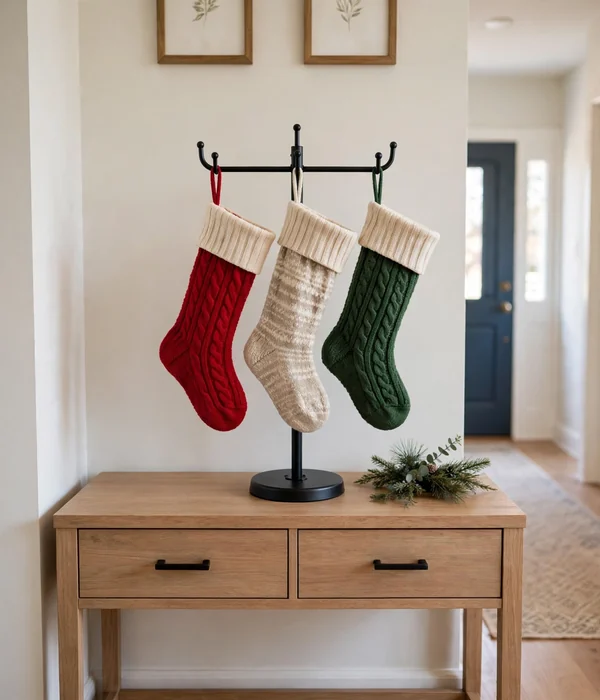
No mantel does not mean no stockings. A freestanding stocking holder with a weighted base sits on any shelf, console or sideboard and holds stockings exactly where a mantel would. Most are rated for 3 to 5 pounds per hook, which covers a stuffed 18-inch stocking with room to spare.
The trick is placement discipline. One holder with three stockings on the entryway console is a focal point. Stockings taped to every doorway in the house is clutter with good intentions. A weighted-base holder needs a shelf at least 6 inches deep, so check before you buy.
Tips for best results: for renters, a row of removable hooks rated for 3 pounds each on the side of a bookshelf works just as well and leaves no marks. Hang stockings 6 to 8 inches apart so they do not bunch together. Stuff the toes with tissue paper so they hold their shape all season.
Watch out: adhesive hooks need 24 hours to cure before they carry weight, and they fail on textured or cold walls. Test one hook overnight with a 5-pound bag of flour before trusting it with gifts. For dedicated no-mantel setups, see these stocking holder ideas without a fireplace.
10. Pack It All Away: One 64-Quart Latching Bin
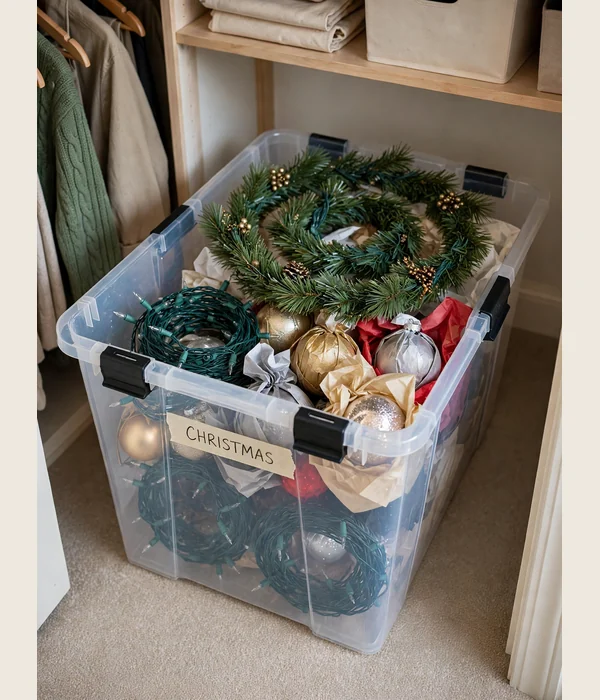
Storage is where minimalist decor proves itself: if the whole season fits in one bin, the plan was genuinely minimal. A standard 64-quart latching bin measures about 23.75 inches long, 16 inches wide and 13.5 inches tall, holds everything in this plan, and its latching lid keeps the seal tight for 11 months.
Pack the one-bin system:
- Wind each light strand around a 12-inch piece of cardboard so it cannot tangle. Label the cardboard with the strand’s length.
- Layer ornaments with tissue paper between layers; shatterproof baubles can share, glass gets its own nest.
- Coil the 6-foot garland loosely on top instead of folding it, since folds crush branches permanently.
- Set stockings, the tree skirt and LED candles on top. First unpacked means last buried.
Pin this: the decor-box sizing cheat sheet
- 64-quart latching bin (23.75 x 16 x 13.5 in): lights, ornaments, garland, stockings and candles for the whole plan.
- 27-gallon tote (30 x 20 x 15 in): for the disassembled 6-foot tree only, never the decor.
- 24 to 30 inch wreath bag: one wreath, stored flat, hung on a garage hook.
- 32-quart bin (about 16 x 12 x 10 in): overflow for sentimental ornaments outside the palette.
- Label every bin on two sides with painter’s tape: CHRISTMAS plus the year you last edited it.
11. Shop From a Checklist: 10 Items, Nothing Extra
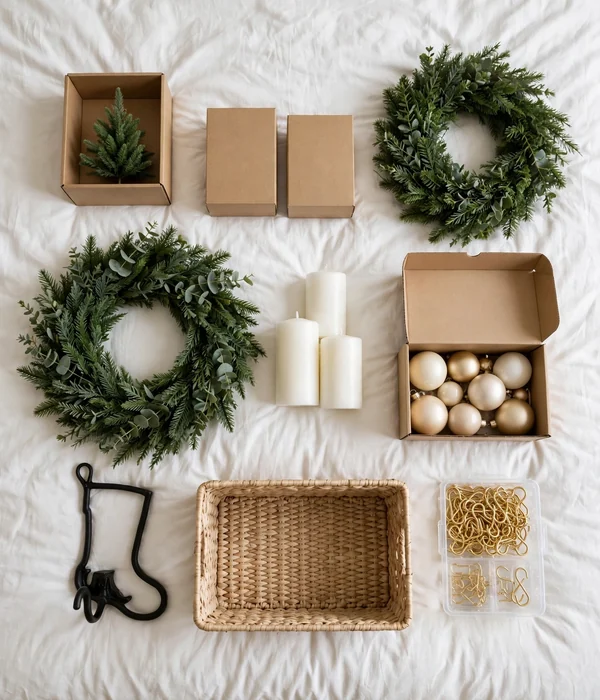
Minimalist decor fails at the store, not at home. You walk in for hooks and walk out with a light projector, a second garland and a singing reindeer. A written checklist with a hard cap turns every aisle into a yes-or-no question: is it on the list.
Ten items is the right ceiling for this plan. It covers every idea above with two spares for whatever your home specifically needs, and it fits on a phone note you can check off in the aisle.
The 10-item minimalist Christmas checklist:
- A 4 to 6 foot slim tree, only if you do not own one.
- Two 100-light warm-white LED strands, only if your tree is not pre-lit to 100 per foot.
- One 24-inch wreath for the door.
- One 6-foot garland, plain or pre-lit.
- Three flameless LED pillars (4, 6 and 8 inch) with a tray.
- 24 ornaments in one palette, shatterproof.
- One freestanding stocking holder, or a 4-pack of 3-pound removable hooks.
- One 64-quart latching bin for storage.
- One box of ornament hooks and one roll of painter’s tape for labels.
- Your one wildcard: the single item your home actually needs, chosen after the audit, never before.
Buy nothing that is not on this list until next December’s audit. That sentence is the whole system. Total spend for the full list, buying everything new, typically lands between $120 and $200 at big-box stores, and drops under $60 if you already own the tree and the bin.
12. Schedule the January Edit: One In, One Out Forever
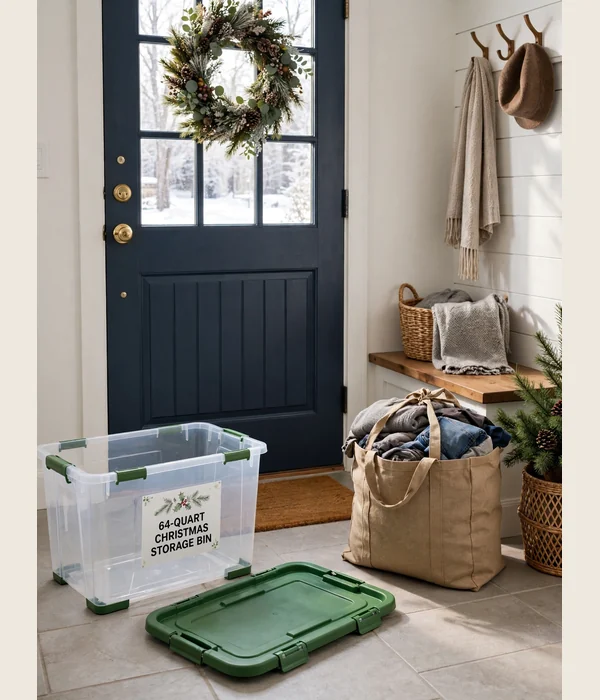
Minimalism is maintenance. Every December adds one well-meaning gift ornament and one clearance find, and without an annual edit the box quietly doubles. The January takedown is the cheapest time to edit because you are already handling every piece and the sentiment is low.
The rule is one in, one out, forever. It takes ten extra minutes while you pack, and it is the reason this plan still fits in one bin five years from now. Photograph the packed bin before the lid goes on; next December the photo tells you exactly what earned its place.
Tips for best results: take decor down in the first week of January, while the habit is fresh. As each item goes into the bin, ask whether it earned its space this year.
Anything you did not hang gets donated, not stored. Keep a donate bag by the bin and drop it off within two weeks, before it migrates to a closet.
Watch out: do not buy bigger bins in January to solve overflow. Overflow means the edit failed, not the bin. If the lid does not close easily on the 64-quart bin, remove items until it does. A bin that will not close is the plan telling you it worked.
Conclusion
The one to skip: the giant novelty inflatable, the most popular clutter trap in Christmas decor. It dominates the entire yard, looks deflated and sad in daylight, and one 6-foot inflatable eats most of a 27-gallon tote in storage. Nothing else costs you that much visual noise and that much garage space at once.
Twelve ideas, one bin, one calm house. Start with the audit this weekend, buy only what the checklist allows, and let the empty space do the decorating. Your January self will thank you when the whole season packs away in a single afternoon.
Frequently Asked Questions (FAQ)
How can I do minimalist Christmas decor without my home looking bare?
If your rooms feel empty now, then restraint will only sharpen them, not hollow them out. Keep one focal point per room, a lit tree in the living room and a wreath on the door, and let the glow do the decorating. Bare happens when pieces are scattered; one intentional cluster per room always reads as finished.
What size Christmas tree works best for a minimalist look?
Under 200 square feet, a 4-foot slim tree with a 20 to 24 inch footprint is the sweet spot. In a full-size room, a 6-foot slim tree still reads minimalist with lights capped at 100 per foot and ornaments at 24. Taller than 6 feet and the tree starts demanding more of everything.
How many ornaments should I put on a minimalist tree?
If your tree is 4 to 6 feet tall, then 24 ornaments in one palette looks dressed without crowding. If it still looks thin at 24, then add light count before ornaments, since under-lit trees fake being under-decorated. If yours are sentimental and multicolored, give them their own tabletop tree and keep the main one in palette.
Are flameless LED candles really better than real candles for a calm home?
If you want candles glowing every evening without supervision, then yes, LEDs win outright. A 6-hour timer and 200-hour battery life mean they run themselves all season. If the ritual of lighting a real candle at dinner matters to you, then keep one or two real ones at the table and use LEDs everywhere else.
Where should I store minimalist Christmas decor the rest of the year?
With this plan, everything but the tree fits in one 64-quart latching bin, about 23.75 by 16 by 13.5 inches. If you keep a 6-foot tree, add one 27-gallon tote for the tree and a wreath bag on a garage hook. Label two sides of every bin so you can find it all next October.
Can I hang stockings if I do not have a fireplace or mantel?
If you have any shelf, console or sideboard, then a freestanding stocking holder with a weighted base solves it; most hold 3 to 5 pounds per hook. If you rent, then removable 3-pound hooks on a bookshelf side work, but let them cure 24 hours first. Either way, keep stockings 6 to 8 inches apart.