
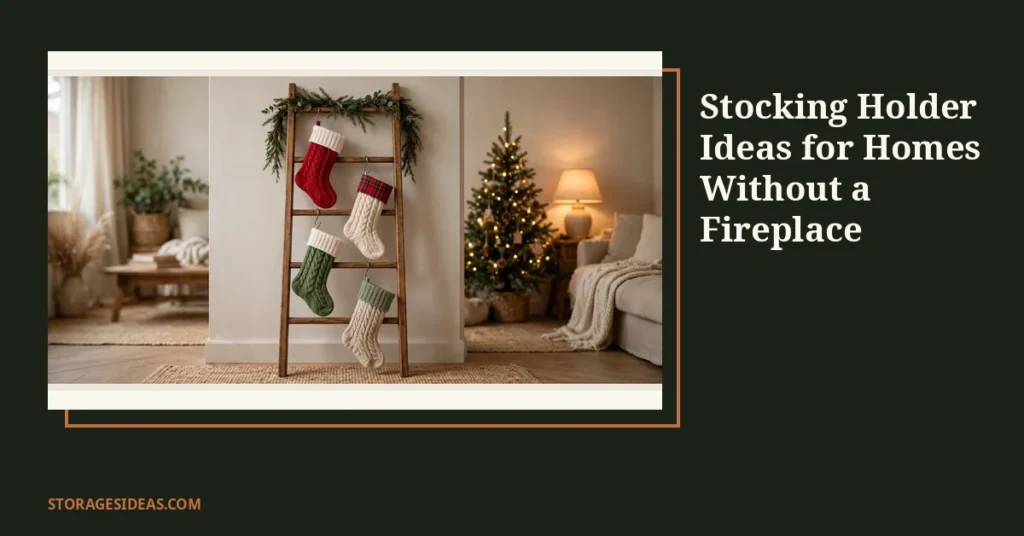
The first weekend of December is stocking weekend in my house. The tree is up, the boxes are open, and the stockings need a home by Sunday night. If you are shopping for a stocking holder with no fireplace in your home, you are not stuck taping them to a wall.
Every one of these nine ideas works with zero fireplace. Six of the nine are completely damage free, which matters if you rent. Just pick the surface you already own: a shelf edge, a blank wall, a window, a doorway, or a staircase.
Why a Stocking Holder With No Fireplace Can Still Look Intentional
Most people treat the stocking as decoration instead of a load. A stuffed stocking weighs two to five pounds, and a whole row pulls down and outward. Tape slides, thumbtacks pull out, and cheap hooks pop off in the night.
What works is matching the holder to the weight and the surface. That is the whole game.
Think in surfaces, not products: clamp to a shelf edge, stick adhesive to a smooth wall, or borrow a doorway with a tension rod. Glass, stair rails, and a leaning ladder work too. Hang stockings at eye level, a few inches apart.
Pair these with our broader Christmas decor ideas so the stocking spot does not look like an afterthought. For a narrow shelf or console, our Christmas mantel and shelf decor ideas show how to style the surface.
Weight-rating cheat sheet (save this before you buy):
- Stuffed stockings weigh 2-5 lb, so size every holder for at least 5 lb per stocking.
- Adhesive hooks: 1 lb (small), 3 lb (medium), 5 lb (large); stocking-specific holders reach 5.5 lb.
- Clamp-style shelf hangers: up to 10 lb each on edges up to 3 inches thick.
- Heavy-duty tension rods (1-inch): 30-45 lb across the span; standard 7/16-inch rods hold about 12 lb.
- Freestanding stocking stands: about 10 lb per hook.
- Suction-cup hooks: 5-7 lb per large cup; recheck seals every few days.
1. Adjustable Clamp Hangers on a Shelf Edge: Grip Any Shelf up to 3 Inches Thick
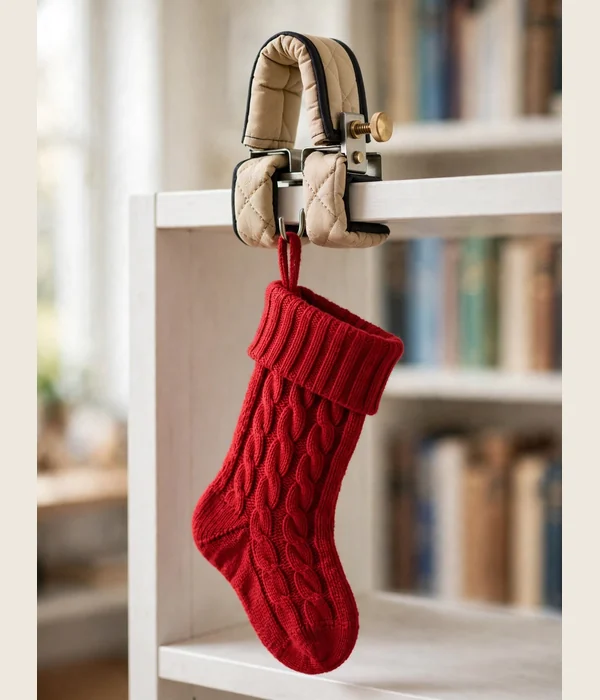
A clamp hanger is two padded jaws joined by a screw. You slide the top jaw over the shelf edge, tighten the screw, and the bottom jaw presses up from underneath. The stocking’s weight transfers straight into the shelf, which is why these hold a full 10 pounds each.
The rubber pads keep the finish safe on wood, laminate, and painted shelves. No marks, no slipping.
Look for hangers that adjust to shelf edges up to 3 inches thick, which covers most bookshelves, floating shelves, consoles, and closet shelves. Typical sets run about $15 to $20 for four. The metal body should feel stiff, not bendy, and the jaws must have pads, because bare metal teeth will dent soft pine.
What you can do with it:
- Clamp to a bookshelf edge and let stockings hang between the books
- Use a floating shelf or TV console as a stand-in mantel at any height
- Space hangers 8 to 10 inches apart so stockings do not crowd each other
- Choose low-profile jaws if the shelf sits below eye level, since they stay hidden
- Move them to a different shelf next year with no trace left behind
Renter check: fully damage free. No screws, no adhesive, no marks when you remove them.
2. Freestanding Stocking Stand: An 8-Hook Display That Stands Anywhere
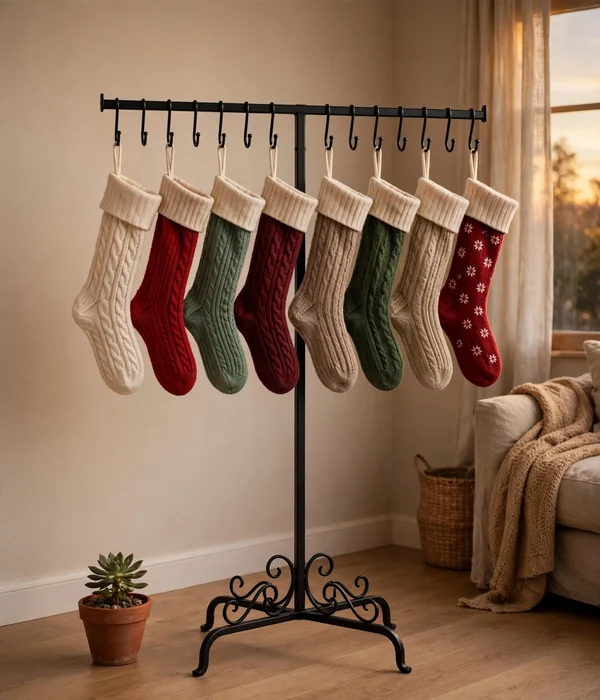
A stocking stand is a weighted metal frame with a row of hooks across the top bar, about 37 to 47 inches tall. It stands on the floor and needs no wall, shelf, or door. The hooks carry 10 pounds each, and the load hangs inside the frame’s footprint, so it does not tip forward, even fully loaded.
The common size is 39.4 inches long, 11.8 inches deep, and 37.4 inches high with eight hooks, holding four to eight stockings. Larger models run about 47 inches tall and 33 inches wide with a gift shelf. Prices run $25 to $40 for the compact size, $60 to $80 for the larger gift-shelf models.
- Set the stand where you want it and adjust the leveling feet until it does not rock.
- Hang the heaviest stockings toward the center of the bar for balance.
- Keep stockings 6 to 8 inches apart so they hang straight instead of bunching.
- After the season, it folds or breaks down flat for storage behind a closet door.
Renter check: fully damage free. It touches nothing but the floor.
3. Adhesive Hooks on the Wall or Door: A 5-Pound Hold With Zero Holes
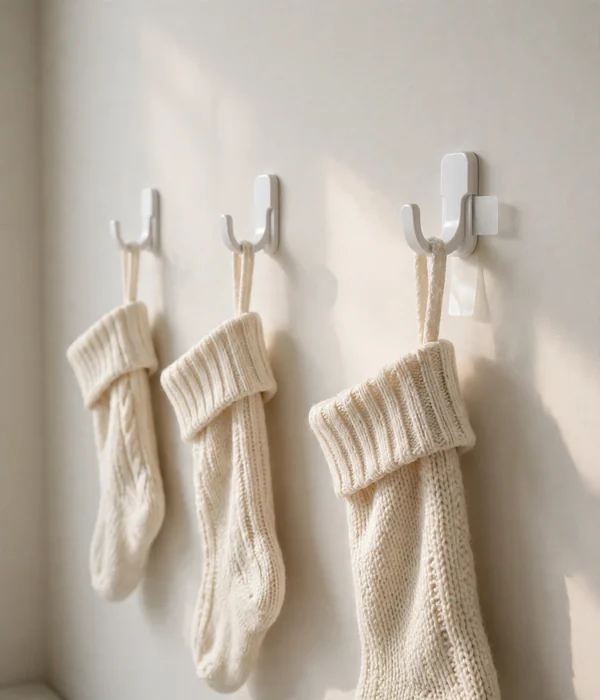
Adhesive hooks work by bonding a foam strip to a smooth surface, and the hook arm carries the load in shear. Size sets the rating: small holds 1 pound, medium 3, and large 5. Stocking-specific adhesive holders push that to 5.5 pounds, so one large hook per stocking is safest.
Prep is everything. Wipe the spot with rubbing alcohol, press the strip firmly for 30 seconds, then wait a full hour before hanging anything.
Removal is clean if you pull the tab straight down along the wall, never out toward you. Typical packs run $8 to $12, and one pack usually covers a row of four stockings.
Tips for best results:
- Painted drywall, finished wood, glass, tile, metal, and laminate all take adhesive well
- Space hooks 8 to 10 inches apart and keep them in a straight row at one height
- Keep the heaviest stocking on the largest hook
Watch out:
- Textured wallpaper, brick, unpainted drywall, and dusty surfaces will fail. Test one hook first.
- Cold rooms weaken the bond, so avoid exterior doors and unheated entryways.
- Replace the strips each season instead of reusing them, since the bond degrades.
Renter check: fully damage free when you use the right surface and pull the tab down, not out. Keeping the look spare pairs well with minimalist Christmas decor ideas.
4. Leaning Blanket Ladder: 18 Inches of Wall Becomes a Stocking Station
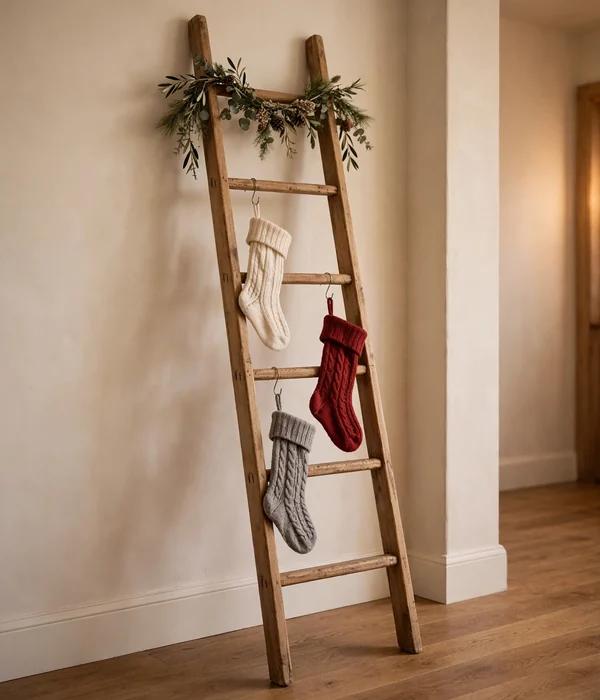
A blanket ladder leans against the wall at roughly 60 degrees, and the stockings hang from S-hooks on the rungs. Gravity pushes the ladder’s feet into the floor and its top into the wall, so the rungs take the load in shear. Nothing needs fastening, and even slim rungs hold a stuffed stocking fine.
Most ladders run 60 to 78 inches tall, with 72 inches the most common, and 16 to 21 inches wide. Four or five rungs spaced 8 to 12 inches apart fit four or five stockings, with room for a garland across the top rung.
The footprint is barely two inches deep, so it works in a corner, beside a door, or at the end of a hallway. Look for wood or metal models with felt pads top and bottom, typically $35 to $60.
What you can do with it:
- Hang stockings on S-hooks at alternating rung heights for a staggered look
- Drape a light garland or string lights across the top two rungs
- Pair stockings on the lower rungs with a folded throw for a finished corner
- Choose a white or natural wood finish to match the room year round
- Move it anywhere in seconds, since it weighs five to eight pounds
Renter check: fully damage free. The lean is doing all the work.
5. Tension Rod in a Doorway: a 30-Pound Grip With No Drilling
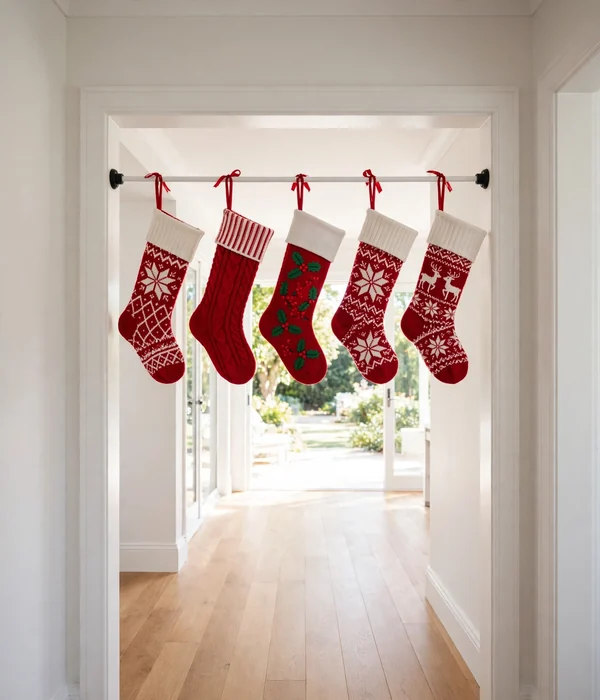
A tension rod holds by pushing outward. The internal spring drives rubber end caps into both door jambs, and the friction from that pressure resists the stockings’ downward pull. Diameter and span set the rating: a 1-inch heavy-duty rod holds 30 to 45 pounds, while a standard 7/16-inch rod manages about 12.
Rods come in sizes like 24 to 42 inches, 30 to 52 inches, and 42 to 72 inches, so measure your doorway first. A 1-inch rod is the right pick, since a short span at that diameter holds a whole row with margin. Typical price runs $15 to $25, working best on interior doorways with flat, solid trim.
- Measure the inside span of the doorway at three heights and use the smallest number.
- Choose a rod whose range includes that number with room to spare, never at its max.
- Twist to extend, seat both rubber caps flat against the trim, and give it a hard tug.
- Hang stockings on ribbon loops or S-hooks, spaced 6 to 8 inches apart.
Renter check: fully damage free. The rubber caps protect the trim, and it removes in seconds.
6. Suction-Cup Hooks on Windows: Glass Becomes a Hanging Spot
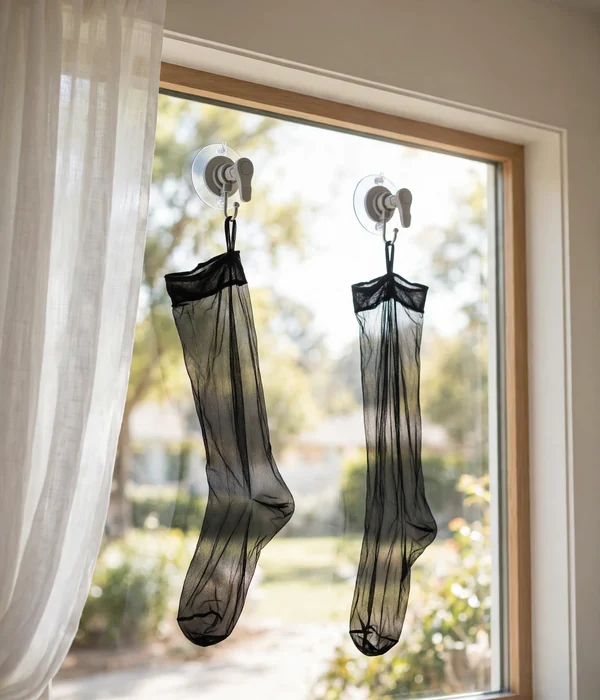
A suction cup seals against smooth glass by pressing out the air under the cup, and the vacuum that forms holds the hook. Large cups are rated for 5 to 7 pounds, enough for most stockings, and twist-lock stainless models claim up to 10 to 15. They work on glass and mirrors, and fail on anything textured or porous.
Cold is the enemy, since rubber stiffens and the seal weakens as temperatures drop. Indoor windows stay warm enough, but skip the cup on a window that ices over inside.
Typical packs run $8 to $15 for two to four hooks. Hang the stockings on the inside of the window, where the room heat keeps the seal supple.
Tips for best results:
- Clean the glass with rubbing alcohol first, then dampen the cup’s rim with one drop of water
- Press the cup straight on with firm pressure, then wait 30 minutes before hanging
- Recheck the seal every few days, especially after a cold snap
- Twist-lock models hold far better than plain press-on cups
Watch out:
- Press only on the flat glass, not on the frame or the sealed edge of double-pane units
- Keep each stocking under the hook’s rating, and go one size up for heavy stockings
- If a cup pops off twice, the glass is too cold or the cup is worn out. Replace it.
Renter check: fully damage free. No residue, no marks, just glass.
7. Over-Door Hook Rack: Your Door Holds the Whole Row
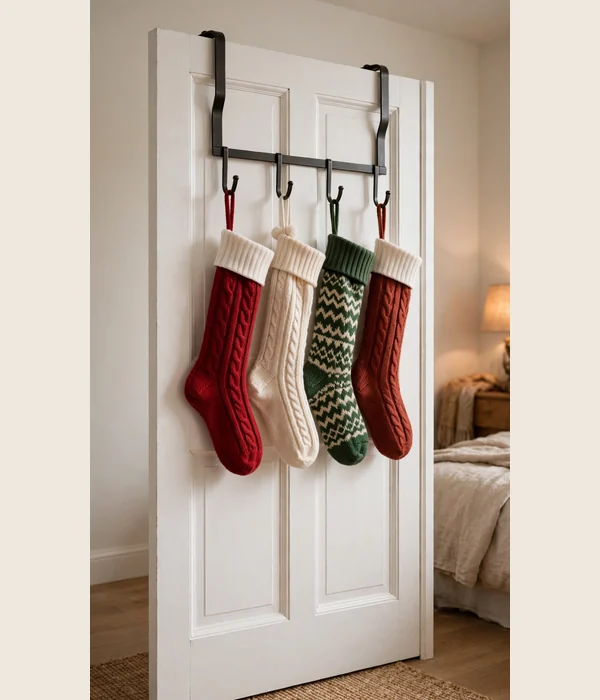
An over-door rack drapes two metal brackets across the top of a door, with hooks hanging down the front face. The weight transfers through the door slab into the hinges: individual heavy-duty hooks are rated up to 18 pounds, and full racks up to 50 pounds total. That is far more than any row of stockings needs.
Fit is the detail that matters: the brackets fit doors from 1.25 to 1.8 inches thick, and most interior doors are 1-3/8 inches. The bracket edge is about 0.04 inches thin, so the door still closes without rubbing. Closet, pantry, and bedroom doors all work, and typical racks run $12 to $25.
What you can do with it:
- Hang four to six stockings across the rack for a full, even row
- Use the closet door in a bedroom or the pantry door near the kitchen
- Add felt pads behind the brackets to protect the door’s finish
- Keep loads balanced across the hooks instead of piling them on one side
- Lift it off the door in January and slide it behind a door to store
Renter check: fully damage free. Nothing is screwed, glued, or stuck to anything.
8. Picture Ledge Rail: The Permanent Stocking Shelf (Two Screws)
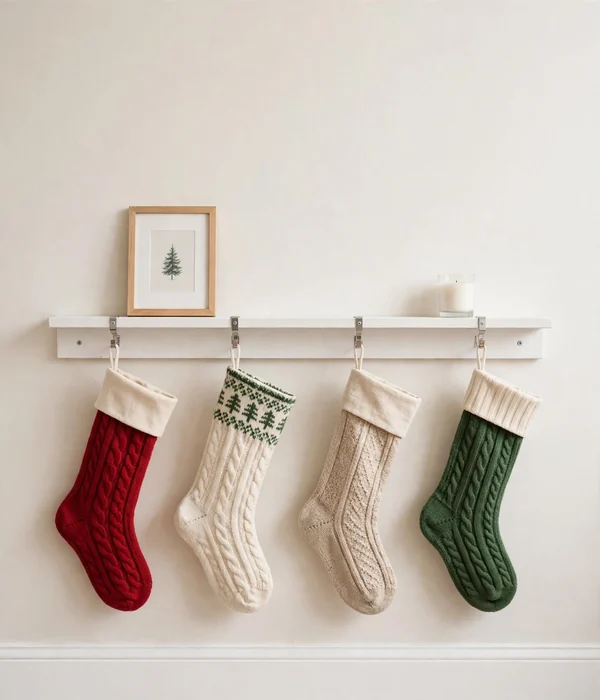
A picture ledge is a shallow 24 to 36 inch shelf with a raised lip, screwed to the wall at stocking height. Clip-style stocking hangers hook over its front edge, or small S-hooks loop over the lip, and the row hangs at eye level like a mantel.
The screws are the mechanism: two to four of them driven into a stud, or into drywall anchors rated for 25 pounds plus, carry the whole row with zero wobble.
This is the only point on this list that needs screws, an owner’s pick or a renter’s ask-your-landlord pick. In exchange you get the most mantel-like result of all nine ideas: a true shelf line for stockings, small frames, and a garland. Typical ledges run $15 to $30; four-packs of clip hangers cost $10 to $15.
Tips for best results:
- Find the stud with a stud finder, or use drywall anchors rated above 25 pounds
- Level the ledge before tightening, since a crooked line shows instantly
- Space hangers 8 to 10 inches apart and face the stockings slightly outward
Watch out:
- Hollow drywall with no anchors will not hold a loaded row. Do not skip this.
- If you rent and cannot drill, pick one of the damage-free ideas above instead.
Renter check: needs screws. Not damage free, but the closest thing to a real mantel.
9. Ribbon-Tied Stockings on the Stair Rail: The Banister Becomes the Mantel
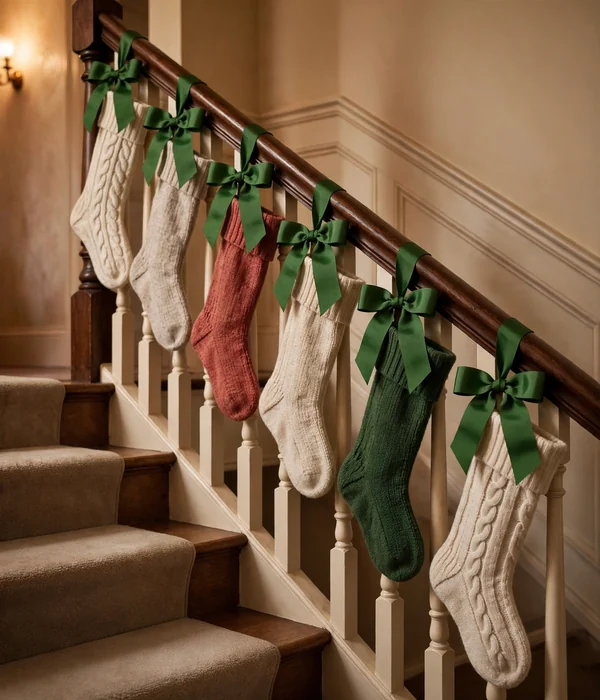
A stair rail already carries weight by design, so it makes a natural stocking station. Loop grosgrain ribbon through each stocking’s hanging tab, tie it above a baluster, and the rail carries the load in compression. Nothing touches a wall and nothing needs hardware, and standard railings run 34 to 38 inches high, putting the stockings right at sight line.
Use ribbon 2 to 3 inches wide so the ties look intentional; wire-edged ribbon keeps its bow all season. Tie above a baluster so the loops cannot slide. Space ties 12 to 16 inches apart, and a roll of ribbon ($5 to $8) covers four to six stockings.
Tips for best results:
- Tie the ribbon above a baluster so gravity keeps it from sliding sideways
- Face every stocking outward toward the room, the way a camera would see them
- Match the ribbon to your tree ornaments for a pulled-together look
Watch out:
- Skip this if the rail is loose or wobbly. Test it by hand first.
- Keep stockings off the steps themselves so nobody trips on Christmas morning.
- Pets and toddlers can reach these easily, so hang the stockings higher or choose another idea.
Renter check: fully damage free. Ribbon ties leave no trace on the rail.
Conclusion
Nine ideas, no fireplace, and not one of them needs a mantel to work. Most of them cost less than a pizza night and come down in minutes after the holidays.
Best for renters: start with the adjustable clamp hangers from point 1. One buy covers any shelf in the house, the 10-pound rating handles the heaviest stockings, and nothing needs patching or explaining to a landlord in January. No shelf edge at all? Use the tension rod in point 5. Then circle back to our Christmas decor ideas hub and build outward.
Frequently Asked Questions (FAQ)
How much weight can a stocking holder hold?
If your stockings are stuffed with candy and small toys, plan on two to five pounds each. Clamp hangers and freestanding stands hold about 10 pounds per stocking, which gives you real margin. Large adhesive hooks hold 5 pounds each, so use one per stocking and keep the heaviest items out of them.
What is the best stocking holder for a home with no fireplace and kids or pets?
If little hands or paws can reach the stockings, choose a high, out-of-reach spot over a freestanding stand, which can tip. A tension rod in a doorway or clamp hangers on a high shelf keep everything up and away. Suction cups on windows also work, as long as the stockings hang above reach.
Will adhesive hooks damage my walls when I take them down?
If you follow the removal directions, they come off clean. Pull the tab straight down along the wall, slowly, and the strip releases without taking paint. If the paint is old or already peeling, test one hook in a hidden spot first, since weak paint can lift regardless of the hook.
Can I hang stockings on a tension rod in a wide doorway?
If the span is under 52 inches, a 1-inch heavy-duty rod rated for 30 to 45 pounds works well. Capacity drops as the span grows, so avoid stretching a rod to its maximum length. For spans over six feet, add a second rod or switch to a freestanding stand instead.
How far apart should stockings hang?
If your stockings are the standard 18 inches long, space the holders 8 to 10 inches apart on center so the stockings hang straight without bunching. If the stockings are oversized or heavily stuffed, give them 12 inches so each one keeps its shape and the row looks even.