Advent starts December 1, which means your calendar has to be up by November 30, no exceptions. Here’s the trap most of us fall into: we buy the pretty cardboard chocolate calendar, enjoy it for 24 days, and throw the whole thing in the trash on December 26. Eleven months of storage saved, zero months of storage gained.
These ten advent calendar ideas refuse that deal.
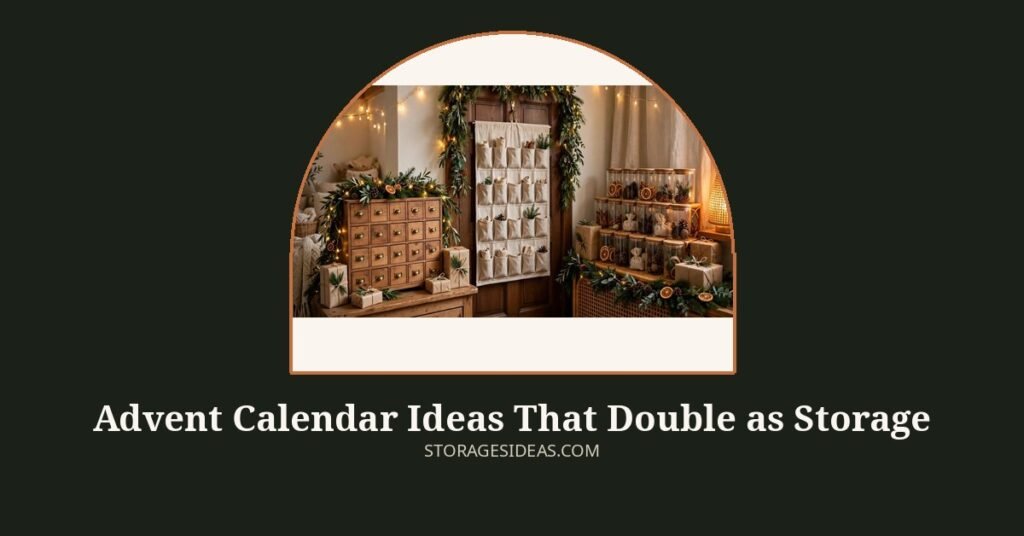
Every one of them is a working storage piece from December 1 onward, a drawer chest that holds paper clips and earrings by January, a fabric pocket organizer that swallows chargers and hair ties all year, a set of glass jars that becomes your spice rack, a wooden house frame that lives on the shelf as decor long after the ornaments come down.
You get the daily countdown your family looks forward to, plus a storage item you were probably going to buy anyway. One purchase, two jobs, eleven extra months of usefulness.
Set aside one evening before Thanksgiving to fill whichever one you choose, aim for under $25 in fillers per calendar (a bag of wrapped candies, dollar-store finds, and printed activity cards do it), and come January, instead of storing an empty countdown, you’ll be using a full storage piece.
Why Advent Calendars That Double as Storage Beat the One-Year Wonder
A standard disposable advent calendar occupies about 2 square feet of wall or shelf for 24 days, costs $10–25, and ends the season as trash. A reusable calendar that doubles as storage occupies the same footprint, but pays rent year-round.
The math is simple: the wooden drawer chest you hang on the wall in December becomes a 24-drawer mini organizer for jewelry, batteries, and screws from January to November. The glass jar set that held December’s daily tea becomes your spice jars. You haven’t bought a holiday decoration; you’ve bought an organizer that dresses up for Christmas.
This matters more in small homes, because holiday decor is where tiny spaces bleed storage space. Every garland hung, every village set displayed, every calendar pinned to the door is square footage that isn’t holding anything useful. A dual-purpose advent calendar flips that: the decor is the storage, so December doesn’t cost you a single inch of function.
Fill it with the refill rules below, keep every filler under 2 inches, budget roughly $1 per drawer, and favor consumables (candies, tea, activity coupons) so December 26 leaves you with empty compartments ready to refill with things you own.
And because each idea below lists its January storage footprint, you’ll know exactly where it goes before you buy it.
1. Wooden 24-Drawer Chest Calendar: A Mini Organizer With Christmas Cheer
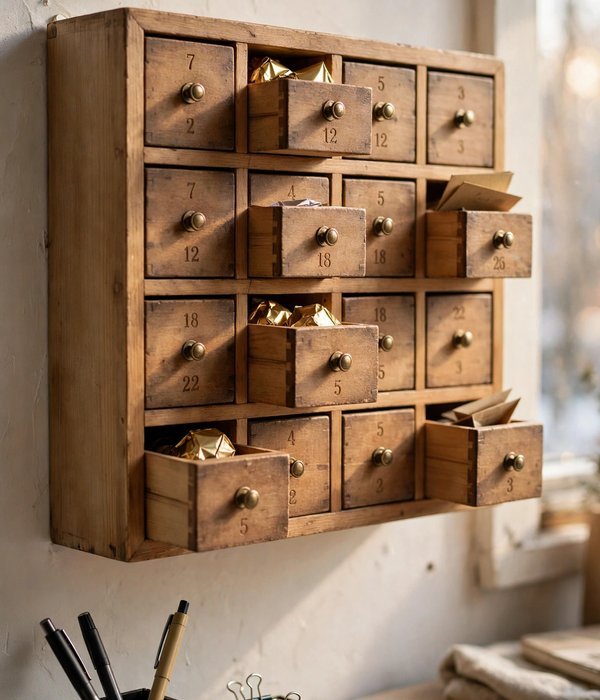
The wooden drawer chest is the workhorse of the advent world for one reason: 24 individual drawers, each roughly 1.5 × 2 × 2 inches inside, arranged in a grid about 14 × 18 inches overall. All December, each drawer hides a day’s surprise, a folded note, a wrapped chocolate, a tiny toy.
Come January, you pull the whole chest off the wall and it becomes the most useful small organizer in the house.
What you can do with it:
- Sort jewelry, hair ties, and clips, one drawer per category, label the fronts with tiny stickers
- Park batteries, USB drives, and SD cards in the craft room or office
- Hold screws, wall anchors, and picture-hanging bits in the utility closet
- Stash spice packets, tea bags, and single-serve coffee in the kitchen
- Keep a child’s Lego minifigures or trading cards sorted (kids love 24 “treasure” drawers)
Refill cost per December runs $15–25: a variety bag of wrapped candies (~$8), a few dollar-store finds (~$7), and printed activity coupons (free). One caution, most drawers are only 2 inches deep, so keep fillers under 2 inches and wrap anything sticky; a melted chocolate in a wooden drawer is a December memory you don’t want.
January footprint: 14 × 18 inches of wall or a 6-inch-deep shelf ledge. Measure your shelf before buying, the drawers need a ledge at least as deep as the chest’s body.
2. Fabric Hanging Pocket Calendar: From Countdown to Everyday Door Organizer
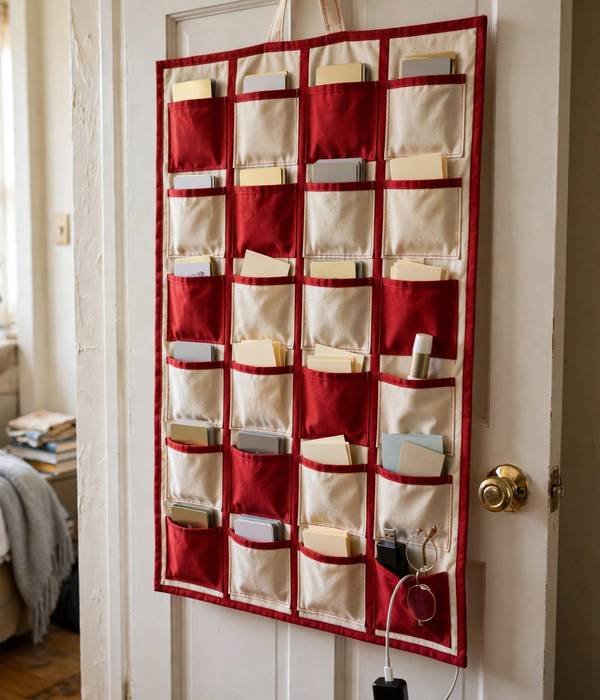
A fabric advent calendar is usually a 20 × 15-inch panel with 24 sewn pockets, each roughly 3 × 4 inches, the size of a gift card or a handful of wrapped treats, hanging from a single rod or hook.
Kids reach into the pockets all December; the rest of the year, those same pockets are an over-the-door organizer that costs nothing extra and folds flat in a gallon bag for summer.
Tips for best results:
- Choose pockets at least 3 inches deep with a stiffened back so they hold phones and chargers without sagging
- After Christmas, reassign it to the room with the most clutter: bedroom door for glasses and chargers, bathroom door for hair tools, pantry door for spice packets and sauce mixes
- Refill with flat items only, folded coupons, stickers, lip balm tubes, gift cards, since fabric pockets won’t hold heavy items
- Wash it on gentle before storing so dried chocolate doesn’t stain the pockets
Watch out: cheap panels use one shared hook at the top, which tears under a full load of December fillers. Reinforce with two hooks or a curtain rod through a sewn sleeve, and don’t exceed about 3–4 pounds total load.
January footprint: zero if folded (a 1-gallon zip bag), 20 × 15 inches on a door the other eleven months, which is door space, not shelf space, so it costs you nothing you were using.
3. Glass Apothecary Jar Calendar: Daily Treats Now, Spice Rack in January
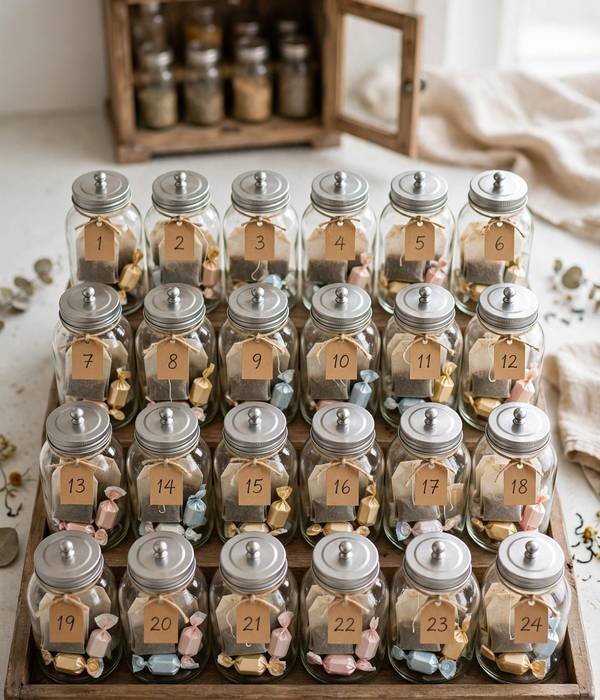
Twenty-four matching 4-ounce glass jars (about 2 inches wide × 3.5 inches tall) lined up on a tray or shelf: each holds one day’s tea bag, wrapped candy, or small treat, numbered with tags or a wax pencil.
It looks stunning all December, and on December 26 you wash the jars and they become the spice-and-tea storage you meant to buy last spring.
What you can do with it:
- Decant spices, dried herbs, and specialty salts, 4-ounce jars fit standard grocery spice refills perfectly
- Store loose-leaf tea, one blend per jar, with the labels still readable through the glass
- Hold cotton balls, bobby pins, and bath salts in the bathroom
- Keep desk supplies (paper clips, binder clips, rubber bands) visible and sorted
- Park sewing notions: buttons, needles, pins, the glass shows you exactly what’s inside
Refill is nearly free if you shop your pantry: bulk-bin tea, wrapped candies, and spices bought in bulk cost $10–15 total and nothing goes to waste. One rule, buy jars with airtight lids (metal or wood-gasket), because the same seal that keeps a December tea bag fresh is what keeps paprika fresh in March.
January footprint: one 12 × 16-inch tray or shelf section, which your spice cabinet already had, the jars just finally organize it.
4. Wooden House-Frame Calendar: Open Cubbies That Stay Up All Year
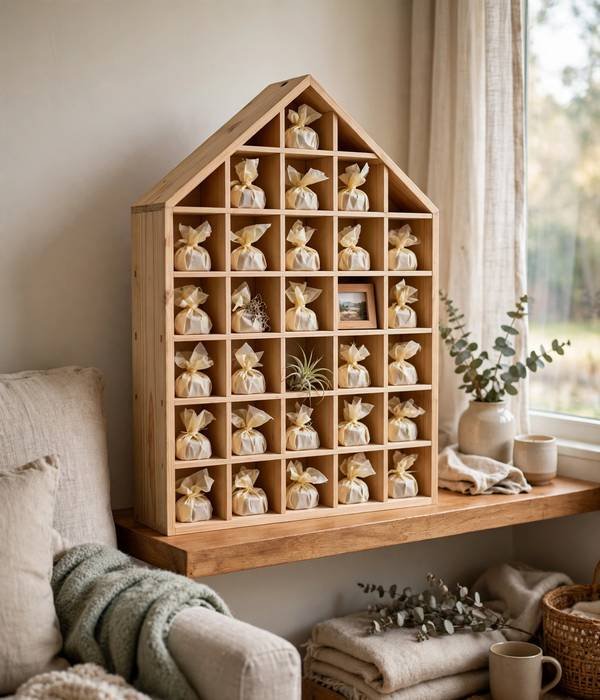
The open-concept house frame, roughly 16 × 12 × 3 inches with 24 to 25 open cubbies, no doors, is the minimalist’s answer to the drawer chest.
You wrap each December treat in tissue so the surprise survives the open design, and once January arrives, the frame never comes down: it’s a display shelf for mini plants, photos, and keepsakes that happens to wear Christmas once a year.
Tips for best results:
- Wrap every filler in tissue or a small drawstring bag, since cubbies have no doors to hide treats
- Keep cubbies small, 2 × 2 inches is typical, so the frame reads as decor, not storage, the rest of the year
- In January, fill it with air plants, framed 2×3 photos, and tiny framed art; rotate seasonally
- Hang it with two picture hooks rated for 10+ pounds; a loaded frame weighs more than it looks
Watch out: open cubbies and toddlers are a bad combination, everything will be emptied by December 3. If you have small kids, hang it at adult eye level and treat it as decor first, calendar second. January footprint: one 16 × 12-inch wall section, which in a small home is display space you were already going to use.
That’s the whole point: the frame never goes into storage because it never stops being furniture.
5. Hook-Rail Calendar: 24 Numbered Bags on Hooks That Become an Entryway Rail
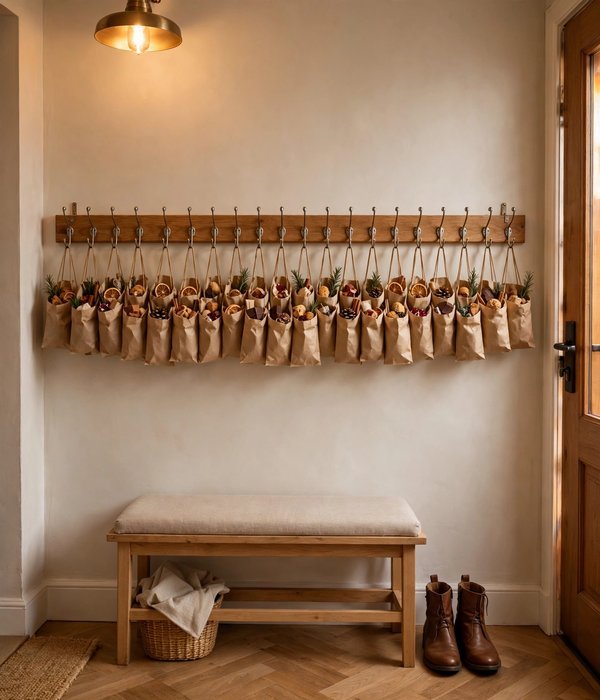
A wall-mounted rail, about 36 inches long with 24 small S-hooks or pegs, holds 24 numbered fabric or paper bags all December, each with a day’s treat inside. This is the renter’s favorite of the list: one rail, one adhesive or two-screw mount, zero damage.
And in January, you take the bags off and the rail stays, as the hook rail your entryway was missing.
What you can do with it:
- Hang keys, dog leashes, sunglasses, and the bag you grab daily, one hook per item ends the entryway pile
- In the bedroom, hold tomorrow’s outfit, hats, and scarves
- In the kids’ room, hang backpacks and library books
- Number the December bags 1–24 on kraft paper tags; store the empty bags folded in a quart bag for next year
Refill costs almost nothing: kraft gift bags from a multipack ($5) plus candies and activity coupons (~$10). The rule that makes this work: buy a rail rated for at least 25 pounds, the December load of 24 full bags is the heaviest this rail will ever carry, and if it survives December it survives anything.
January footprint: 36 × 4 inches of wall. The bags fold into a quart zip bag; the rail earns its spot holding your keys.
6. Vintage Suitcase or Card-Box Calendar: Keepsake Storage With a Countdown Past
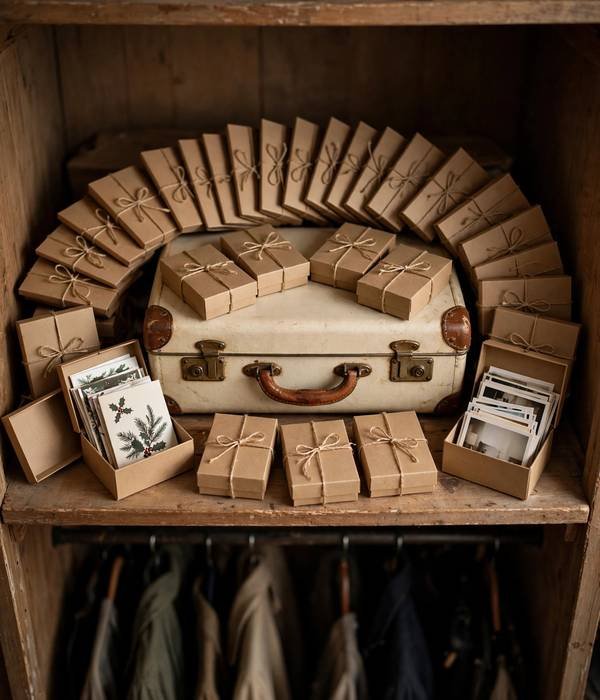
A vintage-style suitcase or a set of 25 nested card boxes, each 3 × 3 inches, stacked or fanned on a shelf: every box holds a day’s surprise, and the whole arrangement looks like boutique packaging.
After Christmas, the suitcase becomes the keepsake box, holiday cards, kids’ December artwork, the year’s photos, and the card boxes become permanent gift-wrap storage.
Tips for best results:
- Pick a suitcase no larger than 18 × 12 × 6 inches so it fits a closet shelf; anything bigger becomes the clutter it was meant to solve
- Line the card boxes with tissue; they double as gift boxes all year, saving you the gift-bag aisle
- After Christmas, sort December’s cards and photos into the boxes by month, a keepsake system that starts itself
- Number boxes with removable stickers, not markers, so the same boxes serve next year
Watch out: unlined cardboard absorbs moisture and odors, so skip the garage or basement for storage. Keep the suitcase in a closet, and put a cedar block inside if it lives near woolens.
January footprint: one shelf section (18 × 12 inches) or the inside of a closet door, and since it’s holding your cards, photos, and gift boxes, it’s already full of things that needed a home.
7. Magnetic Tin Calendar: Fridge Decor in December, Memo Board by January
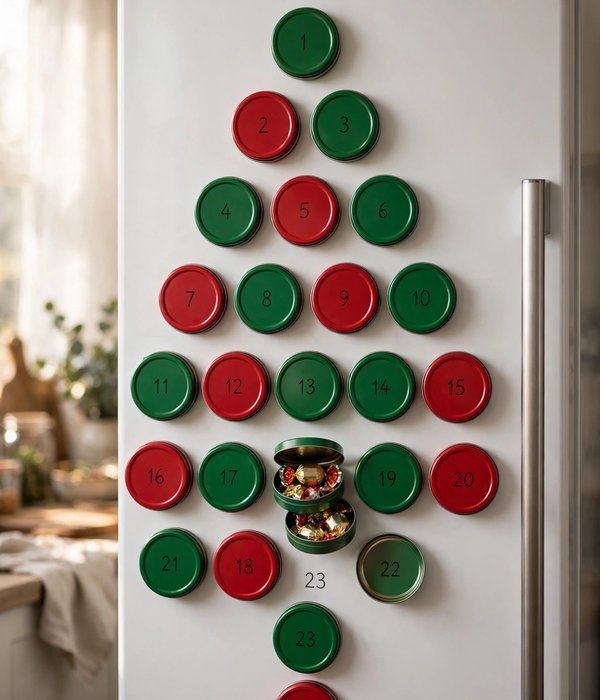
Twenty-four small magnetic tins (about 2 inches round) arranged on a magnetic board or straight on the fridge, each holding a day’s treat: the tastiest idea on this list for kitchen people. December’s countdown lives where you already look every morning, and on December 26, the tins scatter into their real job as the world’s most flexible small-item storage.
What you can do with it:
- Stick them to the side of the fridge or a magnetic knife strip: paper clips, rubber bands, tea bags, single-serve coffee
- One tin per spice, 2-inch tins hold exactly the contents of a standard spice jar, visible through the lid if you buy glass-lid tins
- Hold bobby pins, safety pins, and earring backs on a bathroom mirror frame
- Park the tins on the washing machine during laundry day: coins, buttons, and the mysterious single socks
Refill is cheap and fun: wrapped candies, lip balm minis, and folded coupons fit 2-inch tins perfectly (~$12–20 total). One rule, buy tins with a real magnet base, not glued-on magnets, because the tins get opened 24 times in December and glue gives up by the 12th. January footprint: none extra.
They live on the fridge, the cabinet side, or inside a drawer in a single stack, surfaces you already had.
8. Book-Shaped Calendar: A Keepsake Box Disguised as Decor
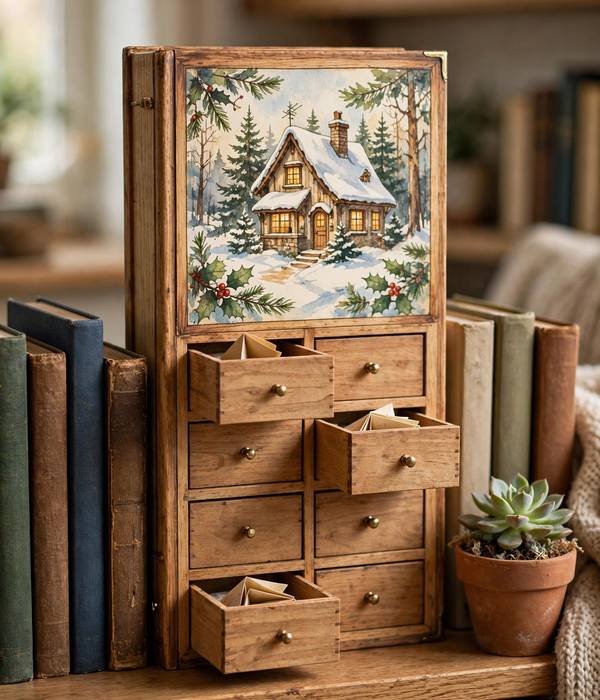
The book-shaped advent calendar, an MDF or wood box about 12 × 9 × 3 inches, printed like a storybook with 24 tiny drawers or doors inside, sits on the shelf looking like decor all December. It’s the stealth option: when January comes, it doesn’t look like storage at all, which is exactly why small homes love it.
It becomes the letter box, the photo box, the “important things I lose” box.
Tips for best results:
- Choose one with real drawers, not just doors, drawers get used; doors get ignored
- Inside, the drawers are tiny (about 1.5 inches square), so plan January use for small valuables: spare keys, SIM cards, foreign coins, heirloom jewelry
- Store it upright like a book on any shelf; a 3-inch spine needs no dedicated space
- Wrap December fillers in notes, tiny drawers fit folded messages better than candy
Watch out: the book shape is a dust magnet on its printed top, so keep it on a shelf you actually reach, not the top of the armoire. If it’s hard to reach, it’ll become decor you never use, the opposite of this list’s promise. January footprint: one book’s worth of shelf.
If your shelves are full, it replaces the decorative box you were storing nothing in.
9. Garland String Calendar: 24 Clip Bags That Become Reusable Gift Bags
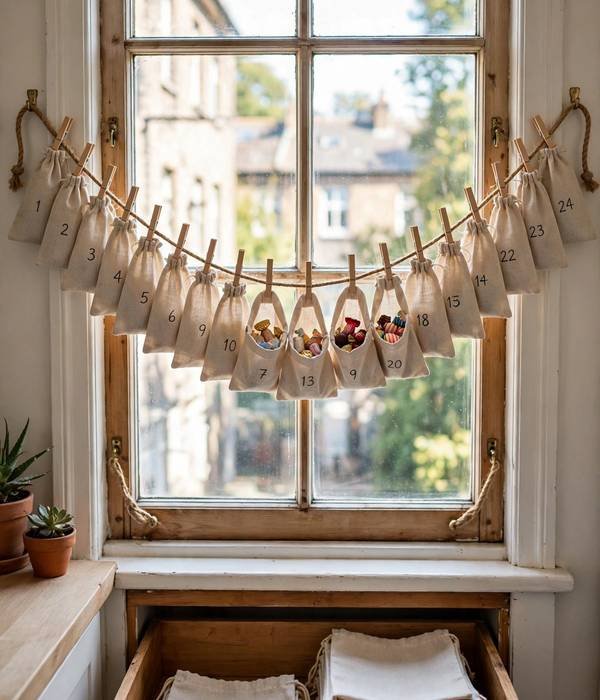
A length of jute or ribbon, about 8 feet, strung across a window, mantel, or doorway with 24 numbered mini cloth bags clipped on, each holding a day’s treat.
This is the lightest, cheapest, and most packable idea on the list: the whole December setup folds into a quart bag in January, and the bags go right back to work as reusable gift bags, produce bags, and travel organizers.
What you can do with it:
- Reuse the mini bags as gift bags all year, a 4 × 6-inch cloth bag fits jewelry, gift cards, and small treats
- Use them as travel organizers: one for chargers, one for toiletries, one for medications
- Hang the garland in a child’s room year-round as a photo string, clip school photos and art to it
- Store the string coiled in one of its own bags; label it “Dec” so next year’s setup takes five minutes
Refill is the cheapest on this list: the bags themselves are the packaging, so fillers are just candies and coupons, ~$8–12 total. The one rule: use real clips (mini clothespins or S-hooks), not tape, because tape fails by December 10 and takes paint with it.
January footprint: one quart zip bag in a drawer, the smallest footprint here, for the home where even a shelf section is contested territory.
10. Photo-Clip Frame Calendar: December Countdown, Year-Round Memory Wall
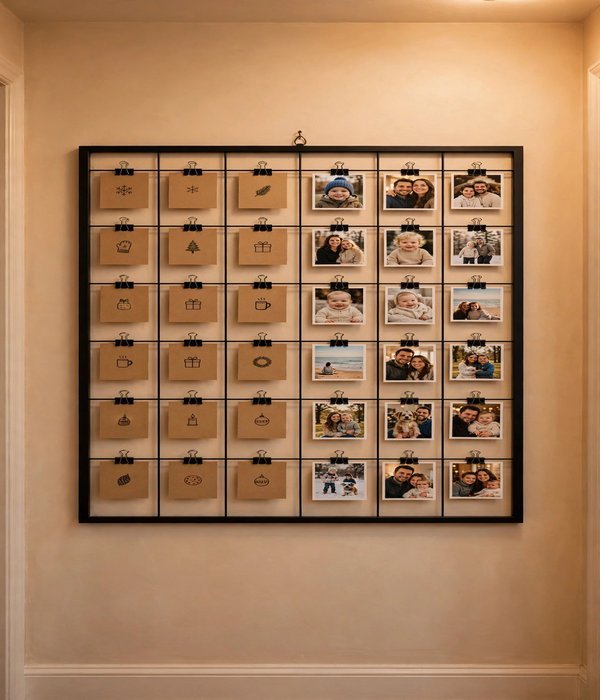
A framed wire or string grid, about 18 × 24 inches, with 24 clips holding numbered cards, each card with a treat attached or a folded note behind it. Kids pull a card a day; by Christmas Eve the frame holds the season’s photos.
Then it stays up all year as the memory wall, the frame your family actually looks at, instead of the photo box nobody opens.
Tips for best results:
- Print the December cards as 3 × 4-inch photos or activity coupons, they become January’s first memory-wall batch
- Use double-sided clips or mini clothespins so cards show on both sides and nothing falls
- Hang it with a single centered hook and a wire back; at 2–3 pounds loaded, one good hook is enough
- Rotate the photos quarterly, a memory wall that never changes becomes wallpaper
Watch out: 24 clips on one frame looks busy if the room is already visually full, so give it a clean wall, hallway, bedroom, or the inside of a closet door in a studio. If every wall is decorated, this one fights for attention instead of earning it.
January footprint: one 18 × 24-inch wall section, the same wall it had in December. It never comes down, so there’s nothing to store, which is the ultimate storage win.
Conclusion
Best for small spaces: the magnetic tin calendar (#7). It costs nothing in footprint, the fridge and cabinet sides were already there, the tins are the most genuinely useful storage of the ten in January, and the whole thing sets up in ten minutes on November 30.
If your kitchen is the heart of your December, this is your calendar.
If wall space is what you have, take the hook-rail calendar (#5) and gain an entryway rail. If you want the prettiest option that still earns its keep, the glass jar set (#3) becomes a spice rack you’ll use daily.
Whichever you choose, buy it by mid-November, fill it for under $25, hang it by November 30, and when January comes, enjoy the rare holiday purchase that gets more useful after Christmas.
For the tree that anchors it all, see small Christmas tree ideas, and for the entryway it greets, Christmas entryway decor; the full seasonal collection lives at Christmas decor ideas.
Frequently Asked Questions (FAQ)
How early should I buy a reusable advent calendar?
Buy by mid-November. The good reusable ones, wooden chests, house frames, jar sets, sell out or ship slowly after Thanksgiving, and you need it in hand by November 30 to fill it. If you’re DIY-ing with a garland string or hook rail, you can start the weekend after Thanksgiving, but give yourself one unhurried evening for filling.
How much does it cost to refill a reusable advent calendar each year?
Plan $10–25 per calendar. A variety bag of wrapped candies ($8–12) plus dollar-store finds ($5–8) plus free printed activity coupons covers all 24 days easily. If you refill from your pantry, bulk tea, spices, nuts, it can cost under $10.
The calendar itself is the investment; the refills are the cheapest part of December.
What fits in small advent calendar drawers?
Anything under 2 inches: wrapped chocolates, lip balm minis, folded coupons, stickers, earrings, USB drives, gift cards, tea bags, and tiny toys. If a drawer is only 1.5 inches deep, measure before you shop, the number-one refill mistake is buying treats that don’t fit.
When in doubt, put a clue in the drawer and the real gift under the tree.
Where do I store a reusable advent calendar after Christmas?
That depends on the type, and it’s the whole point of this list. Fabric calendars and garland strings fold into a gallon or quart bag in a drawer. Jar sets, tin sets, and drawer chests never go into storage; they become spice racks, organizers, and memo boards in January.
Only the wooden house frame and book calendar need a shelf, and they earn it as year-round decor.
Are reusable advent calendars worth it for adults?
Yes, arguably more than for kids. Adults use the January storage (the organizer drawers, the spice jars, the hook rail) every single day, and the December countdown becomes a genuinely personal ritual: tea blends, notes, small luxuries. Fill one for a partner with 24 tiny self-care items and watch it become the most-used “decoration” in the house.