
Why Firewood Storage Outdoor Is Really a Drying Problem
Most people treat firewood storage as a stacking problem. It’s a drying problem. Fresh-cut “green” wood holds around 50 percent moisture and won’t burn clean until it’s below 20 percent, which only happens when air moves through the stack and carries moisture away.
A neat, tight, fully tarped pile is the worst of both worlds: it looks tidy and stays wet. The three enemies are ground contact (soil wicks water into the bottom rows), trapped air under a full tarp (condensation rots bark and grows mold), and rain from above.
Solve all three and wood stays seasoned all winter; miss one and you’re burning steam in February.
On distance: 30 feet from the house is the fire-code recommendation for large stacks, because a full cord of dry wood is a serious fuel load. That doesn’t exile your evening armload to the property line, small working racks by the door are a different category (see point 9).
The big winter supply goes out in the yard, not against the back wall.
October stacking cheat sheet (pin this before you buy):
- Full cord = 4 ft × 4 ft × 8 ft = 128 cubic feet of stacked wood (the gaps between logs are included)
- Face cord (also called a rick) = 1/3 of a full cord: a 4×8-foot face, one log-length deep (usually 16 inches)
- Seasoned target: below 20% moisture, measured on a freshly split face with a pin meter
- Minimum lift: 6+ inches of air between wood and soil
- Setback: 30 ft from the house for large stacks is the fire-code recommendation
- Sides: always open for airflow, cover only the top
- Typical burn: a casual fireplace goes through about 1 cord a season; a stove heating the house burns 3 to 5
Buy seasoned, not promised (the 5-point check):
- Ends show radial cracks (“checks”), the classic sign of drying
- Bark is loose or falling off; green wood grips its bark tight
- Two splits clapped together ring hollow, not thud
- A pin moisture meter reads under 20% on a fresh-split face (meters run under $25 and end every argument)
- Never pay seasoned prices on a seller’s word alone, check two or three splits from the middle of the load
1. Two-Tier Log Rack With Cover: the no-build dryer
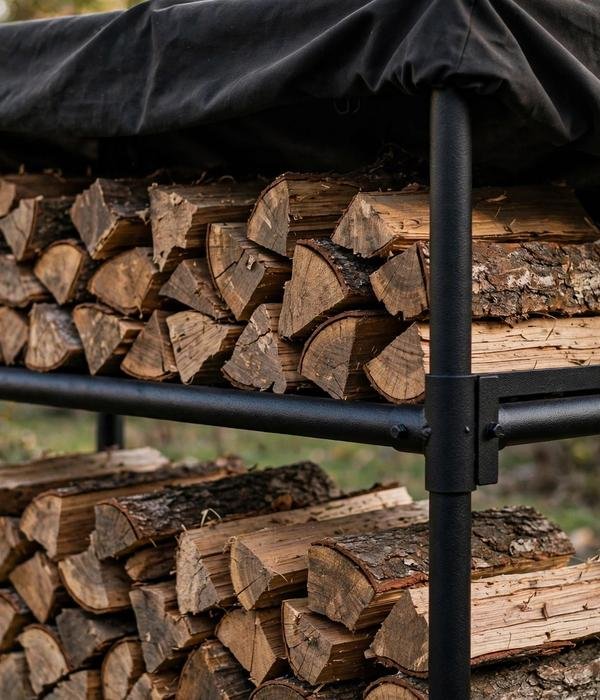
A two-tier steel log rack is the fastest legitimate firewood storage you can own: a bolt-together tube frame, 4 to 8 feet long, holding 1/4 to 1/2 cord with wood elevated 4 to 6 inches off the ground. The fitted cover drapes over the top only, and that “top only” is the whole design.
Rain and snow shed off the top while open sides let wind move through, so seasoning continues all winter instead of stalling under a wrapped tarp. A 4-foot rack holds roughly a quarter cord; the 8-foot version holds half, enough for a casual fireplace’s season.
The mechanism is airflow plus elevation. Wood dries fastest from end grain and bark faces; a rack keeps every row off wet soil while open sides expose maximum surface area to wind. The cover handles the one thing airflow can’t, direct precipitation.
Where it works best:
- Patios and decks, the working supply close to the door
- Renters, freestanding, no screws, moves with you
- Holding the “burning cord” while a bigger stack seasons behind it
- Small yards where a shed won’t fit but a 4-foot rack will
Shop 1.25-inch powder-coated steel tubes rated 500-plus pounds per 4-foot section: 4-foot kits run $40–$70, 8-foot kits $70–$120. The cover must be top-drape, skip any that wraps the sides. Assembly is one wrench and 20 minutes.
2. Firewood Shed: the serious-burner cord store
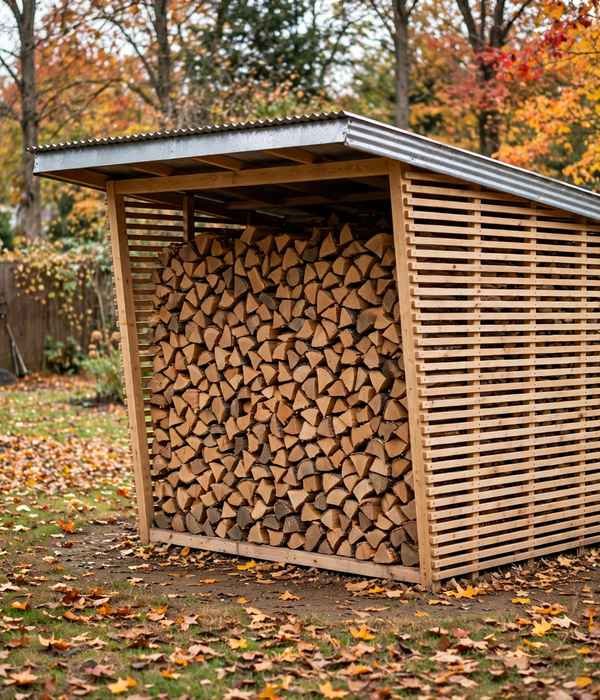
For wood-stove heating, a firewood shed is the endgame: a cord-sized lean-to, 4 by 8 feet, with slatted walls and a roof overhanging 6 to 12 inches on all sides.
A full cord fits inside, and the 1- to 2-inch gaps between slats turn it into a drying chamber: wind passes through from every direction while the roof keeps driving rain off the front face. Wood stored like this holds below 20 percent moisture all winter, unattended.
The mechanism is controlled exposure. A shed gives wood the two things it needs (airflow, rain protection) and nothing it doesn’t. Rain rarely falls straight down, so those extra inches of roof keep angled rain off the top rows.
Floor it with pallets or spaced deck boards at 6-plus inches, pitch the roof 1 inch per foot, and leave a ventilation gap under the eaves.
Tips for best results: Face the open side away from prevailing rain and toward the sun, south-facing sheds dry noticeably faster. Keep 6 inches clear of any wall for airflow and pest checks. Stack the top course bark-side up.
Watch out: At 32 square feet it stays under the 120-square-foot permit threshold in most places, but check HOA rules, some restrict outbuildings near property lines regardless of size. The 30-foot house setback still applies to a full-cord shed. And never let the roof sit flush against anything: no ventilation gap means trapped humid air.
3. Circular Log Ring (Holzhausen): the self-drying circle

The holzhausen is a German method that turns a woodpile into a self-supporting ring: logs in concentric courses, ends facing outward, rising about 5 feet, the center left hollow so air rises through the core. A 6-foot ring holds roughly half a cord.
Cap it with angled splits and it sheds rain like a roof; as wood dries and shrinks, the ring settles inward and stays stable.
The mechanism is geometry doing the drying. Every log’s end grain faces the weather, and end grain is where moisture escapes fastest, a ring exposes more drying surface than a flat stack of the same volume.
The hollow core acts as a chimney: cool air enters at the base, warms against the wood, rises out the top, pulling moisture with it. No lumber, no hardware, no cover beyond the top course.
Where it works best:
- Big yards where a 6-foot circle reads as a garden feature, not clutter
- Half-cord buyers who want zero construction and zero cost
- Nearly seasoned wood, the ring finishes the last few percent beautifully
- Anyone who likes their firewood storage to photograph well
Build on pallets or gravel, never bare soil, with 16- to 18-inch splits. Angle the top course inward like shingles. First build takes about an hour for half a cord; half that once you’ve done it.
4. Wall-Mounted Side-Yard Rack: the dead-side-yard solution
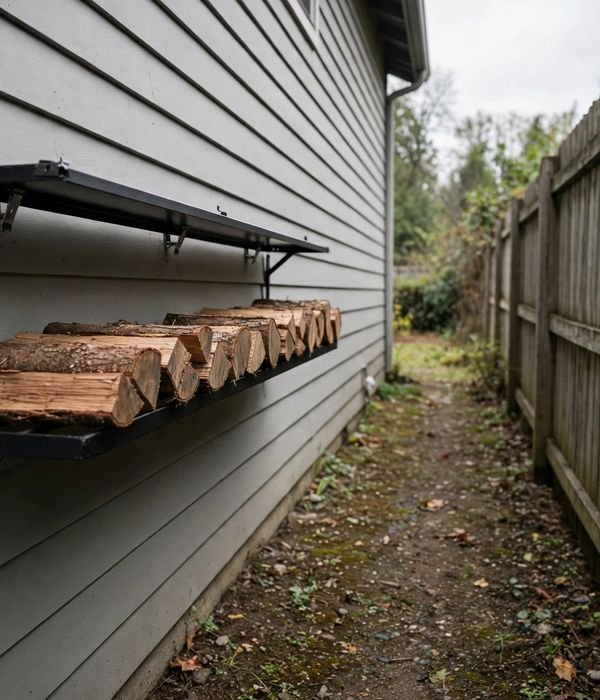
Nearly every house has a dead strip, the 3- to 4-foot gap between house and fence that collects weeds and nothing else. A wall-mounted rack turns it into firewood storage: heavy brackets on the house or garage wall hold rails that keep a single row of 16-inch splits 6 to 8 inches off the ground.
The wall gives one-sided shelter, and the single-row depth means every log gets airflow. It won’t hold a cord, but it holds the week’s burning within steps of the door.
The mechanism is dead-space capture plus elevation. That strip was already paved and wasted; the rack converts its length into storage without touching lawn or patio. Wall-mounting eliminates the back legs, so the footprint is just the depth of the logs.
Tips for best results: Mount into studs or masonry anchors, never into siding alone. Space 100-plus-pound L-brackets 24 inches apart on 2×4 or steel-tube rails, pitch the front rail an inch lower so rain runs off, and clip a small top cover to the wall above.
Watch out: Never let stacked wood touch wooden siding, ground-adjacent wood draws termites and carpenter ants to the house, which is why the rack sits 6 inches off the wall. Screws make this not renter-safe; renters should use a freestanding 4-foot rack in the same strip. Keep gutters above clear, overflow dumps water straight into the stack.
5. Pallet Platform + Tarp Tent: the free weekender
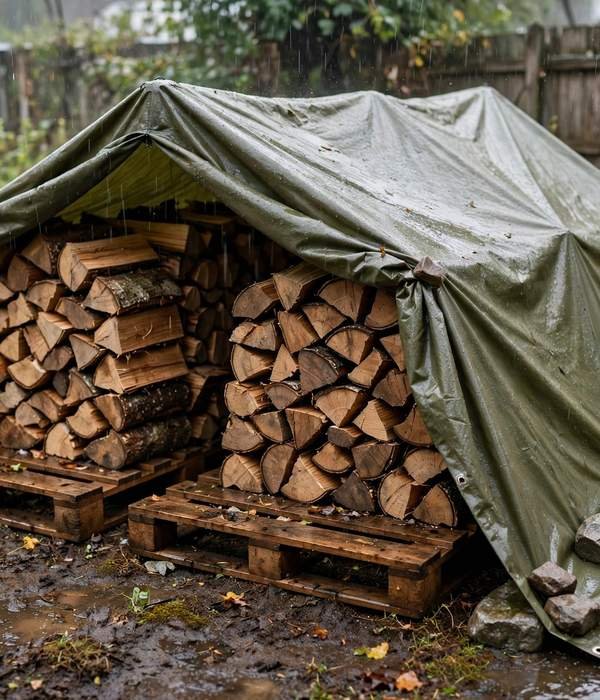
The cheapest real firewood storage is also the most honest: heat-treated pallets (“HT” stamp, never chemical “MB” pallets) on level ground lift wood 4 to 6 inches off the soil. Stack a face cord on top, drape a heavy-duty tarp over it like a tent, both ends open.
Nearly free, pallets from most warehouses cost nothing, and an 8×10-foot tarp runs under $20. The open ends are non-negotiable: cross-breeze keeps the wood drying instead of sweating.
The mechanism is elevation plus a rain roof with ventilation: pallets break ground contact, the fastest way wood rots, and the tent-drape sheds rain while the open ends breathe. It holds a face cord through winter at proper moisture, and teaches the drying principles every fancier method follows.
Where it works best:
- Renters and first-winter homeowners learning how much they burn
- Overflow when the main rack is full mid-season
- Green wood bought cheap in spring, stack it tented now, burn it seasoned by fall
- Back corners of the yard
Stake or weight the tarp’s bottom edges against wind, and check after the first big storm, a slipped tarp that pools water is worse than none. Keep it one row deep so air reaches every log.
6. Under-Eave Covered Stack: the roof you already own
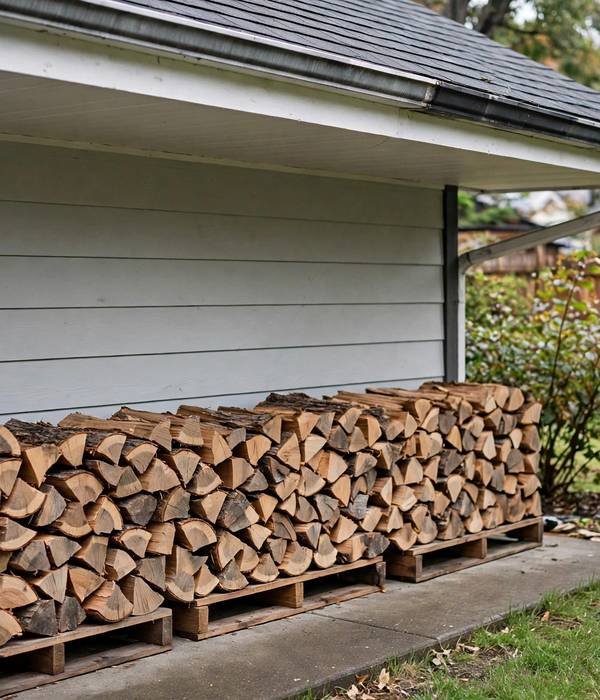
The house already built you a firewood cover, it’s called the roof overhang. Stacking split wood in a single row under the eave, on pallets at 6-plus inches, uses 12 to 24 inches of existing roof as the rain shield.
No structure to buy or build: the wall side stays sheltered, the outer face dries by sun and wind, and the stack sits steps from the door.
The mechanism is borrowed shelter. A typical eave extends far enough past the wall to cover a single row of 16-inch splits with margin, which is precisely the row depth that dries fastest. You get shed-roof rain protection for free; you supply only the elevation and the discipline to keep sides open.
Tips for best results: South- or west-facing eaves dry fastest. Stack bark-side-out rows to shed splash-back, keep the stack 6 inches below the eave for air circulation, and use a 4-foot steel rack for tidy rows and exact elevation.
Watch out: Never stack against wooden siding, use a freestanding rack for the 6-inch wall gap, and inspect it for insects a few times a season. Check HOA rules; front-eave stacks are restricted in many neighborhoods. Keep gutters clear, one overflowing gutter dumps a waterfall into your wood.
Big volumes still belong 30 feet out; the eave holds the working supply, not the reserve.
7. Log Store Bench: the patio-seating double
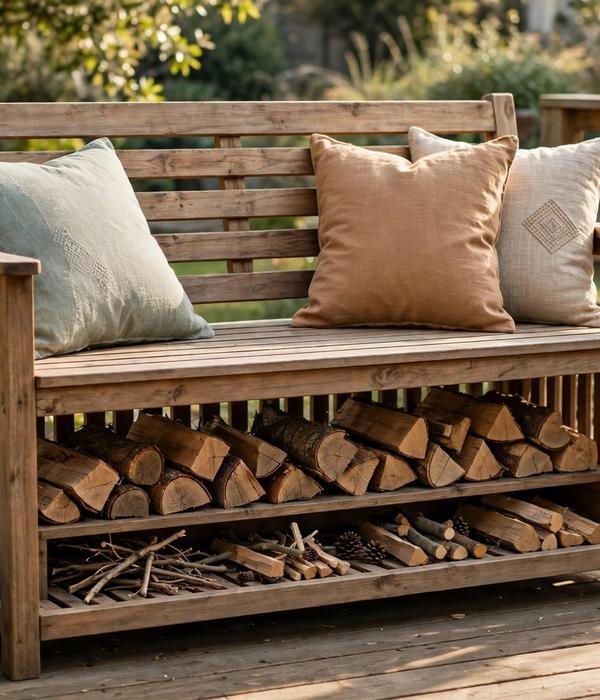
A log store bench is a 4-foot bench with slatted storage underneath, you sit on your firewood.
The under-bench bay holds roughly a quarter of a face cord of splits with a shallow kindling shelf above them, and the slatted sides (1- to 2-inch gaps) give the stored wood the airflow it needs while the bench top keeps the upper rows dry. One object, two jobs: seating by day, the evening’s fuel within arm’s reach.
The mechanism is furniture that dries. Small patios can’t spare separate footprints for seating and wood storage, so the bench merges them, the storage bay uses the dead volume under the seat that would otherwise hold nothing.
The slats are the critical detail: a solid-sided bench would trap moisture and rot the wood from the inside, while slats let the stack breathe like a miniature shed.
Where it works best:
- Patios under 100 square feet where every object earns its footprint twice
- A week’s worth of wood within arm’s reach of the door
- HOA-heavy neighborhoods, it reads as patio furniture, not a woodpile
- The kindling shelf ends the nightly “where are the starters” hunt
Build or buy in cedar or pressure-treated lumber: 4 feet wide, 18 inches deep, 18 inches of seat height, with a 4- to 6-inch kindling compartment. Ready-made benches typically run $80–$150. If you build, leave the back slatted too, airflow on all four sides dries noticeably faster than three.
8. Rolling Log Cart: the stack-to-door shuttle
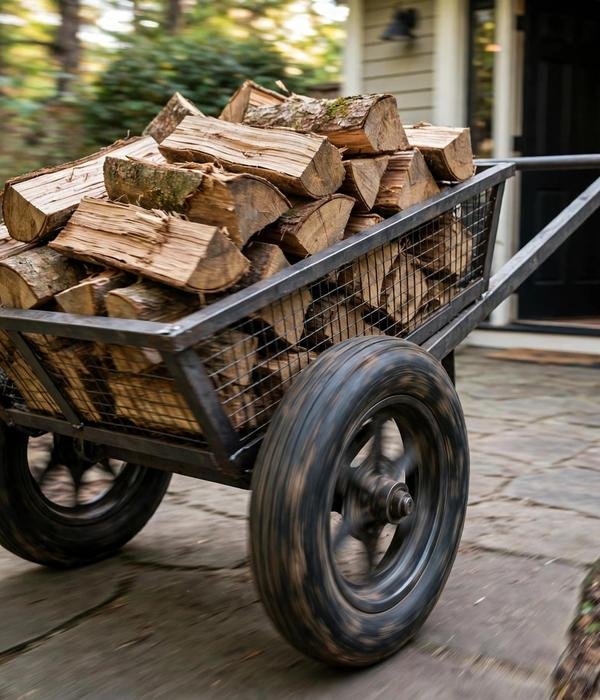
The rolling log cart bridges the big outdoor stack and the fireplace: a metal cart on wheels holding about a quarter cord, rolled from woodpile to door so nobody carries armloads through snow at 10 p.m. Fill it weekly at the main stack, park it in the garage or under the eave, and the nightly routine becomes wheeling, not hauling.
The mechanism is batch transport. The 30-foot setback puts your reserve out in the yard where it belongs, but that distance makes refueling miserable in bad weather. The cart closes the gap: the reserve stays properly placed, and a week’s wood lives one trip away instead of six.
It also keeps bark debris and hitchhikers out of the house, since the cart parks outside or in the garage.
Tips for best results: Load heaviest splits low, and look for 10- to 12-gauge steel with 8-inch pneumatic or solid wheels, pneumatics roll over snow and mud that hard wheels sink into. Park under cover between runs, keep tires off bare soil overnight, and shop the 200-plus-pound rating; typical price band is $60–$120.
Watch out: A loaded cart on a slope will run away, chock the wheels or park across the grade, never facing downhill. Don’t roll 200-plus pounds across a softwood deck. And this is a shuttle, not storage: a cart left loaded and tarped for weeks recreates the moisture trap this guide warns about.
9. Indoor Transition Stack: the 48-hour rule
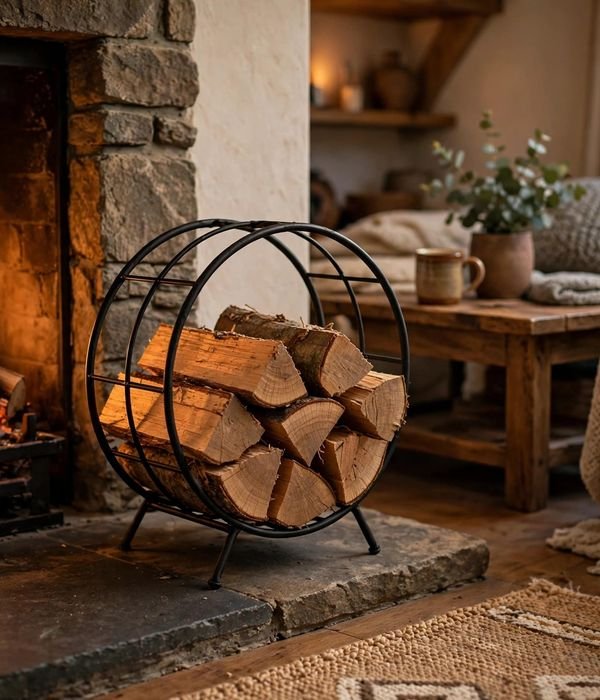
The indoor transition stack is the last link in the chain: 1 to 2 days of wood by the door on a log hoop or small rack, 8 to 12 splits, enough that you’re never dressing for a blizzard at 10 p.m., little enough that nothing moves in.
A full winter’s supply should never live indoors: bark carries beetles, spiders, and mice inside, and a cord of wood releases gallons of moisture into your indoor air, condensation on windows and musty smells by February.
The mechanism is buffering, not storing. The outdoor methods above do the drying and the bulk holding; the transition stack holds only the working buffer between the yard and the fire. At 48 hours of burning, the wood can’t raise indoor humidity meaningfully, and anything riding in gets burned before it establishes itself.
Refills come from the rolling cart or eave rack, a waystation, never a warehouse.
Where it works best:
- A log hoop or small rack right beside the hearth for the evening’s fire
- Refilling from the rolling cart (point 8) once or twice a week
- Bark-side-down splits indoors keep debris off the floor
- Checking each split for hitchhikers before carrying it inside
Keep the rack 3 feet from the stove or fireplace opening, standard clearance code, not a suggestion. Apartment and condo dwellers should check lease and fire rules first. And resist “stocking up” indoors before a storm: a bigger indoor pile buys pests and moisture, not convenience.
Conclusion
Every method above follows the same four rules: wood 6-plus inches off the ground, top covered with sides open, 6 inches clear of walls and never against wooden siding, and the big multi-cord stacks 30 feet from the house. Get those right and the specific method is just a question of budget, space, and how much you burn.
Best value pick: the pallet platform + tarp tent (point 5). Free heat-treated pallets, one heavy-duty tarp under $20, and an hour of stacking gets a face cord through winter at proper moisture, and it teaches you the drying principles that make every fancier method work.
If you’d rather buy than scavenge, the 4-foot two-tier rack with a top-drape cover is the best under-$70 upgrade: same physics, tidier footprint, zero DIY.
Once the evening’s fire is lit, see indoor log storage, post #1677 for keeping the hearth-side stack tidy, patio winter storage to get the rest of the yard ready before the first snow, and shed organization if your wood shares its shed with tools.
Frequently Asked Questions (FAQ)
How much firewood storage outdoor space do I need for winter?
Start from your burn, not your yard. A casual fireplace user who burns a few evenings a week goes through about 1 cord a season, one 4×4×8-foot stack.
A wood stove heating the house burns 3 to 5 cords, which is a serious footprint: plan a shed or multiple 8-foot racks, and give yourself the 30-foot setback from the house. First winter? Buy 1 cord seasoned, store it right, and track what you actually burn, that’s your real number for next year.
Can I just cover my woodpile with a tarp?
Cover the top only, never the whole pile. A fully wrapped tarp traps ground moisture and condensation, and the wood comes out wetter and moldier than uncovered wood. Drape it over the top like a tent, weight the edges, and leave the sides and at least one end open.
A tarp that wraps the sides is hurting, not helping.
How far should firewood be stored from the house?
For large stacks, a cord or more, 30 feet from the house is the fire-code recommendation, because seasoned firewood is a significant fuel load.
Small working racks (a quarter cord or less) by the door are a different category and are fine close to the house, as long as the wood sits 6 inches off the wall and never touches wooden siding. Ground-contact wood against the house also invites termites and carpenter ants, so the setback and the air gap both matter.
How do I know if my firewood is seasoned enough to burn?
Check three things: a pin moisture meter reads under 20 percent on a fresh-split face (meters cost under $25 and settle every debate), the log ends show radial cracks, and two splits clapped together ring hollow rather than thudding. Loose or falling bark is another good sign.
Honest warning: green wood bought this fall will not hit these marks by deep winter, wood needs 6 to 12 months to season, so buy already-seasoned now.
What is a face cord versus a full cord?
A full cord is 4×4×8 feet of stacked wood, 128 cubic feet. A face cord (sometimes called a rick) is one-third of that: a 4×8-foot face, one log-length deep, usually 16 inches.
The classic pricing trap is a seller advertising a “cord” that’s actually a face cord at near-cord prices, always ask for the stack dimensions and do the math. For reference, most fireplace owners burn 3 to 4 face cords a season; stove-heated homes burn 9 to 15.