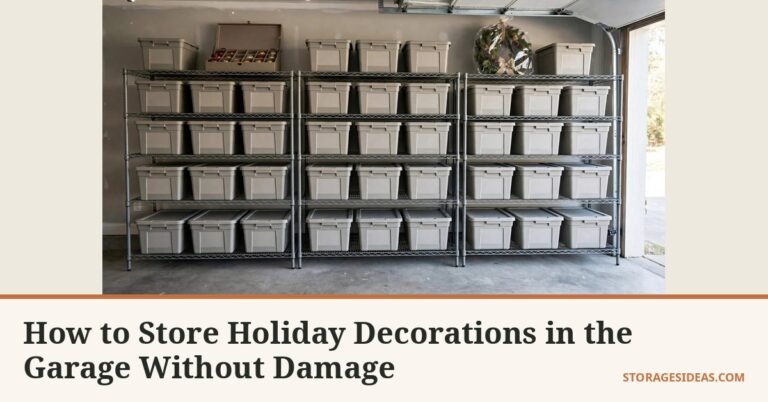

I watched a neighbor roll a $400 cushion set into his garage last November, dusty, slightly damp from the last cookout, piled in a corner under a thin tarp. By March, every cushion smelled like a basement and the bottom two had mildew stains that never came out.
He threw away $400 and spent another $300 replacing them, all because of one wet weekend he never accounted for.
That is the whole lesson of patio furniture winter storage: it is not about buying fancy storage, it is about doing three unglamorous things right, dry, seal, and lift. Skip any one of them and winter collects the bill.
These 9 ideas cover every part of the job: the washing rules that matter, how to size a deck box so it actually fits your set, covers that breathe instead of sweating, where in your house this stuff should live, and how to keep mice from nesting in your cushions.
Measure-first, renter-safe where possible, with exact sizes and capacities for every recommendation. Let’s get your patio winter-proof.
Why Winter Kills Patio Furniture (And How Storage Fixes It)
When people search how to store outdoor furniture for winter, the real question underneath is: what is actually destroying it? It is not the cold. Most patio materials, powder-coated aluminum, resin wicker, teak, acacia, survive freezing temperatures just fine. What destroys them is moisture that gets trapped and time.
Here is the mechanism. A cushion that goes into storage even slightly damp sits in a sealed, dark space for four or five months. Mold and mildew need exactly that: darkness, still air, and moisture above roughly 60% relative humidity inside the fabric.
One humid afternoon before storage is all it takes, the mildew grows all winter, and by spring the foam core smells and the cover is stained. The same logic applies to frames: water pooling in joints or under a non-breathable cover corrodes fasteners and rots untreated wood feet.
The fix is mechanical, not mysterious: (1) remove all moisture before storage, (2) store where air can move or where the container itself is sealed and dry, (3) keep everything off bare concrete, which wicks moisture and stays cold. Everything below follows that logic. Get these three right and your furniture comes out in spring looking like October.
1. Wash and Fully Dry Everything Before It Goes Away: the non-negotiable prep
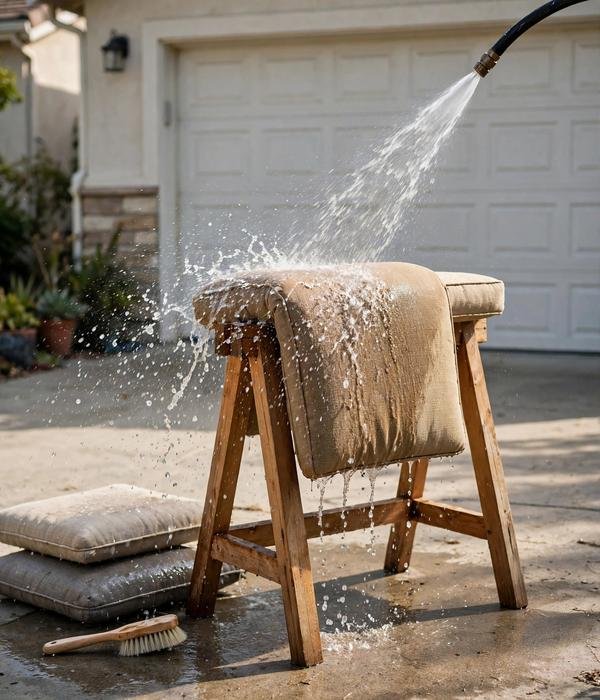
Nothing else in this list matters if you store dirty, damp cushions. Sunscreen, pollen, food grease, and bird droppings are all organic material, meaning mildew food. Clean fabric stores clean; dirty fabric rots slowly all winter. Plan this for a dry, sunny weekend at least 48 hours before your storage day, so drying time is guaranteed.
- Knock off loose debris with a stiff brush, then hose everything down.
- Wash cushion covers (zip them closed) and wipe frames with warm water plus a squirt of dish soap and 1 cup of white vinegar per gallon, vinegar kills mildew spores without bleaching.
- Rinse thoroughly; soap residue attracts dirt in storage.
- Stand cushions on edge in full sun with airflow on both sides, never flat on the ground. Flip once.
- Give them a full 24–48 hours of drying. The poke test: press the foam hard through the cover. If you feel any coolness or dampness, give it another day.
Watch out: “sun-dried for a few hours” is not dry. Foam cores hold water for a day or more after the surface feels dry. Sealing a cushion that only feels dry is the single most common cause of spring mildew.
2. Size a Deck Box to Your Cushion Set: the cheat sheet
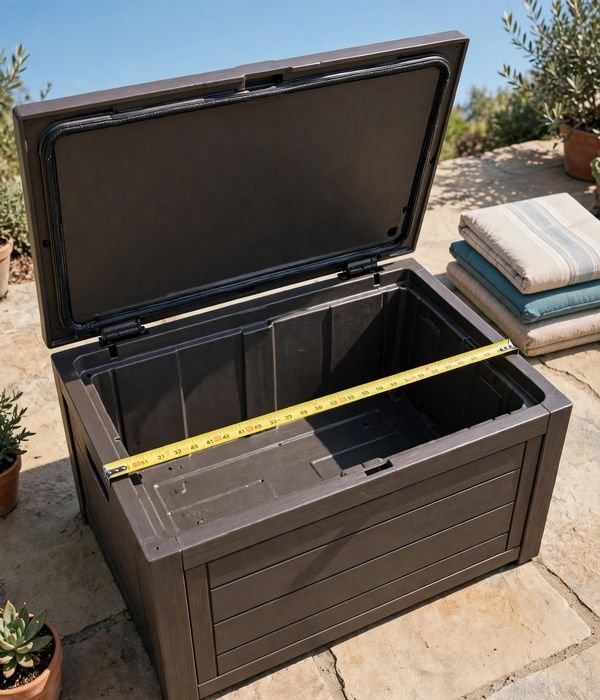
Deck boxes are the workhorse of cushion storage, lockable, weatherproof, and they double as a bench on the patio come spring. But the number-one mistake is buying too small, then forcing cushions in until the lid bulges and the weather seal fails. Here is how to size it without guessing.
What you can do with it:
- A standard 6-cushion patio set (4 seat + 2 back, or 6 seat pads) needs roughly 10–12 cubic feet of space when stacked snugly, about what a 150-gallon deck box (≈ 20 cu ft) holds with room to spare.
- A 4-cushion set (love seat + 2 chairs) needs roughly 6–8 cu ft, a 100-gallon box (≈ 13 cu ft) is comfortable.
- Throw pillows and small pads only: a 50-gallon box (≈ 6.7 cu ft) handles about 8–10 pillows.
- Measure your tallest cushion stacked height, not the footprint, stack them on the floor, measure the pile, and buy a box at least 2 inches taller. Lid clearance is the binding constraint, not the base.
- Buy boxes with latching lids and a weather seal, the cheap ones without seals let in the first freeze-thaw rain and become mildew tubs.
- Weight matters for placement: a loaded 150-gallon box weighs 60–80 lbs, so put it where it will sit all winter.
Save-worthy cheat sheet, box size vs. what fits:
- 50 gal (6.7 cu ft) → 8–10 throw pillows
- 100 gal (13 cu ft) → 4-cushion set or love-seat cushions
- 150 gal (20 cu ft) → full 6-cushion set, lid closes flat
- Over 20 cu ft need → two boxes beat one giant one (a full 150-gal box is already hard to drag)
Watch out: if the lid bulges, the seal is broken and rain gets in. Two properly sealed boxes always beat one overstuffed box.
3. Use Breathable Fitted Covers, Never Plain Tarps: outdoor overflow storage
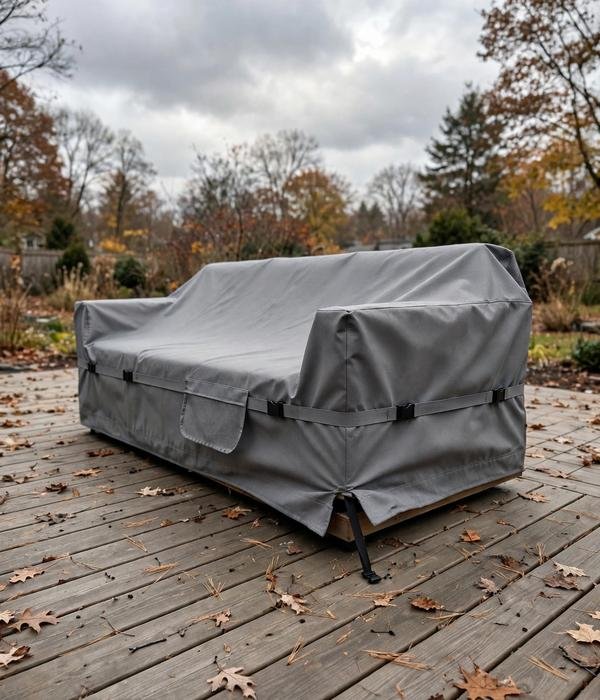
If part of your set has to live outside all winter, common with heavy sectionals and no garage, covers are the answer, but the type of cover decides whether it works. A cheap blue tarp traps condensation under itself, and that trapped moisture does more damage than leaving the furniture uncovered.
Breathable polyester covers with vent flaps and tie-down straps are the only covers worth buying.
- Measure each piece and buy covers sized to the frame: standard sofa covers fit pieces 76–86 in wide, love seats 55–60 in, dining chairs 30–40 in each. Too-big covers balloon, catch wind, and rub the finish.
- Look for covers with adjustable straps or buckle clips at the base plus at least one mesh vent, the vent is what lets trapped humidity escape.
- Wipe the furniture down and let it dry fully before covering (point 1’s rules apply outside too).
- Leave the bottom edge 2–3 inches off the ground, don’t seal the cover to the patio. Airflow underneath prevents the condensation cycle.
- After the first hard rain, check underneath once. If you find pooling, the cover is sagging, tighten straps or add a prop (a bucket under the cover’s middle sheds water like a tent).
Watch out: furniture covers are a 3–4 season solution in most climates. In the snowiest zones (Great Lakes, New England), plan to brush heavy snow loads off the covers after big storms so the weight doesn’t bend frames.
4. Elevate Everything 4+ Inches Off the Concrete: the cheapest insurance
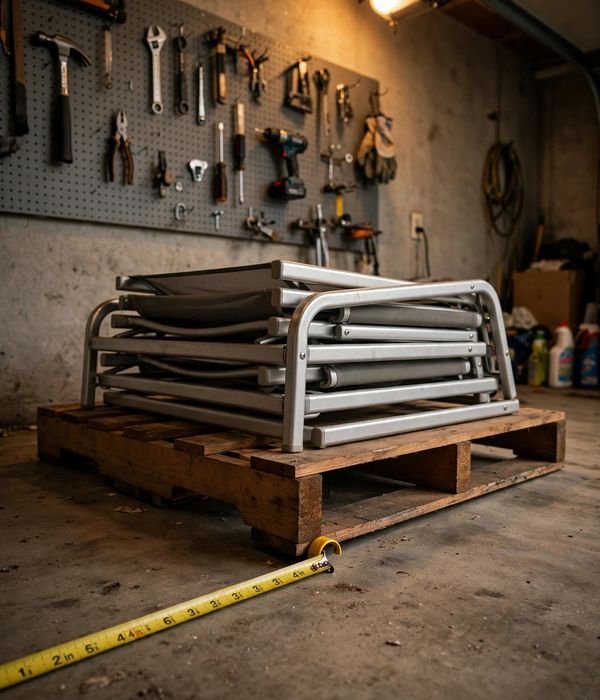
Concrete floors are the silent killer of stored patio furniture. A garage or basement slab wicks moisture upward, stays 10–15°F colder than the air, and creates a condensation zone exactly where your furniture feet and box bottoms sit. The fix costs almost nothing: nothing stored touches the slab.
What you can do with it:
- Standard wooden pallets (48 × 40 in, free behind most big-box stores) give you 4–5 inches of lift, enough for airflow under frames and boxes.
- Plastic pallets or garage floor tiles work where moisture is heavy, they don’t wick at all and won’t harbor pests the way wood can.
- Metal wire shelving (24 in deep, 48 in wide, rated 300–500 lbs per shelf) doubles as both elevation and vertical storage for cushions in sealed bins.
- Folded aluminum frames stack flat, a stack of 6 folded chairs is only about 20 in tall and sits neatly on one pallet.
- Stack cushions in sealed bins on the second pallet tier, not the floor, if the garage floods in spring thaw.
- In damp basements, add a moisture barrier, a sheet of 6-mil poly under the pallet breaks the slab’s capillary action completely.
Watch out: cardboard boxes on concrete absorb moisture from below within weeks. If your cushions are in cardboard, they are sitting in a slow sponge. Upgrade to plastic bins with latching lids.
5. Rodent-Proof With Sealed Boxes and Zero Food Scents: keep mice out
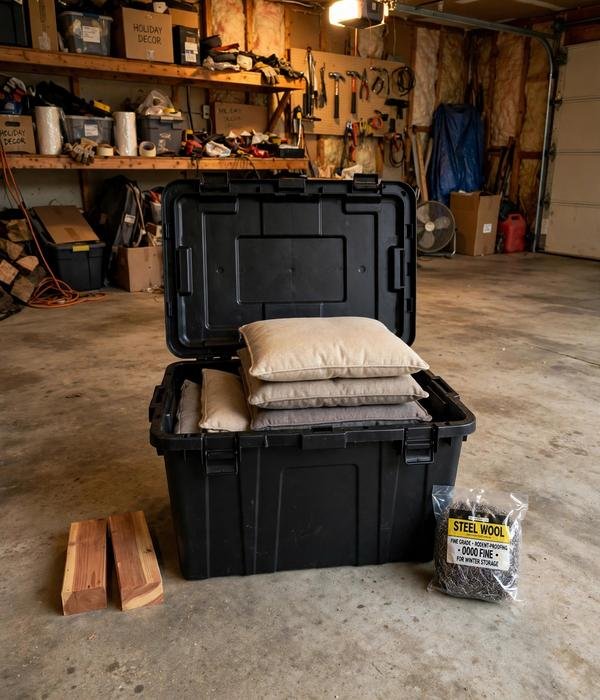
Ask anyone who stores cushions in a shed: the enemy is not just moisture, it is mice. A shed is a perfect mouse hotel, dark, quiet, and full of soft nesting material if your cushions smell like last summer’s cookout. The defense is a system, not a single trick.
- Wash everything (point 1), grease and food smells are what bring rodents in. No scent, no invitation.
- Store cushions in hard plastic bins or deck boxes with latching lids, not bags. Mice chew through fabric bags and thin totes in one night; they cannot chew a latched 5-gallon-rated bin wall.
- Seal entry points to the shed or garage corner: steel wool packed around pipe and cable holes, door sweeps on doors. Mice enter through gaps as small as a dime (about 1/4 in).
- Place cedar blocks around (not touching) the bins. Honest caveat: cedar is a mild repellent, not a barrier, it helps, it is not a guarantee. Lavender sachets are weaker still. Use them as a supplement, never as the plan.
- Skip mothballs in living-adjacent spaces, naphthalene is toxic in enclosed air and illegal for off-label use in several states. Snap traps checked weekly beat poison (poisoned mice die inside your cushions).
Watch out: do not leave the shed door open for ventilation, that is a welcome sign. Sealed bins plus a sealed building beats airflow in rodent country.
6. Stack Frames Tight or Stand Folding Chairs Vertical: reclaim the wall
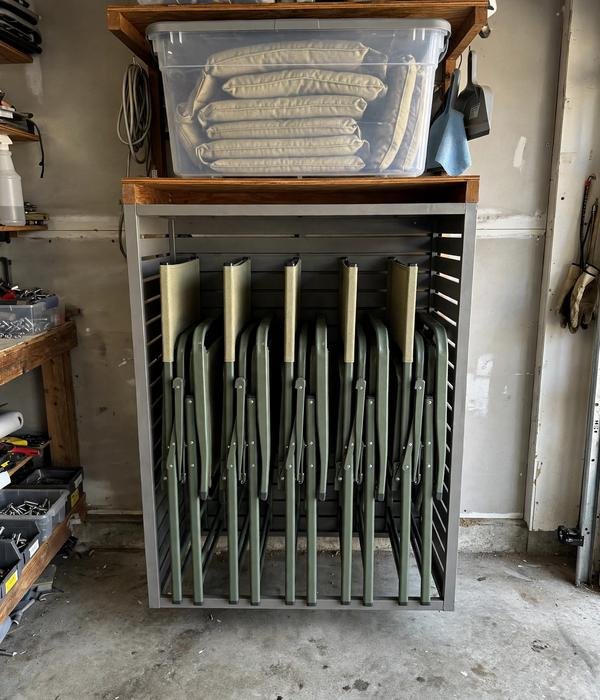
Furniture frames take up absurd space stored flat, a 4-chair dining set spread on the garage floor eats a 6 × 8 ft zone. Stored vertically or stacked, the same set fits a 2 × 6 ft wall strip. The stacking math is the difference between a garage you can still park in and one you cannot.
What you can do with it:
- Aluminum frames stack: nestable patio chairs stack 4–6 high in a 30 × 30 in footprint. Strap the stack with a ratchet strap so it cannot topple.
- Folding chairs stand vertical in a slotted wall rack, one 24-in-wide rack holds 5–6 chairs and sticks out only 10 in from the wall. Freestanding versions exist for renters (no screws).
- Tabletops go on edge against the wall like mattresses, padded with moving blankets between, a 48-in round table needs only 48 in of wall and 6 in of depth.
- Umbrella poles and stands strap to the same wall strip with two bungees; stands go at the base where they cannot tip.
- Hang hammocks and swing cushions in sealed bins above the rack, the vertical space is free.
- Label a winter zone on the garage wall (a strip of painter’s tape with “PATIO, DO NOT BLOCK”) so the holiday storage shuffle in December doesn’t bury the stack.
Watch out: never lean glass tabletops on bare concrete, one frost heave or a kicked tool cracks them. Pad both faces and store them indoors if you get hard freezes.
7. Pick Your Zone, Garage vs. Shed vs. Basement: choose by moisture, not habit
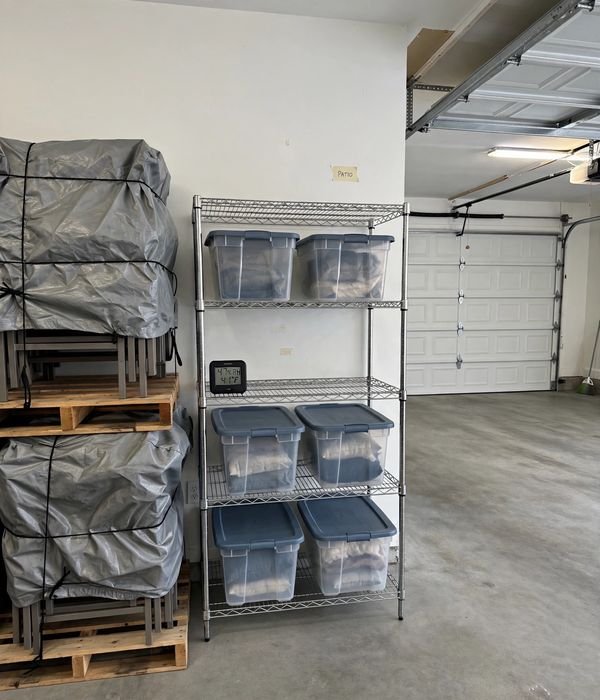
Most people default to wherever is closest. But temperature swings and humidity decide how your furniture fares, and each zone has a real trade-off worth weighing before you commit.
- Test the zone first: leave a cheap humidity meter in the spot for 48 hours. Under 60% relative humidity = safe zone. Above 70% = you need desiccant or a different zone.
- Garage (best all-rounder): attached garages stay 10–20°F warmer than outside, rarely freeze hard. Watch the floor, elevate everything (point 4). Freeze-thaw drips from cars are the main moisture source, so keep cushions away from the car bay.
- Shed (worst for cushions, fine for frames): uninsulated sheds swing from 100°F in October to -10°F in January, and that condensation cycle is brutal on fabric. Store frames and tables here; keep cushions elsewhere.
- Basement (great for cushions, check the damp): finished basements hold 60–70°F and steady humidity, ideal for fabric. Unfinished basements need a dehumidifier or desiccant buckets (a 5-lb bucket of silica gel covers ~100 sq ft for a season).
- Covered patio/balcony (frames only): acceptable with breathable covers (point 3), but cushions never, one sideways rain and you have March mildew.
Watch out: never store near the furnace or water heater exhaust, heat cycling dries out wicker and cracks wood, and lint from dryer vents settles on stored fabric all winter.
8. Store the Umbrella Like It Matters: poles, canopies, and bases
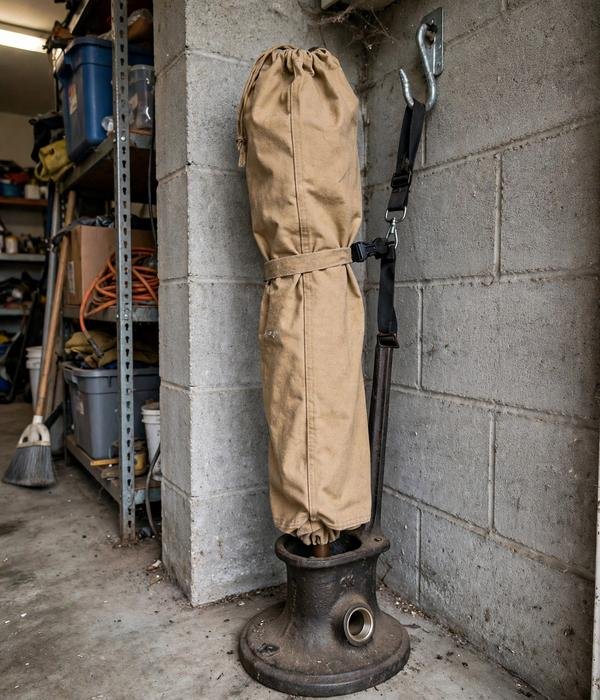
Market umbrellas are the most commonly destroyed patio item, a $150 umbrella left open or leaning in a corner snaps its first spring wind. They are long, awkward, and fragile, which is exactly why they need a deliberate plan instead of an afterthought lean.
What you can do with it:
- Close, dry, and wrap the canopy: open it once on a sunny day, hose off bird droppings and pollen, let it dry fully, then close it and slide a canopy storage bag over it (about $15, sized for 9–11 ft umbrellas). The bag keeps dust and mice off the fabric.
- Store the umbrella upright in its stand with the pole seated, in the garage or basement, the stand’s weight (typically 50–75 lbs of cast iron or concrete) is the ballast that keeps it from falling. Empty the stand’s drain plug so freeze water doesn’t crack it.
- Cantilever umbrellas: remove the canopy from the arm (usually 4–6 bolts), bag the canopy, and strap the folded arm flat against the wall. The cross-base stores flat under a workbench.
- Stands alone can stay outside if drained, cast iron and concrete do not care about frost, but bring resin-filled bases inside, since trapped water cracks them on hard freezes.
- Tie-down straps on wall hooks keep a stored upright umbrella from becoming a 9-foot domino the first time someone bumps it.
Watch out: never lean an umbrella horizontally across two sawhorses all winter, the pole bends slowly under its own weight and the canopy creases permanently at the pressure points.
9. The Balcony and Renter Kit: one cover, one tote, done
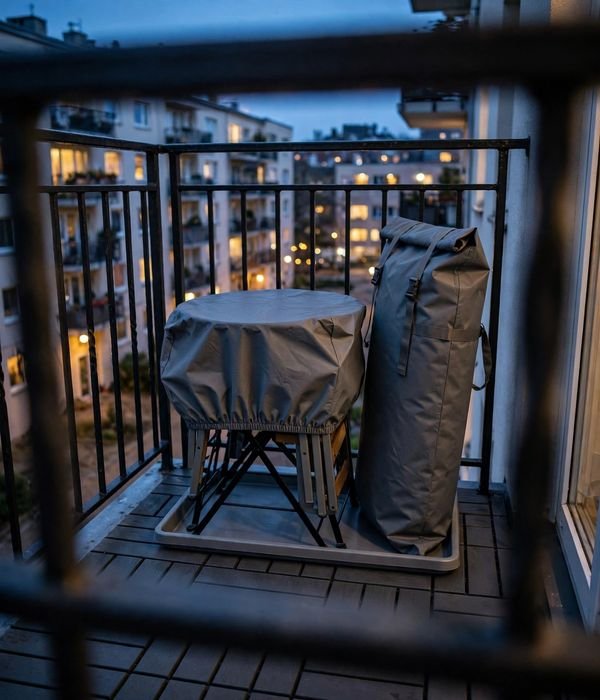
No garage, no shed, no basement, just a 5 × 8 ft balcony and a lease that says no screws. You can still winterize properly. The kit is two items and one rule: everything either goes inside the apartment or lives in one waterproof container.
What you can do with it:
- Buy a waterproof cushion storage bag (the 46 × 18 × 18 in size holds a full balcony bistro set’s cushions), heavy-duty 600D polyester with a drawstring or zip closure. It stands in a closet or behind the couch all winter.
- For frames: a fitted balcony furniture cover (bistro sets typically 28–36 in table + 2 chairs fit a 55-in cover) with elastic hem, no straps needed, no screws, fully renter-safe.
- Folding bistro chairs collapse to 6 in thick and slide behind the couch or under the bed, dead space, zero footprint.
- Small tables (under 28 in) flip upside down over the folded chairs and get covered as one unit, one cover protects the whole stack.
- Keep a doormat-sized drip tray (24 × 36 in boot tray, $15) under the stored stack on the balcony, it catches condensation and protects the landlord’s flooring.
Watch out: check your lease or HOA rules before winter, some complexes ban covered furniture on balconies as a fire/visual rule. When in doubt, cushions inside and the covered frame in a storage locker or a friend’s garage.
Conclusion
Of all nine ideas, one is the Non-negotiable step: wash and fully dry everything (point 1) before anything gets sealed, covered, or stacked. It costs nothing but a sunny weekend, and it is the single difference between cushions that come out fresh in April and cushions that come out as trash.
Every other idea, the right box, the right zone, rodent-proofing, only works if the fabric going in is clean and bone-dry. Start there, and the rest of the list is just optimization.
Frequently Asked Questions (FAQ)
Do I really need to wash cushions before storing them for winter?
If they were used this season, yes, always. Sunscreen, food grease, and pollen feed mildew in dark storage, and even “looks clean” cushions hold invisible residue. If the set sat unused under a cover all summer and still smells neutral, a hose-down and full dry is enough.
When in doubt, wash: 20 minutes now beats $400 of replacements in spring.
Can I leave patio furniture outside all winter with just covers on?
If the frames are powder-coated aluminum or resin wicker, yes, with breathable fitted covers (point 3) and snow brushed off after storms. If the frames are wood, steel, or natural wicker, no; bring them into a garage, shed, or basement, because freeze-thaw moisture rots and corrodes those materials within a season or two.
How do I keep mice from nesting in my stored cushions?
If you store in a shed or garage: wash off all food scents, pack cushions in hard plastic bins or deck boxes with latching lids (mice chew through bags, not bins), seal building entry points with steel wool, and add cedar blocks as a mild supplement.
Skip mothballs indoors, they are toxic in enclosed air and not worth the risk.
Will my cushions get mildew inside a deck box?
Not if they go in bone-dry and the box seals properly. The mildew equation is moisture + darkness + time, a sealed box only fails when damp cushions go in, or when an overstuffed lid breaks the weather seal. Toss in two or three silica gel packets per box as cheap insurance in humid climates.
What is the best patio furniture winter storage option if I only have a balcony?
If you rent with no garage: a waterproof cushion storage bag (46 × 18 × 18 in holds a bistro set’s cushions) kept inside the apartment, plus one fitted elastic-hem cover over the folded frames on the balcony. Total cost is typically under $75, nothing screws into walls, and everything comes back out in spring without mildew.