
Here’s the math nobody does before December: a standard kitchen counter is 24 inches deep, and a holiday cook needs at least 15 inches of landing zone beside the stove and 15 beside the sink just to set down a hot tray or a mixing bowl safely. Every christmas kitchen decor idea below protects those landing zones instead of eating them.
Now add the cookie cooling racks, the gift-wrapping overflow, and the snack trays for guests, and your work surface shrinks by a third exactly when you need it most.
So this list follows one hard rule: nothing here sits on your counters. Every single idea lives on a window, a wall, a cabinet face, above the cabinets, or on the fridge.
Your counters stay 100% work zone, 24 full inches of depth, landing zones intact, while your kitchen still looks like December walked in and made itself at home.
I’ve sized every piece for real kitchens: the garland length for a standard 36-inch window, the weight ratings that hold a wreath on a fridge door, the above-cabinet gap heights that actually exist in most homes.
Why Christmas Kitchen Decor Starts With Counter Space
Between Thanksgiving and New Year’s, the average home cook runs roughly double the usual number of cooking sessions, cookie batches, party appetizers, big family meals, and the endless reheating of leftovers. Every one of those sessions needs the same thing: clear, wipeable counter space with room to land a hot pan.
Think of it in zones. Your prep zone is the 24-inch depth of counter next to your cutting board. Your landing zones are the 15-inch stretches flanking the stove and sink.
When decor eats those zones, cooking doesn’t just get annoying, it gets unsafe. Hot pans get set on trivets balanced on canisters; knife work migrates to the dining table.
The good news: kitchens have more unused vertical real estate than almost any room in the house. A standard window is 36 inches wide and framed by 6 to 10 inches of trim on each side. Cabinet doors are 24 to 30 inches of flat, empty face.
The gap between cabinet tops and the ceiling runs 12 to 18 inches in most kitchens built after 1990. And the side of a full-size fridge is 28 inches wide by 70 inches tall of magnetic real estate.
That’s the territory we’re decorating, and once you see how much of it there is, you’ll wonder why anything ever lived on the counter in the first place.
1. A Window Garland Swag: Frame the Light Without Touching the Sill
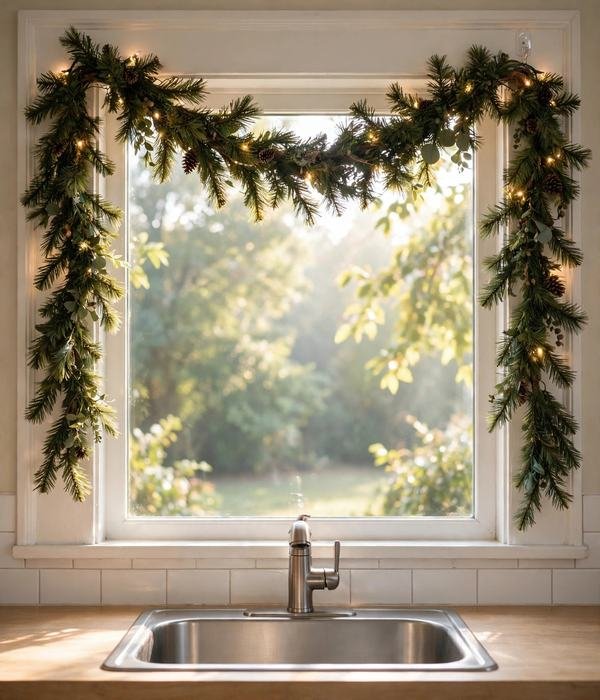
The kitchen window is the single best zero-counter decorating surface you own. A swag of pine garland across the top of the window frame draws the eye up and takes up exactly zero inches of your prep zone, because it hangs on the trim and the wall above it.
Start with the measurement that matters: a standard double-hung kitchen window is about 36 inches wide. For a swag across the top with two tails at the sides, you need 6 to 9 feet of garland.
Realistic faux pine runs $25 to $60 for a 9-foot length, and lasts years stored coiled loosely in a seasonal decor storage guide box rather than crushed in a bag.
Hang it with two adhesive hooks on the wall or trim above the window corners, rated for 3 to 5 pounds. The detail people skip: adhesive strips need a 24-hour cure time on a clean, dry surface. Hang the hooks the day before the garland, or your swag will slide down the wall by Christmas Eve.
Tips for best results:
- Twist a 20-foot strand of battery fairy lights through the garland before hanging, one strand, warm white, timer function.
- For a double window (60 inches wide), go 12 feet of garland and add a third hook in the center so the middle doesn’t sag.
- If your window is directly behind the sink, keep the tails above backsplash height, steam and splatter will soil anything hanging within 6 inches of the faucet.
Watch out:
- Skip real pine above the stove-adjacent window, dried needles near a gas burner are a fire risk. Faux is the right call within 36 inches of any flame.
2. Mini Wreaths on Cabinet Doors: 10 Inches of Ribbon, Zero Counter
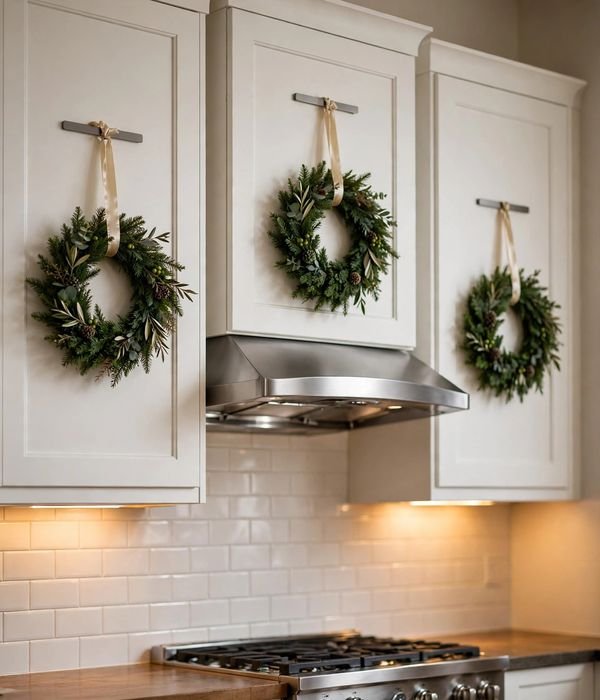
Cabinet doors are wasted square footage eleven months of the year. In December, three or four mini wreaths hung on upper cabinet doors turn a plain kitchen into a Christmas kitchen, and the wreath hangs flat against a surface that was doing nothing, costing you zero inches of counter and zero inches of floor.
The hardware is an over-the-door wreath hanger, but the cabinet-sized version: a flat metal hook that slips over the top of the door, with the wreath hanging from ribbon on the front face.
Buy hangers sized for your door thickness, standard cabinet doors are 3/4 inch thick; the hanger’s slot needs to clear that plus a felt pad so it doesn’t scratch the finish. A 10- to 12-inch wreath is the right scale for a standard 30-inch-tall upper cabinet door; anything bigger overwhelms the door and anything smaller reads as an afterthought.
What you can do with it:
- Hang matching 10-inch wreaths on the two cabinets flanking the range hood for a symmetrical, designed look.
- Use one larger 14-inch wreath on the pantry or broom-closet door as the room’s focal point.
- Tie wreaths with 1.5-inch-wide ribbon in a single color (deep red, forest green, or champagne), unified ribbon makes mismatched wreaths look intentional.
- Swap to eucalyptus or olive-branch wreaths after Christmas and leave the hangers up through January, the hardware is invisible once you look past it.
- If a door gets opened constantly (spice cabinet, I’m looking at you), hang the wreath with a removable adhesive hook on the door’s face instead of an over-door hanger, so it doesn’t swing and bang.
3. Magnetic Wreath on the Fridge: The Biggest Blank Wall in the Kitchen
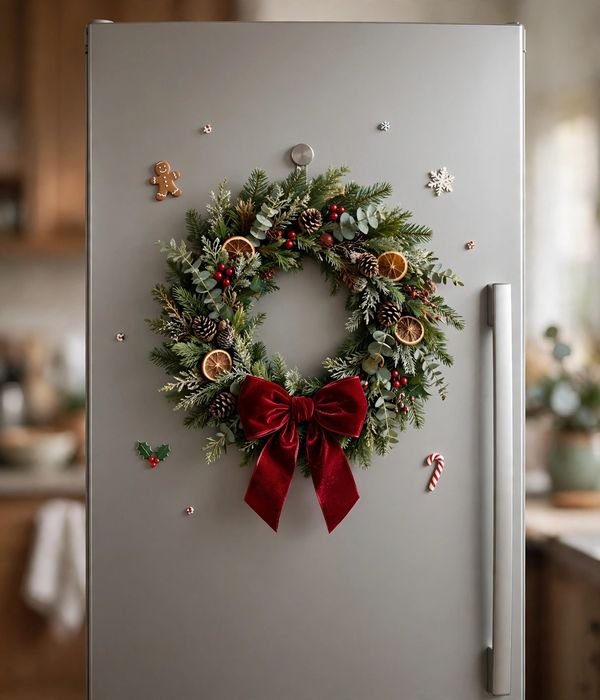
A full-size refrigerator is roughly 36 inches wide and 70 inches tall, and its front and side are magnetic, which makes it the largest unused decorating surface in most kitchens.
A single 18- to 24-inch wreath hung dead-center on the fridge door has more visual impact than five small countertop items, and it occupies a surface that was never going to hold a cutting board.
The key spec is magnet strength. A 24-inch decorated wreath weighs 3 to 5 pounds once you add the bow. A standard souvenir magnet holds about half a pound.
You need a purpose-made magnetic wreath hanger, a disc magnet rated for 10 to 25 pounds, which grips through the door’s finish without sliding. Place it in the upper third of the door so the wreath hangs centered at eye level, roughly 55 to 60 inches off the floor.
Tips for best results:
- If your fridge is stainless, test one small magnetic hook first, some stainless finishes are only weakly magnetic, and you’ll want the 25-pound-rated hanger rather than the 10-pound one.
- Hang the wreath from a 6-inch loop of ribbon so it sits flat; a wire hanger alone lets the wreath tilt forward.
- The side of the fridge (facing the room in many layouts) works even better than the front, it doesn’t swing when the door opens.
Watch out:
- Keep the wreath clear of the ice/water dispenser by at least 6 inches, drips will stain ribbon and flocked branches.
- Don’t hang anything magnetic over the door’s control panel; some touch panels misbehave near strong magnets. A wreath centered on the lower two-thirds avoids it entirely.
4. Above-Cabinet Greenery and Lights: The Forgotten 12 to 18 Inches
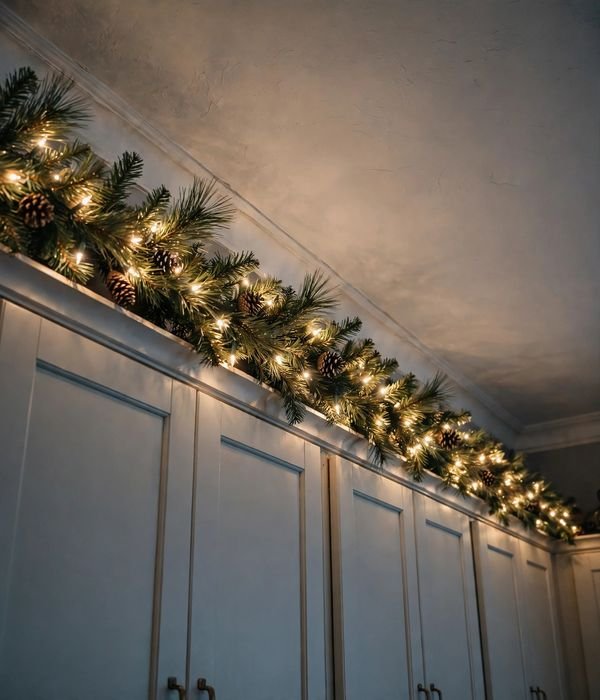
Look up. The gap between the top of your upper cabinets and the ceiling, 12 to 18 inches in most kitchens, is a decorating shelf you already own.
A run of garland up there with warm fairy lights reads as pure Christmas from every sightline in the room, and it is physically impossible for it to interfere with your counters.
Measure the run first: a typical galley kitchen has 8 to 12 linear feet of cabinet tops. Two 9-foot garlands cover most kitchens ($25 to $60 each for decent faux pine). Lay the garland 2 to 3 inches back from the cabinet’s front edge so it doesn’t drape over the cabinet faces.
Then weave in one 33-foot strand of battery-operated micro fairy lights (100 LEDs, warm white) per 9 feet of garland, and set the built-in timer to 6 hours on, 18 off, the standard cycle that means you never touch them again until January.
What you can do with it:
- Tuck three to five flameless pillar candles (3×4 inches and 3×6 inches, real-wax exterior) into the garland for height variation, no fire risk near the ceiling.
- Add pinecones or dried orange slices wired into the garland every 18 inches for a crafted look that costs almost nothing.
- If your gap is on the shallow end (10 to 12 inches), use a slim 6-inch-wide garland profile rather than the fat 12-inch kind.
- In January, coil the garland (lights removed) and box it with your other seasonal decor storage pieces.
5. Open-Shelf Holiday Swap: Restyle What You Already Display
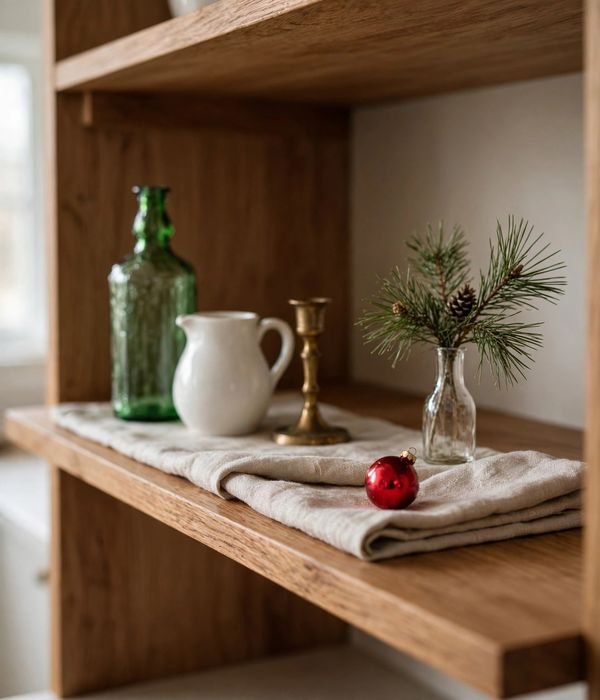
If you have open shelving, even one 24-inch shelf, you don’t need to add a single new object to decorate it. You need to swap. Pull the everyday canisters and mismatched mugs, and restyle the shelf with pieces in a tight holiday palette: deep green, warm white, and one metallic.
The shelf was already there. The decor just changes clothes.
The formula that looks designed rather than cluttered: the rule of three, twice. Three larger pieces (a green bottle, a white pitcher, a small framed print) and three smaller ones (a candle, a pine sprig in a bud vase, a brass ornament), grouped with breathing room between.
Standard open shelves are 10 to 12 inches deep, which allows a two-deep arrangement: tall pieces at the back, small pieces forward, nothing within 2 inches of the shelf edge.
Tips for best results:
- Corral small items on a tray or a folded linen runner, one tray reads as one object, five loose objects read as clutter.
- Borrow from other rooms: that brass candlestick from the living room looks better on a kitchen shelf in December than it does where it lives.
- Keep one shelf (or one section) purely functional, the everyday coffee mugs stay, styled in a neat row. A kitchen that can’t make coffee isn’t festive, it’s frustrating.
Watch out:
- Don’t stack above the shelf’s weight comfort zone, most floating shelves hold 15 to 25 pounds per bracket pair. Ceramics add up fast.
- Keep decor at least 12 inches from the range if the shelf is near the stove, heat and grease film will coat everything by New Year’s.
6. Holiday Textiles: Towels, Mitts, and the Apron Hook
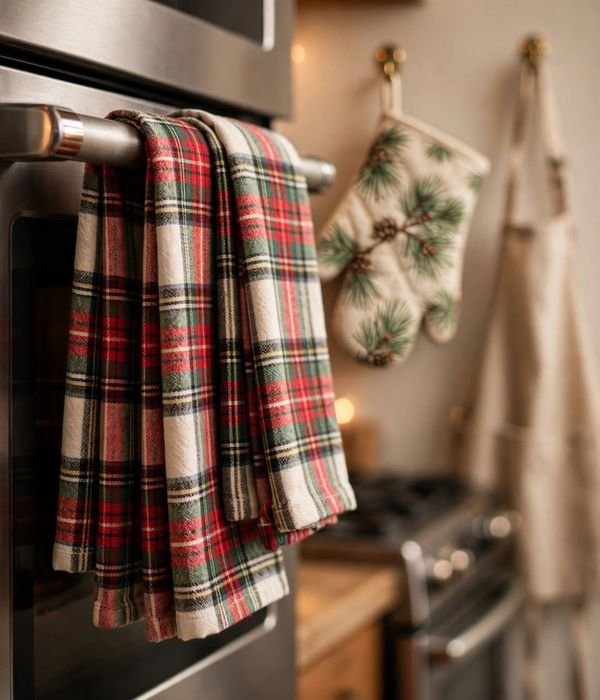
Textiles are the highest-impact, lowest-footprint Christmas decor in existence. A set of holiday dish towels on the oven handle, an oven mitt with a pine print, and a linen apron on its hook change the room’s color story for under $30 total, and every one of them is a working object that was going to be there anyway.
Buy the right sizes so they look intentional: standard dish towels are 16×28 inches. Hang two on the oven handle, folded in thirds so the pattern shows. If your oven handle is a bar (most are, 18 to 24 inches wide), two towels side by side fill it exactly.
Add one holiday oven mitt on the hook beside the stove and hang your apron on a wall hook or the pantry door at 60 inches high, where it’s visible but never in the way of a cabinet door swing.
What you can do with it:
- Choose one pattern family (ticking stripe, plaid, or botanical pine) across towels, mitt, and apron, matching sets look deliberate; mixed patterns look like a gift-shop explosion.
- Layer a flat-woven holiday runner (2×3 feet) in front of the sink, it defines the zone and hides nothing, since the floor was never counter space.
- Swap the everyday soap dispenser for a ceramic one in a holiday color, it’s a 3-inch object that punches above its weight.
- After the season, holiday textiles fold flat to almost nothing, they slot into the same drawer as your everyday linens, which is why they’re the easiest decor in this whole list to store after the season.
7. Cabinet-Face Message Board: Chalk Art on the Pantry Door
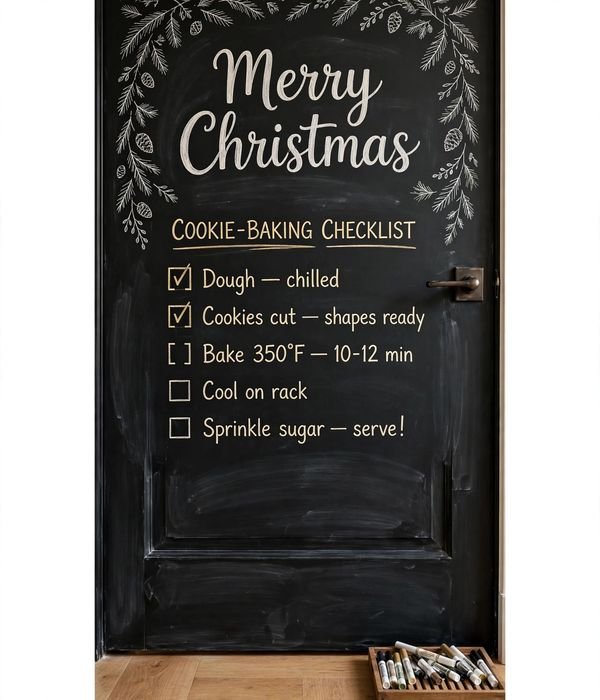
A pantry door or the flat face of a tall cabinet is a 24-by-80-inch canvas hiding in plain sight.
A sheet of chalkboard adhesive film, sold in rolls 17 inches wide by 78 inches long for $10 to $15, turns it into a changeable Christmas message board: a hand-lettered “Merry Christmas,” the week’s cookie-baking schedule, or a countdown the kids update daily.
Application is straightforward but has one critical step: clean the door with isopropyl alcohol first, and apply the film with a credit card as a squeegee, working from the center outward to push out air bubbles. Trim with a craft knife, leaving a 1/8-inch margin from the door’s edge so the film never catches and peels.
Chalk markers (not real chalk, markers give crisp lines and wipe off with a damp cloth) in white and metallic gold are all you need.
Tips for best results:
- Sketch your design on paper first at roughly the door’s proportions, lettering that’s too small is the number-one reason these look amateur.
- Use the board functionally through December: grocery lists, defrost reminders, the cookie-exchange headcount. A working board earns its wall space.
- Peel the film off in January with a hair dryer on low heat, 30 seconds of warmth softens the adhesive and it lifts clean.
Watch out:
- Test a corner of the film on an inconspicuous spot for 48 hours first, on cheap thermofoil cabinet finishes, some adhesives can lift the coating. Painted wood and laminate are almost always fine.
- Keep markers away from small kids’ reach if you’d rather the countdown stayed accurate.
8. Pendant-Light Wreath: Decorate the Air Above the Island
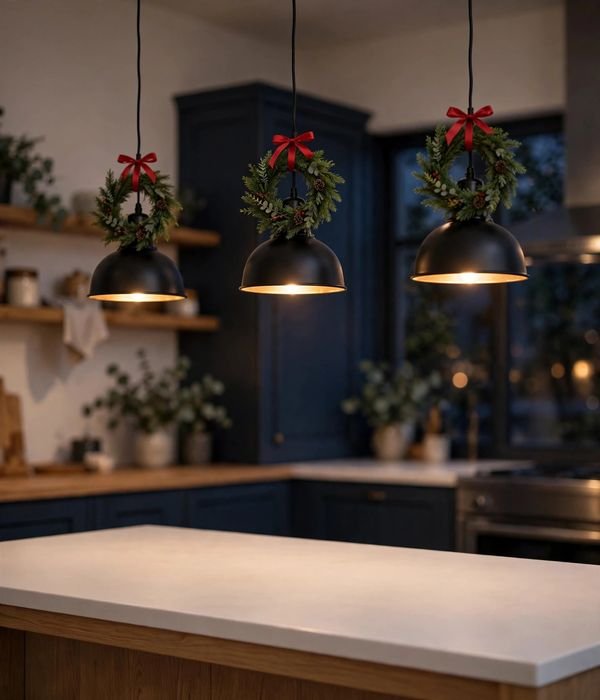
If you have pendant lights over the island or sink, you have hanging points already wired into the ceiling. A small 8- to 10-inch wreath or a dried orange-slice garland looped over each pendant cord puts Christmas at eye level in the center of the room, floating above the island, never touching it.
The method: a 12-inch loop of 1-inch ribbon tied around the pendant cord just above the shade, with the wreath hanging from the ribbon’s tail.
The wreath should hang 6 to 8 inches above the shade’s top, high enough to clear the light’s heat (LED pendants run cool; if yours are halogen, keep 12 inches of clearance), low enough to read as part of the fixture.
For orange slices: thread dried slices on jute twine, 18 to 24 inches per pendant, and drape the strand over the cord in a shallow U.
What you can do with it:
- Three matching mini wreaths over a three-pendant island is the classic, symmetry does the heavy lifting.
- Dried orange slices cost about $8 for a bag of 20 and smell faintly of citrus for the first week, the cheapest real fragrance in this list.
- Tie a small brass bell into each wreath’s bow, it catches light and gives a soft chime when the HVAC kicks on.
- After the season, the ribbon loops stay on the cords year-round, invisible, ready for next December’s wreaths, no storage needed at all.
9. Doorway Garland on a Tension Rod: Frame the Kitchen Entrance
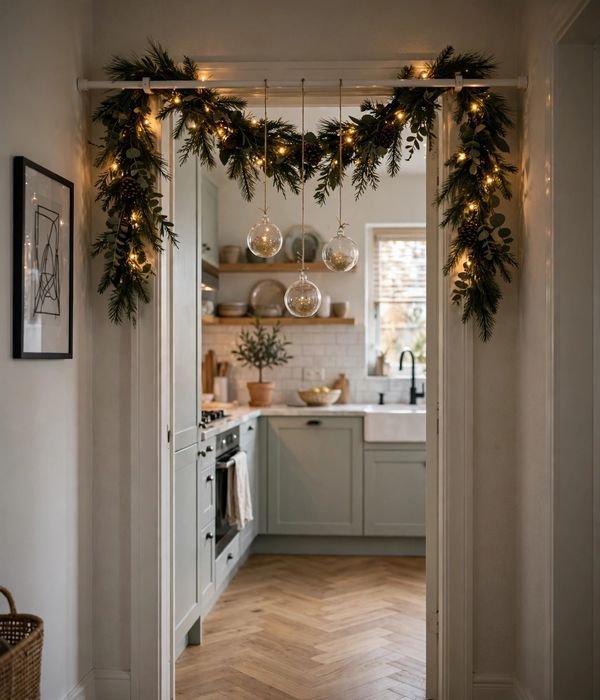
The doorway into the kitchen is a threshold every guest crosses, which makes it prime decorating territory that costs zero kitchen inches. A tension rod across the inside of the doorframe, dressed with garland, turns the entrance itself into the decor.
Measure the frame: interior doorways run 28 to 36 inches wide. A spring tension rod spanning 24 to 36 inches ($8 to $12) twists tight between the jambs, no screws, no adhesive, fully renter-friendly.
Drape 6 feet of garland over the rod so it hangs in a shallow swag, tails falling 12 to 18 inches down each side, and secure it with two discreet zip ties or floral wire so it can’t slide.
The bottom of the swag should clear 78 inches off the floor, well above head height for all but the tallest guests.
Tips for best results:
- Weave the same 20-foot battery fairy-light strand through this garland, one strand does the window swag (point 1) or this one; buy two and do both.
- Add three hanging ornaments at staggered heights from the rod’s center, glass balls in one color, hung on 4-, 6-, and 8-inch ribbons.
- This is the single best renter-friendly idea in the list: rod, garland, and lights all come down in five minutes with zero wall damage.
Watch out:
- Check the rod’s tension weekly, temperature swings can loosen the spring. A quarter-twist retightens it.
- If the doorway is your main traffic path with hands full of groceries, keep the tails pinned back with small adhesive clips so they don’t snag sleeves.
10. The December Clutter Audit: Remove More Than You Add
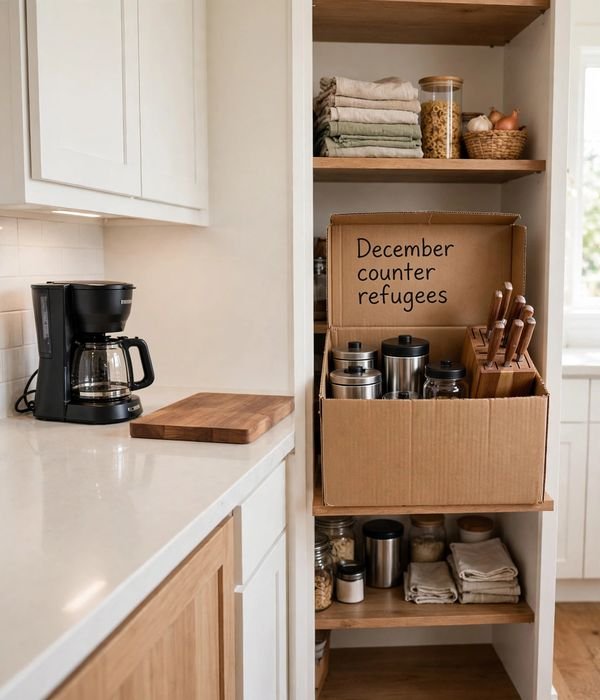
The most powerful zero-counter Christmas decor move isn’t adding anything, it’s removing the everyday clutter that competes with the season. Do a 20-minute December audit: every object on your counters has to justify its place during the heaviest cooking month of the year, or it goes into temporary storage.
The usual suspects: the decorative canister set that holds nothing (pantry shelf), the fruit bowl (pantry or dining table), the knife block (a magnetic wall strip frees a full square foot), the paper-towel holder (under-cabinet mounted holder, $12), the stand mixer you use twice a month (appliance garage or pantry floor).
A typical audit frees 30 to 40 percent of counter surface, more workspace than any single organizing product can give you.
Where it all goes matters, because January-you has to find it again. Box the displaced items together, one box, labeled “December counter refugees”, and slide it onto a pantry shelf or into the wrapping paper storage zone you’re already setting up.
When the decorations come down, the box comes back out, and the kitchen reassembles itself in one trip.
What you can do with it:
- Photograph each counter before you clear it, the photo is your reassembly map in January.
- Be ruthless with duplicates: the second cutting board, the third utensil crock. One of each survives December.
- Keep out only the daily non-negotiables: coffee maker, wall-mounted knife storage, dish soap, and one landing zone per work area.
Conclusion
If I had to crown one idea, my Zero-counter favorite, it’s the magnetic wreath on the fridge (point 3). It’s the biggest visual payoff for the smallest effort: one $15 magnetic hanger, one wreath, and the largest surface in your kitchen is suddenly Christmas. No cure times, no ladders.
But the real win of this list isn’t any single idea, it’s the principle. Once you start seeing the window trim, the cabinet faces, the 12 inches above the cabinets, and the fridge side as decorating territory, you’ll never sacrifice a landing zone to a ceramic village again. Clear counters, full Christmas.
That’s the whole game.
Frequently Asked Questions (FAQ)
How do I decorate my kitchen for Christmas without losing counter space?
Hang everything. Windows, cabinet doors, the fridge, above-cabinet gaps, pendant cords, and doorways give you roughly 40 square feet of decorating surface in an average kitchen without touching a single inch of counter. If a decor idea needs counter space, it fails this list’s one rule, find its vertical equivalent instead.
Will adhesive hooks damage my cabinets or walls?
If you follow the cure and removal rules, no. Let the strip cure 24 hours before hanging weight, stay within the rated pounds (usually 3 to 5 per hook), and remove by pulling the tab slowly along the wall, never outward. On thermofoil cabinets, test one hook in a hidden spot for 48 hours first.
What’s the best garland length for a kitchen window?
For a standard 36-inch window, 6 to 9 feet gives you a swag across the top with tails at the sides. For a 60-inch double window, go 12 feet with a center support hook.
Buy one size up rather than one down, you can always gather extra garland into a fuller swag, but a too-short garland looks stretched and sad.
Are battery fairy lights safe around kitchen heat and steam?
Yes, with placement sense. LED fairy lights run cool, the concern is never the lights, it’s the batteries corroding in steam. Keep battery packs tucked inside the garland (not dangling near the stove), and keep the whole arrangement at least 12 inches from direct burner heat.
The built-in 6-hour timer means you’re not fumbling with packs daily.
Where do I store all of this in January?
Coil garlands loosely (never fold, folded branches snap), nest wreaths in individual bags or boxes so they don’t crush each other, and keep all of it in one labeled zone with your other holiday pieces. Our decor, Christmas entryway decor guide covers the full takedown system, and holiday textiles just fold into your regular linen drawer.