
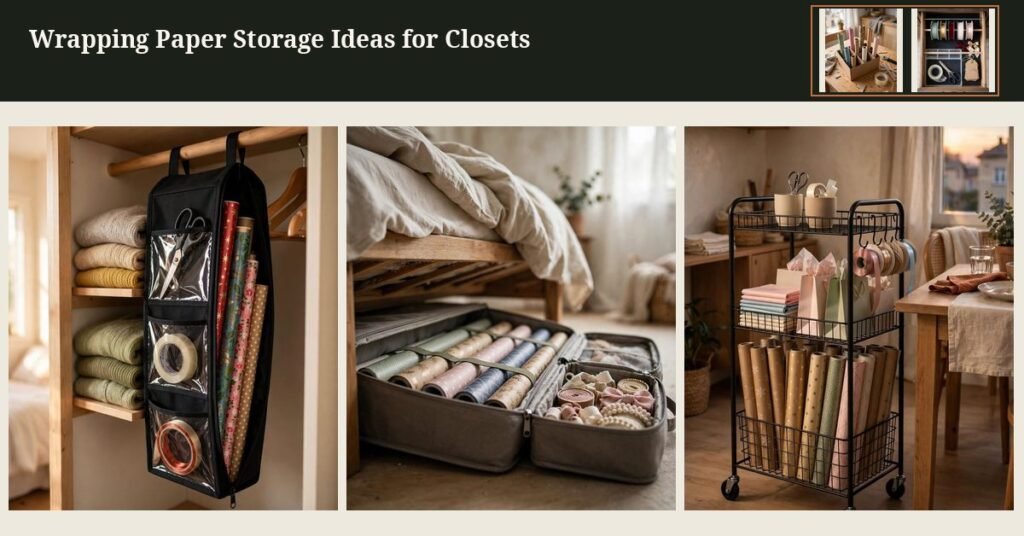
Every December the same thing happens: you reach into the closet corner for the good wrapping paper and pull out a crushed, torn roll with a dented end that makes clean cuts impossible. Those rolls survived eleven months of storage only to be ruined by the storage itself.
If that’s your current system, a pile leaning against the closet wall, slowly buckling, you’re not alone, and you’re not doing anything wrong. Rolls are simply awkward: 30 inches long, round, top-heavy, and easy to crush.
This guide gives you 10 wrapping paper storage ideas built for closets, under-bed dead space, and rolling carts, the three zones small homes actually have. Each idea includes exact dimensions so you can check your space with a tape measure before you buy or build anything, plus what it holds, what it costs, and where it fails.
No drilling required for most of them, which matters if you rent.
Why Wrapping Paper Storage Ideas Start With Your Roll Lengths
The reason wrapping paper is so hard to store is simple geometry. A standard consumer roll is about 30 inches long (the paper is typically 30 inches wide, with 10 to 30 feet wound on the tube), while warehouse-club jumbo rolls stretch to 40 inches.
That 10-inch difference is the whole game: a 36-inch organizer or bin swallows standard rolls neatly and leaves jumbo rolls sticking out the top, collecting dust and bent ends. Before you buy anything, measure your longest roll. If every roll you own is 30 inches, a shorter organizer is fine.
If even one roll hits 40 inches, size everything for 40.
The second problem is gravity. Standing a roll on end concentrates its full weight on one small cardboard rim, which is why rolls stored upright in tall bins lean, crease, and develop flat spots.
Laying rolls flat distributes the weight along the whole tube, so horizontal storage is kinder to the paper over months, another reason under-bed bins work so well. The third problem is visibility: when rolls are buried, you rebuy paper you already own.
Every method below either shows you what you have at a glance or keeps the full set in one grab-and-go unit, which is the difference between a wrapping paper storage diy project that works and one that just moves the pile.
Measure-first cheat sheet (save this before you shop):
- Standard consumer roll: ~30 inches long, 2.5–3.5 inches in diameter
- Warehouse jumbo roll: ~40 inches long, 3–4 inches in diameter
- Closet organizer that fits both: at least 40–41 inches long
- Under-bed clearance to check: 6–8 inches from floor to bed frame
- Standard interior closet rod height: about 66 inches off the floor, hanging organizers use this vertical run
- Interior door thickness: 1.75 inches, over-door hooks fit this without screws
1. Hanging Garment-Bag Wrap Organizer: the closet-rod workhorse
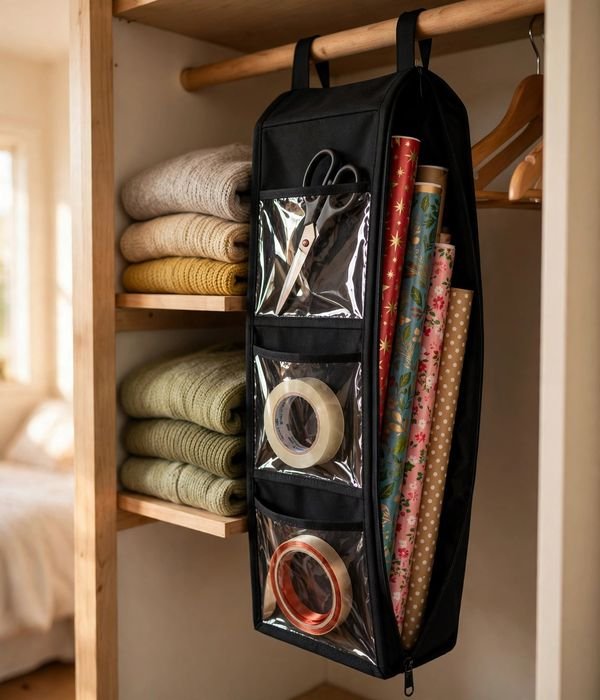
A hanging wrap organizer is essentially a garment bag rebuilt for rolls: a soft-sided bag about 40 inches long, 14 inches wide, and 6 inches deep, with a hook or loop that slides over a standard closet rod.
It turns the dead air below your hanging clothes into storage for 12 to 24 rolls, depending on thickness (standard rolls run 2.5 to 3.5 inches in diameter). Clear PVC front pockets swallow scissors, tape, tags, and ribbon spools.
The mechanism is vertical volume: reach-in closets have 40-plus inches of unused height below shirts and jackets, and a bag that hangs in that space costs you zero shelf or floor footage. It’s fully renter-safe, nothing is screwed or stuck to anything.
What you can do with it:
- Hang it on the main closet rod of a hall or bedroom closet, behind or beside hanging clothes
- Store every roll length you own: the 40–41 inch body swallows jumbo rolls whole
- Keep scissors and tape in the clear pockets so they never go missing
- Unzip one side and pull a single roll without unloading the rest
- Fold it flat when it’s empty, it collapses to about 2 inches thick
- Move the entire kit to the living room when it’s time to wrap
Look for tear-proof fabric like 600D polyester with a reinforced zipper; budget versions run under $25. Skip vinyl-only bags if the spot gets warm, vinyl can stick to metallic and foil papers in heat.
2. Over-Door Clear Organizer: turns door backs into a wrap wall
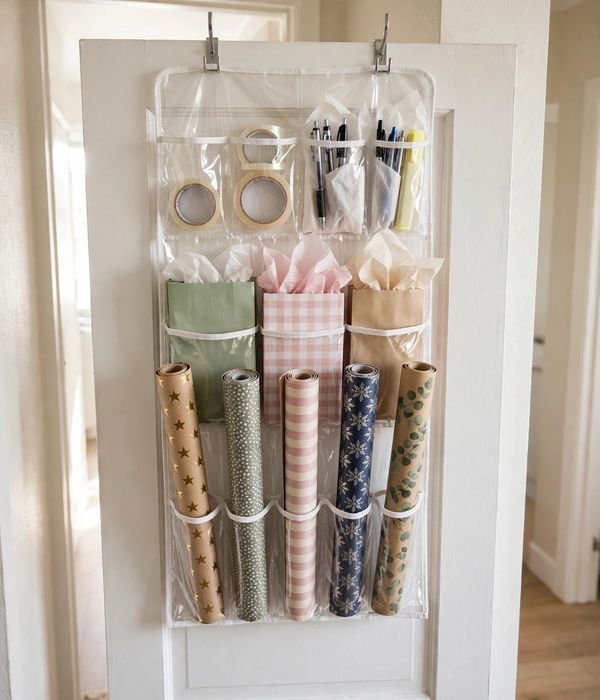
The back of a closet or bedroom door is a full sheet of unused vertical real estate, typically 24 to 36 inches wide and 78 to 80 inches tall.
An over-the-door clear organizer, usually about 16 inches wide by 41 inches long with 8 to 10 deep pockets, hangs from the door top on two metal hooks sized for standard 1.75-inch interior doors. Rolls drop into the tall bottom pockets, gift bags and tissue fill the middle, and the shallow top pockets hold tape, pens, and tags.
Door backs have zero competition for space, and the clear pockets give you the visibility bins lack, you see every pattern at a glance and stop rebuying paper you already own.
Tips for best results: Hang it on a door you don’t slam, daily-use bedroom doors can bounce rolls out of the pockets. The closet door is ideal. If the hooks leave the organizer swinging, anchor the bottom with a removable adhesive hook rated for 3–5 pounds.
Watch out: Measure the gap between the door and frame first. Over-door hooks need about 0.5 to 1 inch of clearance above the door. If your door fits tightly, the hooks will scrape or stop it closing, use an adhesive-handle version instead.
Not for rolls longer than 40 inches, and skip it if the door is flimsy hollow-core: 10 loaded pockets can weigh 8 to 12 pounds.
3. Under-Bed Wrap Organizer Bin: the 40-inch flat-lay solution
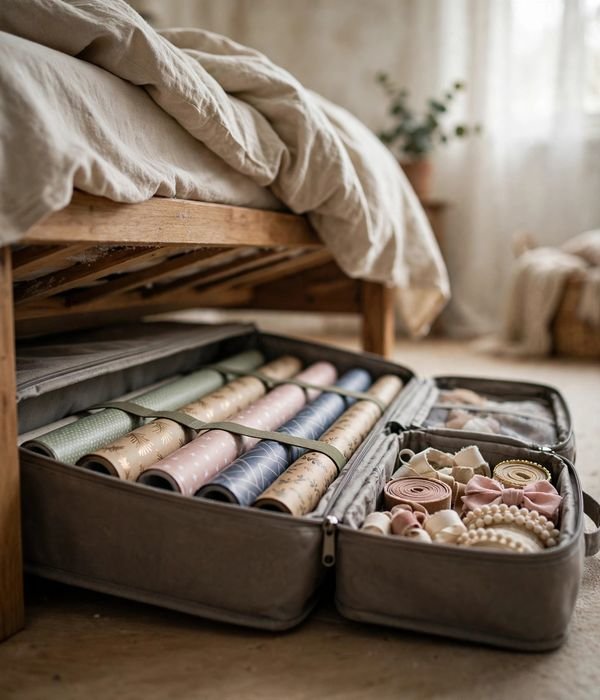
The under-bed organizer is the highest-capacity option on this list: a soft-sided box roughly 40.5 inches long, 14 inches wide, and 6 inches high, built so 40-inch jumbo rolls lie flat, end to end, with elastic straps keeping them from shifting. Depending on roll thickness, it holds 18 to 25 rolls plus a zippered accessory section.
Dual zippers open the full length so you can pull any roll without unstacking.
The mechanism is physics in your favor: lying flat spreads each roll’s weight along its whole tube instead of one rim, so paper survives the year in better shape. The under-bed zone is genuine dead space, most beds have 6 to 8 inches of clearance, and a 6-inch-high box slides in and disappears.
What you can do with it:
- Fit every roll you own, including 40-inch warehouse rolls, lying perfectly flat
- Use the elastic straps or dividers to separate Christmas, birthday, and everyday paper
- Stash the accessory pockets with everything that normally scatters: tape, scissors, tags, ribbon spools, gift bags
- Slide it out by the end handles for full access, then push it back under
- Fold it flat to drawer-size when the collection shrinks
Measure your bed clearance first: anything under 6 inches rules this out. The soft fabric versions are spot-clean only, so if the area is dusty, slide a bed skirt or a sheet of fabric underneath first. Typical price band: under $25 for 600D polyester versions.
4. Tension-Rod Closet Nook: corral rolls in the 8-inch dead gap
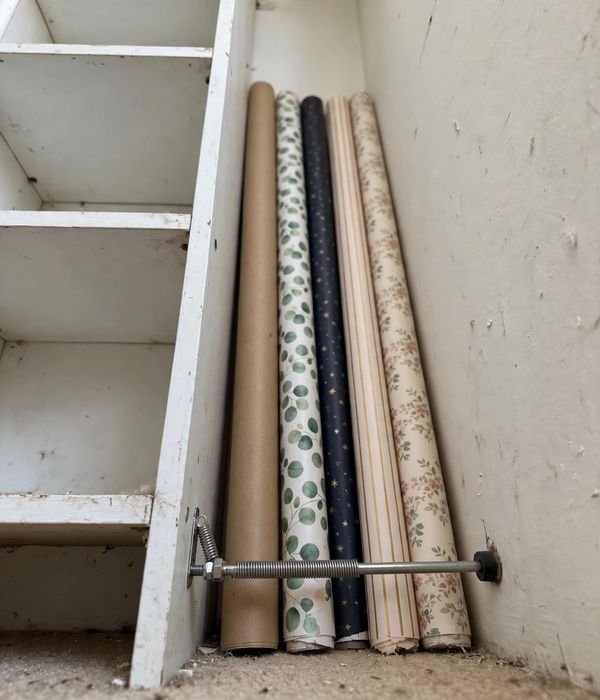
Almost every reach-in closet has a narrow dead gap, the 6 to 10 inches between the end of a shelf tower and the closet side wall, or between the wall and a dresser tucked in the closet.
A spring tension rod, adjustable from 28 to 48 inches and about 1 inch in diameter, wedges horizontally across that gap at about 12 to 18 inches off the floor, creating a corral: rolls stand upright in the gap, leaning between the rod and the wall, and can’t tip over or slide away.
This is the cheapest real solution on the list, tension rods run $3 to $15, and the most renter-friendly, since the spring holds by friction with zero holes or hardware.
Tips for best results: Twist the rod until it’s snug, then give it another quarter-turn, the rod should not rotate when you grip it. Place the rod at roughly one-third of your roll’s height for the most stable lean. For 30-inch rolls, position it 10 to 12 inches off the floor.
Watch out: Tension rods hold light loads only, they corral rolls, not hang weight. They need two solid, parallel surfaces and will slip on textured or bowed drywall. Test the grip by leaning against it before loading rolls.
Skip this for 40-inch jumbo rolls in a low closet, at that length, rolls topple over the rod instead of leaning on it.
5. Rolling Gift Wrap Station Cart: the wrap-everything-in-one-place hub
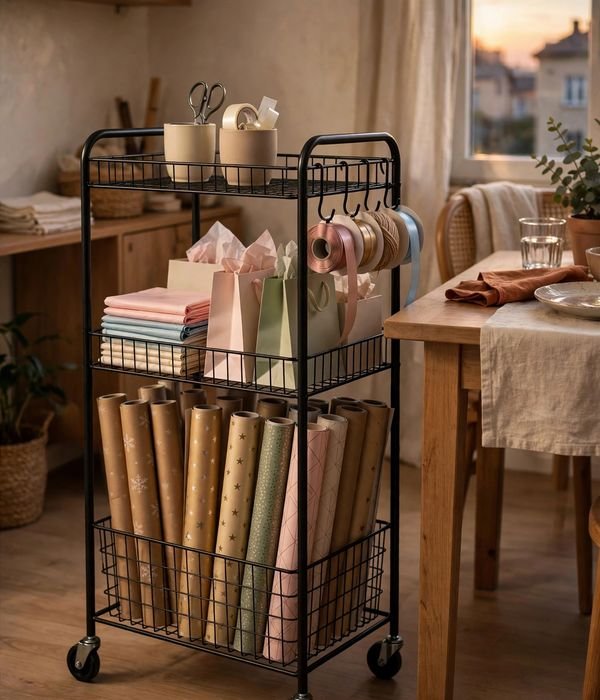
A three-tier rolling utility cart, about 14 inches wide, 18 inches deep, and 30 inches tall, becomes a complete mobile gift wrap station. Rolls stand vertically in the bottom basket, tissue and gift bags live on the middle tier, and scissors, tape, ribbon spools, and tags ride on top.
Add small cups to the top tier and adhesive hooks on the cart’s side for ribbon spools.
The mechanism is consolidation plus mobility: instead of gathering supplies from three rooms every time you wrap, you wheel one cart to the table, wrap, and wheel it back. The footprint is barely over 1.5 square feet, so it parks in a closet, beside the washer, or in a hallway gap, and the casters lock so it stays put.
What you can do with it:
- Stand 6 to 10 standard 30-inch rolls upright in the deep bottom basket
- Sort tissue by color and gift bags by size on the middle tier
- Mount scissors and tape in top-tier cups where they’re always reachable
- Wheel it to wherever you’re wrapping, then park it back in its slot
Check the bottom basket’s interior height before you buy, some carts have shallow bottom tiers that won’t take a full 30-inch roll standing up. You want at least 26 inches of clearance there. Purpose-made wrap carts cost $25 to $45; a standard utility cart plus dollar-store bins does the same job for less.
Not the pick for 40-inch jumbo rolls.
6. Wine-Rack Style Cubby: a cube per roll, nothing crushes
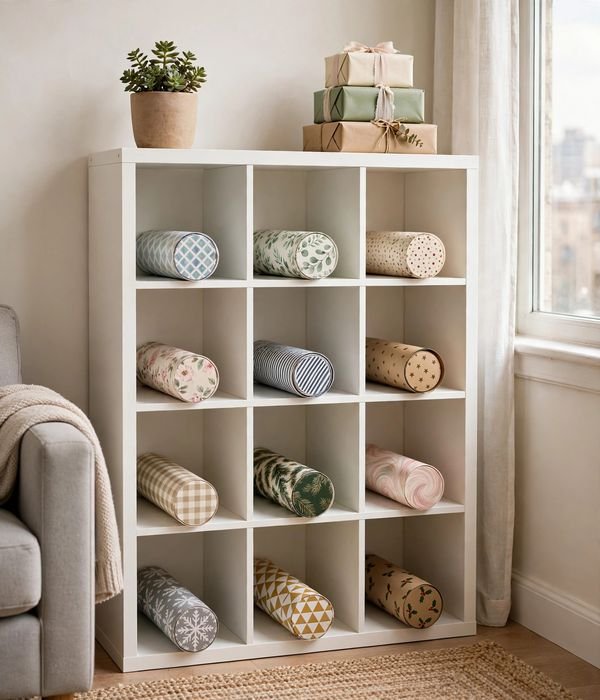
A cube storage unit with 4-inch by 4-inch openings, the classic 12-cube organizer is about 36 inches wide by 48 inches tall, gives every roll its own cell. Rolls slide in horizontally, one per cube, ends facing out, so you can read every pattern like a library.
Each 4-inch opening fits rolls up to 3.5 inches in diameter, and the rigid grid means no roll can ever lean on, crush, or crease another.
This is the best method for big pattern collections, 12 to 16 dedicated cells stop the “mystery roll” problem completely. It also doubles as a room divider or entryway unit in a small apartment, earning its floor space twice over.
Tips for best results: Slide rolls in end-first with the loose end tucked under a rubber band, loose ends catch on cube edges and tear. Label the top edge of each cube with the occasion (Christmas, birthday, wedding) using removable labels. If the unit wobbles once loaded, anchor it to the wall with the included anti-tip hardware.
Watch out: A 12-cube unit weighs 30 to 50 pounds empty and needs about 3 square feet of floor, not the pick for the tiniest closets. It fits standard 30-inch rolls; 40-inch jumbo rolls stick out of the standard 12-inch-deep cubes, so use method 3 instead. Assemble where it will live, loaded cube units are miserable to move.
7. Tall Slim Bin Roll Holder: the closet-corner crock
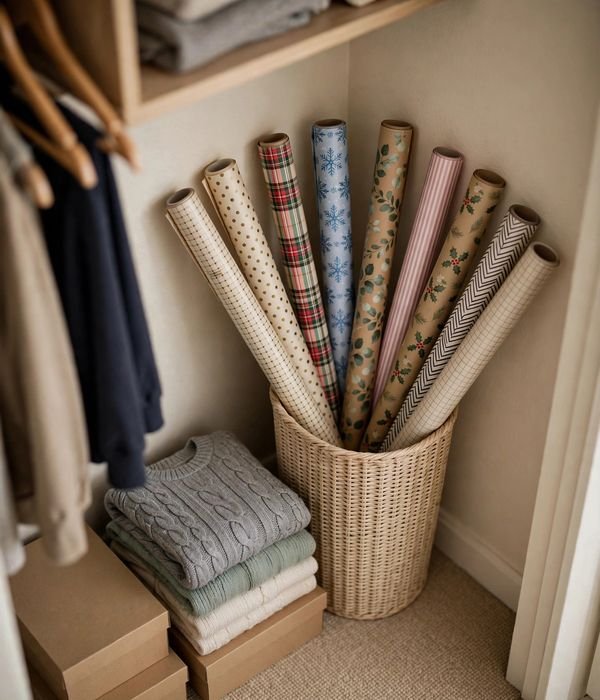
Sometimes the simplest method is a tall, narrow bin used like an umbrella stand: a slim trash can or laundry hamper about 13 to 15 inches wide and 26 to 28 inches tall holds 8 to 12 rolls standing upright in a closet corner, using about 1 square foot.
Rolls fan out at the top so every pattern is visible and grabbable, and the whole unit weighs almost nothing, so you can lift it to reach what’s behind.
The mechanism is containment without compression: the bin’s walls keep rolls from tipping and spreading, but nothing squeezes them, so ends stay crisp. A hard plastic bin also protects against closet-corner hazards, vacuum cleaner bumps and rolls migrating across the floor.
What you can do with it:
- Drop 8 to 12 standard 30-inch rolls into a 13-inch bin, the tops fan out for easy selection
- Use a bin with a flat, weighted base so a half-full load can’t tip
- Line a mesh or open bin with a fabric sleeve if dust is a problem
- Repurpose any tall hamper or umbrella stand you own for zero cost
A 26-inch-tall bin leaves the top few inches of 30-inch rolls exposed, fine in a closet, dusty in a garage. If your rolls are 40-inch jumbos, they’ll stick out 12-plus inches: workable in a deep closet corner, awkward anywhere visible. Skip open bins in damp basements or garages; paper wicks moisture and the bin won’t stop it.
8. DIY Cardboard-Box Dividers: the free wardrobe-box method
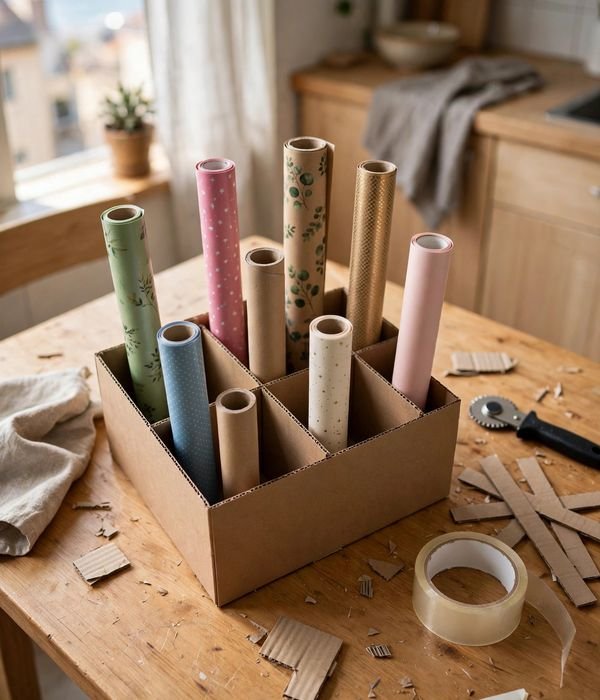
Before you buy anything, check what a wardrobe moving box can do. A standard wardrobe box, about 24 inches square and 40 inches tall, is already the right shape for 40-inch jumbo rolls standing upright, costs under $10 at any moving-supply store (or free if you’ve moved recently).
Cut it down to about 32 inches for standard 30-inch rolls, then make dividers from a second flattened box: cut cardboard strips 6 inches wide and as long as the box is deep, slot them into a grid, and drop it inside. Each cell holds 2 to 3 rolls, separated so they can’t lean on each other.
This is the purest wrapping paper storage diy on the list: about 20 minutes with a box cutter and packing tape, it fits any roll length because you size the box, and it costs nearly nothing. Wrap the outside in leftover paper and it stops looking like a moving box.
Tips for best results: Reinforce the box bottom with a second layer of cardboard taped in an X pattern, 10 loaded rolls weigh 8 to 15 pounds. Cut handholds near the top for lifting.
Watch out: Cardboard and moisture are enemies, dry closets only, never a garage, basement, or attic, where humidity softens the box and the paper inside. Replace the box every 2 to 3 years; the dividers fatigue first. If anyone has dust allergies, open cardboard sheds fibers, line it with a fabric bag or switch to method 3.
9. Trouser-Hanger Clips: hang partial rolls from the closet rod

Partial rolls, the ones with 5 feet left that are too short to stand and too good to throw away, are the orphans of every wrap collection. Trouser hangers with clamp clips solve them: the felt- or rubber-lined clips grip the cardboard tube end firmly without crushing it, and the hanger hook goes straight onto the closet rod.
Three or four hangers hold short rolls in a row, fully visible, in about 12 inches of rod space.
The mechanism is using the closet’s strongest existing structure, the rod, to suspend light items in otherwise empty air. Each hanging roll weighs under a pound, and the clips’ rubber lining keeps the tube from slipping or tearing.
What you can do with it:
- Rescue short rolls that can’t stand on their own and would otherwise get tossed
- Group clips by occasion: all birthday remnants on one section of rod
- Pair each hanging roll with its matching ribbon by draping the spool over the same hanger
- Use skirt hangers with two clips for wider stability on heavier foil rolls
Clip the cardboard tube, never the paper, clamping paper creases it permanently. This suits light use only; don’t hang more than about 2 pounds per hanger or the clips bend. It’s a complement to a main organizer, not a replacement: with more than 6 to 8 rolls, combine it with method 1 or 3 and reserve hangers for remnants.
10. Accessory Drawer Station: give the small stuff a divided home
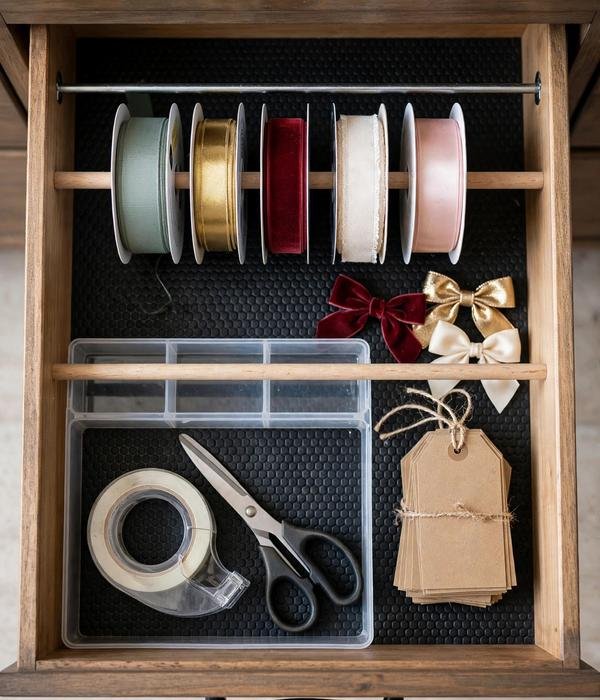
Rolls get all the attention, but the tape, ribbon spools, gift tags, bows, scissors, and tissue are what actually scatter. Dedicate one deep dresser or desk drawer, at least 6 inches deep and 24 inches wide, to wrap accessories, divided with spring tension rods or a cut-to-fit organizer so every category has a lane.
Ribbon spools thread onto a wooden dowel laid across the drawer; tape and scissors get a front compartment; tags and bows sort into the back.
The mechanism is category containment: small items disappear in big bins and jam in shallow ones, but a divided 6-inch-deep drawer keeps everything visible in a single layer. Placed near your rolls, it completes the system: rolls in the organizer, everything else in the drawer.
Tips for best results: Line the drawer with non-slip shelf liner so compartments stay put when you open and close it. Thread ribbon spools onto the dowel in rainbow order, you’ll actually use them. Keep one pair of scissors in the drawer permanently; “borrowing” them for the kitchen is how the system dies.
Watch out: Measure drawer depth first, a standard 4-inch dresser drawer is too shallow for ribbon spools standing upright; you need 6 inches minimum. If the drawer sticks when loaded, the slides are underrated for the weight, move heavy items like tape multipacks to a shelf.
This drawer pairs with any roll method above; on its own it solves only half the problem.
Conclusion
Crushed rolls aren’t a wrapping problem, they’re a storage problem, and every method above fixes it with a tape measure and one decision about where the rolls live. If your rolls are all standard 30-inch, you have the most options; if jumbos are in the mix, size for 40 inches and half the list still works.
Start here: the 40-inch under-bed wrap organizer. It fits every roll length including jumbos, holds 18 to 25 rolls plus every accessory in one zippered unit, costs under $25, needs zero installation, and uses dead space your home already has. Nothing else on this list covers more of the problem for less money and effort.
Buy the 40-inch length even if your current rolls are all 30, the next warehouse-club roll you bring home will thank you.
Once the rolls have a home, add the accessory drawer (method 10) so the small stuff stops scattering, and clip your short remnants on trouser hangers (method 9) instead of throwing them out.
When you’re ready to think bigger about where all of this lives after the holidays, see how to store seasonal decor in a small home for the full small-home system, plus small Christmas tree ideas for tight spaces and gift and wrapping organization ideas for the holiday-specific pieces, and the existing Christmas decor ideas hub for the decorating side.
Frequently Asked Questions (FAQ)
What are the best wrapping paper storage ideas for a small apartment?
If you have no spare closet, the 40-inch under-bed organizer wins: it holds 18 to 25 rolls in 6 inches of dead space under the bed. If your bed sits too low for that, use the over-door organizer on the closet door, it needs zero floor space.
Renters should avoid anything that screws into walls and stick to tension rods, over-door hooks, and freestanding bins.
How do you store 40-inch jumbo wrapping paper rolls?
Size everything for 40 inches: a 40- to 41-inch hanging garment-bag organizer, a 40.5-inch under-bed bin, or a 40-inch-tall wardrobe box with DIY dividers. Standard 36-inch organizers and rolling carts won’t take jumbo rolls standing up. If you only have one or two jumbos, the tall slim bin in a closet corner handles them fine even with the tops exposed.
Can I store wrapping paper in the garage or attic?
Only if the space is dry and temperature-stable. Paper wicks moisture, so a damp garage softens rolls and a hot attic can fuse metallic and foil papers to each other or to vinyl organizers. If you must use these spaces, choose a sealed hard-plastic bin with a gasket lid and add silica gel packets.
For most homes, a closet, under-bed spot, or interior room wins on paper condition alone.
How do I keep rolls from unrolling in storage?
A wide rubber band or a purpose-made paper band around each roll works, but put the band around the cardboard tube end, not the middle of the paper, tight bands crease paper over months. The cleanest fix is storage that holds rolls snugly (elastic straps in an organizer bag, individual cubby cells) so they physically can’t unroll.
Avoid tape on the paper itself; it tears the design when removed.
What’s the best wrapping paper storage if I can’t drill or damage walls?
Tension rods, over-door organizers, and freestanding bins are the full renter-safe toolkit: none of them touch your walls permanently. The tension-rod closet nook corrals rolls in a dead gap, the over-door organizer uses the door you already have, and the under-bed bin or tall slim bin needs nothing but floor or bed clearance.
If you use adhesive hooks, choose removable strips and clean the surface with rubbing alcohol first for a hold that releases cleanly.