
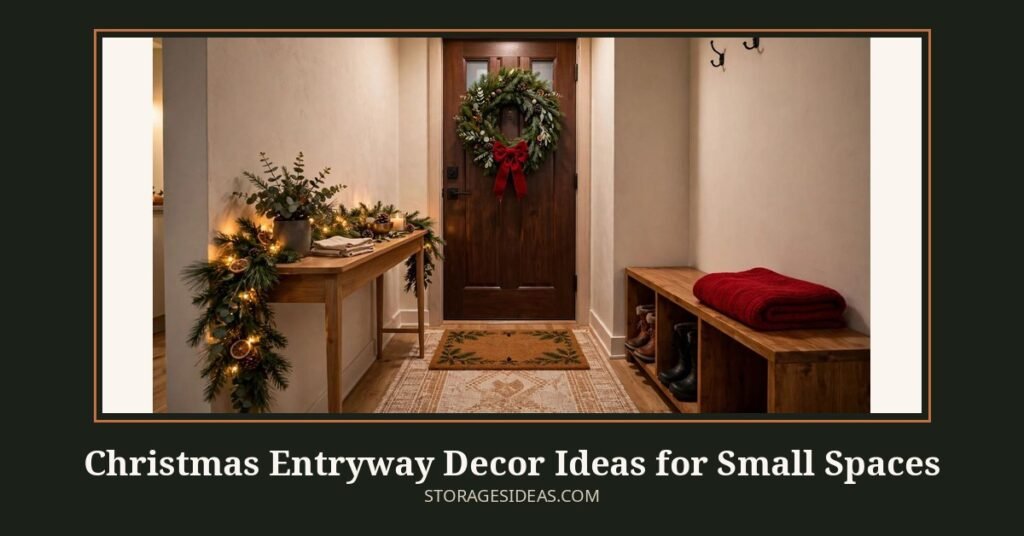
Before you buy a single sprig of garland, get out the tape measure. Most apartment entries are a landing of about 4 by 5 feet, 20 square feet, and your front door’s swing eats roughly 10 of those. The christmas entryway decor ideas below are built for exactly that footprint.
The rule that makes Christmas decor work in a small entryway: keep at least 36 inches of clear walking path from the door to the first hallway or room. That’s the standard minimum passage width, and it’s the difference between a festive welcome and an obstacle course with your coat.
The good news: a small entryway doesn’t need less Christmas, it needs smarter Christmas. These 10 christmas entryway decor ideas pass two tests, they fit a sub-20-square-foot entry without stealing the walkway, and they store flat or tiny in January. Everything is renter-safe, with exact measurements and what-to-buy specs you can take straight to the store.
Why Small Entryways Need a Different Christmas Playbook
An entryway has the hardest job of any room in December: it’s the first thing guests see and the drop zone for every coat, bag, and shoe, often in 15 to 20 square feet.
The classic Christmas entryway advice (full garland staircase, 7-foot tree in the corner, deep bench piled with pillows) was written for foyers with square footage to burn. Shrink it without rethinking it and you get blocked doors and decor that must be moved every time someone walks in.
The fix is to think in layers instead of objects. Decor should live on surfaces that already exist, walls, the door itself, furniture tops you already own, and light should do the heavy lifting that bulky objects do in big houses.
A 16-foot strand of battery fairy lights makes a 20-square-foot entry feel like Christmas for under $10 and stores in a sandwich bag. A 24-inch wreath fills a standard 36-inch door completely. No tree required.
Measure first, always: door width (most are 32 to 36 inches), the swing arc, and the 36-inch path. Then choose decor for the leftover space, not the fantasy space. Every idea below lists its footprint and exactly how it packs away in January, so nothing here becomes a storage problem you’ll regret in the new year.
1. A Slim Console That Holds Christmas, and Your Keys All Year
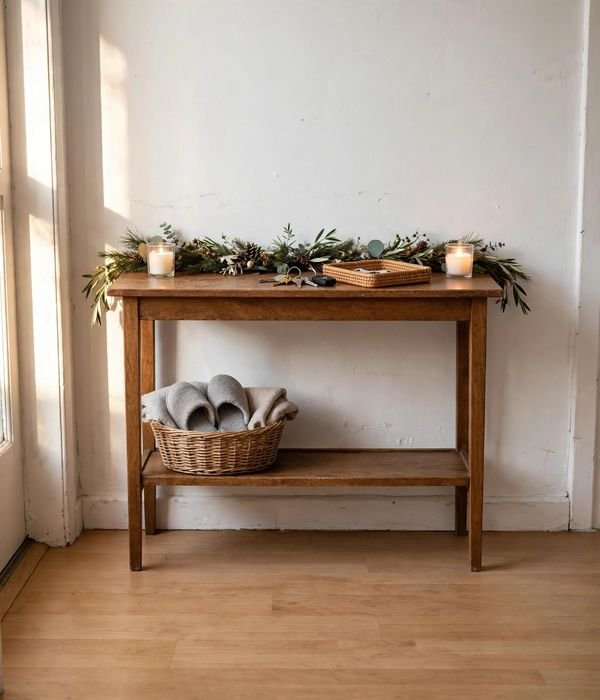
The best Christmas investment for a small entryway isn’t decor, it’s a console table shallow enough to live there permanently. A console 10 to 12 inches deep and 40 to 48 inches long adds a full display surface while barely denting your 36-inch clear path: in a 5-foot-wide entry, a 12-inch console still leaves 48 inches of walkway.
It converts dead wall space into a landing strip, and in December that landing strip becomes your Christmas vignette. In January the garland comes off and it’s your key tray again.
Shop for a freestanding console, 30 to 33 inches tall, with at least one lower shelf; solid wood or metal frames handle daily abuse, and freestanding means zero wall damage. Typical price band: $60–$120 for wood, under $40 for a metal-and-wood folding style.
What you can do with it:
- Holiday vignette up top: a small garland runner, two LED pillar candles, and a key tray, Christmas in 48 inches.
- Key and mail landing: a shallow tray keeps the surface from creeping into the walkway.
- Glove and scarf basket: one low basket (about 12 × 10 inches) on the lower shelf.
- Shoe overflow: a pair of boots fits under most consoles with 10+ inches of leg clearance.
- The mini tree’s home: an 18–24-inch tabletop tree lives here and costs zero floor space (see idea #8).
2. Hang Garland on the Wall With Adhesive Hooks, No Holes, No Damage
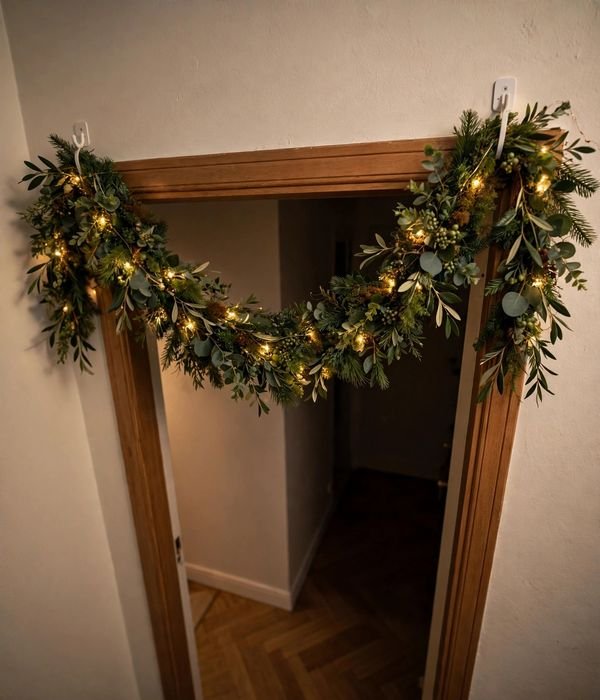
If your entry has no spare floor and no spare furniture top, it still has walls, and a 6 to 9-foot garland swagged along a door frame or mirror turns bare wall into the Christmas focal point, then removes cleanly in January.
Clean the spot with rubbing alcohol (not household cleaners, which leave residue) and let it dry. Press the hook base firmly for 30 seconds, then wait a full hour before hanging anything, that cure time is what gets you the rated hold.
Ratings run 3 lb (medium) to 5–7.5 lb (large) per hook; a 6-foot plain garland weighs 1–2 lb, a lit one 3–4 lb, so size up and use one hook every 18 to 24 inches. Removal: slide the hook off, then stretch the strip straight down along the wall at least 12 inches, never pull it toward you.
Tips for best results: map the swag with painter’s tape first so hooks land symmetrically. Buy extra adhesive refill strips, cheaper than extra hooks, and you’ll reuse the hooks for wreaths and next year’s garland.
Watch out: skip adhesive hooks on wallpaper, textured or brick walls, and paint less than 7 days old. Keep them indoors (rated 50–105°F) and never exceed the weight rating, a falling garland is annoying, a falling framed mirror is a disaster.
January storage: coil the garland into a 24-inch wreath box or zip bag and stash the hooks with fresh strips in a drawer, about half a cubic foot total.
3. Choose the Right-Size Wreath, 24 Inches for a Standard Door
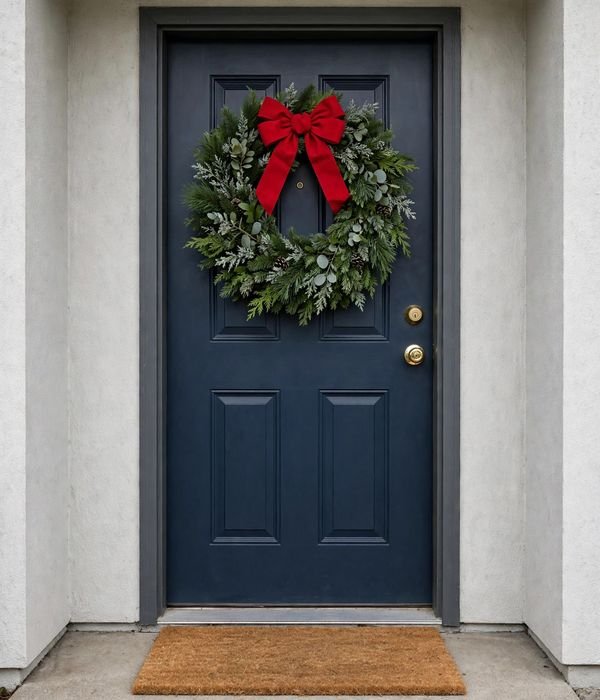
A wreath is the highest-impact, lowest-footprint Christmas decor that exists: zero floor space, zero surface space, and it reads as Christmas from the street. But size is everything. The florist’s rule: leave about 6 inches of bare door on each side, which means a 24-inch wreath for a standard 36-inch door.
On a 40-inch-plus door, step up to 30 inches. Measure your door width before shopping, the wrong size wreath ruins the proportion either way.
Weight is the spec most people miss: a full 24-inch artificial wreath weighs 3 to 5 pounds (real evergreen can push 6–8 lb fresh). Hang it on an over-the-door hanger or a large adhesive hook rated 5 lb-plus, installed with the 1-hour cure from idea #2.
Where it works best:
- Front door: 24-inch wreath + an 18×30-inch doormat (idea #7) = a complete Christmas entry in two objects.
- Entry mirror: a 16–18-inch wreath on a small adhesive hook doubles the greenery in the reflection.
- Above the console: lean a 20-inch wreath against the wall on the console top for a layered look.
- Double duty: pick a neutral evergreen base and swap the bow, red for Christmas, burlap for the rest of winter.
January storage is the wreath’s secret superpower: a 24–30-inch storage box or zip bag (about 5 inches deep) slides flat onto a closet shelf, roughly 2.5 cubic feet, and it protects the shape for next December.

4. Battery Fairy Lights on a Timer, Christmas Glow, Zero Cords
Here is my renter-safe favorite: battery-operated fairy lights. Light is what makes a small entry feel like Christmas, and these deliver it with no outlet and no cords across the walkway.
Drape a 16-foot strand along the garland, around the mirror frame, or inside a glass vase on the console, in a 20-square-foot entry, 50 LEDs genuinely carry the whole room after dark.
Buy the right specs: 50-LED strands about 16 feet long on 3 AA batteries, with a built-in timer, 6 hours on, 18 hours off, repeating daily. Flip to TIMER at 6 p.m. and the lights run until midnight, then return at 6 p.m. tomorrow untouched. Warm white reads coziest; copper-wire strands bend around anything.
Price band: $6–$12 per strand, often in 2-packs. LEDs stay cool to the touch, safe around garland, fabric, and kids.
Tips for best results: keep a spare set of AAs with your decor box, one set lasts roughly 2–3 weeks of nightly timer use. Coil each strand around cardboard before storing so it doesn’t knot by next December.
Watch out: the LED wire is usually water-resistant, but the battery case is not waterproof, keep it indoors and dry. These are ambiance, not task lighting.
January storage: the coiled strand plus battery case (batteries removed to prevent leakage) fits in a sandwich-size zip bag.
5. The Mirror-and-Garland Trick That Doubles Your Light
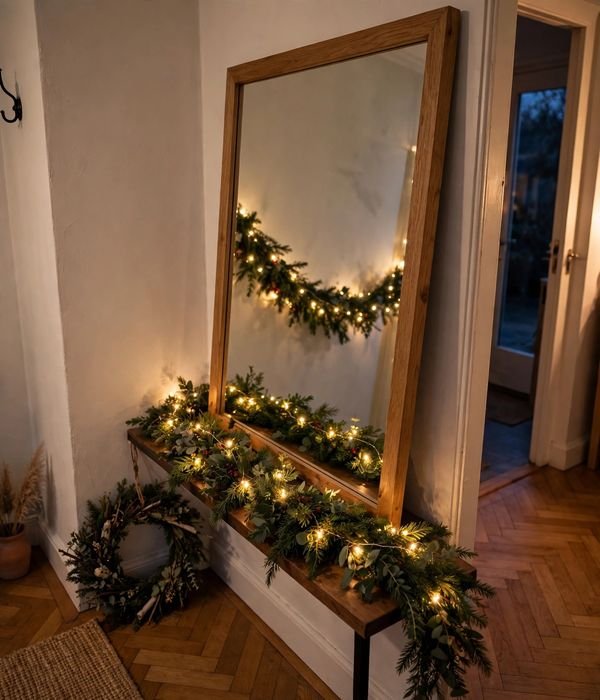
A mirror is the oldest small-space cheat in the book, and at Christmas it works overtime: drape garland and fairy lights where the mirror can see them, and the reflection doubles the perceived light and greenery without one extra object. In a sub-20-square-foot entry, that perceived doubling matters, the space reads bigger and more decorated simultaneously.
Specs: a 20×30 to 24×36-inch mirror is the sweet spot, big enough to catch the garland’s reflection, slim enough to lean behind the console or hang with damage-free strips. For hanging, adhesive picture-strip sets hold up to 16 lb per 4-pair large set (same 1-hour cure).
Leaning is simpler: set it on the console, tilt 5 degrees against the wall, anchor the base with a pea of museum putty.
Where it works best:
- Across from the fairy lights: the reflection turns 50 LEDs into 100, the whole trick in one placement.
- Behind the console vignette: garland reflects into depth, looking twice as lush.
- Opposite the front door: guests see Christmas reflected the second they step in.
- Narrowest entries: a mirror on the long wall makes a 36-inch path feel like 6 feet.
January storage: nothing to store, the mirror is permanent entry decor. Only the garland and lights come down.
6. A Storage Bench That Hides the Shoe Pile
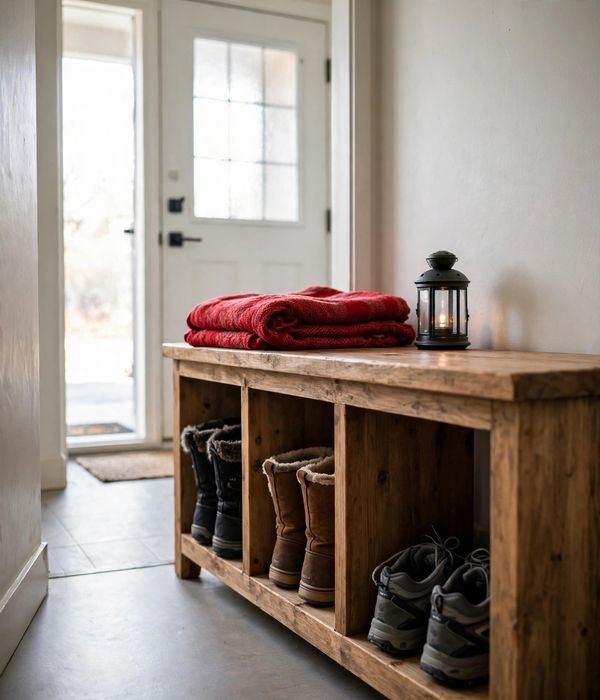
December multiplies shoes, yours, your partner’s, every guest’s, and in a small entry a shoe pile reads as chaos no matter how pretty the garland is. A storage bench consolidates 4 to 6 pairs into cubbies or baskets, clears the floor, and adds seating for the boot-on, boot-off dance. The bench top becomes one more Christmas display surface.
Measure before you buy: 36 to 42 inches long, 14 to 16 inches deep, 17 to 19 inches high (standard seat height). Cubby benches with 3–4 openings fit shoes directly; flat-top benches need 2 to 3 low baskets, roughly 12 × 12 × 10 inches, underneath. Price band: $50–$100 for a wood cubby bench, under $40 for fabric cubes.
Place it against the wall opposite the door swing and re-check your 36-inch path with the bench in place.
Tips for best results: assign one cubby per household member and leave one empty for guests, the empty one keeps visitor shoes off the floor. Top it with a folded holiday throw and one LED candle for the Christmas layer.
Watch out: a bench deeper than 16 inches in a 4-foot-wide entry eats the walkway, if the tape measure says no, use a wall hook rail for coats plus one low basket for shoes instead. Check weight ratings if kids climb on it; most wood benches support 200+ lb, cheap fabric cubes don’t.
January storage: zero, it’s year-round furniture. Swap the holiday throw for an everyday one.
7. The Layered Doormat Formula, 18×30 Plus a Flatweave Runner
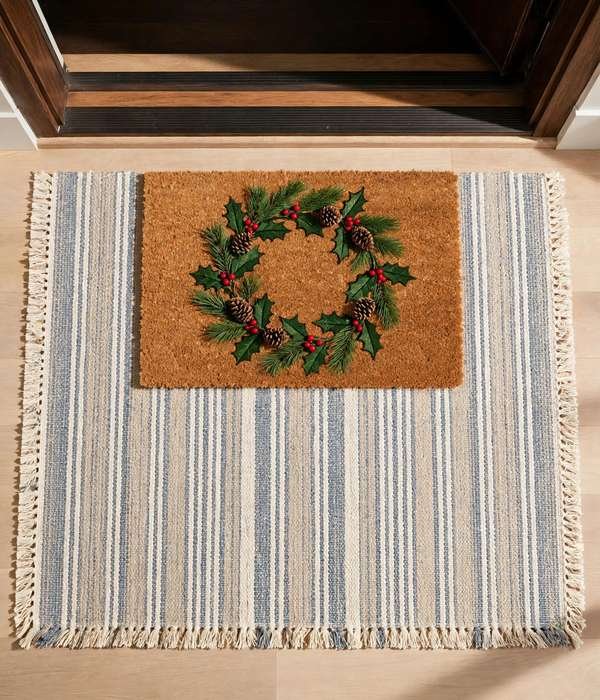
Layering turns the doormat into decor: a rugged 18×30-inch coir mat (the standard size, covering at least 80% of a 36-inch door’s width) over a slightly larger flatweave cotton or jute rug, about 20×34 to 24×36 inches. The bottom layer peeks out like a frame; the top carries the message.
In December the top mat becomes the holiday one while the base stays neutral all year.
The mechanism is function-first: coir scrapes grit off shoes before it reaches your floors, which matters more in a small entry where dirt has nowhere else to go.
Specs that matter: coir around ½ to ¾ inch thick (thicker mats can catch a low door swing, test it) and a non-slip pad or rubber backing under the flatweave so the stack doesn’t skate. Price band: $15–$25 for coir, $20–$35 for the flatweave, you only rebuy the top layer for a new look.
What you can do with it:
- Holiday swap: one Christmas top mat, one everyday mat, the swap takes 30 seconds on December 1st.
- Grit control: coir scrapes, flatweave catches what shakes loose, cleaner floors all winter.
- Visual widening: a 24×36 bottom layer makes a narrow entry feel wider on first step.
- Apartment-friendly: the whole thing lifts in one roll, no adhesive, no hardware.
January storage: roll the holiday mat tight, a 30-inch roll about 3 inches in diameter, and stand it in a closet corner. Total seasonal storage: a closet corner.

8. A Mini Tree That Earns Its Footprint
You don’t need a 7-foot tree, and in a sub-20-square-foot entry, a full-size tree’s 3-foot-diameter footprint would eat the entire walkway. The small-space answer is a tabletop tree 18 to 24 inches tall on the console or bench: zero floor space, reads as a real tree from the doorway, 15 minutes to decorate.
Pick your format: the 18–24-inch tabletop tree on the console is the default, pre-lit versions with 30–50 micro-LEDs skip the cord problem. A 2–3-foot slim pencil tree (16–22-inch base) works if you have a true corner free; a pre-lit pop-up tree deploys in under a minute.
Keep ornaments small and light, shatterproof mini balls, 1–2 inches, and finish with the battery fairy lights from idea #4. Price band: $20–$50 for a good pre-lit tabletop tree.
Tips for best results: set the tree in a basket or ceramic pot instead of the plastic stand, it looks intentional and hides the base. Elevate a short tree on books to bring it to eye level from the door.
Watch out: keep 24 inches of clearance around it so branches don’t snag passing coats, and 3+ feet from heat sources or candles. In an entry under 20 square feet, console-top is the only placement I’d trust, floor corners belong to the walkway.
January storage: an 18–24-inch tree nests into roughly 1.5–2 cubic feet, its original box on a closet top shelf, or a 30-gallon tote shared with the garland and wreath.

9. Simmer-Pot Scent, Christmas Smell With Zero Clutter
Nothing says Christmas faster than scent, and scent takes up zero square feet. A stovetop simmer pot, orange slices, a handful of cranberries, 2–3 cinnamon sticks, a few cloves, rosemary in a pot of water, perfumes the whole apartment within 20 minutes for under $5.
Guests walk in, smell Christmas, see the wreath and lights, and the entry feels fully decorated with barely any objects in it.
The method: fill a small saucepan three-quarters with water, add ingredients, bring to a bare simmer on low heat for 2–3 hours, topping up water every 45–60 minutes. The same mix gets 2–3 simmers before it’s spent, dry it between uses, store in a zip bag in the pantry.
Versus the alternatives: plug-in diffusers need an outlet near the entry, reed diffusers are year-round console clutter, and real candles are an open flame in a 20-square-foot traffic zone.
What you can do with it:
- Party trick: start the pot 30 minutes before guests arrive.
- Gift angle: bag the dry mix with a handwritten tag, a neighbor gift that pairs with our gift guides.
- Stovetop-free option: an electric wax warmer works if you’d rather not watch the stove.
- Zero entry footprint: everything lives in the kitchen; the entry just enjoys the result.
Watch out: never leave a simmering pot unattended, set a phone timer for each water check. If you won’t be home to babysit it, the electric warmer is the safer pick.
January storage: nothing, consumable ingredients and kitchenware you already own.
10. What to Skip in an Entry Under 20 Square Feet
The most useful Christmas decor advice for a tiny entry is what not to buy. The math: a 4×5-foot entry is 20 square feet and the door swing claims roughly half, leaving a strip about 2 feet wide for everything else. These don’t make the cut.
Skip the full-size floor tree. A 7-foot tree needs a 3-foot footprint, the whole room. The 18–24-inch tabletop tree (idea #8) gives 90% of the feeling for 0% of the floor.
Skip deep furniture. A 16-inch-deep chair or chunky ottoman eats the walkway. Over 12 inches deep doesn’t belong in the entry.
Skip floor lanterns and oversized planters. Shin-level obstacles in a 36-inch path, and tipping hazards when guests arrive with bags.
Skip the 30-inch wreath on a narrow door. On a 30-inch apartment door it covers the peephole and looks crammed. Size the wreath to the door (idea #3).
Skip sliding layered rugs. Two overlapping rugs with no pad in a high-traffic 20-square-foot zone will bunch and trip someone. One anchored doormat stack (idea #7) is the limit.
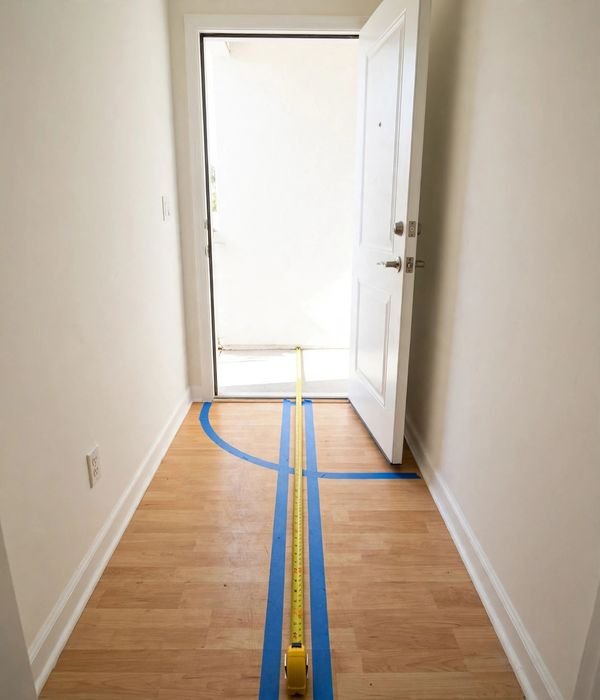
Tips for best results: lay painter’s tape on the floor marking the 36-inch path and door swing, then “shop” your entry with tape outlines of each candidate piece. If the tape version blocks the path, the real one will too, this 10-minute test saves more money than any sale.
Watch out: the one-in, one-out December rule, for every holiday object that enters, one everyday object leaves for the month. Small entries work on rotation, not addition.
Conclusion
A small entryway doesn’t need a smaller Christmas, it needs a measured one. Tape out your 36-inch path, size every piece to the space that’s left, and let walls, doors, and light do the work floor space does in bigger homes.
Every idea here passes the January test: garland coils into a box, the wreath slides flat onto a closet shelf, lights fit in a sandwich bag, and the furniture underneath was earning its place all year.
Renter-safe favorite: if you do one thing, make it the battery fairy lights on the 6-hour timer (idea #4). Under $10, zero tools, zero wall damage, zero storage footprint, and in a 20-square-foot entry after dark, 50 warm LEDs do more “Christmas” than any object you could buy.
Add the adhesive-hook garland (idea #2) and you’ve decorated the whole entry for under $30 without drilling a single hole.
Which are you trying first, and how small is your entry, really? Tape-measure it this weekend and tell me in the comments whether the 36-inch rule changed your plan.
Frequently Asked Questions (FAQ)
How should I plan christmas entryway decor so it doesn’t block the door?
Measure first: door width (usually 32–36 inches), the door’s swing arc, and mark a 36-inch clear walking path from the door to the next room with painter’s tape. Choose decor that fits the leftover space, walls, the door itself, furniture tops, and test each piece against the tape outline before buying.
If the tape version blocks the path, the real one will too.
How do I hang Christmas garland without damaging the walls?
Use adhesive utility hooks: clean the spot with rubbing alcohol, press the base 30 seconds, and wait 1 hour before hanging. Medium hooks hold 3 lb, large hold 5–7.5 lb, one hook every 18–24 inches of garland. In January, slide the hook off and stretch the strip straight down 12+ inches to remove it cleanly.
Avoid wallpaper, textured walls, and paint less than 7 days old.
What size wreath should I get for my front door?
For a standard 36-inch door, choose a 24-inch wreath, about 6 inches of door visible on each side, the proportion florists recommend. For 40-inch-plus doors, step up to 30 inches. A full 24-inch artificial wreath weighs 3–5 lb, so use an over-door hanger or a large adhesive hook rated 5 lb or more.
Where do I store Christmas entryway decor in a tiny apartment?
Think flat: the wreath goes in a 24–30-inch storage box (about 5 inches deep) on a closet shelf, garland coils into the same box or a 30-gallon tote, the rolled holiday doormat stands in a closet corner, and light strands coil around cardboard into a zip bag.
This article’s decor fits in one 30-gallon tote plus a closet corner, and the console, bench, and mirror never needed storing.
Can I decorate my entryway for Christmas on a budget?
Easily. The highest-impact combo costs under $30: a $6–$12 strand of battery fairy lights with a 6-hour timer plus a $15–$25 basic garland on adhesive hooks. Add a $15 coir doormat if yours is worn, and simmer-pot scent for under $5.
Light and scent carry a small entry further than expensive objects.