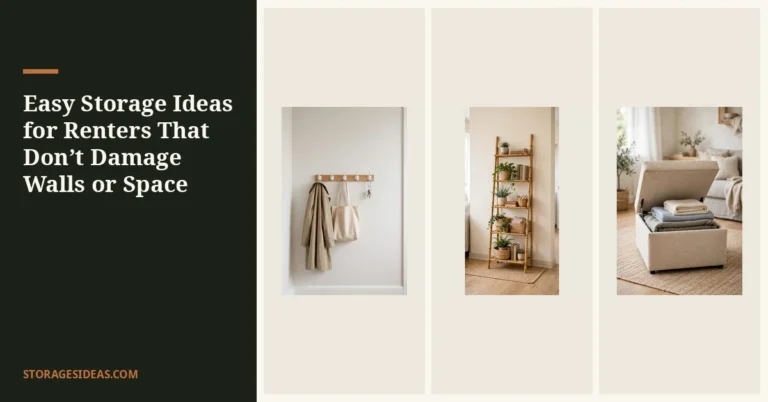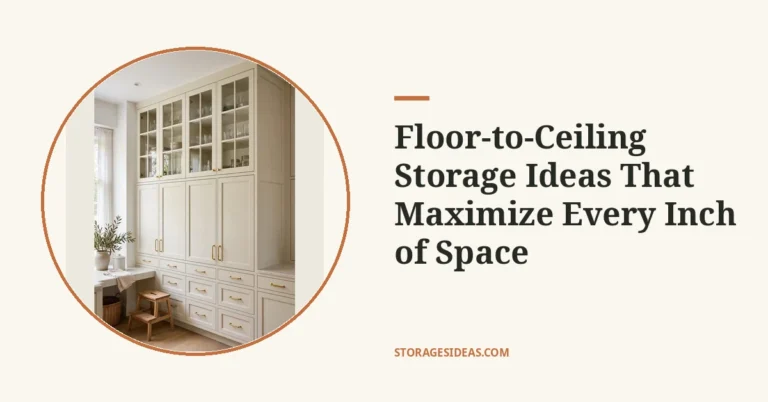
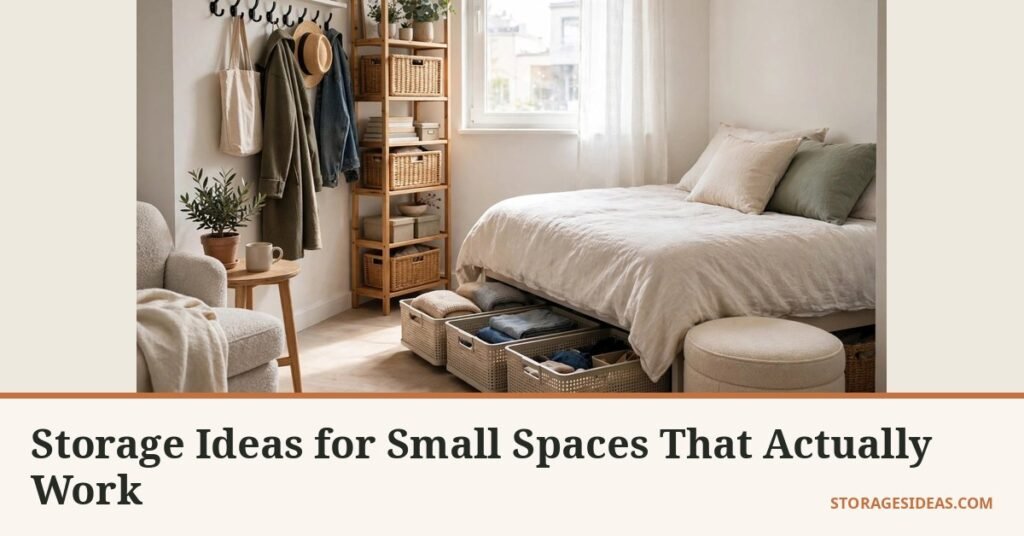
Your apartment isn’t out of floor space, it’s out of cubic inches. A 500-square-foot apartment holds roughly 4,000 cubic feet of air, and most of it sits empty: above your cabinets, under your bed, inside every door, over the toilet.
This guide covers 40 storage ideas for small spaces, each chosen because it reclaims a specific, measurable pocket of space. Every point carries exact dimensions, weight limits, and typical costs, plus an honest note on where it doesn’t work (renters, hollow doors, humid bathrooms, all flagged).
Measure first, buy second, and start with whatever zone in your home is currently doing nothing.
Why Small Spaces Fail on Cubic Inches, Not Square Feet
Think of your home as a box, not a floor plan. A closet rod holds shirts; the 24 inches of air above those shirts holds nothing. A standard bed frame leaves 6 to 8 inches of dead space underneath. The average kitchen cabinet wastes half its vertical space on one row of cans.
The fixes follow three physical rules. Go up before you go out: a $15 wall shelf reclaims space your floor plan can’t give you. Steal the dead zones: under beds, above doors, behind doors, the toe-kick gap, the 5-inch slit beside the fridge. Divide what you have: one tall shelf holds a pile; two short shelves hold two tidy zones.
📏 Save-worthy: the cubic-inch cheat sheet. Over-door organizer = 0 sq ft. Shelves above a doorway = 0 sq ft. Slim rolling cart ≈ 0.5 sq ft. Under-bed bins = 0 sq ft of new floor. One 3-drawer dresser = 4–6 sq ft.
Vertical: Walls, Doors & Above
The highest-yield zone in any small home: walls are free real estate, and doors are storage you’re using for nothing.
1. Over-Door Organizers: 44 Pounds of Storage on Zero Floor Space
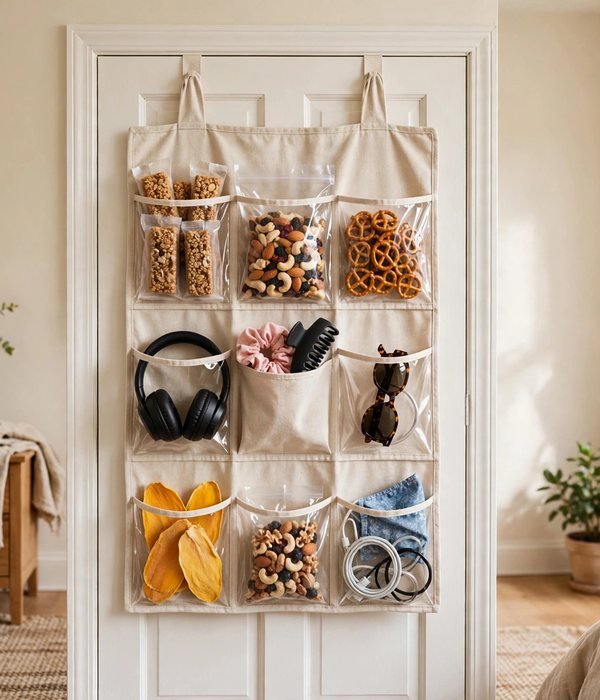
A fabric or metal over-door organizer converts the dead slab of any interior door into 5 to 6 tiers of storage, holding up to about 44 pounds distributed evenly. The door’s back face is a flat, structural, already-paid-for surface swinging through space you’d never put furniture in. Standard interior doors are 1-3/8 inches thick; most hooks fit 1.35–2 inches.
Leave 5 to 7 inches of clearance behind the door when it closes, or loaded pockets hit shelving.
Where it works best:
- Pantry door: 25–30 pounds of cans and snacks in the 5-inch gap behind the door
- Bathroom door: towels, paper goods, cleaning supplies
- Bedroom closet door: shoes and accessories in clear pockets
- Entry closet door: gloves, hats, dog-walking gear
Tips for best results: pick clear-window pockets so you can see contents without digging, and load the heaviest items in the middle tiers (closest to the hinges, where leverage is lowest).
Watch out: on hollow-core doors keep total weight under 25 to 30 pounds, and never screw stabilization clips into one without hollow-door anchors, the cardboard honeycomb interior won’t hold screws.
2. Floating Shelves Above Doorways: The 18-Inch Dead Zone
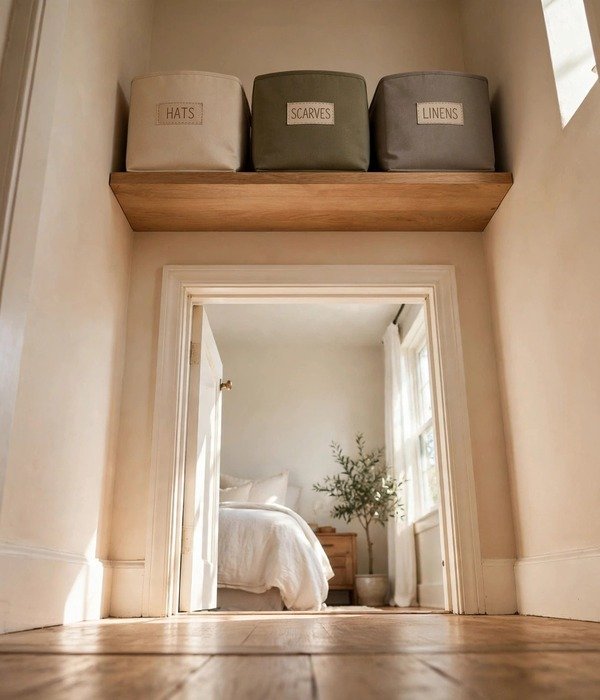
The space above every interior doorway, roughly 12 to 18 inches between trim and ceiling, is perfect for a shallow shelf and invisible from most angles, ideal for things you touch a few times a year: spare linens, seasonal bins, the guest blanket set.
A 24-to-36-inch floating shelf holds 10 to 15 pounds on toggle anchors, or 25 to 50 pounds on a stud.
What you can do with it:
- Over the bedroom door: the guest bedding zone (two sheet sets, one blanket, one spare pillow)
- Over the bathroom door: spare TP tower and cleaning refills
- Over the closet door: off-season accessories in 16-quart bins
- Two shelves down a hallway = a 6-foot gallery for keepsakes in matching bins
Tips for best results: keep shelf depth at 8 to 10 inches, bins fit, nothing vanishes two rows deep. Mount at least 6.5 feet high, and use matching opaque bins so it reads as intentional.
Watch out: this needs screws. Renters: Command strips hold up to 16 pounds in pairs, enough for one small shelf of light items, or use a tension-mounted above-door shelf instead.
3. Tall Narrow Bookcases: 80 Inches High, 12 Inches Wide
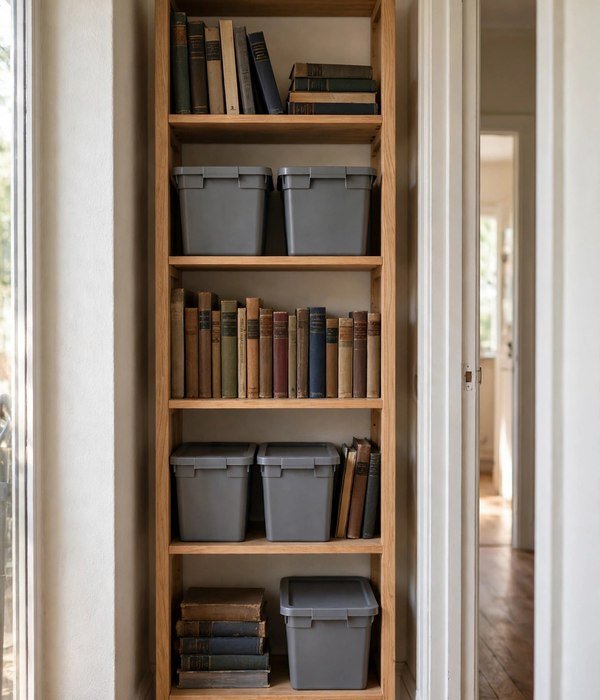
A bookcase that goes tall instead of wide reclaims vertical volume in corners, beside doorways, and in the 18-inch gaps beside windows that nothing else fits.
The standard sweet spot is 12 inches deep by 12 to 24 inches wide by 72 to 84 inches tall, a footprint of about 1 to 2 square feet that holds the equivalent of two to three dresser drawers of books, games, craft supplies, or pantry overflow.
Every shelf should be adjustable, because mixed content (tall cereal boxes, short cans) wastes 30 percent of a fixed-shelf bookcase.
Mini-steps:
- Measure your tallest item first, then set one shelf to that height plus 1 inch.
- Anchor it with an anti-tip strap, anything over 48 inches tall tips when a loaded top shelf gets tugged.
- Daily-use items between knee and eye level; the top two shelves for the rarely-touched.
- Slide 6-to-10-quart bins onto two shelves to convert open shelves into closed storage.
Watch out: particle-board bookcases sag over time under book weight. For shelves wider than 24 inches, add a center support bracket or choose solid wood, a sagging shelf is a broken shelf six months from now.
4. Adhesive Hooks: The Weight Ladder (2 to 16 Pounds, No Holes)
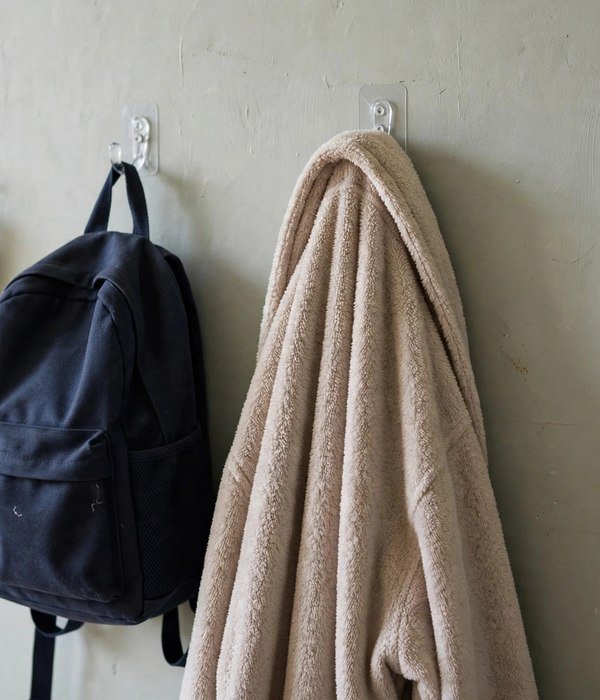
Damage-free adhesive hooks are the renter’s screws, but only if you respect the weight ladder. Small hooks hold 2 to 3 pounds, mediums 3 to 5, larges 8 to 13, and jumbo outdoor-rated ones up to 16.
The foam adhesive bonds to wall paint and spreads the load over a large contact area; use the wrong size and you’ll hear the 3 a.m. crash.
What you can do with it:
- 2–3 lb hooks: keys, lanyards, light jewelry
- 3–5 lb hooks: a bathrobe, a handbag, a folded blanket
- 8–13 lb hooks: a backpack, a mop-and-broom pair
- Two large hooks flanking a doorway = a hanging-plant zone (each plant under 8 pounds)
Tips for best results: clean the wall with rubbing alcohol first (not household cleaner, residue kills adhesion), press 30 seconds, then wait a full hour before hanging anything. Cure time is the step everyone skips and the reason most failures happen.
Watch out: remove by pulling the tab straight DOWN, never out, pulling out rips paint. Avoid textured walls, fresh paint (wait 4 weeks), and heavy loads on humid bathroom tile; steam loosens adhesive over months.
5. Magnetic Knife and Tool Strips: 18 Inches of Wall That Cuts Clutter
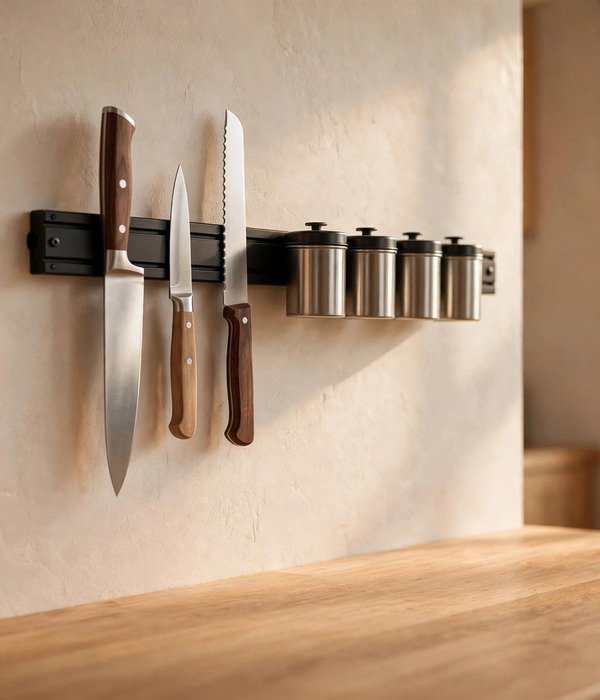
A magnetic wall strip takes the knife block, the spice tin collection, or the bathroom’s scattered bobby pins off the counter and onto 18 inches of wall that was holding nothing. A single 18-inch strip holds 8 to 12 kitchen knives, or a dozen small metal tins, or the bathroom’s tweezers, clippers, and pins in plain sight.
The payoff is double: you free counter space and you stop losing small metal items in drawers.
Mini-steps:
- Mount at eye level in the kitchen (away from the stove’s heat), at mirror level in the bathroom.
- For knives, use the two-screw mount into a stud or toggle anchors, a loaded strip weighs several pounds.
- For spice tins, the strip holds the tins themselves; buy tins with clear lids so labels stay readable.
- In the bathroom, a 12-inch strip inside a medicine cabinet door holds pins, clippers, and tweezers invisibly.
Watch out: needs screws, so flag it for renters, the alternative is a freestanding knife dock or a drawer insert. Keep magnets away from the stove’s heat (heat degrades magnetism) and out of reach of small children’s fingers.
6. Pegboard Panels: A 16-by-32-Inch Custom Wall
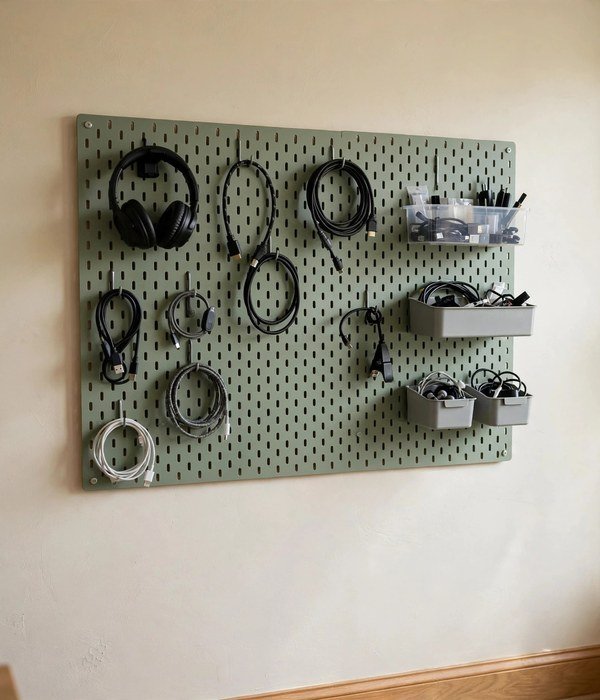
Pegboard is the most flexible wall storage ever made: one 16-by-32-inch panel plus a bag of hooks converts a wall section into a fully reconfigurable organizer for tools, craft supplies, kitchen utensils, or jewelry. The hook-and-hole grid means your layout changes in seconds as your life changes.
A framed panel holds 20 to 30 pounds when screwed into two studs, and hooks cost pennies each.
Where it works best:
- Home office wall: headphones, cables, notebooks, small bins on hooks
- Craft corner: scissors, ribbon spools, paint bottles visible at eye level
- Kitchen: measuring cups, whisks, small pans (with heavy-duty hooks into studs)
- Entryway: keys, sunglasses, masks, the dog leash
- Garage or closet: tools, cleaning supplies, flashlights
Tips for best results: paint the panel to match your wall and it reads as decor; use thick hardboard (not thin craft-store stock) for real weight. Mount with a 3/4-inch spacer behind so hooks have room to engage the holes.
Watch out: two screws into studs required. Renter alternative: a freestanding pegboard on a desk, or a magnetic board on adhesive strips for light items.
7. High Pantry and Closet Shelving: The Shelf Above the Shelf
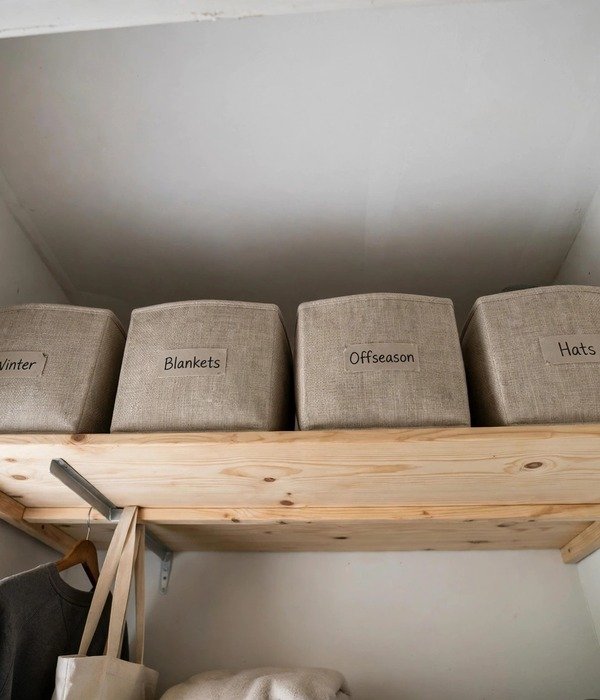
Almost every closet and pantry wastes the top 12 inches because builders set the top shelf at “easy reach” instead of “ceiling.” Adding one more shelf 12 inches below the ceiling turns that dead air into the seasonal and backstock zone: holiday supplies, bulk paper goods, the spare air filter stash.
A 12-inch-deep shelf spanning a 36-inch closet holds six to eight 6-quart bins, roughly 40 quarts of stuff that was living on your floor.
Mini-steps:
- Measure from the existing top shelf to the ceiling; if it’s 12 inches or more, there’s room.
- Use 1×12-inch pine boards (cheap, paintable, strong) with L-brackets every 24 inches into studs or toggle anchors.
- Dedicate this shelf ONLY to things you need less than monthly, daily items up here die of neglect.
- Label the bins. From the floor, every bin looks identical.
Watch out: keep a folding step stool nearby (the 2-step folding kind stores flat at 2 inches deep). Anything over 24-inch span without a center bracket will sag under bin weight.
Under: Beds, Sofas & Stairs
A queen bed hides roughly 33 square feet of footprint. The key is containment: the right bins make it a second closet; loose stuff becomes chaos.
8. Under-Bed Wheeled Bins: 60 Liters Each, Zero Floor Space
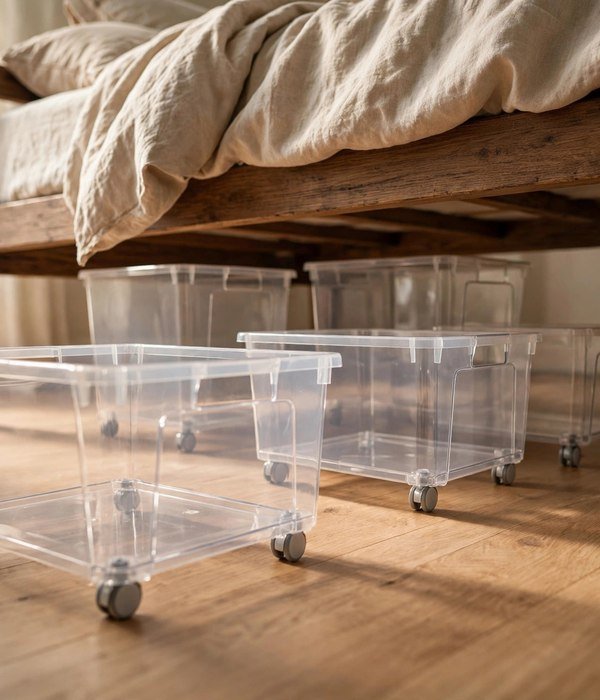
The average queen bed hides a 60-by-80-inch footprint with 6 to 8 inches of clearance, that’s room for four 60-liter rolling bins, or about 240 liters (8.5 cubic feet) of off-season clothes, shoes, gift wrap, and keepsakes, all on zero new floor space.
Wheeled bins matter: without wheels you won’t pull a loaded bin out from under a bed twice before giving up. Look for bins 6 to 6.7 inches tall, with wheels on the short end so they roll toward you.
Tips for best results: measure your clearance first, metal frames on legs are usually the easy case; platform beds often sit under 6 inches and need the soft-fabric options below. Check which way the wheels face in listing photos: wheels on the long side roll sideways, which is useless against a wall.
Assign one bin per category (winter coats, shoes, linens, keepsakes) and label the short end facing out.
Watch out: dusty climates or pet hair? Choose lidded bins. And center-support legs on many platform frames block bins from sliding straight through, measure around them.
9. Bed Risers: 5 Inches of Lift for $20
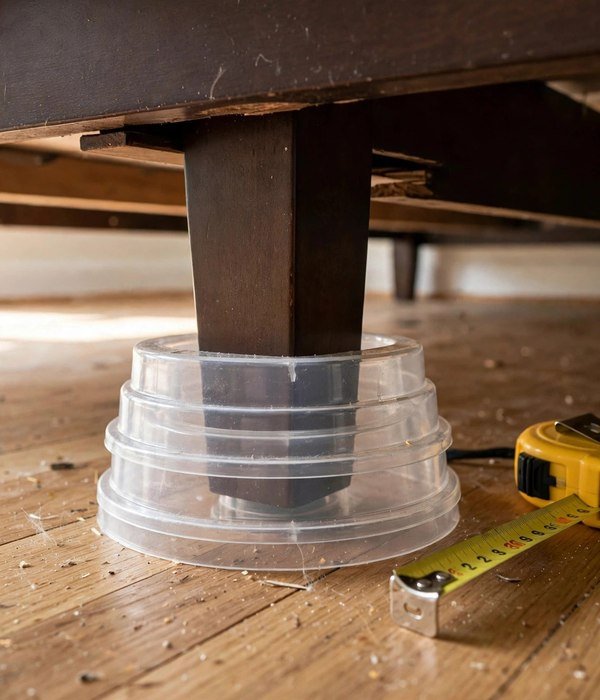
If your bed sits too low for bins, under 6 inches of clearance, a set of bed risers lifts the frame 3 to 8 inches for about $20 a set, buying you the difference between “dust bunnies only” and “four bins of storage.” The math: raising a queen bed 5 inches adds roughly 20,000 cubic inches of storage volume underneath.
Standard riser heights are 3, 5, 6, 8, and 10 inches, and stackable sets let you experiment.
Mini-steps:
- Measure current clearance, under 6 inches means risers or soft bags.
- Lift so final clearance is at least 7 inches (fits standard 6-inch bins).
- With a second person, seat each leg fully in its riser cup, legs resting on rims, not cups, are the failure mode.
- Skip risers on bunk beds or very heavy solid-wood frames, and don’t stack past the manufacturer’s limit.
Watch out: the higher the bed, the more dorm-room it reads; hide the gap with a bed skirt. Risers change mattress height relative to nightstands, a 20-inch nightstand pairs with a 24–27-inch mattress top.
10. Vacuum Bags: 70–80% of the Bulk, Gone
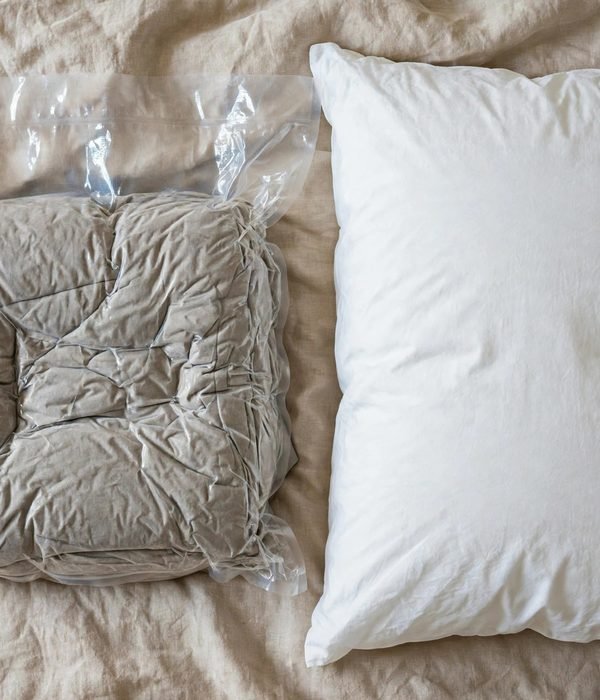
Vacuum storage bags compress bulky soft goods, comforters, winter coats, spare pillows, down to 20 to 30 percent of their original volume by removing the air that makes them huge. A queen comforter that fills a 60-quart bin compresses to the size of a folded sweater.
That’s the highest compression ratio of any method in this guide, and multi-packs cost a few dollars per bag.
What you can do with it:
- One queen comforter per jumbo bag → stores flat on a closet shelf instead of filling a bin
- 4–6 winter coats per bag → the whole household’s off-season outerwear in one bag
- Spare pillows (2 per bag) → shrink to throw-pillow size
- Kids’ stuffed animals → one bag instead of a toy-box eruption
Tips for best results: roll the bag before sealing to push air out, then vacuum. Double-seal the zip, one missed inch and the bag re-inflates in a week. Keep bags away from sharp shelf edges.
Watch out: don’t store natural down or feather items compressed for more than 6 months, they lose loft. And never vacuum-bag anything damp: trapped moisture becomes mildew in a sealed bag.
11. Under-Sofa Storage: The 4-Inch Gap Behind the Kick Plate
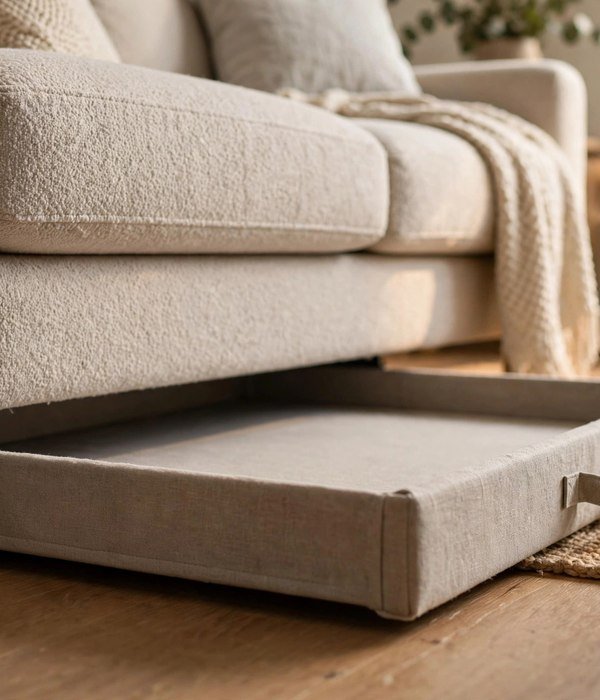
Most sofas sit 3 to 5 inches off the floor, enough for flat fabric storage bags, board-game boxes, or a shallow tray that holds remotes, chargers, and the reading glasses that always vanish. A 30-by-18-inch flat tray slides under most sofa fronts and converts that dusty dead zone into the living room’s junk drawer, minus the junk-drawer guilt.
Measure your sofa’s clearance: blocky modern sofas often have less than 3 inches, in which case only 2-inch flat bags work.
Tips for best results: choose a tray or bag with a handle on the short end so you can pull it toward you without moving the sofa. Fabric bags beat rigid bins here, they flex past the sofa’s front rail. One tray per sofa section max; more than that and retrieval becomes furniture-moving.
Watch out: this zone collects pet hair and dust first. Wipe the tray monthly, and skip it entirely if you have a robot vacuum that needs the clearance to pass underneath.
12. Under-Stair Drawers: 30 Cubic Feet Hiding in Plain Sight
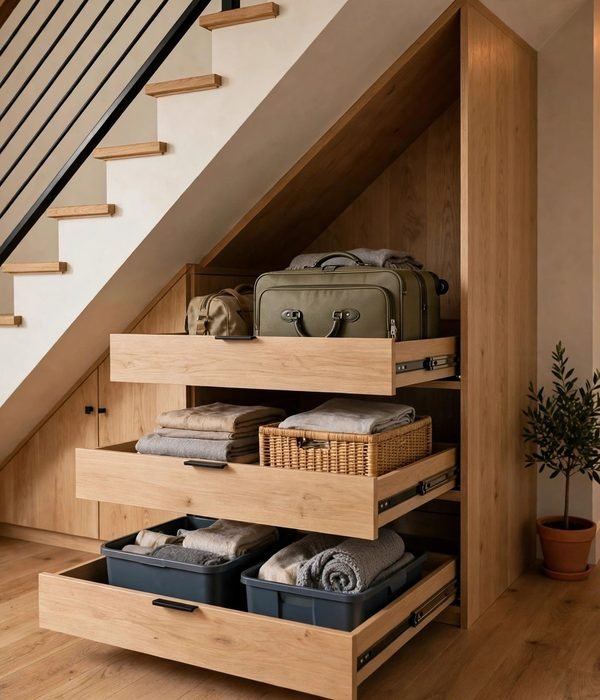
The triangular void under a staircase holds roughly 25 to 35 cubic feet of volume in a typical home, and most of it sits behind a drywall panel holding nothing. Purpose-built under-stair drawers (or a simple pull-out cabinet on casters) turn that wedge into deep storage for luggage, holiday decor, or the toolbox.
The shallow end of the wedge fits 12-inch-deep drawers; the tall end swallows a full-size suitcase standing upright.
Mini-steps:
- Find the access: many stairs have a removable panel or closet on the tall end, start there.
- Measure the wedge: height at the tall end (often 6+ feet) and depth at the shallow end (12–24 inches).
- For a no-build option, slide rolling under-bed bins into the shallow end, they fit the low triangle perfectly.
- For the tall end, a narrow rolling cart or a luggage stack keeps the deep zone reachable.
Watch out: this is homeowner territory, renters shouldn’t be cutting into stair drywall. And in humid climates, check the wedge for moisture before storing anything paper or fabric down there.
13. Toe-Kick Drawers: 3 Inches Tall, Hiding in Your Cabinets
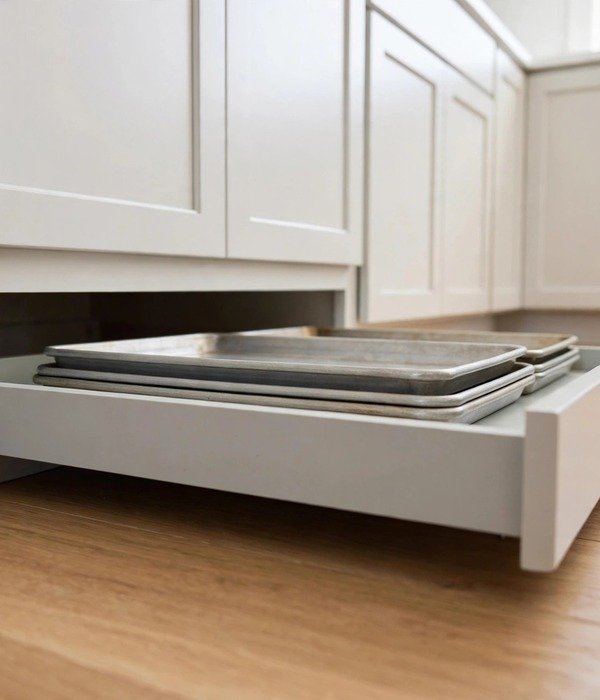
The toe-kick, the recessed 3-to-4-inch-tall gap under your kitchen and bathroom cabinets, is dead space with a finished face. Retrofit toe-kick drawers (shallow drawers that pull out from the recessed base) add roughly 0.5 to 1 cubic foot of storage per cabinet run, perfect for flat items: baking sheets, cutting boards, placemats, the rarely-used roasting pan.
The mechanism is simple: a shallow drawer box on the existing cabinet base, hidden behind the toe-kick face.
What you can do with it:
- Baking sheets and cutting boards standing on edge (the 3–4 inch height fits them perfectly)
- Placemats and table runners rolled flat
- The turkey roaster you use twice a year
- Wrapping paper rolls in a hallway-adjacent cabinet
Tips for best results: this is a homeowner project (the drawer box screws into the cabinet base), but it’s reversible, the toe-kick face reattaches. Measure toe-kick height first: 3.5 inches is most common, and kits come in 18, 24, and 30-inch widths.
Watch out: renters, skip this one. And keep heavy items out, toe-kick drawers are for flat and light, not the cast-iron collection.
14. The High-Profile Bed Frame Swap: 14 Inches of Clearance
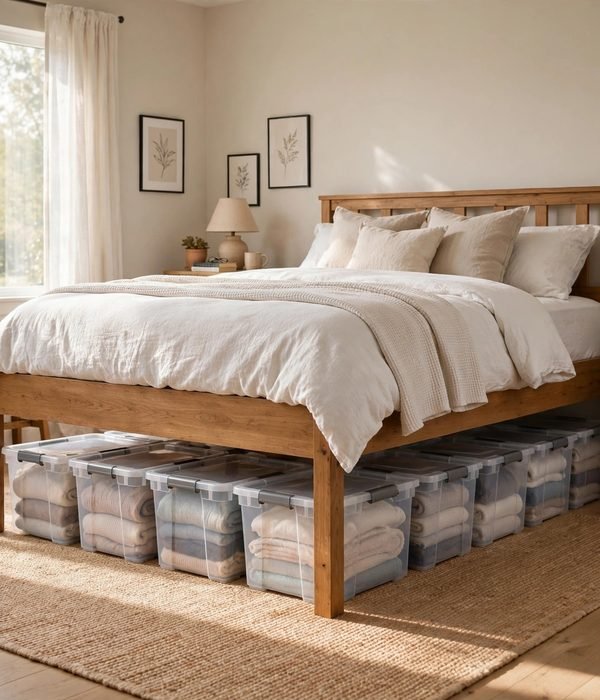
If risers feel like a hack, the real fix is a high-profile bed frame: 14 inches of under-bed clearance instead of the standard 6 to 8, which fits full-size plastic totes (the 60-liter kind), a folded guest mattress, or two stacked rows of bins.
Fourteen inches of clearance under a queen bed equals roughly 37 cubic feet of storage, more than a standard 4-drawer dresser, on the exact same footprint the bed already occupies.
Mini-steps:
- Confirm your ceiling and mattress math: 14-inch frame + 10-inch mattress + your sitting height should still let you get in and out comfortably.
- Shop frames by clearance, not total height, listings bury this number in the specs.
- Buy the bins after the frame, not before: measure the real clearance once it’s assembled.
- Add a bed skirt or upholstered base if the tall gap bothers you visually.
Watch out: the higher the bed, the harder for kids, pets, and anyone with mobility issues. And tall frames need a step stool for making the bed, factor in 24 inches of side clearance for that.
Kitchen Inches
Every inch of kitchen has to earn it. These ideas target the gaps kitchens waste: cabinet air space, the slit beside the fridge, the inside of doors, the void above the fridge.
15. Cabinet Shelf Risers: Double Your 10-Inch Shelves
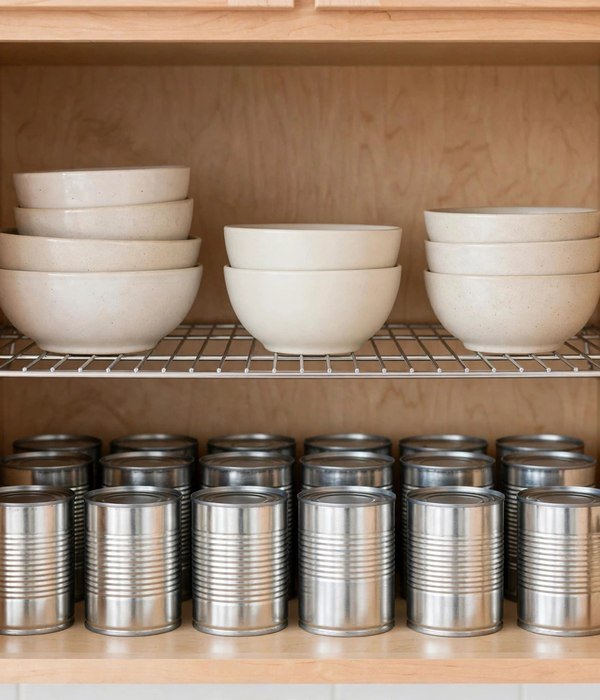
Standard kitchen cabinets are 10 to 12 inches tall inside, and one row of cans uses about 4 inches of that, the rest is wasted air. A wire or bamboo shelf riser creates a second deck inside the same shelf, instantly doubling usable storage: cans below, bowls or mugs above.
A 10-by-14-inch riser costs under $15 and holds 20 to 30 pounds of dishes.
Mini-steps:
- Measure your shelf height and your tallest item; the riser needs to clear the tall items on the lower deck.
- Choose wire risers for plates and cans (visibility), bamboo for a warmer look in open shelving.
- Stack risers in the pantry for a three-deck system on deep shelves.
- For corner cabinets, pair a riser with a small turntable so the back corner stops being a black hole.
Watch out: risers reduce the clearance for tall items, measure the blender or the oil bottle first. And in earthquake-prone areas, the upper deck needs a lip or non-slip liner.
16. Over-Sink Dish Racks: The Window Above the Sink
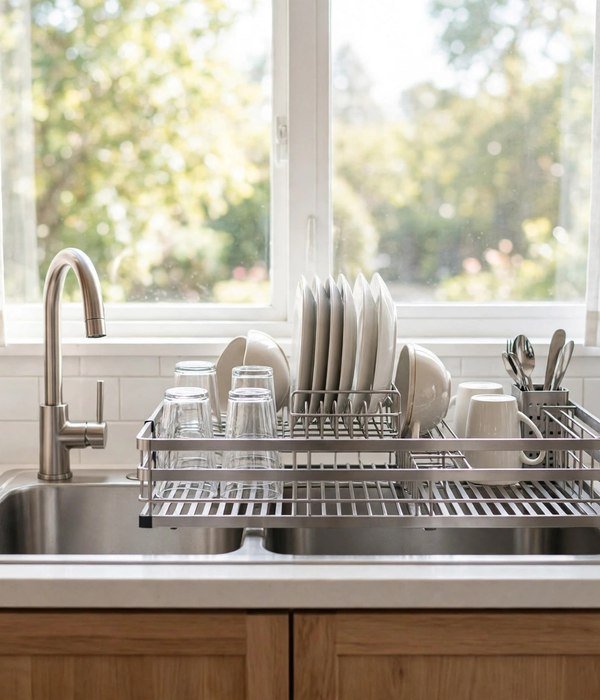
The 24 inches of air above your kitchen sink is a dead zone that an over-sink dish rack turns into the dish drainer, the produce dryer, and extra prep space in one.
These racks span 25 to 33 inches wide (measure your sink first) and hold dishes, cutting boards, and utensils where the water drips straight back into the sink, no counter footprint, no dish mat taking up a 2-foot counter section.
What you can do with it:
- Daily dishes air-dry above the sink instead of on a counter mat
- A top shelf holds 6–8 plates plus cups; side hooks hold utensils and cutting boards
- The bottom tier doubles as a produce-washing station
- Frees roughly 2 square feet of counter, in a galley kitchen, that’s the whole prep zone
Tips for best results: measure sink width AND faucet height, tall faucets need the taller rack models. Choose stainless steel over chrome for rust resistance. Anchor freestanding models so a loaded rack can’t tip.
Watch out: renters, this is fully reversible, the rare no-flag kitchen win. But you need at least 20 inches from sink rim to the cabinet bottom.
17. Cabinet-Door Racks: Inside Every Door
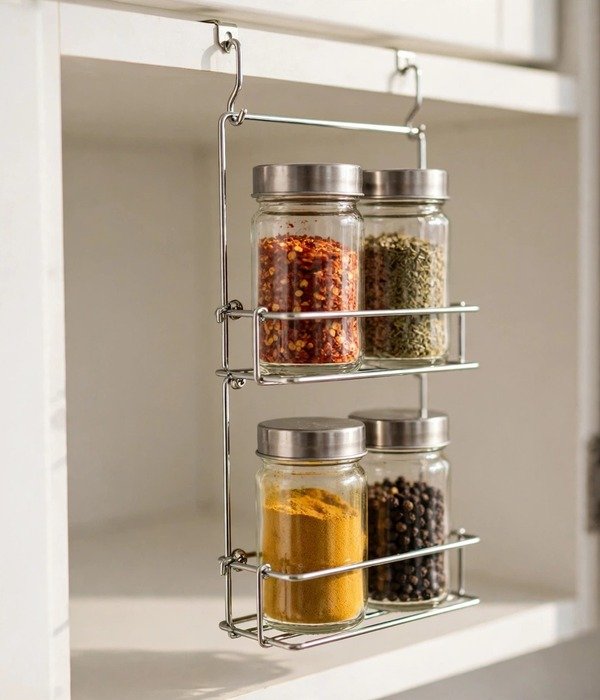
The inside face of every cabinet door is a flat storage surface holding nothing. Slim wire racks that hook over or screw into cabinet doors add 2 to 4 inches of depth for spices, wraps, lids, and cleaning supplies, the small stuff that clutters countertops.
A standard 18-inch-wide cabinet door holds a 3-tier rack with 12 to 18 spice jars, freeing an entire shelf.
Mini-steps:
- Measure the inside door width and the clearance to the shelf edge, you need at least 2 inches of depth so the door still closes.
- For upper cabinets: spice racks, wrap holders, measuring cup hooks.
- For under-sink doors: a narrow caddy for sponges, brushes, and trash bags (keeps them off the damp cabinet floor).
- For pantry doors: a full-height rack turns the door into a can and snack wall.
Watch out: hook-over racks need a door thick enough to grip (3/4-inch cabinet doors work; thin IKEA doors may not). Screw-mounted versions are sturdier but leave holes, renters should stick to the hook-over style and check door-closing clearance twice.
18. The Slim Gap Cart: 5 Inches Wide, 4 Tiers Deep
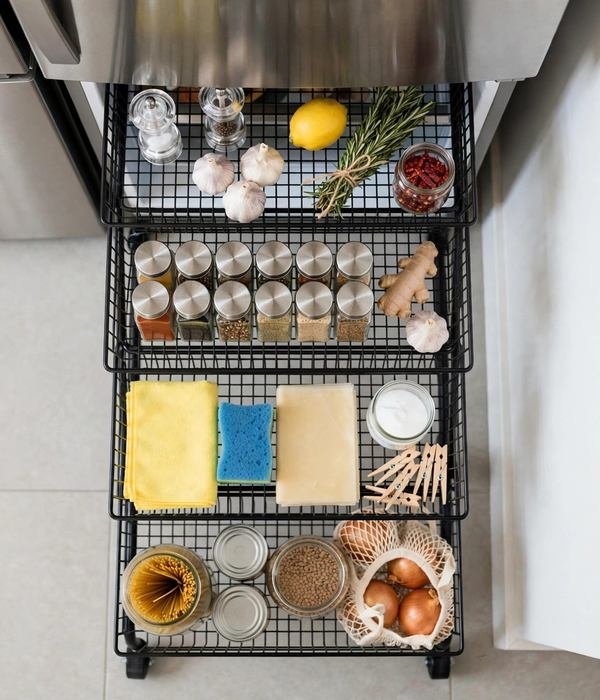
The 5-to-6-inch gap between the fridge and the wall, the slot that currently holds dust and one lost magnet, fits a slim rolling cart with 3 to 4 tiers of storage. That’s roughly 2 cubic feet of pantry overflow, spice backup, or cleaning supplies on wheels, invisible from the front.
Standard carts are 5 to 6 inches wide, 15 inches deep, and 28 to 40 inches tall, with a top handle for pulling.
What you can do with it:
- The fridge gap: oils, vinegars, and spice refills bought in bulk
- The washer-dryer gap: detergent, dryer sheets, stain sticks
- The toilet-to-wall gap: 4 rolls of TP plus cleaning supplies
- Between dresser and wall: charging station and book storage
Tips for best results: measure the gap at the floor AND at counter height, walls bow, and a cart that fits at top may jam at bottom. Locking wheels keep it from drifting; the pull-out handle matters more than you’d think.
Watch out: keep heat-sensitive items (chocolate, medications) out of the fridge-adjacent gap, the compressor side runs warm. And measure depth: a 15-inch-deep cart in a 12-inch gap sticks out.
19. Under-Shelf Baskets: Clip-On Extra Shelves
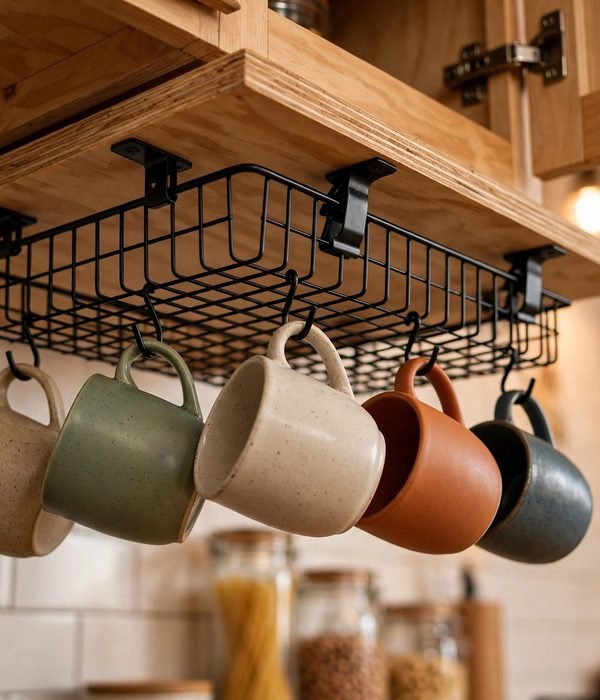
Wire baskets that slide onto existing shelves add a hanging storage deck underneath, no screws, no tools, instant. Each basket holds 5 to 10 pounds of mugs, produce, or wrapped snacks, and a 12-inch-wide basket costs under $10. In a small kitchen, three of these across your cabinets add the equivalent of an entire extra shelf of storage.
Mini-steps:
- Measure your shelf thickness, the slide-on arms fit standard 3/4-inch to 1-inch shelves.
- Hang one under the mug shelf for extra mugs; the handles hook right over the basket wires.
- In the pantry, use them for snack bags and seasoning packets that slide around on flat shelves.
- Under a desk shelf, they hold chargers, notebooks, and the headphone case.
Watch out: the basket steals about 5 inches of the shelf below it, check that the items underneath still fit. Heavy items (cans, jars) belong on real shelves; these are for light and medium loads only.
20. Lazy Susans: The 10-Inch Corner Cure
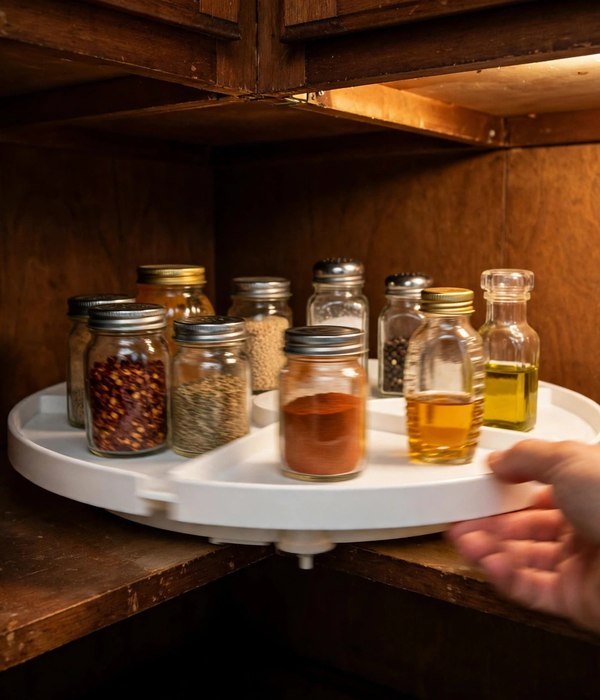
Deep corner cabinets are where condiments go to die, until a 10-to-12-inch turntable makes the back of the cabinet spin to the front. One spin retrieves anything; nothing gets lost behind the mustard anymore. The mechanism is dead simple and it works because it converts depth (the enemy) into rotation (the solution).
A 12-inch turntable fits standard 12-inch-deep cabinets; 15-inch versions suit deep pantry shelves.
What you can do with it:
- One turntable per condiment/oil zone: no more expired bottles discovered at the back
- Under the bathroom sink: cleaning supplies spin into reach past the pipes
- In the fridge: a 10-inch turntable on a shelf ends the “what’s behind the milk” problem
- Craft corner: paint bottles and glue visible with one spin
Tips for best results: choose turntables with a raised rim, flat ones let bottles slide off mid-spin. Non-slip base pads matter on slick cabinet shelves. For upper cabinets, a two-tier turntable doubles the payoff.
Watch out: measure the cabinet opening, not just the interior, a 12-inch turntable won’t fit through a 10-inch door opening. Tall bottles still need headroom above the turntable.
21. Above-the-Fridge Bin: The 24-Inch Void
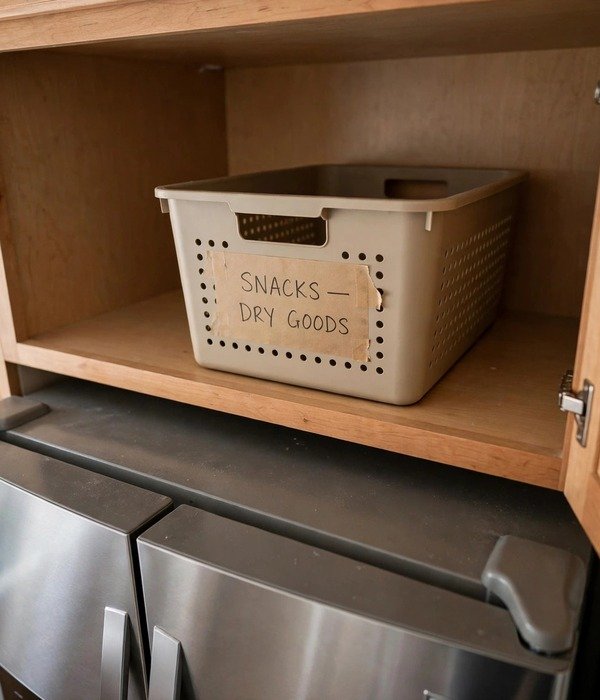
The cabinet above the fridge is the most hated storage in the kitchen, too high, too deep, too hot from the compressor. Stop fighting it: dedicate it to ONE labeled bin holding the rarely-used and the bulky.
A 16-quart bin up there holds the turkey roaster lid, the fondue set, or the bulk paper towels, things you need quarterly, stored in a zone you’d otherwise waste entirely.
Tips for best results: one bin, labeled on the short end facing out, with a written inventory taped inside the cabinet door (because you WILL forget what’s up there). Keep a folding step stool within 6 feet or this bin becomes a write-off. Nothing heat-sensitive: the compressor warms this zone 5 to 10 degrees above room temperature.
Watch out: this cabinet is deep, use a bin with a handle, not loose items, or retrieval becomes an archaeological dig. And never store anything heavy up here; a 16-quart bin of cans at 7 feet high is a head injury waiting to happen.
Bathroom & Laundry Inches
The smallest rooms with the most stuff per square foot. These work the vertical surfaces and gaps around fixtures, the only space they have to give.
22. Over-Toilet Etageres: The 30-Inch Zone
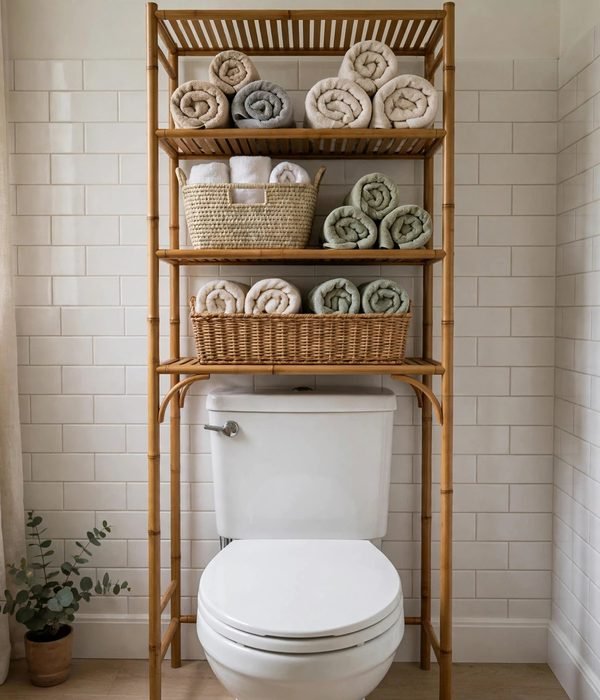
The wall space above the toilet, roughly 30 to 34 inches of vertical zone starting at the tank top, is the bathroom’s biggest unused surface. A freestanding over-toilet etagere (legs straddle the tank, no wall mounting) adds 2 to 3 shelves of storage for towels, toilet paper, and toiletries on zero new floor space.
Standard units are 25 to 30 inches wide and fit over tanks up to 28 inches tall.
What you can do with it:
- Bottom shelf: daily toiletries at arm’s reach
- Middle shelf: 4–6 rolled towels (rolling beats folding, you see every towel)
- Top shelf: the backstock (12-pack of TP, cleaning supplies)
- Side hooks: the bathrobe and hand towel
Tips for best results: measure tank height AND the flush-handle side, legs must clear the handle’s swing. Choose adjustable shelf heights; fixed shelves waste the tall zone. Bamboo or powder-coated steel resists humidity; raw wood doesn’t.
Watch out: freestanding is renter-safe, but in a household with small kids, anchor the top to the wall with one adhesive strip for tip protection. Keep anything you don’t want humid (medications, electronics) elsewhere, this zone steams with every shower.
23. Tension-Rod Shower Caddies: No-Drill Vertical Storage
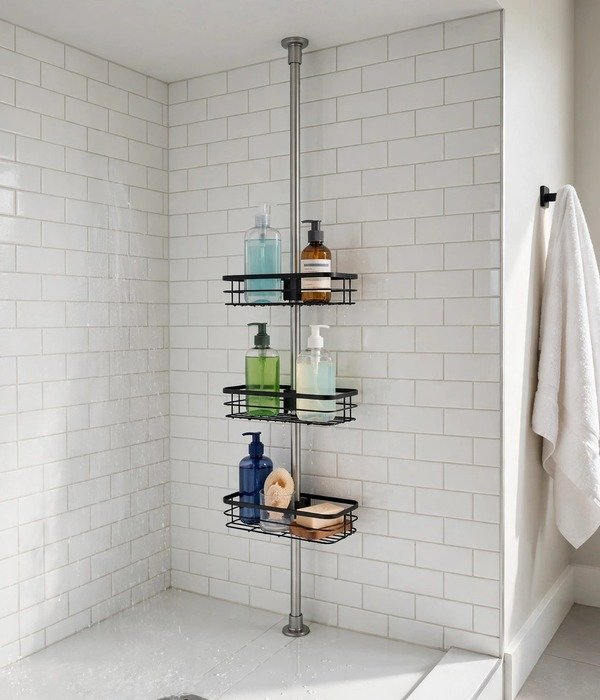
A floor-to-ceiling tension rod in the shower corner (or beside the tub) holds 3 to 4 caddy shelves for every bottle in the household, no drilling into tile, fully renter-safe. Standard rods adjust from 60 to 108 inches to fit any ceiling height, and each shelf holds 5 to 10 pounds of bottles.
The tension mechanism wedges between floor and ceiling; rubber end caps protect both surfaces.
Mini-steps:
- Measure floor to ceiling at the exact corner spot, tile corners are rarely perfectly square.
- Extend the rod 2 to 3 inches beyond the measurement, then twist-lock it into place.
- Load the heaviest bottles on the bottom shelf (low center of gravity).
- Squeegee the shelves monthly, soap scum builds up and the shelves get slippery.
Watch out: textured ceilings or sloped shower ceilings defeat the tension grip, test by hanging your full weight on it gently before loading. In rentals, check the lease about ceiling contact; rubber caps rarely mark, but document with a photo first.
24. Adhesive Bathroom Shelves: 10 Pounds, No Holes
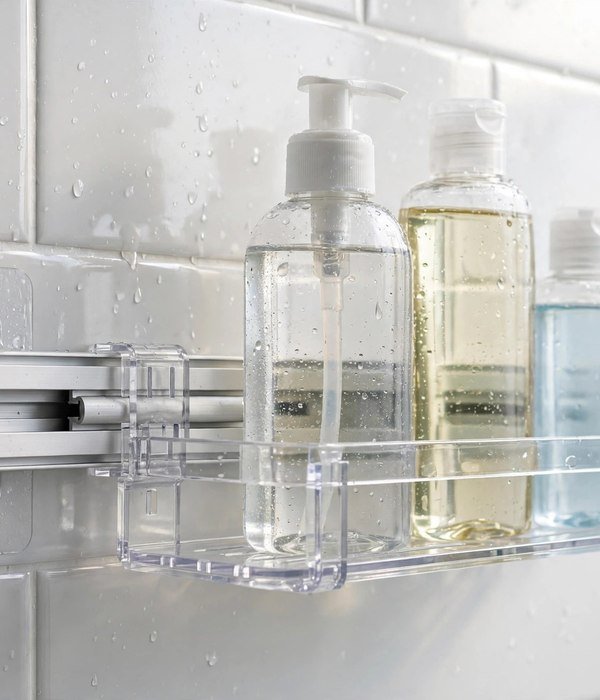
Heavy-duty adhesive shelves (rated 10 to 15 pounds) give renters real bathroom wall storage: a 12-inch shelf beside the mirror holds the daily lineup; two stacked in the shower corner hold the whole family’s bottles. The best use a track-and-shelf system where the adhesive track stays on the wall and the shelf slides off for cleaning.
What you can do with it:
- One shelf at mirror height: the 5–7 daily products, visible and reachable
- Shower corner stack: one shelf per person’s shampoo, conditioner, body wash
- Above the towel bar: the “nice” products and a small plant
- Inside the vanity door: a narrow shelf for hair tools
Tips for best results: mount on smooth tile or glass only, grout lines and textured tile defeat the adhesive. Clean with rubbing alcohol, press 30 seconds, cure 24 hours before loading (shower steam demands the full cure). The track-and-shelf style beats fixed shelves because the shelf slides off for scrubbing.
Watch out: the 10-to-15-pound rating assumes perfect conditions; load to 70 percent of it in a steamy bathroom. Remove by the pull-tab method, never pry, or you’ll take tile glaze with it.
25. Narrow Laundry Gap Cart: Detergent in the Dead Zone
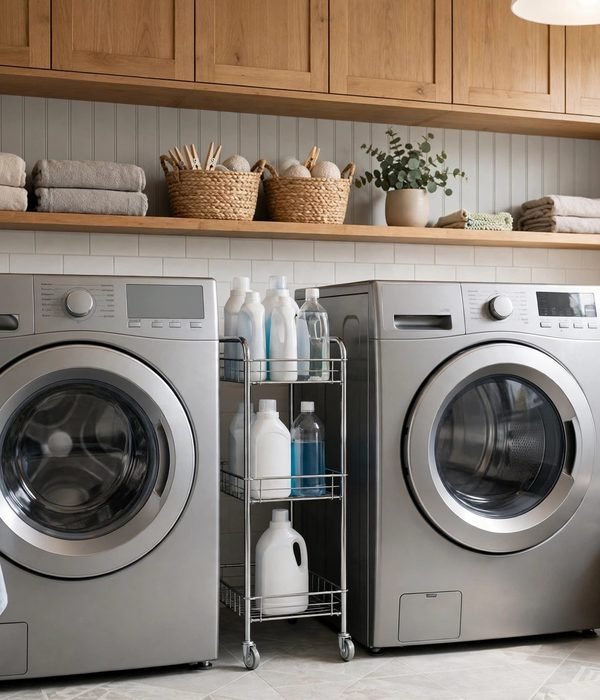
The 5-to-7-inch gap between the washer and dryer (or washer and wall) is exactly wide enough for a slim rolling cart holding detergent, stain treatment, dryer sheets, and the lost-sock bin, the laundry supplies that currently live on top of the machines and fall behind them. Same 5-to-6-inch cart as the kitchen version, different mission.
Mini-steps:
- Measure the gap at floor level, machines vibrate and shift, so measure the narrowest point.
- Load top tier with daily detergent (the stuff you grab every load).
- Middle tiers: stain sticks, dryer sheets, the sewing kit for button emergencies.
- Bottom tier: the single-sock orphanage and a small trash bin for lint and tags.
Watch out: keep the cart’s wheels locked during wash cycles, vibration walks unlocked carts. And never store bleach on a cart beside a dryer vent; heat plus fumes is a bad combination.
26. Over-Door Towel Hooks: 4 Towels, Zero Wall Damage
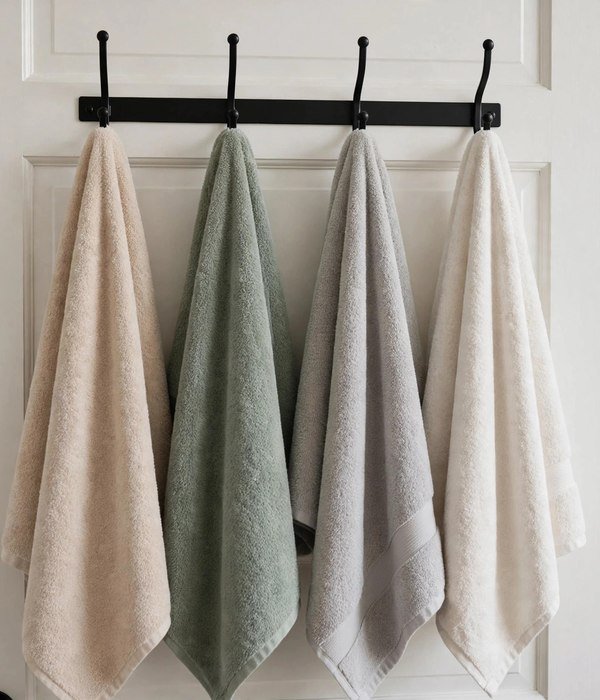
Bathroom walls fill up fast, one towel bar holds two towels and then you’re draping. An over-door hook rack (4 to 6 hooks on a single over-door bracket) hangs on the bathroom door and holds the whole household’s towels: bath towels on the long hooks, hand towels and washcloths on the short ones.
No screws, no wall space, and the door you already have does the work.
What you can do with it:
- 4-hook rack: two bath towels + two hand towels for a couple
- 6-hook rack: the family bathroom’s full towel load
- Back of the linen closet door: the guest towel set, ready to grab
- Laundry room door: the cleaning rags and the delicates bag
Tips for best results: hang it on the door’s upper third so towels don’t drag, standard doors are 80 inches tall, so hooks at 60+ inches work for full-size bath towels. Space hooks 4 to 5 inches apart so towels dry instead of stewing against each other.
Watch out: four soaked bath towels approach 15 pounds, check hinge strength and keep the rack centered. Leave the bathroom door open after showers or the towels won’t dry.
27. Stackable Washer-Dryer: Reclaim 27 Inches of Floor
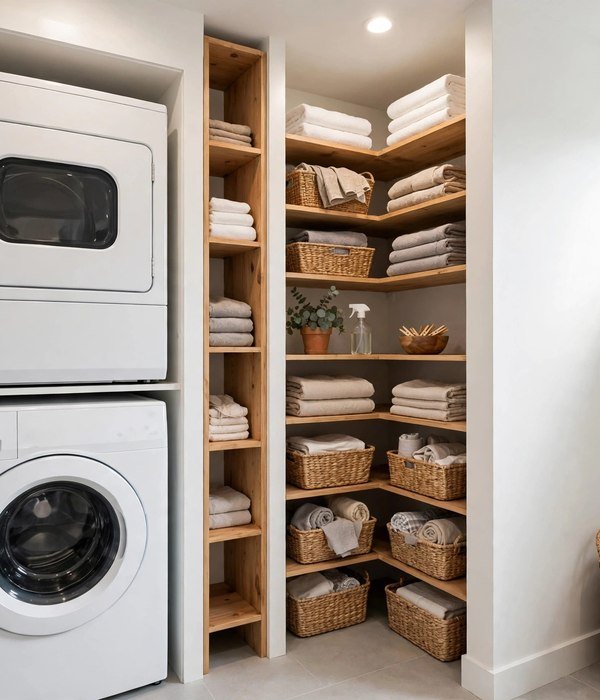
If your side-by-side machines eat 54 inches of wall and you only have one person’s laundry, a stackable washer-dryer unit reclaims half that footprint, 27 inches of floor width back, which in a small laundry closet is the difference between “machines only” and “machines plus storage.” The freed 27-inch column fits a narrow shelving unit, a rolling cart, or a folding drying rack.
What you can do with it:
- The freed column: a 20-inch-wide shelving tower for detergent backstock and cleaning supplies
- A wall-mounted folding drying rack above the freed space
- The hamper station that never fit before
- In a closet laundry: the vacuum and mop finally have a home
Tips for best results: this is a homeowner or long-lease move (appliance swap), so run the math first: measure the closet (stackables need 27 inches wide by 30 inches deep by 76 inches tall minimum, plus venting). Front-loaders are required for stacking, top-loaders can’t stack.
Watch out: the dryer controls end up 6 feet high, short household members need a step stool. And stacked units vibrate more; a vibration-dampening pad under the washer is worth it.
28. Fold-Down Drying Racks: 24 Inches of Rack, 2 Inches of Wall
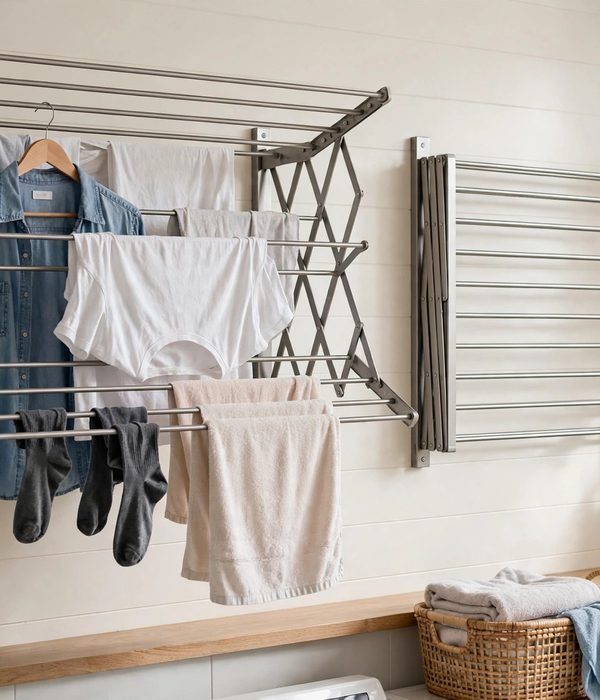
A wall-mounted accordion drying rack gives you 20 to 30 linear feet of drying space when open and folds flat to 2 inches deep when closed, the delicates and air-dry clothes get their rack without a permanent floor-standing eyesore. Mount it in the laundry area, the bathroom, or even inside a closet door.
Mini-steps:
- Mount at a height where the lowest bar clears the floor by 12 inches (clothes hang below the bars).
- Choose a model rated for at least 20 pounds, wet jeans are shockingly heavy.
- In rentals, use the over-door version instead of the screw-mounted one.
- Fold it flat after every use; a permanently-open rack becomes a permanent clothes pile.
Watch out: screw-mounted versions need a stud, 20 pounds of wet laundry will rip toggle anchors out of drywall over time. Keep it away from direct dryer-vent heat, which bakes elastic.
Closet Multipliers
One rod and one shelf waste most of a closet’s volume. These ideas multiply a closet’s capacity two to three times without changing its footprint.
29. Double-Hang Rods: Twice the Clothes, Same Closet
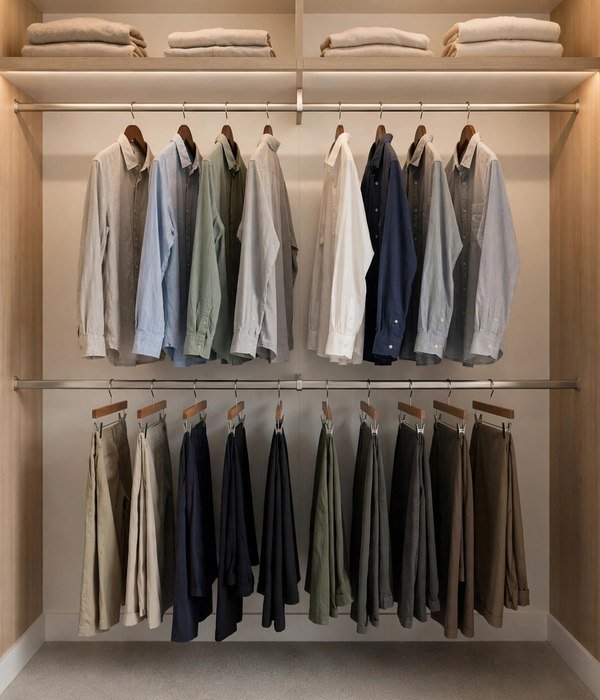
A second closet rod hung 40 inches below the existing one doubles hanging capacity in any closet with 80 inches of vertical space: shirts and blouses on top, pants and skirts below. The average reach-in closet holds 25 to 30 garments on one rod; double-hang takes it to 50 to 60.
A tension-mounted double rod costs under $20 and installs in minutes; a screwed-in version holds more.
Tips for best results: reserve double-hang for the short-items zone, shirts, blouses, folded pants. Long dresses and coats need one full-length section, so don’t double-hang the entire closet; leave 20 to 24 inches of the rod single-height. Hang the lower rod at 40 inches from the floor so pants clear the floor.
Watch out: tension rods slip under heavy loads, for a full double closet, the screw-mounted version into studs or solid blocking is worth it. Renters: the tension version works fine for lighter loads (under 30 pounds per rod).
30. Slim Velvet Hangers: 50 Percent More Rod Space
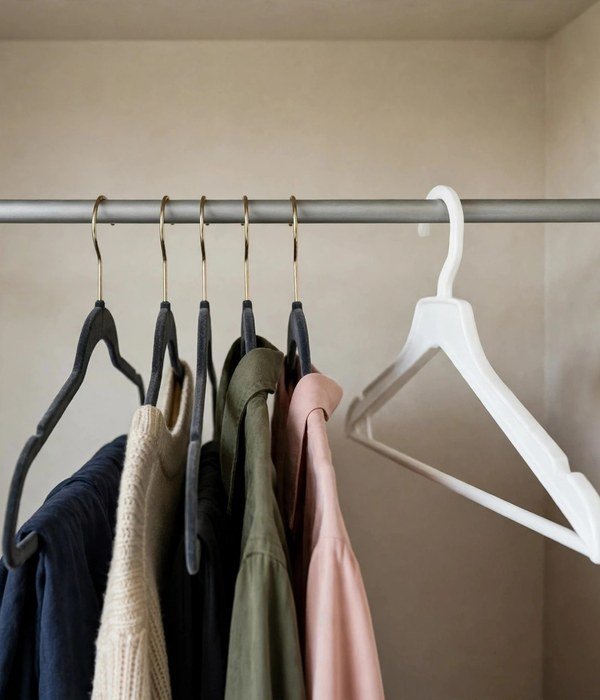
Standard plastic hangers are nearly an inch thick; slim velvet hangers are 0.2 inches. Swap 30 bulky hangers for slim ones and you reclaim about 24 inches of rod, nearly two feet of hanging space from a $15 box of hangers.
The velvet coating grips fabric so clothes stop sliding off, which means fewer items end up in the chair pile.
What you can do with it:
- 30 slim hangers = ~6 inches of rod vs ~30 inches of bulky plastic
- The reclaimed 2 feet fits 15–20 more garments or a hanging shelf unit
- Matching hangers make the closet look twice as tidy (visual calm matters in small spaces)
- The non-slip surface ends the “silk blouse on the closet floor” problem
Tips for best results: buy the 50-pack, you’ll convert the whole closet at once and the per-hanger cost drops. Keep 5 to 10 sturdy wooden hangers for heavy coats; velvet hangers bend under winter-coat weight over time.
Watch out: velvet sheds tiny fibers on dark clothes for the first few weeks, wipe new hangers with a damp cloth before first use.
31. Cascading Hangers: 5 Shirts in 6 Inches of Rod
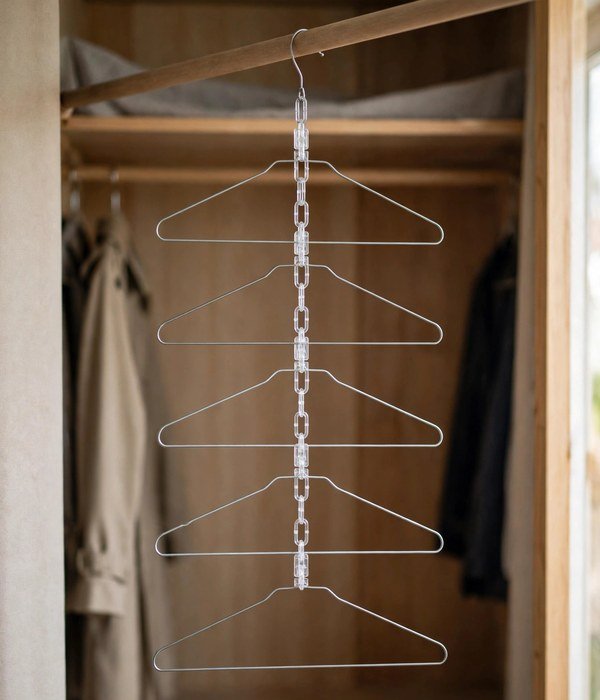
Cascading hanger connectors (or simple S-hooks) link hangers vertically so five shirts occupy 6 inches of horizontal rod instead of 30. It’s the closet equivalent of double-hang, but modular: cascade the out-of-season or work-uniform section, leave the daily section normal. A $10 set of 20 connectors reorganizes a whole closet.
Mini-steps:
- Group the cascade by category, all work shirts, all blouses, so you grab the right chain.
- Hang the heaviest item at the bottom of each chain (gravity keeps the chain straight).
- Limit chains to 4–5 hangers; longer chains swing and tangle.
- Use the freed rod space for a hanging shelf unit or the vacuum-bagged off-season bin.
Watch out: cascaded clothes wrinkle more than single-hung, reserve this for knits, casual wear, and uniforms, not the interview blazer. And the bottom hanger takes the full chain’s weight, so use a sturdy hanger there.
32. Shoe Stackers: Double the Shoe Shelf
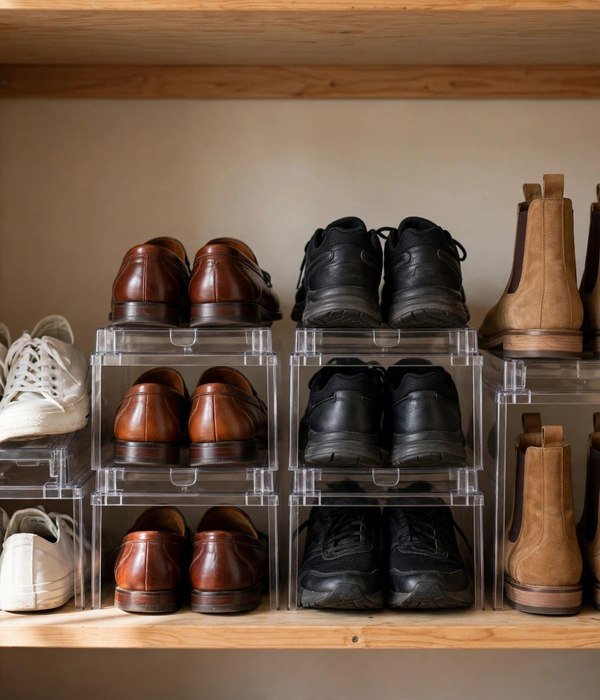
A shoe shelf holds one row of pairs; shoe stackers (the spring-loaded or slot-style risers that hold one shoe above its mate) double it to two rows in the same footprint. Twelve pairs on a 30-inch shelf become 24. The slot-style stackers cost about $1 per pair in multi-packs and work for everything from sneakers to low heels.
What you can do with it:
- One 30-inch closet shelf: 12 pairs single-row → 24 pairs stacked
- Entryway bench shelf: the daily 6 pairs in half the space
- Under-bed shoe organizer: stackers inside the bins double bin capacity too
- Kids’ closet: stackers make small shoes actually findable
Tips for best results: the spring-loaded style adjusts to shoe height (sneakers vs flats); the fixed-slot style is cheaper and fine for uniform collections. Arrange with toes alternating directions so pairs nest tighter.
Watch out: skip stackers for tall boots and high heels, they don’t fit the slot geometry. And they add height: measure shelf clearance (you need 7 to 8 inches per stacked pair).
33. Closet Door Mirror Organizers: Jewelry, Scarves, and a Mirror
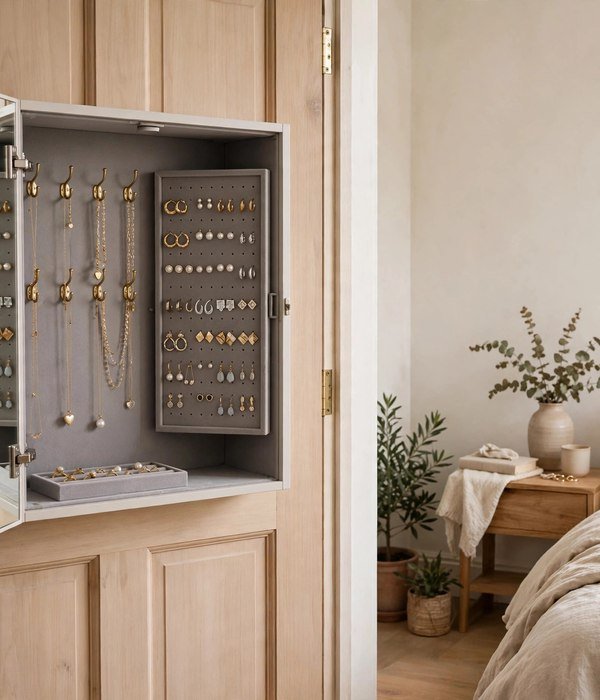
An over-door mirror with built-in jewelry and accessory storage (the cabinet-style kind, 4 to 6 inches deep) gives a small bedroom three things at once: a full-length mirror, a jewelry armoire, and hidden accessory storage, on the back of a door that was holding nothing.
Standard units are 14 by 48 inches and hold 30+ necklaces, dozens of earring pairs, scarves, and sunglasses.
Mini-steps:
- Hang on a solid-core or sturdy hollow door, these units weigh 15 to 25 pounds loaded.
- Sort by type: necklaces on hooks (no tangling), earrings on the felt panels, scarves on the bars.
- Keep the daily pieces at eye level; the rarely-worn goes to the bottom shelves.
- Lock it if kids are around, the small parts are choking hazards.
Watch out: 15 to 25 pounds on a hollow-core door stresses the hinges over time; check hinge screws yearly and upgrade to longer screws if the door starts to sag. Renters: the over-door hooks leave no holes, but confirm the weight with your door type first.
34. Labeled Top-Shelf Bins: The 12 Inches You Ignore
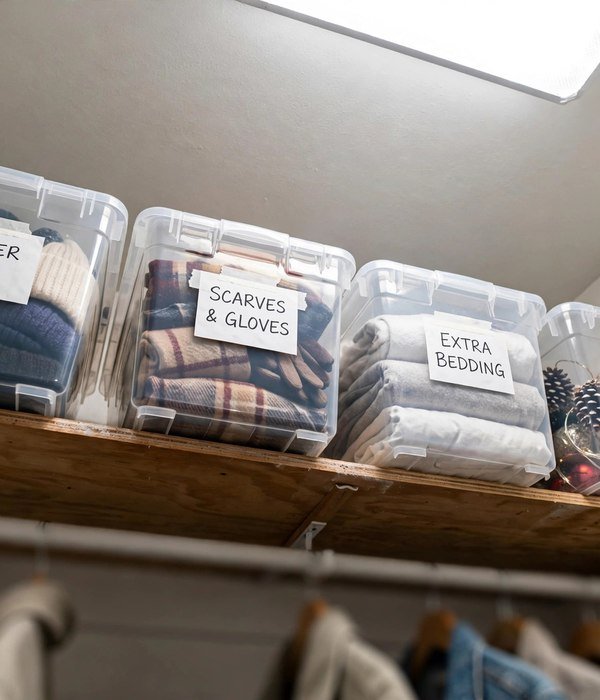
The top shelf of every closet, the 12 inches below the ceiling, holds the things you need quarterly: gift wrap, the Halloween costume, the tax archive. Six-quart to 16-quart bins up there convert that dead zone into 30 to 60 quarts of categorized storage.
The label is the whole trick: from the floor, every bin looks identical, and unlabeled top-shelf bins become mystery boxes within a year.
What you can do with it:
- 16-quart bins: gift wrap rolls (diagonal), seasonal decor, the spare blanket set
- 6-quart bins: batteries, lightbulbs, the “household spares” kit
- One bin per category, labeled on the short end facing out
- A written shelf map taped inside the closet door for the truly forgetful
Tips for best results: clear bins beat opaque for the top shelf, you can identify contents from below. Keep a folding 2-step stool in the closet or this shelf becomes theoretical. Heaviest bins go closest to the wall, over the studs.
Watch out: top-shelf bins and earthquakes don’t mix without a lip or bungee, in seismic zones, add a 2-inch front rail. And nothing fragile up here; retrieval is a two-hand operation at height.
Furniture That Doubles
Every piece of furniture should do two jobs. These store things while being the thing, seating that’s also a closet, tables that are also desks.
35. Storage Ottomans: 2 to 4 Cubic Feet of Hidden Storage
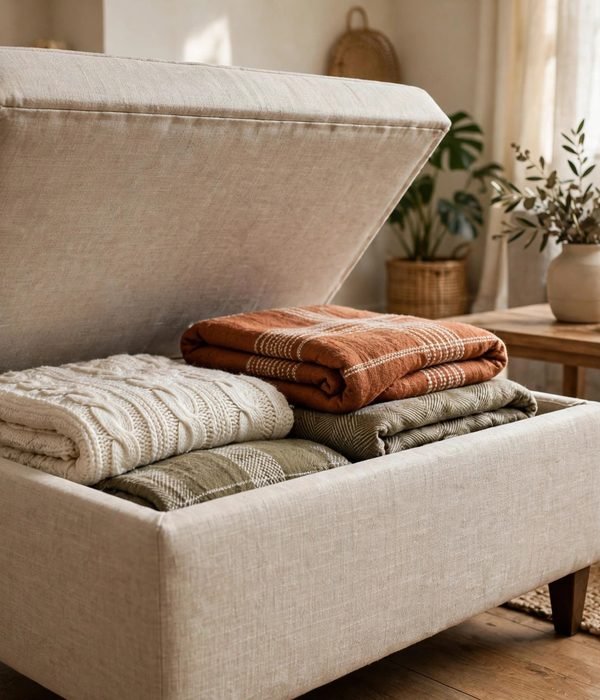
A storage ottoman is a footrest, extra seat, and 2 to 4 cubic feet of hidden storage in one 15-by-30-inch footprint, the highest storage-to-footprint ratio of any furniture in this guide. The average ottoman interior (roughly 13 by 28 by 12 inches) swallows 12 to 15 folded throws, the board-game collection, or the entire gift-wrap station.
What you can do with it:
- Living room: throws, remotes, chargers, the board games, the coffee-table clutter zone, hidden
- Bedroom foot: off-season clothes or the spare bedding set
- Entryway: shoes, gloves, and the dog leash behind a flip top
- Kids’ room: the toy eruption, contained in one lidded box
Tips for best results: choose a hinged lid that stays open on its own (cheap ottomans slam shut, the number one complaint). The tray-top style doubles as a coffee table when you flip the lid. Measure the interior, not the exterior: thick padding eats a full inch on every side.
Watch out: the 2-to-4-cubic-foot rating assumes soft goods; rigid items waste the corners. And check the weight rating if adults will sit on it, cheap ottomans rate for 200 pounds, good ones for 300+.
36. Lift-Top Coffee Tables: Desk, Dining Table, and Storage
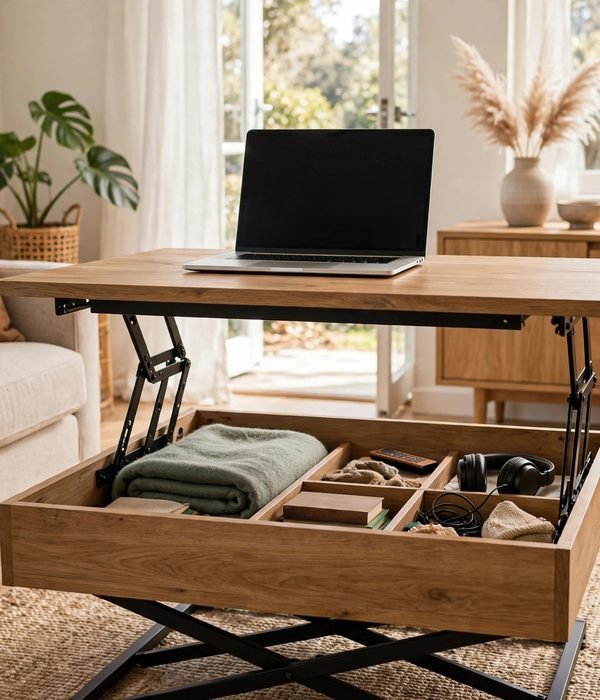
A lift-top coffee table raises its surface to 25 to 30 inches (dining and laptop height) and reveals a storage cavity underneath, in a studio apartment, it’s the coffee table, the work-from-home desk, the dining table, and the board-game closet in one 20-by-40-inch footprint. The hidden compartment (typically 4 to 6 inches deep) holds laptops, chargers, notebooks, and remotes.
Mini-steps:
- Measure your sofa seat height, the lifted top should land within 2 inches of it for comfortable laptop use.
- Test the lift mechanism in person if possible; cheap hinges sag within a year.
- Dedicate the hidden compartment to the work-from-home kit so the table converts in 10 seconds.
- Pair with a storage ottoman (point 35) and the living room needs no other furniture.
Watch out: the lift mechanism adds 30 to 50 pounds to the table, moving day is harder. And the raised top is tippy with a toddler climbing; anchor it or skip it in the toddler years.
37. Murphy Desks and Drop-Leaf Tables: Furniture That Disappears
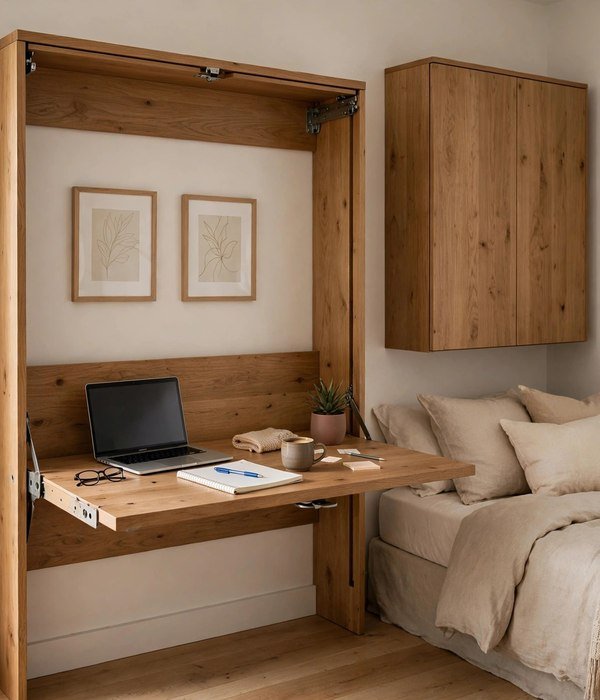
A wall-mounted drop-down desk (or a drop-leaf dining table) gives you a full work or dining surface when you need it and zero footprint when you don’t. A 30-by-20-inch murphy desk folds to 4 inches deep; a drop-leaf table seats four open and two closed. In a studio, that’s the difference between having a desk and not having one.
What you can do with it:
- Murphy desk in the bedroom: the work station that vanishes at 6 p.m.
- Drop-leaf table in the kitchen: daily two-top, holiday six-top
- Fold-down desk in a hallway nook: homework that doesn’t eat the hallway
- Wall-mounted drop-leaf in the laundry room: the folding station that folds away
Tips for best results: the murphy desk needs a stud, 30 pounds of desk plus laptop and elbows will rip drywall anchors out. Drop-leaf tables need 36 inches of clearance per side when open; measure the room, not just the table. The best murphy desks have a small shelf that stays level when folded.
Watch out: screw-mounted, so renters need the freestanding folding-table alternative. Anything on a murphy desk must be cleared before folding, build the 30-second clear into your routine.
38. Storage Benches: The Entryway Workhorse
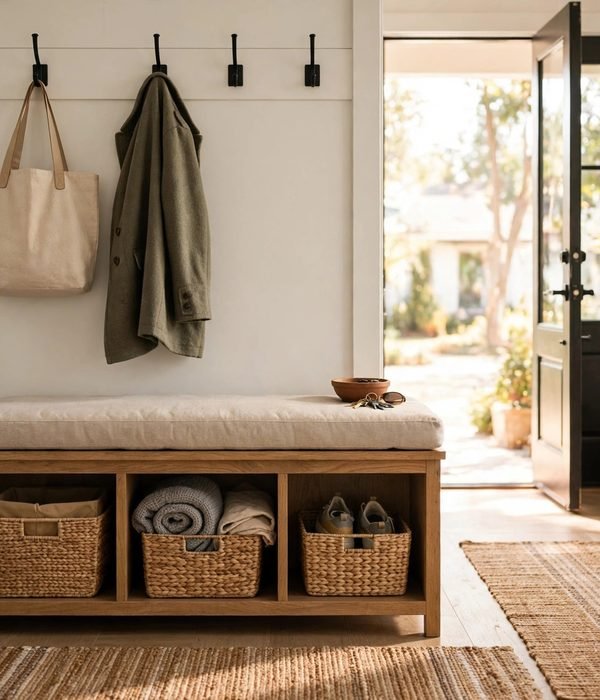
A storage bench at the entry (or the foot of the bed) is seating plus 3 to 5 cubic feet of storage: shoes, bags, winter gear, linens. The standard 36-by-18-by-18-inch bench holds 8 to 10 pairs of shoes inside, with a top that seats one adult for the shoe-putting-on ritual.
Cubby-style benches with bins beat the single-cavity kind, bins pull out, so nothing vanishes into the deep back.
Mini-steps:
- Measure your entryway: you need the bench depth (18 inches) plus 24 inches of standing room in front.
- Choose cubbies over a single cavity, one bin per person, labeled.
- Top it with a cushion (17 to 19 inches is proper seat height) and it becomes the house’s favorite seat.
- Hooks above the bench complete the 30-second entryway: coat, bag, shoes, done.
Watch out: the bench-plus-hooks zone needs a stud for the hooks if you’re hanging winter coats (40+ pounds of coats). Freestanding coat racks are the renter alternative. Keep the bench top clear, it becomes a drop zone within a week if you let it.
39. Beds With Built-In Drawers: The Dresser You Sleep On
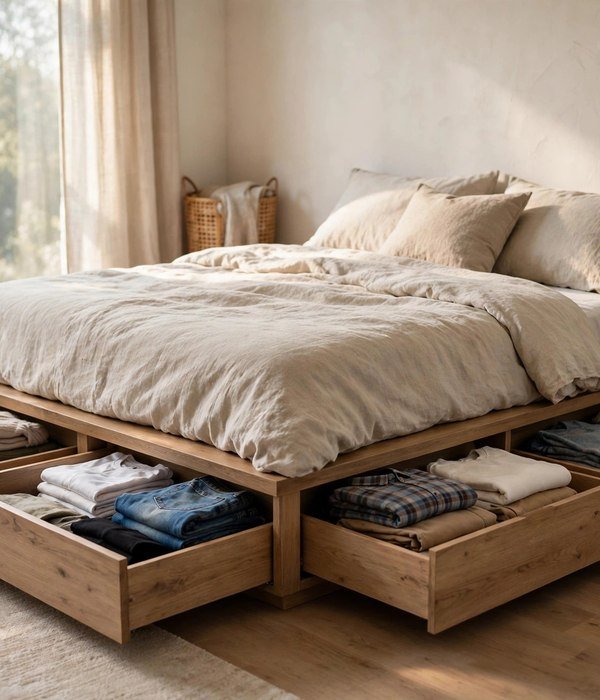
A platform bed with built-in drawers (2 to 4 drawers, each roughly 24 by 18 by 8 inches) replaces a dresser: 4 to 6 cubic feet of clothing storage in the footprint the bed already occupies. Compared to under-bed bins, built-in drawers win on daily usability, drawers glide open in one pull, while bins require kneeling and dragging.
What you can do with it:
- 4-drawer queen: the entire casual wardrobe (tees, jeans, pajamas, workout gear)
- 2-drawer twin: a kid’s full clothing set, no dresser needed in a small room
- Guest room bed: the spare linens and the “guest drawer” with toiletries
- Deep drawers: sweaters and hoodies that would stretch on hangers
Tips for best results: drawers on the long side of the bed are more usable than foot-end drawers (no crawling). Measure your room: drawers need 24 inches of pull-out clearance on the side. Solid-wood drawer boxes outlast particle board by years under daily use.
Watch out: this is a furniture purchase, not a hack, buy it when you’re buying a bed anyway. And drawer beds are heavy; upstairs apartments should check floor loading if you’re doubling up furniture.
40. Nesting Tables: Three Tables in One Footprint
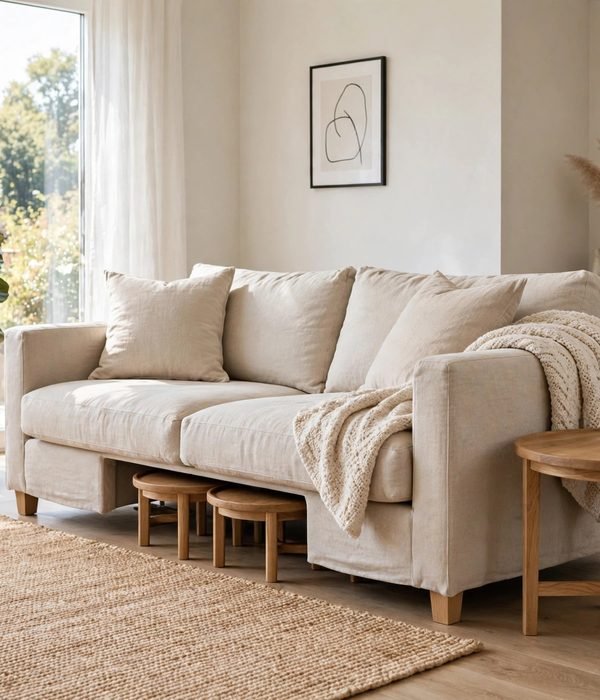
A set of 3 nesting tables occupies the floor space of one side table (about 2 square feet) and deploys into three surfaces when guests come: the coffee-table extension, the laptop side table, the plant stand. Each table is typically 4 to 6 inches shorter than the last so they tuck fully underneath each other.
What you can do with it:
- Daily: one table beside the sofa, two nested invisibly underneath
- Guests: pull all three out, instant side tables for drinks
- Work from home: one as a laptop stand, one as a notebook/printer table
- Small dining: two nested tables become the serving station at parties
Tips for best results: the C-shaped (cantilevered) style slides over sofa arms and chair seats, far more useful than the basic square kind. Measure the nesting clearance: the middle table must clear the smallest table’s height by at least an inch.
Watch out: cheap nesting sets wobble when the small tables are fully extended, test the largest table loaded before committing. And they scratch each other; felt pads between the tiers prevent it.
Conclusion
Forty ideas, one principle: your small space isn’t short on room, it’s short on used volume.
If you do nothing else, do the three highest cubic-inches-per-dollar moves: the over-door organizer (44 pounds of storage, zero floor space, under $25), the under-bed bins (8.5 cubic feet hiding under the bed you own), and the slim velvet-hanger swap (two feet of closet rod for $15).
🏆 Biggest cubic win: the under-bed system, bins plus risers if you need them. Nothing else reclaims 8+ cubic feet for under $50 on space you’re already paying rent for. Measure your clearance tonight, order the bins tomorrow, and by the weekend your bedroom has a second closet.
- 14 vertical storage ideas for small rooms
- 10 over-the-door storage ideas for every room
- 10 rolling cart organization ideas for every room
- 10 small apartment bathroom storage ideas
- 10 small apartment closet storage ideas
- 12 multifunctional furniture pieces with hidden storage
- 18 studio apartment storage ideas for one-room living
- 10 small space storage mistakes that make rooms feel cramped
- 17 small apartment storage tricks
- 10 narrow wall storage ideas
- 10 floor-to-ceiling storage ideas
- 15 renter-friendly storage ideas
- 10 small space transformation ideas
- 30 toy storage ideas for bedrooms, playrooms and living rooms
Frequently Asked Questions (FAQ)
What’s the single best storage idea for a very small apartment?
If you buy one thing, make it an over-door organizer: 44 pounds of storage, zero floor space, no tools, renter-safe, under $25. If you do one project, do the under-bed bin system, 8.5 cubic feet hiding under a queen bed. Both cost under $75 and beat a $300 dresser.
How do I add storage without drilling holes as a renter?
Lean on the damage-free ladder: over-door organizers, tension rods, adhesive hooks and shelves (2–16 pounds with proper curing), freestanding shelves and carts, under-bed bins, and furniture that stores (ottomans, benches). Where a point says “needs screws,” the renter alternative is named.
How much weight can adhesive hooks and shelves really hold?
Small hooks hold 2–3 pounds, large ones up to 13, adhesive shelves 10–15 pounds, but only with proper prep: clean with rubbing alcohol, press 30 seconds, cure 24 hours. Load to 70 percent of rated capacity, avoid textured walls and fresh paint.
Will bed risers make my bed too high or unstable?
A 5-to-6-inch lift is the sweet spot: enough for standard 6-inch bins, not bunk-bed territory. Use a full set with deep leg cups, seat each leg fully, skip risers on bunk beds or heavy frames. A high-profile frame (14-inch clearance) is the permanent version.
What’s the best way to store things in a kitchen with almost no cabinets?
Work the three kitchen dead zones: inside cabinet doors (slim racks), the 5-inch gap beside the fridge (rolling cart), and above the fridge (one labeled bin). Add shelf risers to double every 10-inch shelf and an over-sink rack to free 2 square feet of counter, two full cabinets, zero renovation.
How do I keep a small bathroom from feeling cluttered with all this storage?
Closed storage for the messy, open for the pretty. An over-toilet etagere with matching bins hides clutter; one adhesive shelf at mirror height holds only the 5–7 daily products. Rolled towels read as decor; a dozen half-empty bottles reads as chaos.
More than 5 items on a surface needs a container.
Are vacuum storage bags safe for all clothes and bedding?
Perfect for synthetics, cotton, and bulky items, comforters, coats, pillows compress 70–80 percent. Don’t long-term compress down or feather (they lose loft after 6 months), and never seal anything damp. Double-seal the zip; keep bags away from sharp edges.
What storage mistakes make a small space feel even smaller?
The big three: open piles at eye level (visual noise shrinks rooms, use closed bins), tall furniture blocking window light, and buying before measuring (the wrong-size bin wastes its gap). Matching light-colored bins recede; dark, mismatched ones read as clutter.