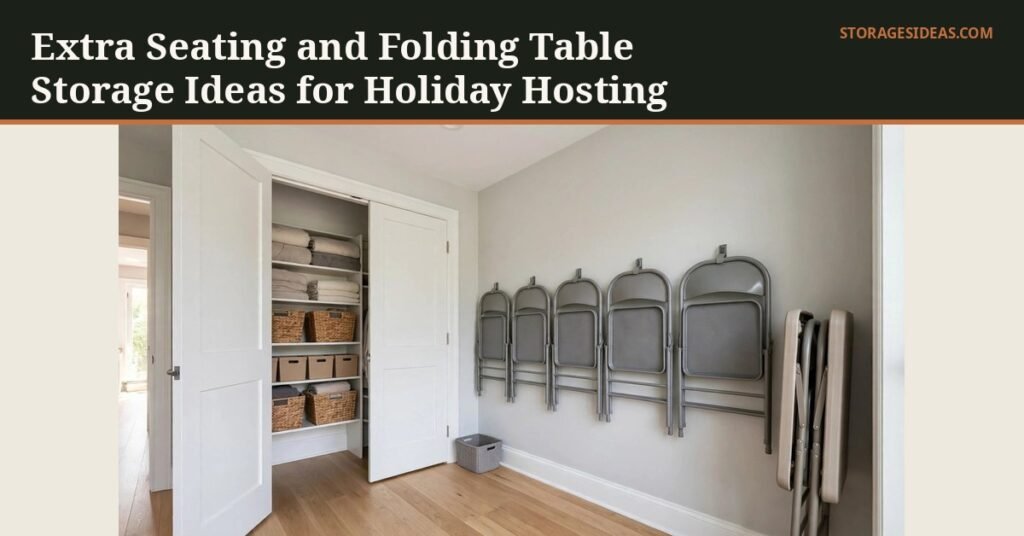
Folding chair storage starts with 60 seconds of math: measure one folded chair’s thickness, multiply by how many chairs you own, and you know exactly how much wall or closet width you need. A slim metal folding chair folds to about 2 to 3 inches thick; a padded one runs 3 to 4 inches.
Six metal chairs stacked flat take roughly 12 to 18 inches of closet width, less space than your winter coats already use. Once you know that number, every storage idea below stops being a guess and becomes a fit.
These 9 ideas cover folding chair and folding table storage for holiday hosting in small homes, apartments, and rentals. Most cost under $30, need zero screws or a handful of stud-mounted screws, and work with the 6 to 8 extra chairs and one folding table most households actually own. Count your chairs first, then pick your spots.
Why Extra Chairs End Up in the Worst Spots Every Holiday
The problem is not that folding chairs are bulky, it is that they arrive all at once, days before guests do, and there is no plan for where the extras live the other 350 days. So they end up blocking the hallway, leaning against the bedroom wall, or stacked on the washer, and every Thanksgiving the same reshuffle happens.
A standard plastic folding chair weighs 7 to 8 pounds and folds to just 2 inches thick; the issue is never weight, it is that 6 chairs take 12 to 18 inches of horizontal width nobody measured a spot for in advance.
That is also why extra chairs cause the most damage: a stack leaning against a wall gouges paint, chairs shoved near radiators warp plastic and scorch fabric, and a folded 6-foot table, 23 to 34 pounds, 3 to 3.5 inches thick, gets wedged somewhere awkward and strains its legs.
Giving each piece a measured, assigned home means the holiday setup takes ten minutes instead of an afternoon of dragging furniture around the apartment.
1. Do the 60-Second Chair Math Before Choosing a Spot
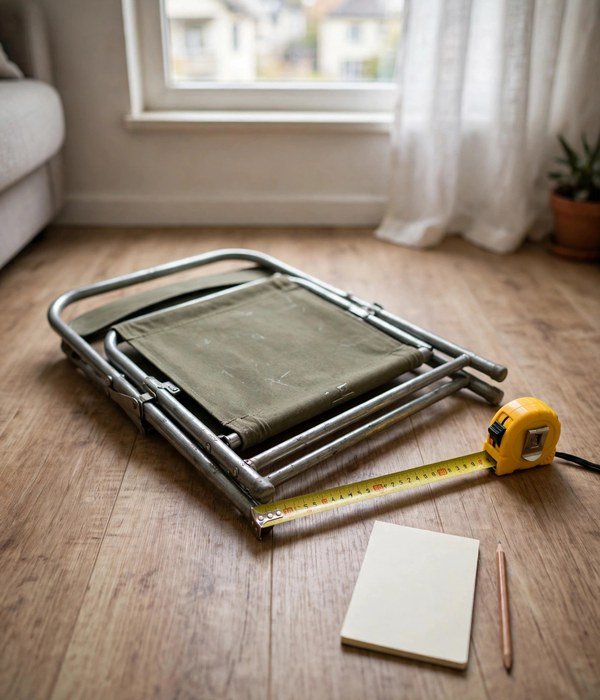
Storage fails start with guesswork. A folding chair’s folded footprint decides everything, and it varies more than people expect: a bare metal chair folds to about 2 inches thick, a standard plastic resin chair folds to about 2 inches thick and 17.7 by 38.2 inches tall, and a padded chair runs 3 to 4 inches thick.
Weigh one too, most plastic and metal chairs run 7 to 8 pounds each, so six chairs weigh roughly 42 to 50 pounds total. Multiply thickness by chair count: 6 metal chairs need 12 to 18 inches of width, 8 padded chairs need up to 32 inches.
Measure that against your closet, hallway wall, or behind-the-sofa gap before committing to anything.
What you can do with it:
- Measure every candidate spot, width, depth, and height, with the tape measure in your junk drawer
- Count chairs and tables together, since they usually need different homes
- Add 2 inches of breathing room so chairs slide in and out without scraping
- If spots keep coming up short, split the set: 4 chairs in the closet, 2 in the bedroom
- Renters: this math is your permission slip, most ideas below need zero screws once you know your numbers
Tips for best results: Measure the folded chair itself, not the shipping box, unfold and refold it once. Watch out: chair backs stick up past the seat when folded (a 38-inch folded chair will not fit a 36-inch-tall spot), so measure height too.
2. Hang Chairs on a Stud-Mounted Hook Rail in the Garage or Closet
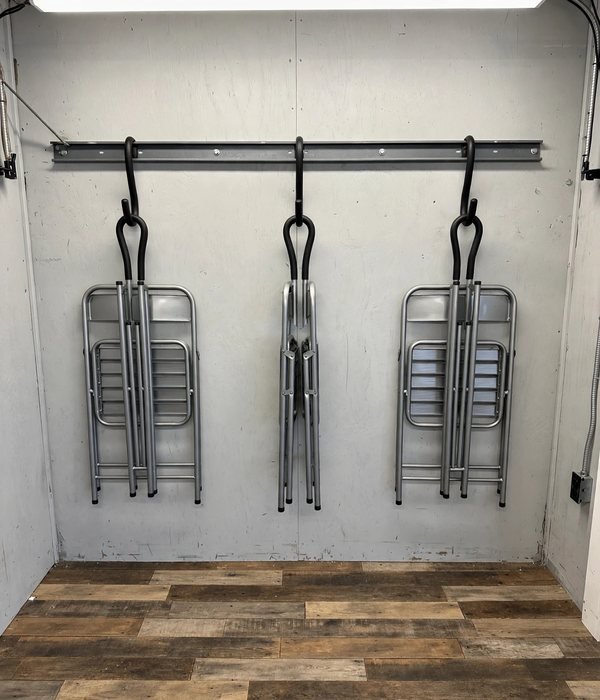
Chairs weigh almost nothing individually but eat closet width fast, so moving them onto a wall converts dead vertical space into a rack. A rail-and-hook system (three 16-inch steel rails plus 6 adjustable hooks) is rated for 265 to 450 pounds total, far more than the 42 to 50 pounds six chairs weigh.
Mounted into wall studs, a single stud-mounted screw holds up to 100 pounds, and hook pairs spaced 12 to 18 inches apart carry a stack of chairs without pulling drywall. Chairs hang folded flat against the wall, taking about 6 inches of depth instead of 18 inches of closet floor.
- Find the studs with a stud finder or the knock-and-listen method, mark them at chair-top and chair-bottom height
- Level the rail and drive the screws into the studs, not the drywall; for anything over 25 pounds, studs are non-negotiable
- Space the hooks 12 to 18 inches apart so each chair hangs flat, back against the wall
- Slide each folded chair onto a hook by its top frame rail, heaviest chairs on the lowest hooks
- Snap the hooks along the rail to fine-tune spacing until chairs do not touch each other
- Set the rail’s end stops so hooks cannot slide off if the rail gets bumped
Tips for best results: Rubber-coated hooks protect chair frames and keep them from sliding. Watch out: drywall anchors alone will eventually pull out under a swaying load, if you cannot hit a stud, use a floor-standing dolly instead (point 5).
3. Turn the Closet Rod Into a Chair Hanger
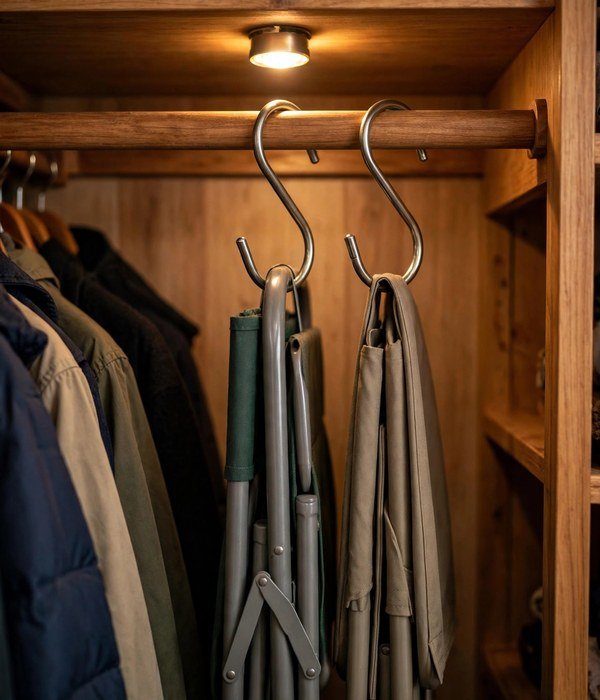
If your coat closet has a rod you do not fully need, the rod is a free horizontal bar rated for more than people assume. Six plastic chairs weigh 42 to 50 pounds, within what a stud-mounted closet rod with center support handles.
Wide S-hooks or purpose-made closet-rod chair hooks slip over the rod, and each folded chair hangs by its top rail with the seat folded flat. The chair’s own center of gravity keeps it hanging straight down, so a 24-inch-deep closet swallows a row of chairs in about 3 inches of depth per padded chair.
Where it works best:
- Reach-in closets with a single high rod, hang chairs on the half you use least
- Walk-in closets whose rod has a center support bracket (skip this on a rod with no center support and more than 6 chairs)
- Coat closets near the front door, where chairs sit closest to where guests enter
- A spare bedroom closet during holiday season, move chairs back after New Year
Tips for best results: Push chairs to one end and clothes to the other so fabric does not snag on frames. Watch out: if the rod sags when you hang the third chair, stop, redistribute to wall hooks or split the set instead of risking a pulled-out rod.
4. Slide Chairs Under the Bed in Storage Bags
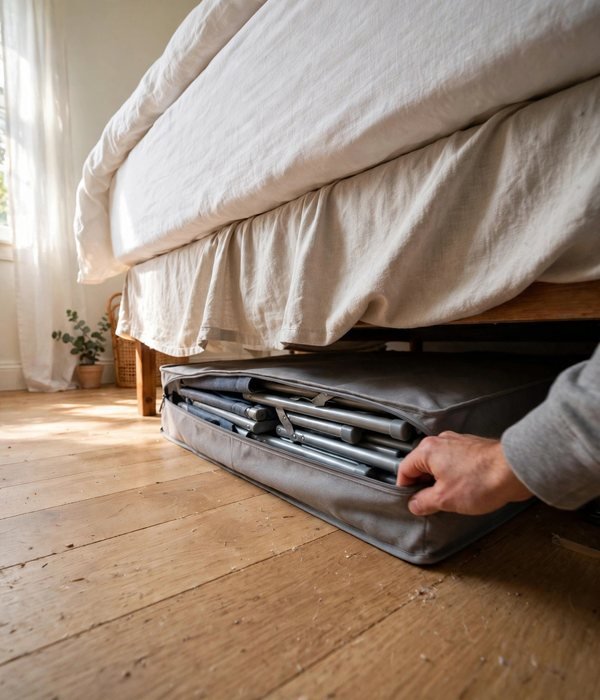
Under-bed clearance is the most underused flat storage in a small home: most bed frames leave 7 to 14 inches of space underneath, and a folded chair is only 2 to 4 inches thick lying flat. A zippered under-bed chair bag keeps dust off padded seats and gives you a handle to pull the whole stack out.
This is also the most renter-safe idea here, no screws, no wall damage, nothing to explain to a landlord. A folded 38-inch chair slides in head-first, and a queen bed hides 6 chairs completely out of sight.
- Measure your under-bed clearance, you need at least 1 inch more than the folded chair’s thickest point
- Choose a flat zippered bag about 40 inches long; skip bags with bulky wheels that eat clearance
- Lay the folded chairs flat in the bag, seats facing the same direction, backs staggered so frames nest instead of stacking lopsided
- Zip the bag and slide it in from the foot of the bed, handles facing out
- Test the slide twice: if the bag catches on the bed’s center rail, split into two smaller bags
- Tag the handle “chairs” so nobody stores boots on top and warps the frames
Tips for best results: Put the least-used chairs at the bottom of the stack. Watch out: upholstered chairs in damp basements or storage units mildew fast, under-bed in a lived-in room is fine, but skip this for humid garage storage.
5. Roll Them Away on a Chair Dolly
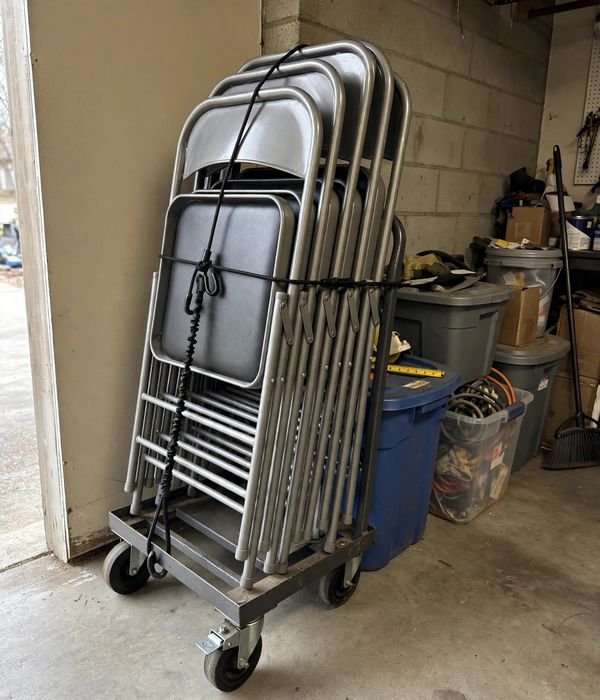
A chair dolly is the honest answer when wall space is scarce but floor space exists somewhere, a hallway nook, a laundry corner, a garage wall. A compact 100-pound-capacity dolly holds 10 folded chairs and measures about 43 by 22 by 23 inches, roughly the footprint of a small dresser.
Six to eight of your chairs weigh 30 to 50 pounds total plus the 12-pound cart, well under that rating. Step up to a 200-pound dolly and you get 14 chairs; 400-pound commercial dollies hold 42.
For holiday hosts, the win is mobility: roll the whole stack to the dining area, set up in minutes, and roll it back when guests leave.
What you can do with it:
- Keep the dolly in a garage, basement corner, or utility closet between holidays, it doubles as a transport cart on party day
- Strap the stack with the dolly’s elastic cord or a bungee so chairs do not slide off over thresholds
- Choose rubber wheels if you will roll across hardwood, hard plastic casters scuff floors
- Park it against a wall with locking casters engaged so it cannot drift into a walkway
- Use the top of the stack for lightweight extras (tablecloths, seat cushions) to squeeze more from the footprint
Tips for best results: Load heaviest chairs at the bottom for stability. Watch out: dollies are tippy on stairs and thick rugs, plan a flat roll path, and never yank a loaded dolly up a step.
6. Slide the Folded Table Behind the Sofa
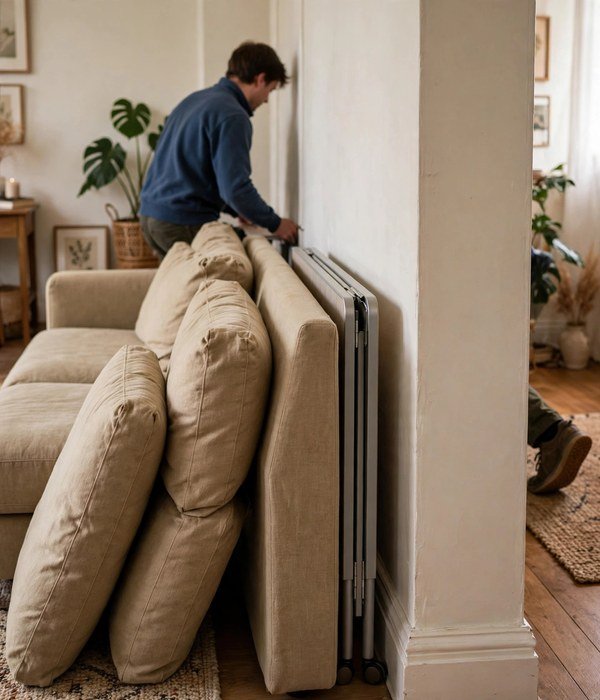
A 6-foot fold-in-half table closes to roughly 36 by 30 inches and only 3 to 3.5 inches thick, thinner than most people guess. The gap between the sofa back and the wall, which in many apartments runs 3 to 5 inches, is a legitimate storage spot.
The table’s folded weight (23 to 34 pounds for standard HDPE-top models) sits on the floor, not on the sofa, so there is no strain on furniture, the sofa just hides it. Pull it out, wipe the top, and you have seating for 6 to 8 for the holiday dinner.
- Measure the gap between your sofa back and the wall at the floor, you need at least 4 inches for a 3.5-inch-thick folded table
- Fold the table fully and engage its center lock so it cannot spring open while you maneuver it
- Slide it in top-first, long edge down, leg side facing the wall to protect the tabletop finish
- If the gap is tight, remove the sofa back cushions temporarily, then replace them to hide the table completely.
- For one-piece 6-footers (no center fold, 72 inches long), check ceiling height and stand the table upright in a closet corner instead
- Note the spot on your phone, “table behind living room sofa”, because in six months you will forget where you put it
Tips for best results: A felt strip or old towel between the table and the wall prevents scuffs. Watch out: baseboard heaters warp plastic tabletops, leave 6 inches of clearance from any heat source.
7. Bag Each Chair in a Garment Bag
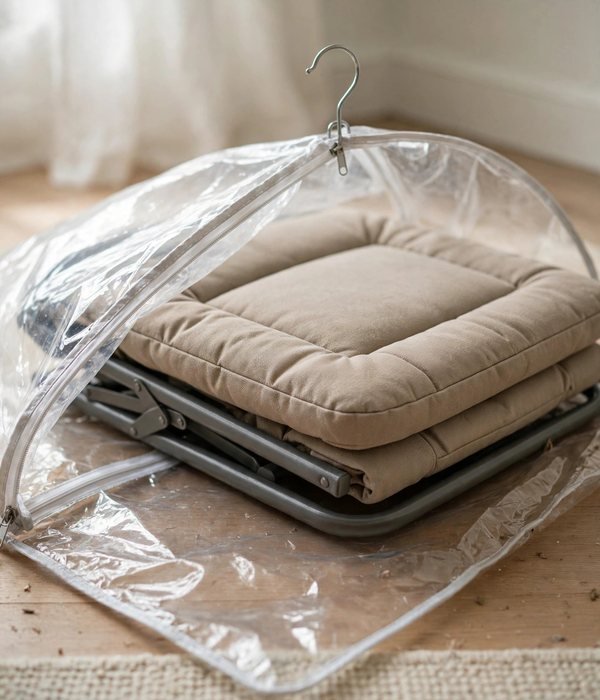
This is the cheapest trick on the list and the one that keeps padded chairs looking new. A standard zippered garment bag, the kind that costs a few dollars, slides over a folded chair like a sleeve, protecting the seat fabric from dust, closet grime, and the scrapes of neighboring chairs.
It also gives you a built-in handle and hook loop at the top, so the chair hangs or carries more easily. Closet dust settles on the bag, not the upholstery, and chairs stored touching each other do not transfer scuffs.
What you can do with it:
- Bag the chairs you use least first, the holiday-only set stays pristine while everyday chairs take the wear
- Choose clear or light-colored bags so you can see which chair is which without unzipping
- Hang bagged chairs from closet hooks or the rod by the bag’s hook loop, the bag takes the friction
- Stack bagged chairs flat on a closet shelf, the bags stop them sliding apart
- Write the chair count on masking tape stuck to one bag: “6 dining + 2 metal” ends the annual recount
Tips for best results: Bags with a full-length zipper are easier to load than top-only openings. Watch out: in humid rooms, plastic garment bags trap moisture, use breathable fabric bags or leave the zipper cracked an inch in damp spaces.
8. Hang the Folding Table from Garage Ceiling Joists
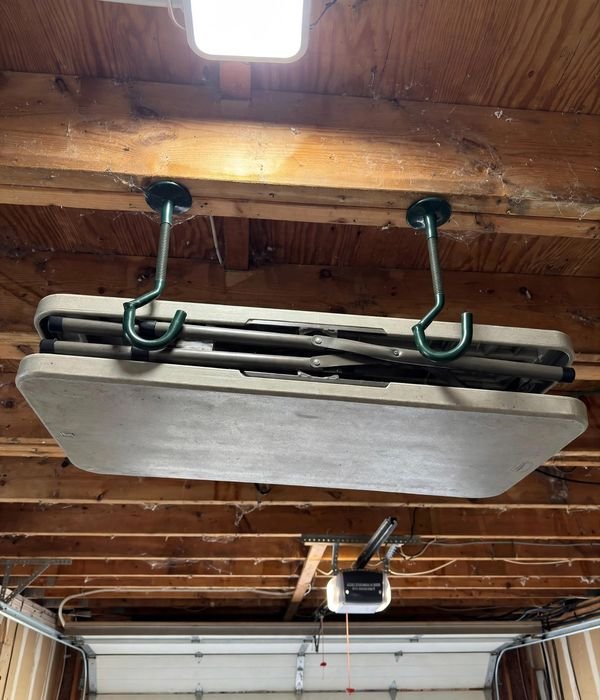
The garage ceiling is wasted storage in most homes, and a folded 6-foot table at 25 to 34 pounds is well within what two screw-in ceiling hooks can carry, individual heavy-duty screw-in hooks are rated 50 to 100 pounds each when driven into a joist.
The trick is joists, not drywall: a hook in drywall alone will pull out under a swaying 30-pound table. Spaced 16 to 24 inches apart along a joist, two hooks cradle the folded table flat against the ceiling, completely off the floor and away from cars, bikes, and project clutter.
- Locate the ceiling joists with a stud finder, mark two points 16 to 24 inches apart on the same joist
- Pre-drill pilot holes slightly smaller than the hook’s screw shaft so the wood does not split
- Screw the hooks in by hand until the threads are fully seated, no wobble when you tug them
- Fold the table, lock it, and lift it onto the hooks with a helper (30 pounds overhead is a two-person job)
- Rest the table’s long edge across both hooks so the weight distributes evenly, then give it a firm downward tug test
- Keep the hanging table clear of the garage door track, opener, and anything that swings
Tips for best results: Vinyl-coated hooks protect the table frame and stop it sliding. Watch out: never hang a table from drywall anchors, a drop ceiling, or an unverified joist, and keep it clear of the garage door’s travel path, where a slip could jam the door.
9. Folding Chair Storage Safety: Never Block Exits, Heaters, or Vents
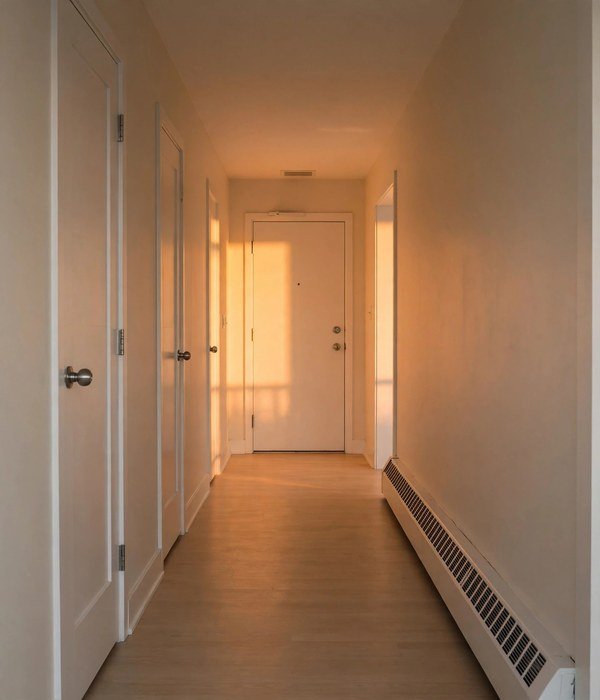
The most important storage rule is the negative one: extra seating must never block an exit path, an egress window, a radiator, a baseboard heater, or an HVAC vent.
Chairs stacked in front of a bedroom door are a fire-escape hazard; a folded table leaning against a radiator warps the plastic top and, with fabric chairs, is a genuine fire risk. Keep 3 feet of clearance in front of electrical panels and exits, and at least 6 inches from any heat source.
Every idea above exists so you never have to choose between hosting guests and keeping the house safe.
Where the safe spots are instead:
- Closet interiors and under beds: zero interference with exits, heaters, or vents, your safest defaults
- Wall hooks in garages and utility rooms: up and out of walkways, away from water heaters and furnaces
- Behind the sofa: dead space with no airflow to block and no exit to obstruct
- Chair dollies parked in a corner: keep 36 inches of clear walkway past them
- Ceiling hooks in the garage: off the floor entirely, with clearance verified from the garage door and opener
Tips for best results: Do a 2-minute walk-through after storing everything: can you reach every exit, the breaker box, and the thermostat without moving furniture? Watch out: renters, this matters doubly, blocking a fire exit can violate your lease, so the no-screw options (under-bed, behind-sofa, dolly) are your safest bets.
Conclusion
Holiday hosting does not require a bigger house, it requires a tape measure and a home for every extra chair. If you do nothing else, do point 1’s 60-second math and point 9’s safety check: know your folded thickness times your chair count, and never trade a blocked exit for convenience.
Best for apartments: my pick is the behind-the-sofa table slide plus under-bed chair bags. Together they hide 6 chairs and a 6-foot table in space you already have, need zero screws, cost less than $20 total, and take about 15 minutes to set up.
The wall rail is the better long-term answer if you own your place and host often, but for most apartment hosts, the no-damage duo wins.
hosting Thanksgiving in a small apartment · prepping a small home for holiday guests
Frequently Asked Questions (FAQ)
What is the best folding chair storage for a small apartment?
If you cannot use screws, slide bagged chairs under the bed and the folded table behind the sofa, both need zero hardware and hide a full 6-chair set. If small screws are allowed, a pair of stud-mounted hooks or S-hooks on the closet rod holds the set in about 18 inches of closet width.
Measure folded thickness first: 6 metal chairs need roughly 12 to 18 inches.
How much space do 6 folding chairs take up when folded?
About 12 to 18 inches of width for slim metal chairs (2 to 3 inches thick each), and up to 32 inches for padded chairs (3 to 4 inches each). The gotcha is height: a folded plastic chair stands about 38 inches tall, so measure the spot’s height too.
Six chairs weigh 42 to 50 pounds total, fine for wall hooks, but only mounted into studs.
Can I store folding chairs on wall hooks if I rent?
Yes, with two conditions: mount only into studs, and fill the screw holes with spackle when you move out, two small holes count as normal wear in most leases. If your lease forbids holes, use the no-screw options instead: under-bed bags, a rolling dolly, or the closet rod.
Never use adhesive hooks for chairs, they are not rated for 40-plus pounds of swaying load.
How do I store a 6-foot folding table in a small home?
Fold-in-half models close to about 36 by 30 inches and 3 to 3.5 inches thick, so the 3-to-5-inch gap behind your sofa is the classic apartment spot. Alternatives: stand it upright in a closet corner, slide it under the bed if clearance allows, or hang it from two joist-mounted ceiling hooks in the garage.
Keep it at least 6 inches from baseboard heaters.
How many chairs can a chair dolly hold?
A compact 100-pound dolly holds about 10 folded chairs and measures roughly 43 by 22 by 23 inches; a 200-pound model holds 14. Do the weight math first: six 8-pound chairs are 48 pounds, plus the 12-pound cart, so a 100-pound dolly handles your holiday set with margin. Always strap the stack and lock the wheels when parked.