
Christmas is about five weeks out, and your living room is the same size it was in July. If a full six-foot tree would swallow the only walkway between your couch and your front door, these Christmas tree alternatives for small spaces still get you a tree. A real, decorated, glowing tree. Just reimagined for the wall, the corner, or the shelf.
Below are eight ideas: wall trees, ladder trees, branch trees, and two more that barely touch your floor at all. Every one lists exact measurements, what to buy, the price band, and whether it is renter-safe. Pair any of them with your wider Christmas decor ideas and you are done decorating in an afternoon.
Why a Full Tree Is the Wrong Tool for a Small Apartment
Here is the math that kills most small-space Christmases. A standard six-foot artificial tree needs a footprint about four feet deep and four feet wide, plus another foot of clearance on each side so people can walk past it.
That is roughly 25 square feet. In a 500-square-foot apartment, one tree can eat five percent of your living space.
The mechanism behind every idea below is simple: move the tree off the floor and onto vertical real estate. Your walls and corners are empty volume you already own.
A wall tree uses about nine inches of depth. A corner ladder claims a corner you could not walk through anyway. You keep the silhouette, the lights, and the ornaments, and you keep your walkways.
This is also a storage question, not just a decor one. Full trees come with giant boxes that haunt closets all year. Most of these alternatives fold flat or collapse to a few inches deep.
Small-space living means every decoration has to justify its January footprint. All eight of these pass that test.
1. Wall-Mounted Tree Kit: Tree Presence at Nine Inches Deep
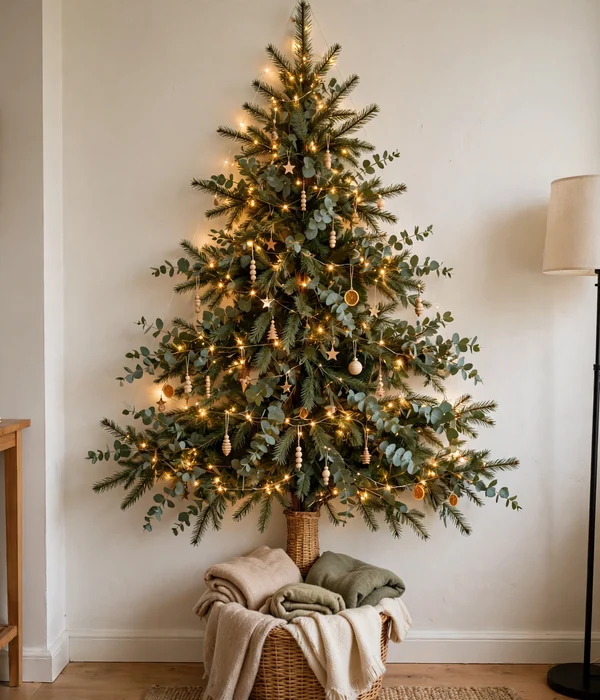
The closest thing to a real tree without touching your floor. These kits hang realistic-looking pine and eucalyptus strands on nearly invisible monofilament line, building a full tree silhouette on your wall.
A typical kit measures 45 inches tall, 40 inches wide, and sits just 9 inches out from the wall. Compare that to a six-foot artificial tree, which reaches about 48 inches deep. You get the shape, the greenery, and the ornament hooks at one-fifth the depth.
Buy a kit rated for indoor hanging, polyester and plastic, in the 40 to 50 inch height range. Price band: under $60 for most ready-made kits. Check the hanging hardware: a keyhole slot or loop needs either one nail or a large adhesive hook rated for at least 10 pounds.
Renter flag: damage-free on an adhesive hook. At teardown, pull the tab straight down, not out, and the strip releases cleanly.
- Mark the center of the wall, about 60 inches from the floor, so the finished tree hangs at eye level.
- Clean the spot with rubbing alcohol, press the hook on, and let it cure for 1 hour before hanging.
- Hang the top strand first, let the rest drop, then fluff each layer outward until the silhouette fills in.
- Add ornaments under 2 ounces each, bottom to top, and tuck a basket underneath as the trunk.
Who it does NOT work for: collectors of heavy glass heirlooms, which will pull the strands crooked. Textured wallpaper is another bad surface, since adhesive hooks will not grip it.
2. Removable Vinyl Wall-Decal Tree: The Zero-Install Tree
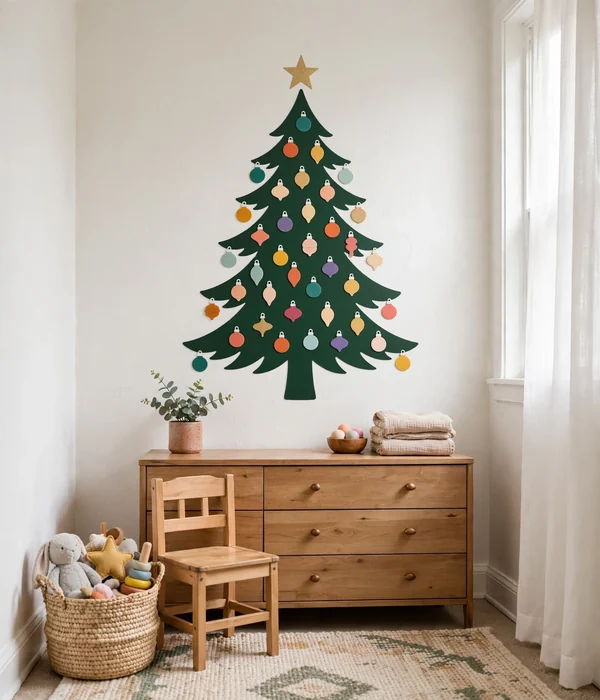
A tree with literally zero depth. Large vinyl decal sets build a tree 23 to 60 inches tall directly on your wall, and many come with a separate sheet of ornaments, stars, and presents the kids can stick on.
The mechanism is pure visual trickery: from across the room, a 48-inch decal in dark green reads as a tree silhouette, and your floor stays completely clear. Setup takes about 20 minutes with no tools at all.
Buy a removable low-tack vinyl set, not a permanent one. Oracal 631 or anything labeled indoor/temporary is the safe choice. Sets around 23 inches tall run about $20; full-size 48 to 60 inch sets run under $30.
Renter flag: fully damage-free. Peel slowly from one corner when January comes, and any faint residue wipes off with a damp microfiber cloth.
Where it works best:
- Nursery and kids’ rooms, where unbreakable “ornaments” are a feature
- Rental bedrooms and studio entries, where you cannot hang anything heavy
- Hallways and tight landings, where any depth at all blocks the path
- Doubling up: one on the wall, and a small real tree alternative elsewhere
- Apartments with strict lease rules about nails and screws
Who it does NOT work for: textured or freshly painted walls. Vinyl will not grip texture, and paint needs about 30 days to cure before any adhesive touches it.
3. Leaning Ladder Christmas Tree: A Tree That Is Also a Shelf
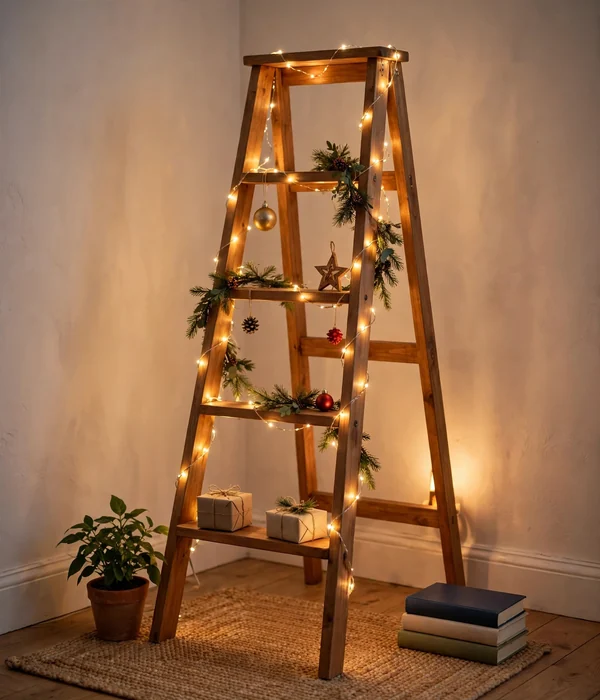
A wooden A-frame ladder, usually about 4 feet tall and 20 inches wide at the base, becomes a tree-shaped shelf for ornaments, garlands, and small wrapped boxes. The mechanism is vertical stacking: four to five rungs give you the display area of a tree’s outer branches without the 4-foot footprint.
It leans against the wall, so the base reaches only about 18 inches into the room. Bonus: it works as a blanket or plant shelf the other eleven months.
Buy a solid-wood leaning ladder, 4 to 5 feet tall, with at least four rungs and a weight rating of 20 pounds or more. Price band: under $50 unfinished, slightly more for stained or painted versions. Avoid hollow composite ladders, which flex under ornament weight.
Renter flag: freestanding, zero holes, zero adhesive. It just leans.
- Unfold or lean the ladder at a slight angle, rungs level, feet flat on the floor.
- Stabilize the top against the wall with a 3-inch strip of museum putty or one small adhesive hook behind the top rung. Clean with rubbing alcohol and cure 1 hour first.
- Drape one 50-count LED string from the top down, weaving around the side rails.
- Hang heaviest ornaments on the bottom two rungs and lightest at the top so the frame never tips forward.
Who it does NOT work for: homes with toddlers who climb. A leaning ladder with glass ornaments is a tipping risk around small children.
4. Corner Ladder Tree: The Corner You Were Not Using Anyway
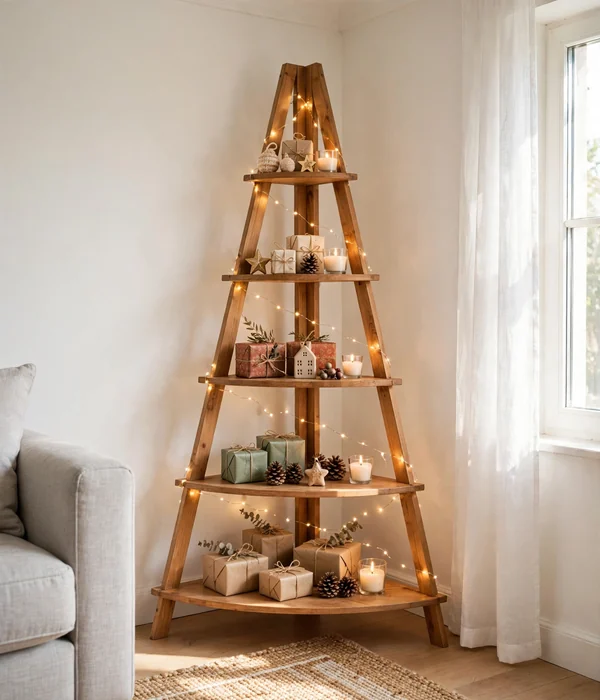
Corners are dead space in almost every small apartment: too tight for furniture, too far from outlets for anything useful. A corner ladder tree turns that dead space into a tree.
These triangular shelves stand about 5 to 5.5 feet tall with sides around 18 inches, fitting snugly where two walls meet. You get four or five graduated shelves for ornaments, candles, and small gifts, in a corner you could not walk through anyway.
Buy a solid-wood corner shelf ladder, 5 to 6 feet tall, with at least four tiers. Price band: under $60. Check that the shelves are at least 8 inches deep at the back, or standard ornaments will hang off the edge.
Renter flag: freestanding. It wedges into the corner under its own weight and needs no mounting.
Where it works best:
- The dead corner beside the TV stand or couch, where a full tree would block the screen
- Small dining nooks, with the bottom shelves holding serving pieces under the tree
- Entryways, where it catches keys and mail on the lower tiers all year
- Bedrooms, with books and a small lamp on it after the holidays
- Studios, where one corner display replaces a whole console table
Who it does NOT work for: corners with heating vents or radiators. Hot dry air will cook real garlands and can warp thin wooden shelves over a month.
5. Lighted Birch Twig Tree: Four Feet Tall on One Square Foot
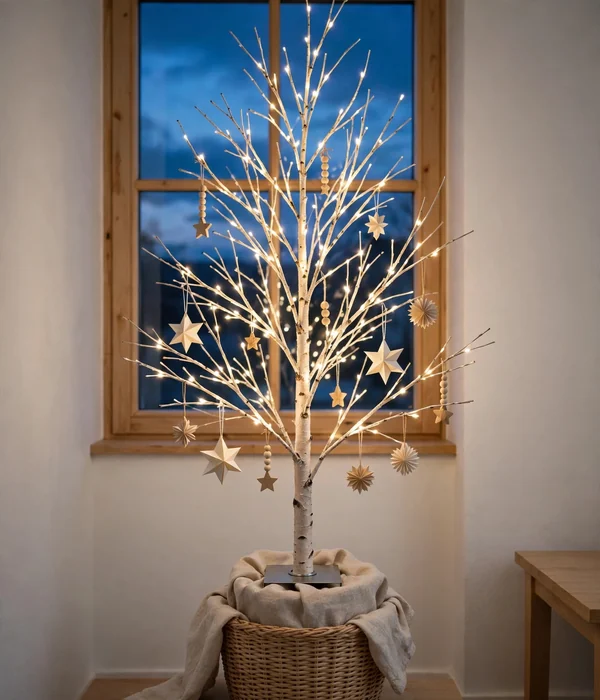
This is the minimalist’s Christmas tree, and it fits a minimalist Christmas decor scheme without trying. A pre-lit birch twig tree stands 4 feet tall with bare white or brown branches studded with about 72 warm-white LEDs.
The base is roughly 12 inches square, so the whole tree occupies one square foot of floor. The branches are stiff enough to hold lightweight ornaments, and the LEDs do the decorating work for you.
Buy a 4-foot pre-lit twig tree with a sturdy metal base, warm-white LED lights (2700 to 3000K), and a cord long enough to reach your nearest outlet. Price band: under $50 for the 4-foot size. Battery-operated versions exist if your only free corner has no outlet, and the good ones include a 6-hour timer.
Renter flag: plug-and-play. No mounting, no adhesive, nothing on the walls.
What you can do with it:
- Hang paper or wooden ornaments up to 1 ounce each; the branches flex under heavier loads
- Wrap the base in a linen throw or place it inside a 14-inch basket to hide the metal stand
- Cluster two 2-foot twig trees on a console for a symmetrical mantel look
- Leave it up after Christmas as everyday ambient lighting, it earns its shelf space
- Move it room to room for parties, since it weighs under 8 pounds
Who it does NOT work for: heavy glass ornament collectors. Twig branches bend and tangle under anything over about an ounce.
6. Hanging Branch Wall Tree: Big Tree Energy on Two Hooks
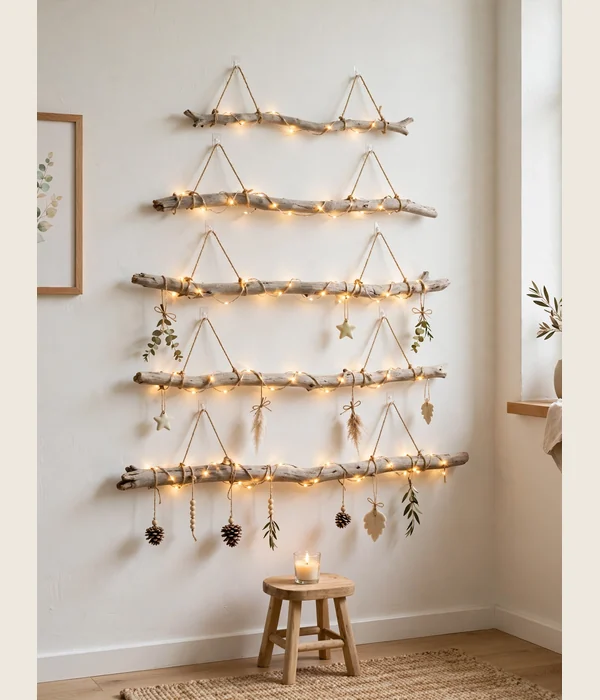
The most dramatic option for renters. Take driftwood branches or simple wooden dowels, 3 to 4 feet wide, and hang them horizontally on the wall in graduated lengths, longest at the bottom and shortest at the top.
Strung with lights and ornaments, it reads unmistakably as a tree from across the room. It hangs on two large adhesive hooks, uses zero floor space, and stores as a bundle of sticks behind a bookshelf.
Buy pre-made graduated branch sets (5 to 7 branches, 24 to 42 inches wide) or cut straight 1-inch-thick branches yourself. Price band: under $40 pre-made, under $20 as a DIY. You will also need two large adhesive hooks rated 4 pounds each and clear fishing line or jute cord.
Renter flag: fully damage-free. Two hooks, no screws, and the teardown takes five minutes.
- Measure a wall span 36 to 48 inches wide and mark the two hook positions with a level, about 55 inches from the floor.
- Clean both spots with rubbing alcohol, press the hooks on firmly, and let the adhesive cure for 1 hour before hanging anything.
- Tie each branch to the hooks with cord, longest branch lowest, spacing them 8 to 10 inches apart.
- String lights first, then ornaments, keeping each branch’s load under 3 pounds.
- In January, pull each adhesive tab straight down, not out, and the hooks release without a mark.
Who it does NOT work for: perfectionists who want symmetry. Natural branches are gloriously crooked, and the charm is in the irregularity.
7. Flat-Back Half Christmas Tree: A Full-Size Tree at Half the Depth
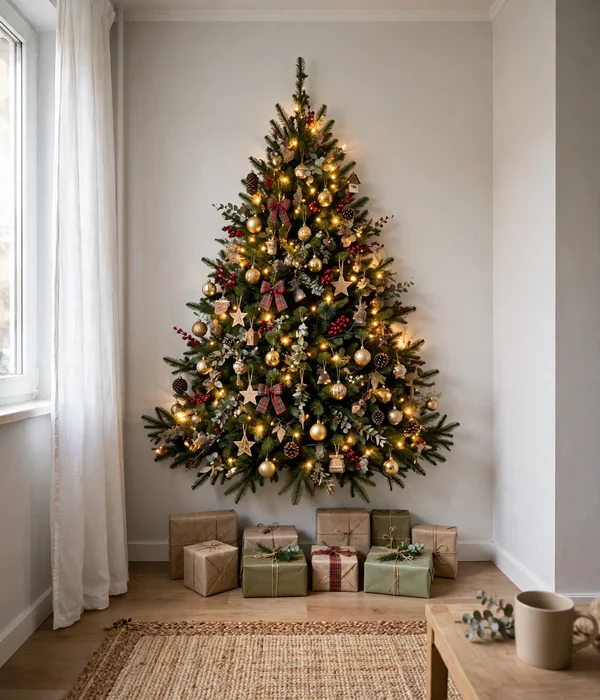
For the person who wants an actual Christmas tree, just smaller in the only dimension that matters. A flat-back (half) tree is literally half a tree: a typical 6.5-foot version measures 43 inches wide but only 22 inches deep, and it stands flat against the wall.
You get real branches, tip counts of 400 or more, and room underneath for presents. A comparable full tree reaches 48 inches into the room, so you reclaim about two feet of walkway.
Buy a half tree in the 5.5 to 7.5 foot range with hinged branches. Pre-lit versions with 150 to 250 warm-white lights save you a whole stringing session.
Price band: under $100 for basic PVC models, more for premium realistic foliage. Always check the depth spec, not just the height.
Renter flag: freestanding on its own stand, no wall mounting. It leans flush against the wall.
What to check before you buy:
- Depth under 24 inches for a true half; some “slim” trees are full trees with fewer branches
- Hinged branches, not hook-in, or setup takes an hour
- A stable stand, since the weight sits closer to the wall than on a full tree
- Pre-lit if you hate stringing lights, unlit if you already own a strand you love
- The box size: most collapse into a box about 45 by 20 inches, measure your closet
Who it does NOT work for: rooms where the only free wall is also the main walkway. A half tree still needs its wall.
8. Tabletop Christmas Tree: The Two-Foot Tree That Feels Full
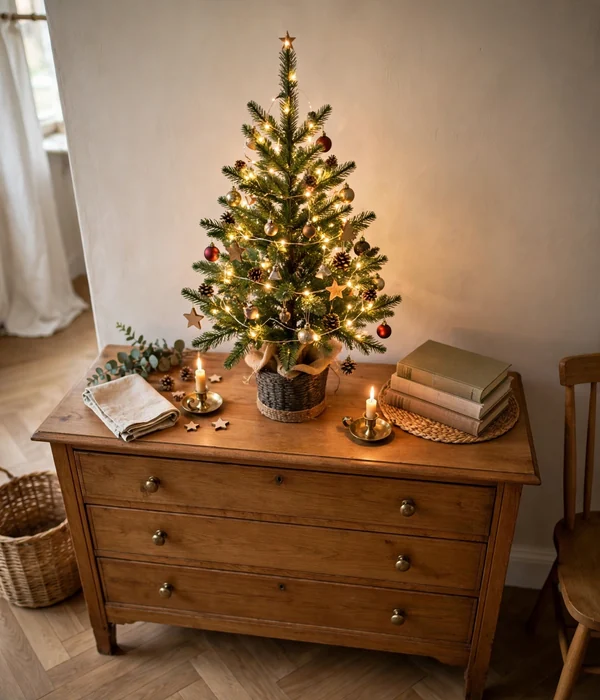
The smallest option with the biggest decorating payoff per inch. A 2 to 3 foot artificial tree with a base 12 to 18 inches wide sits on a sideboard, desk, bookshelf, or dining table, and because it is at eye level, it feels bigger than it is.
Dress it with miniature ornaments, a 20-count light string, and a tiny topper, and it photographs like a full tree. It also pairs beautifully with Christmas mantel decor for small living rooms if your mantel needs a tree-shaped anchor.
Buy a 2 or 3 foot tree with a weighted base and at least 100 branch tips so it does not look sparse. Pre-lit battery versions usually take 4 AA batteries and include a 6-hour timer. Price band: under $40 for most, under $25 for the basic 2-foot size.
Renter flag: it sits on furniture. Nothing touches your walls at all.
Where it works best:
- Sideboards and console tables, where it anchors the rest of your holiday display
- Desks and bookshelves, bringing Christmas into rooms that never had a tree
- Dining tables as a centerpiece, where a full tree would block conversation
- Kids’ rooms, in the 2-foot size, as their own unbreakable decorating project
- Small entryways on a narrow table, greeting guests at the door
Who it does NOT work for: homes where every surface is already full. A tabletop tree needs a table, and if your sideboard is a mail-and-keys landslide, fix that first.
Conclusion
Best for renters: the leaning ladder tree. It needs no hooks, no nails, no wall space. It just leans in a corner and holds your whole ornament collection.
When January comes, you take the ornaments off and it becomes a blanket ladder, a plant stand, or a bookshelf. Nothing else on this list works eleven months a year.
If you want the biggest visual impact for the least effort, the hanging branch wall tree is the runner-up: two adhesive hooks, one afternoon, and a tree that looks custom-made. Whichever you choose, measure first, buy once, and enjoy a Christmas that fits your apartment instead of fighting it.
Frequently Asked Questions (FAQ)
Will a wall-mounted tree damage my rental walls?
If you hang it from adhesive hooks, no. Clean the spot with rubbing alcohol, press the hook on, let it cure for 1 hour, and at teardown pull the tab straight down, not out, and the strip releases cleanly. If you use a nail instead, you will have one small hole to fill with spackle. Avoid textured walls and paint less than 30 days old, since adhesive can pull fresh paint.
Are half Christmas trees stable around dogs and toddlers?
A flat-back half tree is more stable than a full tree because its weight sits closer to the wall, but it is still top-heavy. If you have a large dog with a happy tail or a climbing toddler, anchor the top to the wall with a small adhesive hook and fishing line. Keep glass ornaments on the upper branches and shatterproof ones at tail height, and the tree will survive the season.
Can I hang my real ornaments on a branch or twig tree?
Lightweight ornaments, yes; heavy glass, no. Twig and branch trees handle ornaments up to about 1 ounce each before the branches flex and tangle. Paper, wood, felt, and small plastic ornaments are perfect. If your collection is mostly heavy glass heirlooms, choose the ladder tree or the flat-back half tree instead, since both have rigid supports built for real ornament weight.
Which alternative looks most like a real Christmas tree?
The flat-back half tree, by a wide margin. It is a genuine artificial tree with hundreds of branch tips, just cut in half depth-wise, so from the front it is indistinguishable from a full tree. The wall-mounted pine kit is the runner-up, since the real greenery mix reads as authentic. If realism is your top priority and you have one free wall, the half tree is the honest answer.
How do I store these alternatives after Christmas?
Most of them nearly disappear. The wall kit and branch tree bundle into a flat package that slides behind furniture. The ladder tree folds to about 4 inches deep. The twig tree breaks into a few sections in its original box. The half tree collapses into a box roughly 45 by 20 inches, still large but far smaller than a full tree box. The decal rolls up in its tube and the tabletop tree fits on a closet shelf.