Here’s the truth nobody puts on the toy-storage pin: the beautiful playroom you organize on Saturday will be empty by Sunday afternoon, because the toys will have migrated to the living room, your bedroom, and, somehow, the bathroom. Kids don’t play where the storage is. They play where YOU are.
That’s the room where the toys land, every single time.
So I build toy storage backwards. Instead of starting with a perfect playroom and hoping kids use it, I start with the migration routes: the living room corner where the blocks always end up, the bedroom where the stuffed animals breed, the hallway where the art supplies stage their escape.
Every idea below follows the containment rule: storage works when it’s in the room the toys actually land in, sized for the toys that land there, and simple enough that a five-year-old puts things back faster than they pull them out.
This guide covers all three territories with exact bin sizes, furniture specs, and the safety rules that are non-negotiable with kids in the house (anchoring straps on every tall unit, lid safety on every chest). Pick the ideas for the rooms your toys actually invade.
Why Toy Storage Has to Work Where the Toys Land
Toy migration follows a pattern you can set a clock by. A child wakes up in the bedroom (stuffed animals, books), moves to the living room by mid-morning (blocks, cars, the entire LEGO collection), and returns to the bedroom by evening.
Most parents buy one big storage system for the playroom, the room toys visit the least, and then wonder why cleanup feels like bailing out a boat with a hole in it.
Real toy storage solutions flip the logic. You put containment where the toys land: a lidded basket in the living room for the daily drift, cube bins in the bedroom for the categories that live there, and the playroom gets the deep storage, rotation bins, overflow, the games that need a table.
This is the core principle behind every serious toy organization system: one landing spot per room, one category per bin, and a cleanup routine a tired kid can finish in five minutes. If cleanup takes longer than play did, the system is wrong, not the child.
The second rule is developmental. Toddlers (under 3) need open bins at floor level, lids are a barrier they’ll just dump around. Preschoolers can manage one lid, one category.
Size the storage to the hands that use it: bins no taller than 12 inches for under-5s so they can see and reach in, picture labels instead of words until reading age, and nothing heavier than a child can lift safely.
Bins, Cubes & Everyday Containment
1. The 2×4 Cube Unit: The Workhorse of Toy Storage
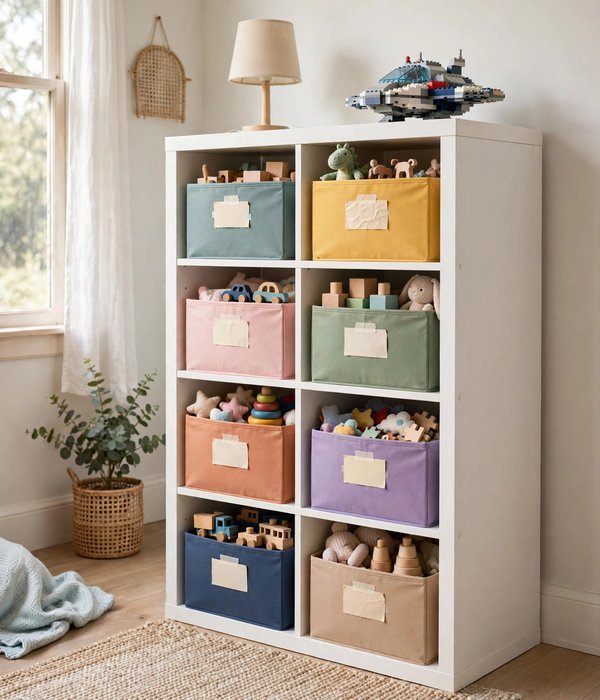
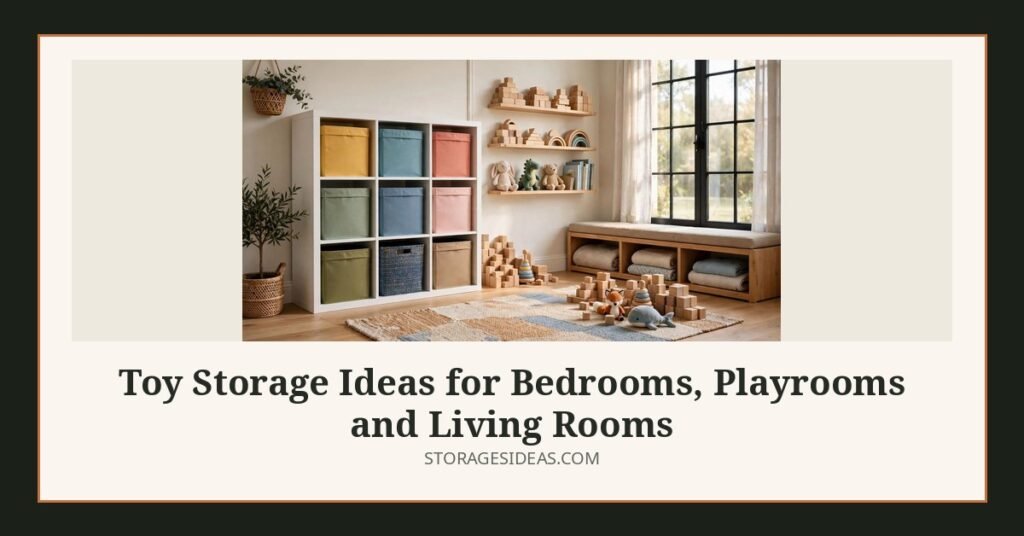
If you buy one piece of toy furniture in your life, make it the standard 2-by-4 cube unit, roughly 58 inches wide, 30 inches tall, 15 inches deep, holding eight bins of the 11-inch cube size.
It’s the only piece that survives every age: open bins for toddlers, labeled bins for preschoolers, game boxes stacked bin-free for older kids. The footprint fits a bedroom wall, and the 30-inch height doubles as a display shelf on top.
Safety first, before anything else: a loaded cube unit is a tip-over risk the moment a child climbs it, and children climb everything. Anchor every cube unit to a wall stud with the included anti-tip strap or a $8–15 aftermarket anchor kit. This is not optional and not “if you have toddlers.” Ten minutes, one stud finder, done.
What you can do with it:
- Eight bins = eight toy categories: blocks, cars, dolls, animals, art, games, dress-up, and one “random” bin you’ll be grateful for
- Two units side by side make a 10-foot storage wall for $80–160 total in the classic $40–80-per-unit range
- Bins at $8–15 each in mixed colors let kids sort by color before they can read labels
2. One Category Per Bin, No “Miscellaneous” Bins
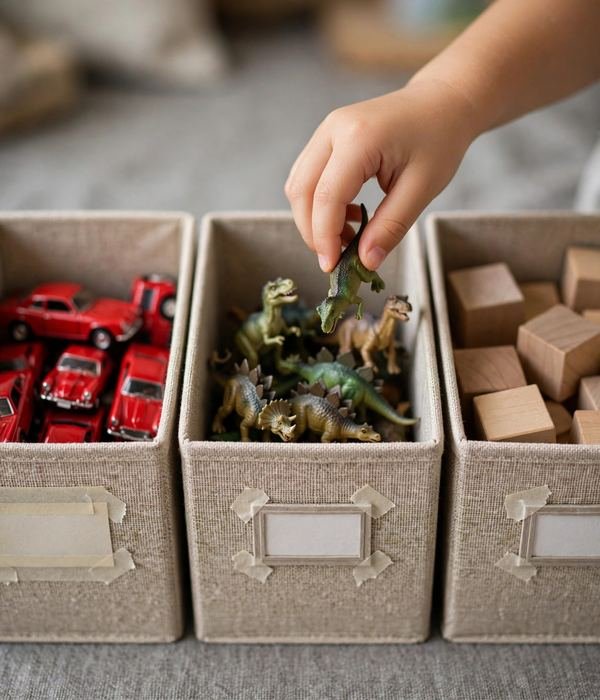
The single biggest reason toy bins fail is the junk bin. One bin labeled “toys” becomes a black hole, nothing gets found, everything gets dumped. The fix is boring and absolute: every bin holds exactly one category, narrow enough that a child can decide where something goes in two seconds. “Cars” works. “Small toys” doesn’t.
That means more bins than you think: six to ten 11-inch bins for a typical bedroom collection, not three. Narrow categories make cleanup a sorting game, preschoolers genuinely enjoy “find all the dinosaurs” as a speed round. For pre-readers, skip word labels: tape a photo of the actual toys to the bin front.
Photo labels cut cleanup arguments in half because there’s no interpretation.
Tips for best results:
- Sort the floor pile into categories FIRST, then buy that many bins, most families need 6–10, not the 3 they guessed
- 11-inch cube bins fit the standard unit; 13-inch bins only fit 15-inch-deep units, measure your cubbies first
- Watch out: bins deeper than 14 inches swallow small toys whole, kids stop seeing the bottom and stop using the bin
3. Open Bins for Toddlers, Lidded Bins for Everyone Else
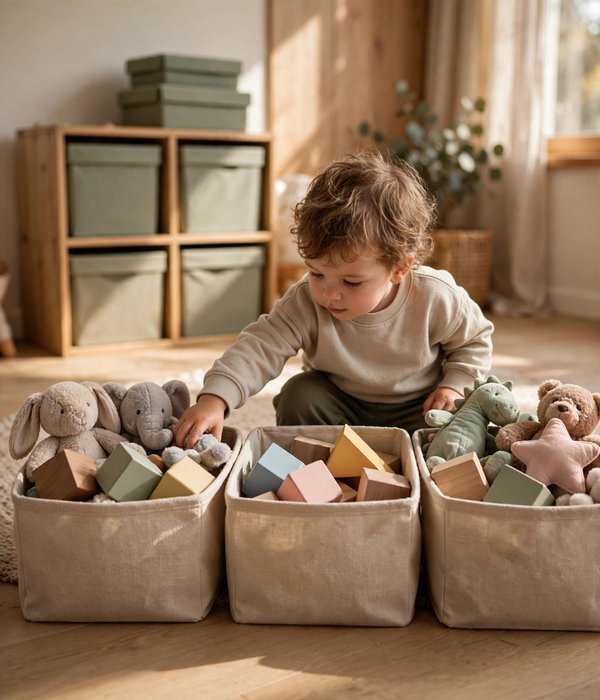
Storage a child can’t open is storage a child won’t use, it becomes a lid they remove once and leave on the floor. For under-3s, use open-top bins at floor level: low fabric cubes or shallow 6-to-8-inch trays. The rule of thumb is reach: if a toddler can’t see into it while sitting, it’s the wrong bin.
Open bins also remove the finger-pinch risk of lids.
Once kids hit 3 to 4, lids become an asset. Lidded bins stack (doubling capacity), hide visual clutter, and keep categories separated during transport. The transition test is motor skills: can the child open and close the lid one-handed while holding a toy? Keep at least the bottom row open for the youngest sibling.
What you can do with it:
- Toddler row: 3–4 open fabric bins, 11×11×7 inches, at floor level
- Preschool row: same bins with snap lids added ($2–4 per lid) once lids stop being floor clutter
- School-age: stackable lidded bins two high, 16 categories in the same footprint
4. Clear Bins for the “Where Is It?” Categories
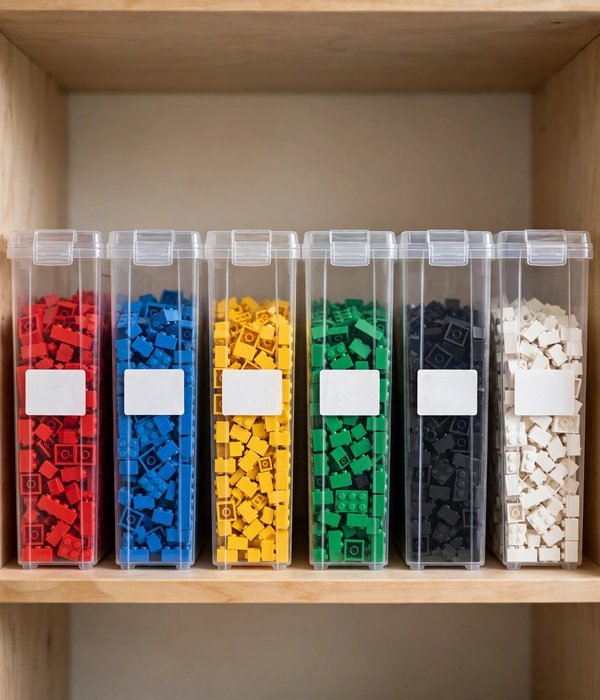
Some categories live or die on visibility: LEGO bricks, craft beads, game pieces, doll accessories. In opaque bins they effectively don’t exist, kids forget and dump every bin hunting for one piece. Clear bins solve it: the contents ARE the label.
A 6-quart clear shoe box ($2–4) is the perfect unit, big enough for one LEGO color, small enough to carry, and they stack ten high.
Reserve clear bins for small-parts categories only (20–30% of your bins); big toys stay in solid colors to avoid visual noise. Add a one-photo label anyway, it turns “which clear bin?” from a hunt into a glance.
Tips for best results:
- 6-quart boxes (14×8×5 inches) for LEGO colors and beads; 16-quart (17×11×7) for doll clothes and figures
- Lids on every clear bin, small parts migrate through open bins into the carpet
- Watch out: clear bins + sunlight = faded toys; keep the art shelf out of direct window light
5. Under-Bed Rolling Bins for the Bedroom Overflow
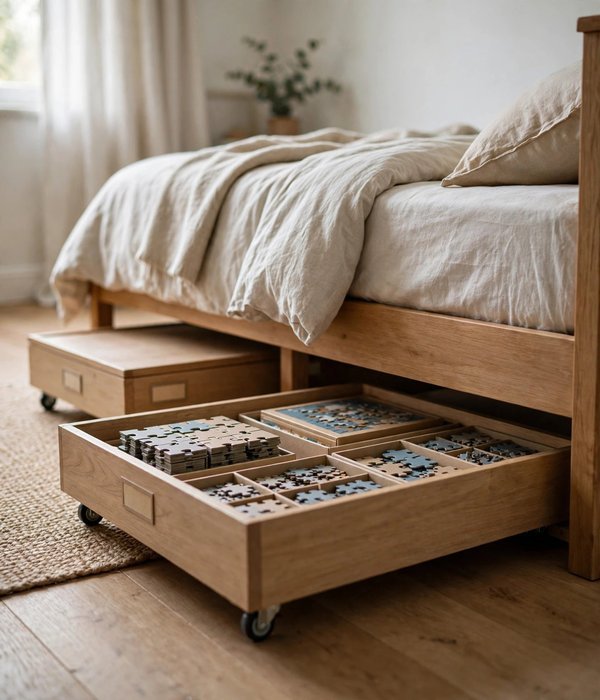
The space under a kid’s bed is 30 to 40 cubic feet most families leave empty while toys pile up three feet away.
Low rolling bins, 6 to 7 inches tall, on casters, sized to the bed’s clearance (most frames give 6–10 inches), turn it into the bedroom’s overflow valve: puzzles between rotations, the board games too big for the cube unit, the “keep but not now” toys.
Casters matter: bins a child drags get abandoned half-pulled-out; bins on wheels glide out and back with one hand. Go shallow, a 12-inch bin becomes a cave where toys are forgotten; a 6-inch bin keeps everything one layer deep. Two to three bins per twin bed; label the ends, since that’s the face you see.
What you can do with it:
- Measure clearance first: 6-inch bins for platform beds, up to 10-inch for standard frames
- One bin per category: puzzles, dress-up overflow, keep-but-not-now toys
- The visible-end label trick: photo or word label on the short end facing the room
6. The Donation Box That Never Leaves
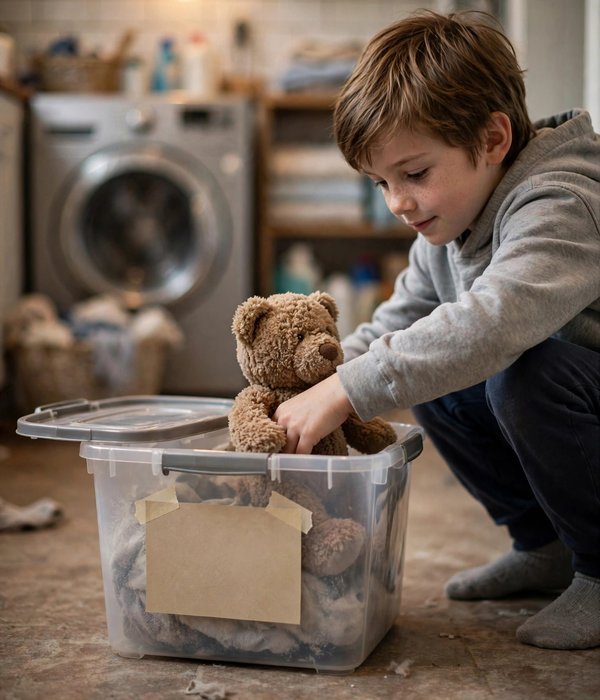
Toy clutter has an input problem: birthdays, holidays, and grandparents add 30–50% more toys a year while nothing leaves. The fix is a permanent donation box, a sturdy lidded bin kept in the closet or laundry room, always open for deposits. Outgrown, broken, or unloved toys go in the box that day.
No quarterly purge marathons, just a standing exit door.
The psychology works because the decision is small and immediate. “Do we still love this?” is easy about one toy on a random Tuesday; it’s paralyzing as a 200-toy Saturday project. When the box fills every 2–3 months, it goes to donation in one trip, and you replace the box the same day so the exit never closes.
Tips for best results:
- 18-gallon lidded tote: big enough to matter, small enough to carry full
- Location is everything: closet floor or laundry room, out of the play flow, on the daily path
- Watch out: never let kids see you rescue items back out, the exit door has to feel permanent or deposits stop
Furniture That Stores
7. The Storage Ottoman: Seating, Table, and Toy Vault
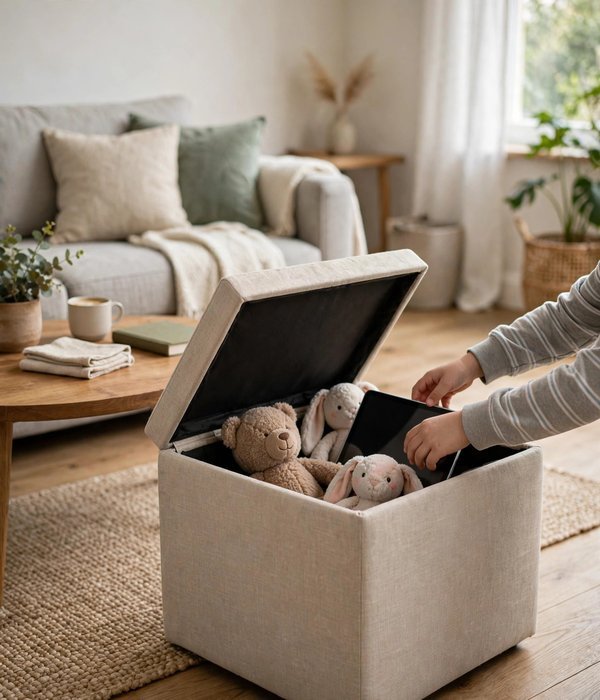
The storage ottoman is the hardest-working kid furniture ever designed: a seat, a footrest, and 2 to 4 cubic feet of hidden toy storage in one 30-by-15-inch footprint. In a living room, it’s the difference between toys-on-the-floor and toys-gone in the ten seconds before guests arrive.
Lid lifts with one hand, toys go in by the armful, lid closes, visual peace. No sorting, no system: this is containment, not organization, and for shared rooms that’s exactly right.
Shop for the hinge, not the fabric. A soft-close hinge is worth real money, a 15-pound lid dropping on fingers is an ER visit. Look for a lid that stays open at 90 degrees on its own. In the $60–120 range you get solid hinges and wipeable fabric; under $50, test the hinge in person.
What you can do with it:
- 2–4 cubic feet swallows the daily drift: remotes, tablets, the LEGO tray, coloring books
- Two small ottomans beat one big one, each kid gets “their” vault and cleanup becomes a race
- Wipeable fabric: juice boxes happen, and this piece sits in the splash zone
8. Bookcases With Doors: Display Up Top, Chaos Behind Closed Doors
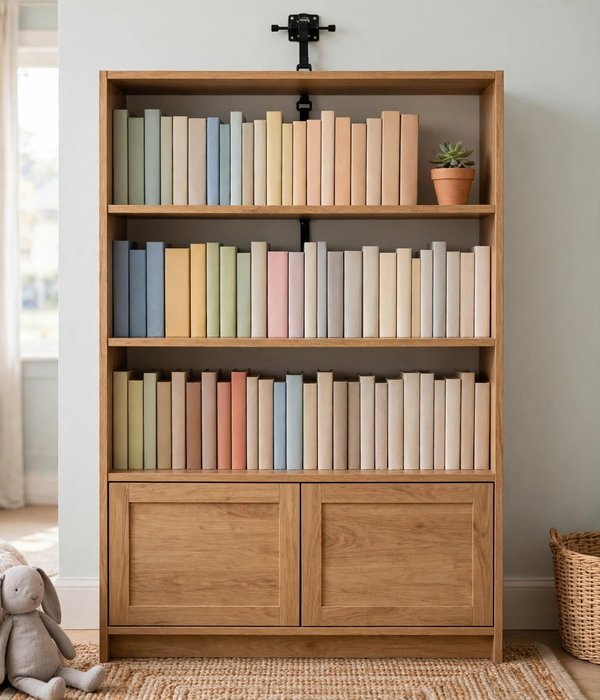
Open bookcases in kids’ rooms look great on day one and become visual noise by day three. The fix: doors on the lower half. A standard 5-shelf bookcase (30×72 inches) with doors on the bottom two shelves gives you the curated look up top and honest toy chaos behind closed doors below, reachable by kids, calm for guests.
The anchoring rule applies double here: a 72-inch bookcase is the classic tip-over hazard, tall, narrow, irresistible to climb. Anchor every bookcase over 27 inches tall to a wall stud with anti-tip straps, no exceptions, regardless of the child’s age. Straps cost $8–15 and install in ten minutes, the single highest-value safety purchase in this guide.
Tips for best results:
- Doors on bottom two shelves, open on top three: the 60/40 calm-to-access ratio
- Magnetic cabinet latches ($6 for 4) keep toddler shelves closed without locks adults fumble
- Watch out: glass doors + kids’ rooms is a combination to avoid; solid or fabric fronts only
9. Toy Chests Without the Lid Hazard
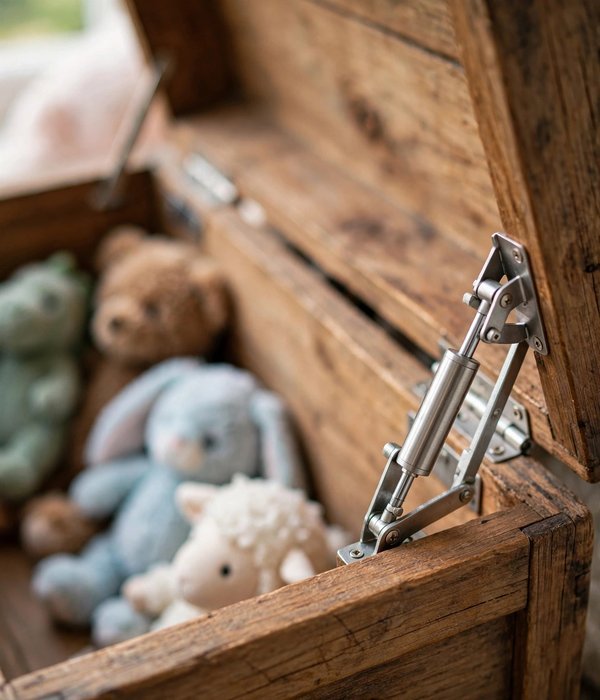
The classic wooden toy chest is a nostalgia trap: heavy hinged lid, deep interior, and a documented history of lid injuries. If you love the look, know the safety spec cold.
A safe chest has a spring-loaded or slow-close lid support that holds the lid open in any position and can’t slam, ventilation gaps (so a climbing child can’t be sealed in), and no latch a child can’t open from inside. A $15–25 soft-close support retrofits an old chest in an afternoon.
Better yet, skip deep chests for daily use, a 36-inch-deep box is where toys go to be forgotten. Shallow wins: 18-inch chests, or two small ones instead of one big one. Let the chest hold the bulky categories, ride-ons, the dollhouse, sports gear, never small toys.
What you can do with it:
- Safe-lid checklist: holds open at any angle, no slam, ventilation gaps, no exterior lock
- 18-inch depth maximum for daily use; deeper only for bulky items
- One chest per bulky category, not one chest for “toys”
10. The Rolling Craft Cart: Art Supplies That Come to the Table
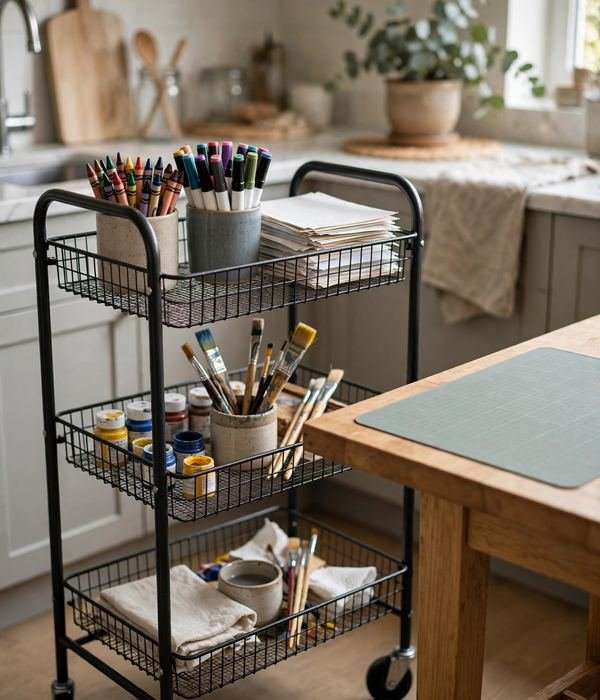
Art supplies spread across every flat surface because they need a table, and the table is wherever the family is. The rolling three-tier cart (17×12-inch footprint, ~30 inches tall, $25–40) solves the mobility problem: supplies live in the cart, the cart rolls to the table for craft time and back to its parking spot after.
Cleanup is pushing a cart, not carrying seventeen items.
Load by frequency: top tier the daily kit (crayons, markers, paper, scissors, glue stick), middle the weekly kit (paint, stickers), bottom bulk refills. Markers stored tip-down last dramatically longer. For under-3s, the cart parks in a locked closet between sessions, small parts + toddlers = choking risk.
Tips for best results:
- Park it in the same spot every time, the habit is the system
- A silicone mat on the top tier catches glue and glitter before it migrates
- Watch out: carts tip if a toddler hangs off one side, load heavy paper stacks on the bottom tier
11. A Dresser as a Toy Dresser (Anchored, Always)
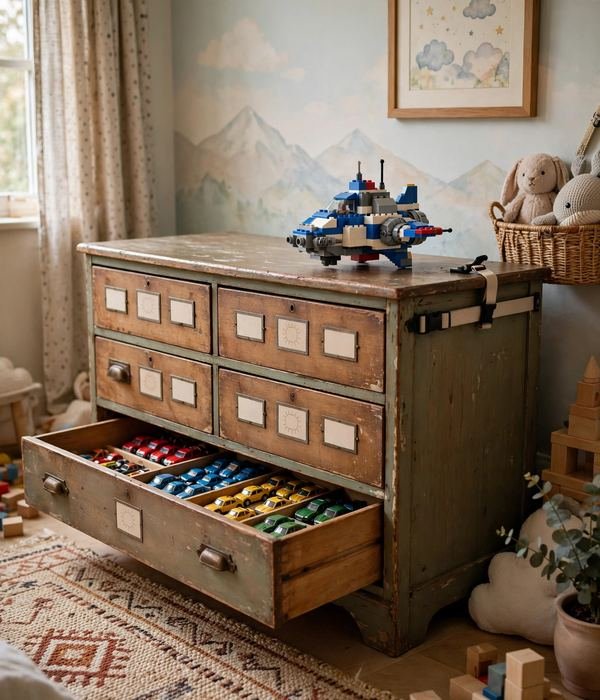
A low, wide dresser, 48 inches wide, 30 inches tall, makes a superb toy dresser: six deep drawers at perfect kid height, with a top surface for the current project. Sturdier than cube units, drawers hide everything, and thrift stores sell them for $30–60. The sleeper pick of toy furniture.
The safety paragraph is not optional. Dressers are the most cited furniture in tip-over injuries: a child opens two drawers and climbs, and an unanchored dresser goes over. Anchor every dresser to a wall stud with anti-tip straps, mandatory, not recommended. Straps are $8–15, install is ten minutes.
Put the heaviest toys in the BOTTOM drawers to lower the center of gravity, and teach one-drawer-open-at-a-time.
What you can do with it:
- Six drawers = six categories at $30–60 thrifted; picture labels on each drawer front
- The 30-inch top is prime real estate: the in-progress LEGO build lives here, safe from floor traffic
- Felt pads underneath protect floors when kids inevitably shove it
12. Window-Seat and Bench Storage for the Bedroom
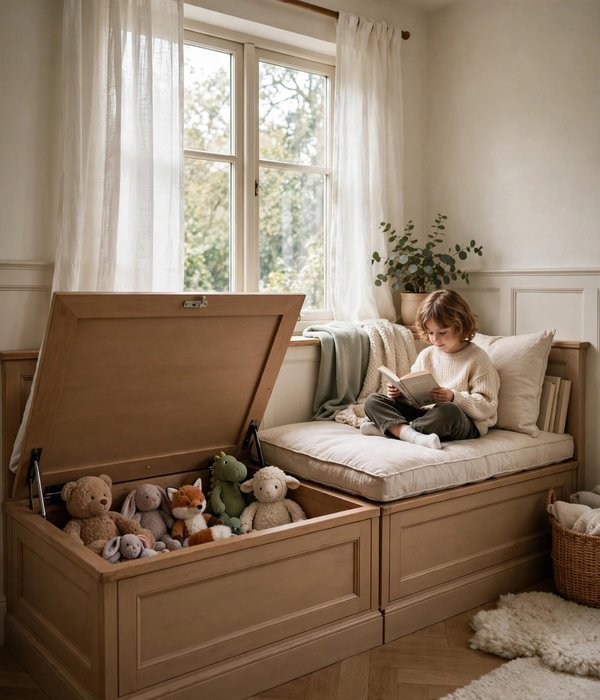
The foot of a kid’s bed and the wall under the window are the two most wasted bedroom zones, both fit a storage bench. A 36-to-48-inch bench with a lift-up seat (seat height 17–19 inches, real seating) holds the bulky-soft categories: stuffed animals, dress-up clothes, spare bedding.
With a cushion on top it becomes a reading nook, which means kids actually use the storage.
For stuffed animals, the category that defeats every other system, the bench wins on volume: animals go in by the armful, lid closes, done. A 48-inch bench holds roughly 15–20 medium animals. Same hinge rule as the toy chest: slow-close or stay-open lid.
Tips for best results:
- 17–19-inch seat height works for ages 4+; 14–15 inches for toddler rooms
- Ventilation gaps or slatted construction, plush holds moisture in sealed boxes
- Watch out: benches become climbing platforms, keep the wall above clear or anchored
Living-Room Toy Peace
13. The One-Basket Rule for the Living Room
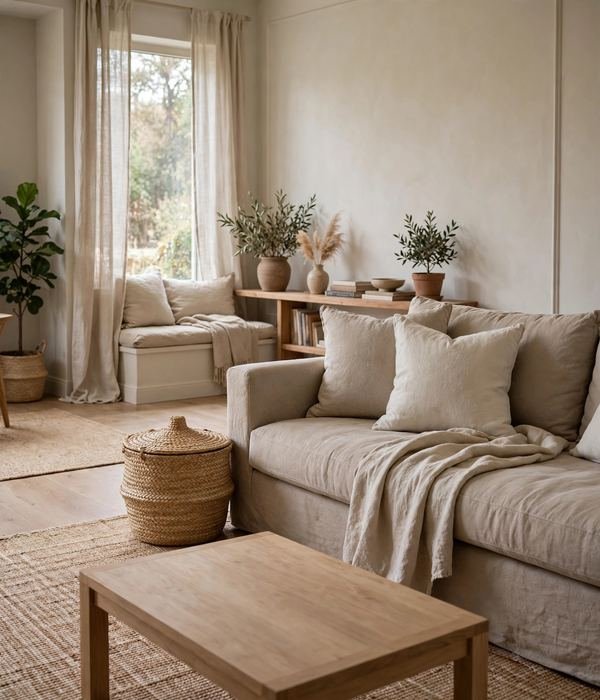
The living room doesn’t need a toy organization system. It needs a peace treaty: one lidded basket, 18–22 inches wide, holding the entire visible toy presence of the room. Toys migrate in during the day, they go in the basket. When it fills, it gets shuttled back to home rooms. The basket is a shuttle, not a home.
Size it to the room’s tolerance: a 20-inch seagrass basket holds a day’s drift and looks like decor with the lid on. The lid is load-bearing, open reads as “toy storage” and invites accumulation; closed reads as “furniture” and enforces the shuttle rhythm. Put it where toys land (beside the couch), not in the far corner.
What you can do with it:
- The nightly 5-minute reset: basket contents shuttle home before bed, a timed game for kids
- One basket per high-traffic room max; a second basket is how living rooms become playrooms
- When it overflows two days running, that’s a declutter signal, not a cue to buy bigger
14. Closed Media Console: The Electronics Fortress
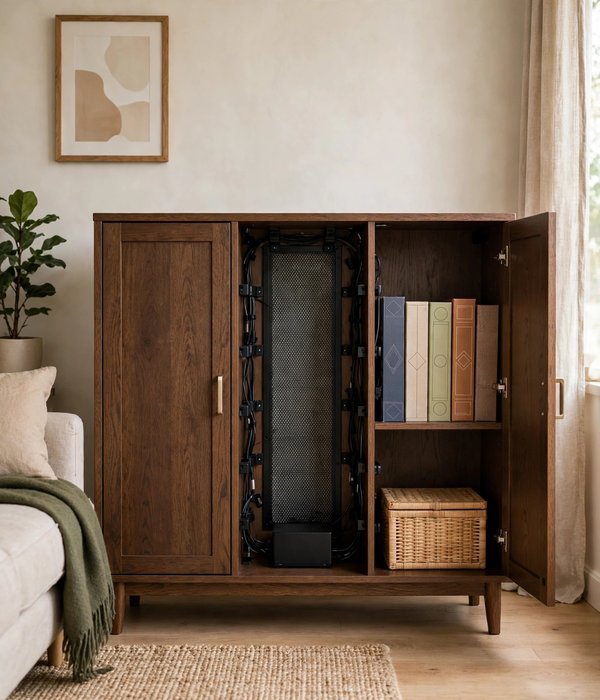
The media console is prime toy storage hiding in plain sight: 48–60 inches wide with compartments behind doors, sitting exactly where kids play. Dedicate one compartment to living-room overflow (controllers, tablets, the craft kit), one to board games stored vertically, electronics in the ventilated section. Closed doors = adult space in ten seconds.
Two specs matter. Ventilation: consoles and cable boxes need 2–3 inches of clearance and airflow, don’t seal electronics into an unventilated box. Anchoring: a loaded 60-inch console is a tip-over candidate when toddlers pull up on open doors, strap it to the stud. A $10–15 cable box plus adhesive clips tames the cord nest.
Tips for best results:
- One compartment = one category; label inside the door so sitters can run cleanup
- Board games vertical like books, every spine visible, no avalanche
- Watch out: remotes need a home, a small lidded box on top ends the Great Remote Hunt
15. Coffee Table With a Secret
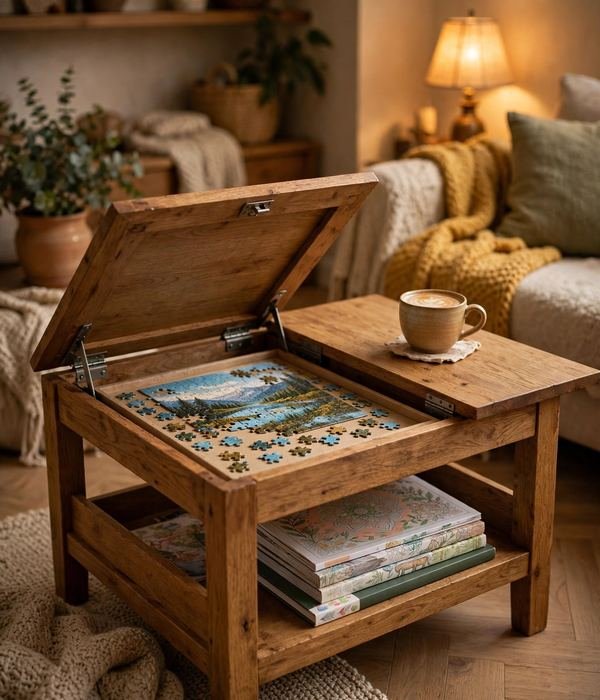
The coffee table sits in the exact center of the toy blast radius, make it containment. A lift-top table (30–48 inches wide) hides the current project inside: the puzzle, the coloring books, the LEGO tray. Bonus: the top raises to 24–28 inches as a kid-height activity table, then closes into a clean surface.
Play space converts to adult space without moving a toy.
Check hinges and pinch points like the ottoman. The closed top must hold a coffee cup and an adult’s feet without wobbling. In the $100–200 range you get mechanisms that survive years; $50–80 flat-pack works but check the hinge yearly.
What you can do with it:
- Lift-top = activity table by day, clean surface by night; drawer table = cheaper, still effective
- Interior fits a puzzle-in-progress on its tray, or 3–4 coloring books plus the marker cup
- The doorbell test: if the room can’t go guest-ready in 60 seconds, the table’s too small
16. The 5-Minute Nightly Reset (The System That Makes Systems Work)
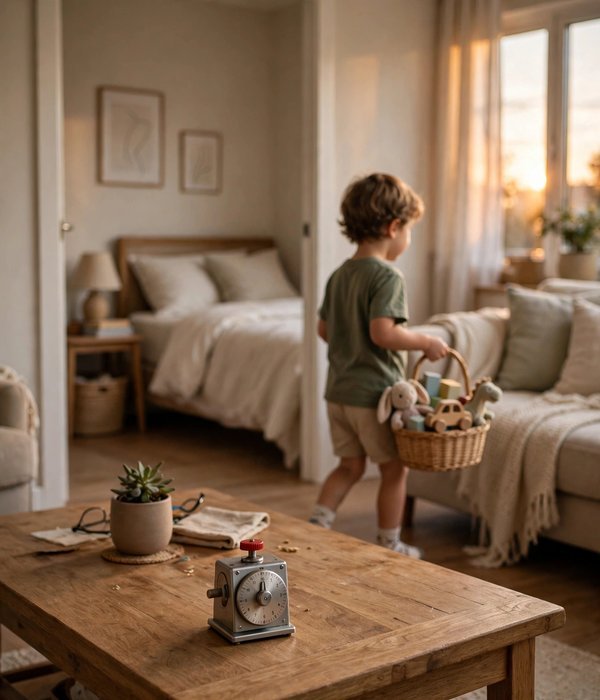
Every idea here fails without the reset, and the reset is a habit, not storage. Five minutes, every night: the basket shuttles home, the ottoman closes, the coffee table closes, the floor gets scanned. Set a timer.
Make it a race. Play the cleanup song. The mechanism is a daily deadline preventing the slow accumulation that defeats every bin ever bought.
Nightly beats weekly on math: 35 minutes a week total, and the house never crosses the chaos threshold. A weekly purge starts from full chaos, feels worse, kids resist harder. After two weeks of nightly resets, kids start doing it unprompted, because a 5-minute tidy of a mostly-tidy room is genuinely easy.
Tips for best results:
- Same time nightly, anchored to an existing routine (after teeth, before story)
- Each child owns one zone (basket, ottoman, floor scan), nobody stands around
- Watch out: skipping two nights breaks the habit for two weeks, protect the streak
17. A Dedicated “Build Zone” Rug or Mat
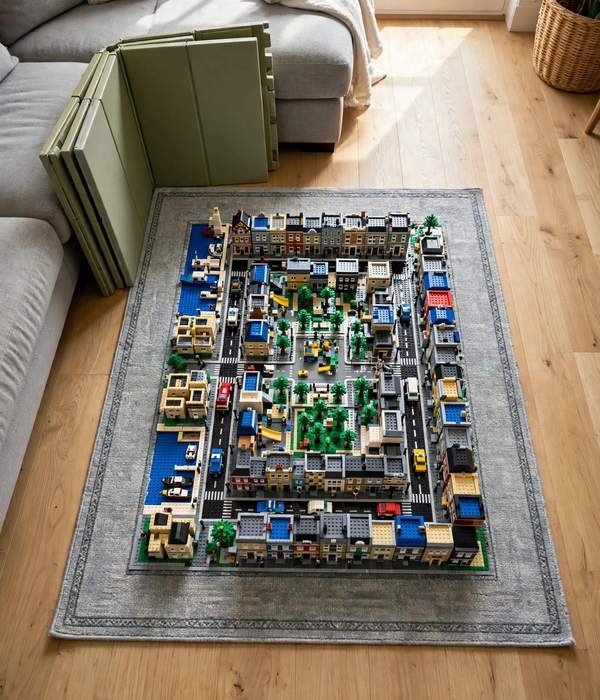
LEGO spreads because it needs floor, so contain it: a dedicated 4×6-foot rug or foldable mat that IS the build zone. Rule: builds live on the mat, the mat lives in one spot. When play ends, small builds go on the shelf, the mat gets shaken out over the LEGO bin, rolled up, floor clear.
The mat protects floors, defines the boundary so builds don’t colonize the walkway, and the shake-out replaces fifteen minutes of brick-hunting with thirty seconds. A low-pile 4×6 rug ($40–80) works permanently; a foldable foam mat ($30–60) disappears for guests. Kids respect visible boundaries better than verbal ones.
What you can do with it:
- 4×6 feet fits two kids; 3×5 for tight living rooms
- Shake-out over the bin: the highest-ROI cleanup habit for LEGO families
- The mat-edge rule: “on the mat or put away”, no third option
18. Side-Table Toy Stations for Small Living Rooms
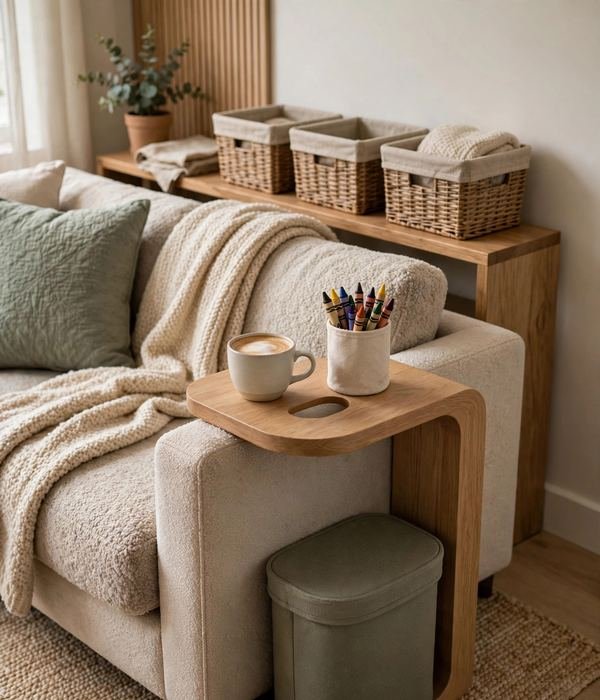
No floor space for a toy corner? Go incidental. A C-shaped side table over the couch arm (15×20-inch top) with a lidded bin underneath becomes a complete station in two square feet: coloring supplies on top, current small-toy rotation in the bin.
A narrow behind-couch console (10–12 inches deep, 48 long) stretches the same idea: three lidded bins below, adult top above.
Every surface earns its footprint twice: the side table holds your coffee AND the crayon cup. For open-plan homes, distributed micro-stations beat one central zone because they sit inside the actual play flow. A two-station setup runs $60–120, and nothing reads as “playroom” with lids on.
Tips for best results:
- C-table + bin: the couch-side station for one child’s current obsession
- Behind-couch console: three 10-inch bins for this room’s permanent categories
- Watch out: measure couch-arm clearance first, arms run 24–28 inches and cheap tables don’t clear them
Small Toys, Games & Crafts
19. LEGO by Color in 6-Quart Boxes (The Only System That Survives)
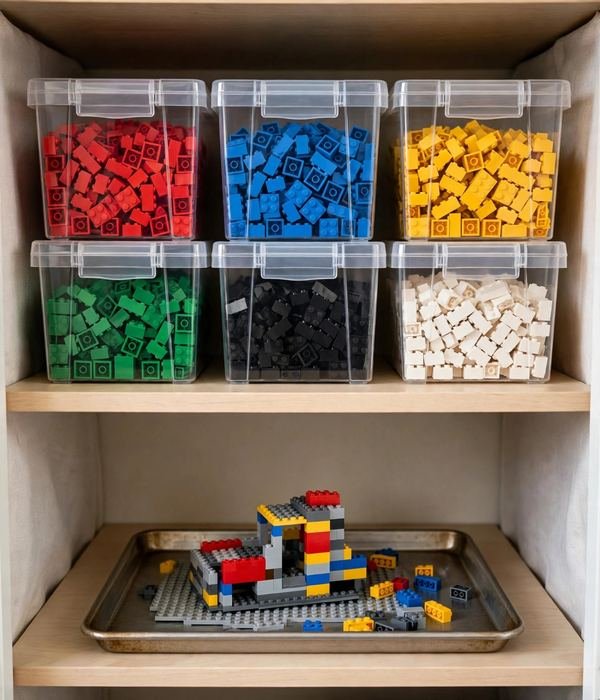
Every LEGO family tries sorting by set or by type, and every system dies within a month, because kids build across categories. Sorting by COLOR survives for one reason: a six-year-old can sort by color at full speed without thinking. Six to eight 6-quart clear boxes (14×8×5 inches, $2–4 each), one per color family, stacked on a shelf. Done.
Two rules make it last. The head-height rule: LEGO lives where kids reach without climbing, 24 to 48 inches for ages 4–8, never atop tall furniture. The flat sorting tray: a rimmed baking sheet ($5–8) is the build surface, dump one color box, build, sweep leftovers back.
Putting away means “toss it in the color box,” not “file it correctly.”
What you can do with it:
- 6–8 color boxes cover 95%: red, blue, yellow, green, white/gray, black, + “mixed”
- The “sets stay built” shelf: finished sets live untouched, the color boxes protect them
- Total cost $20–35 for boxes + $8 tray, the cheapest effective LEGO storage there is
20. The Muffin-Tin Method for Tiny Figures
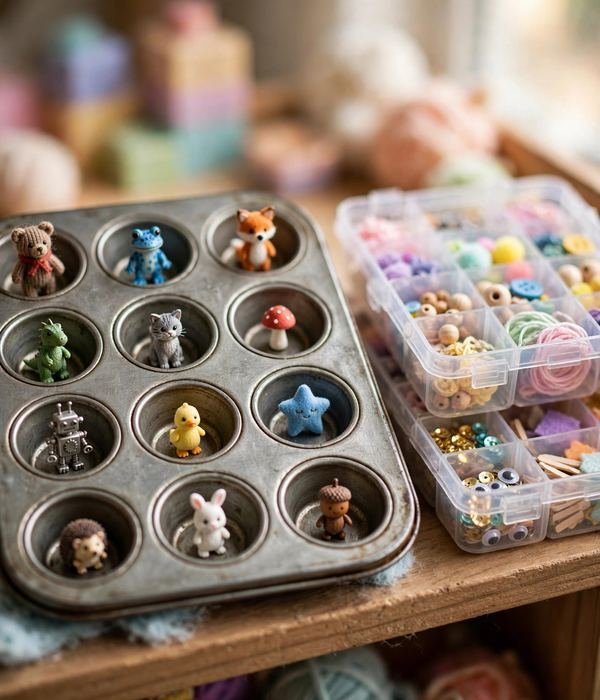
Polly Pockets, Shopkins, figurines, the sub-2-inch toys that vanish into bin depths. The fix is a $3 muffin tin: twelve compartments, rigid, washable, each figure visibly at home. One tin per collection, stacked on a shelf. Kids see everything, grab one-handed, and put them back, because each figure has a visible home.
For bigger collections, graduate to compartment craft boxes (12×9-inch bead organizers, $5–10) with a snap lid. The developmental note: nearly all these toys are choking hazards for under-3s (the CPSC small-parts cylinder: 1.25 inches diameter). In mixed-age homes, tins live above toddler reach, 48 inches minimum, for supervised play only.
Tips for best results:
- Muffin tin for starters; compartment boxes when a collection outgrows 12 slots
- Adjustable dividers beat fixed, collections change shape constantly
- Watch out: tins are loud on hard floors, a shelf liner underneath saves sanity
21. Puzzle Storage: Ditch the Boxes
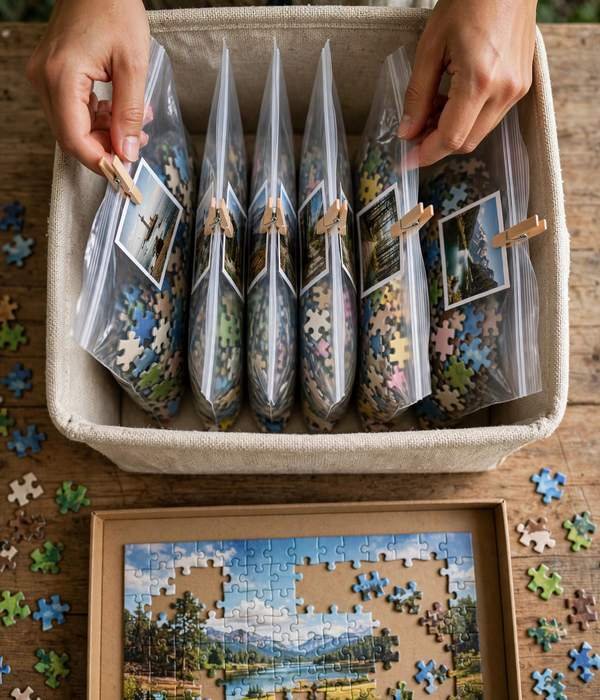
Puzzle boxes are the worst-designed storage in the toy industry: bulky, fragile, crushable. The working system: gallon zip bags. One puzzle per bag, pieces inside, the box lid cut down or a photo of the finished puzzle slipped in for reference.
Twenty puzzles compress from a full shelf into a single 11-inch bin. Bags cost $0.10; the space savings are enormous.
For active puzzles, the box lid doubles as a tray: a contained build surface that slides under the couch mid-puzzle. File bagged puzzles vertically like records, reference photos out. Before bagging, count pieces, bag only complete puzzles; incomplete ones exit via the donation box.
What you can do with it:
- Gallon bags + cut-down lids: 20 puzzles in one 11-inch bin
- Active puzzle lives on its lid-tray; finished ones get bagged the same day
- Count pieces before bagging; incomplete puzzles leave, no exceptions
22. Board Games Stored Vertically, Like Books
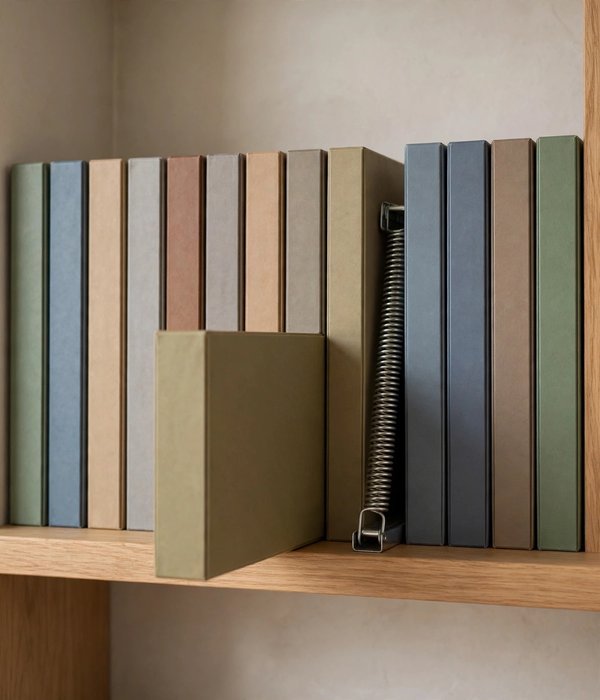
Stacked board games are an avalanche: you want the bottom one, you lift five, pieces scatter. Stored vertically, spines out on a 10-to-12-inch-deep shelf, every game is grabbable without moving another, and the whole collection is visible. Kids start choosing games independently instead of asking you to excavate.
A $5–10 set of bookends keeps the row upright. Inside each box, the zip-bag rule: small pieces in labeled bags, rubber-banded shut, a game with mixed pieces never gets played, and rebagging takes two minutes when you enforce it at put-away time. The lid-latch trick: a wide rubber band around each box keeps lids on in vertical storage.
Tips for best results:
- 10–12-inch shelf depth, games spine-out, bookends on the end
- Zip-bag pieces inside every box; rubber-band lids for vertical storage
- Watch out: oversized 18-inch party games go flat on the bottom shelf
23. Art Supply Caddies, Not Art Supply Drawers
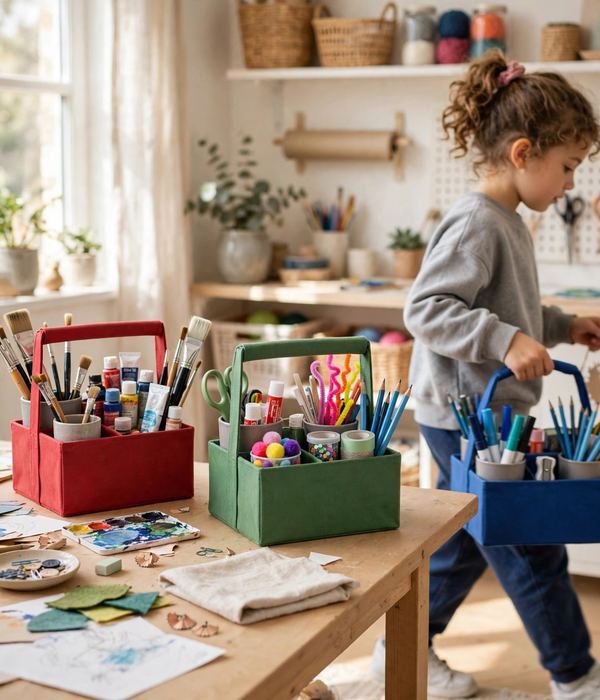
Art supplies in a drawer become strata of dried markers and mystery glue, drawers hide, and hidden supplies don’t get maintained. The caddy system: a handled tote ($5–12) per art type, drawing, painting, craft. The child grabs the caddy, works, returns it. Supplies never scatter because they never leave their carrier.
The handled carrier teaches the “kit” concept: everything for this activity travels together. Color-code caddies per kid in multi-child homes and the ownership fights evaporate. Restock quarterly from the rolling cart’s bulk tier. And the marker rule: tip-down in the cups, dried markers are 90% storage failure.
What you can do with it:
- One handled caddy per art type; color-coded per kid
- Caddies hold the working set; bulk refills live in the cart or closet
- Markers tip-down, always, the highest-ROI art supply habit
24. Doll and Action-Figure Homes With Zones
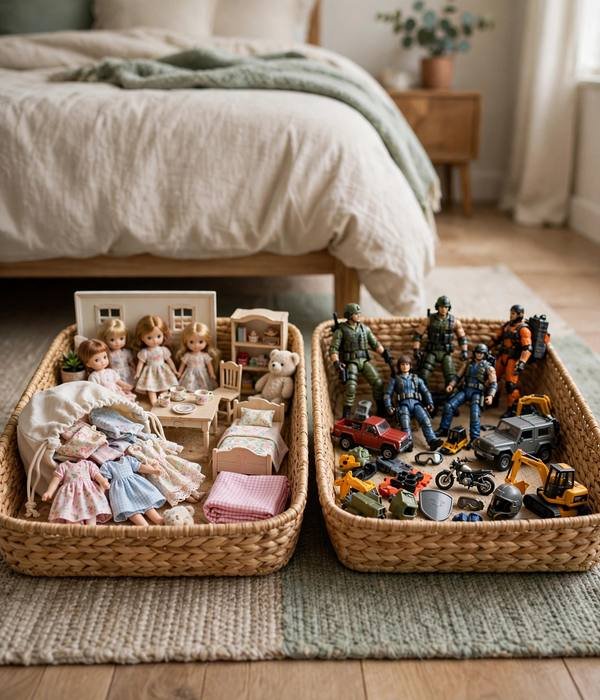
Dolls and figures are played in SCENES with dozens of tiny accessories, and scenes defeat category sorting. The zone system: one shallow 16-quart tote per world. The dollhouse world in its bin, the action world in its bin. Play ends, the whole scene sweeps in unsorted, sorting forty accessories is the enemy.
Bin depth maxes at 6–7 inches, one layer deep, everything visible. Doll clothes, the true chaos vector, get a $3–5 drawstring pouch inside the bin, because loose doll clothes tangle into play-ending knots. Display-worthy figures go on a wall picture ledge at 48–60 inches: visible, dustable, out of the toy flow.
Tips for best results:
- One shallow bin per play world; scenes sweep in unsorted
- Drawstring pouch inside for doll clothes and tiny accessories
- Watch out: zone bins multiply, cap at 3–4 worlds or zones become clutter
Rotation & Overflow
25. The 1-Out-to-2-Stored Rotation Ratio
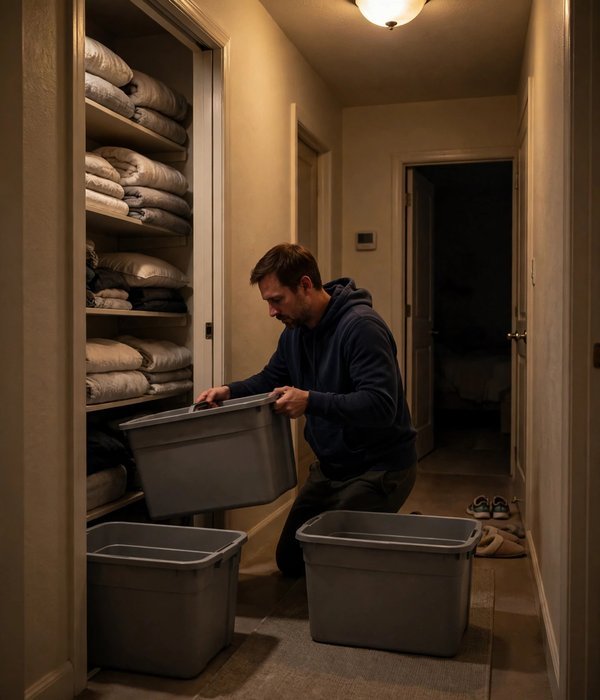
Toy rotation is the highest-leverage idea in this guide: kids play longer with fewer toys, cleanup shrinks, and “new toy” excitement recurs every rotation for free. The ratio: one part active, two parts stored. Implementation: 2–3 rotation bins (18-gallon totes) in a closet or under-bed, swapped every 2–4 weeks.
The swap is a 20-minute parent operation, ideally while kids sleep, the morning “new toys!” reaction is the point. Rotate categories, not toys: this week art + vehicles out, next week building + dress-up. Never rotate comfort objects or the active obsession, that breeds resentment, not novelty.
Label each tote with its categories and the date it went in, and keep a simple list on the closet door so swaps stay consistent.
What you can do with it:
- 2–3 labeled 18-gallon totes; swap every 2–4 weeks
- Rotate categories whole-bin in, whole-bin out
- Never rotate comfort objects or the active obsession
26. The Seasonal Toy Audit (15 Minutes, Quarterly)
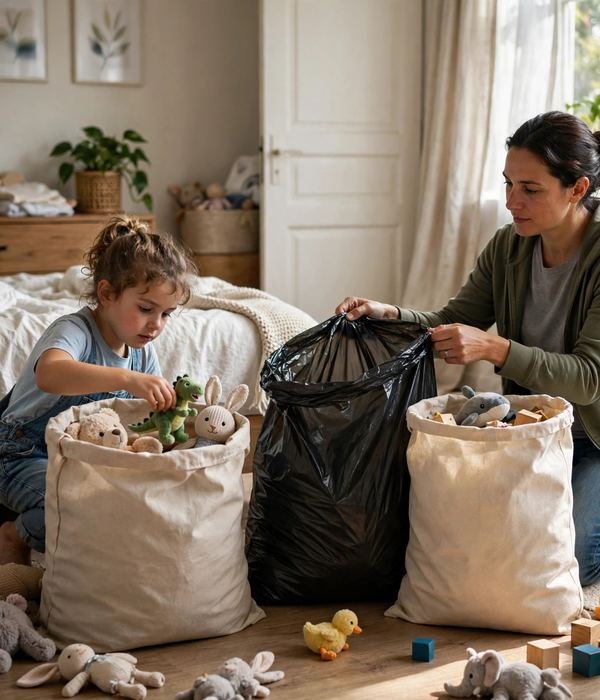
Four times a year, piggybacking the seasonal clothes swap, spend fifteen minutes with three bags: keep, donate, trash. The audit catches what daily maintenance misses: outgrown, broken, duplicated. Quarterly works because no single audit overwhelms, and it rides an existing habit.
Run it with the kids for everything except stealth removals: broken toys, dried markers, incomplete puzzles go straight to trash without a committee vote. Kids as young as four can run the keep/donate sort, the quarterly rhythm teaches the outflow habit the whole system depends on.
End each audit by scheduling the donation drop within the week, before the bags become permanent furniture.
Tips for best results:
- Three bags, fifteen minutes, kids sort their own keep/donate
- Broken/dried/incomplete → trash directly, no vote, no guilt
- The audit feeds the donation box, which feeds the donation trip
27. Overflow Bins in the Garage or Attic (Labeled Like You Mean It)
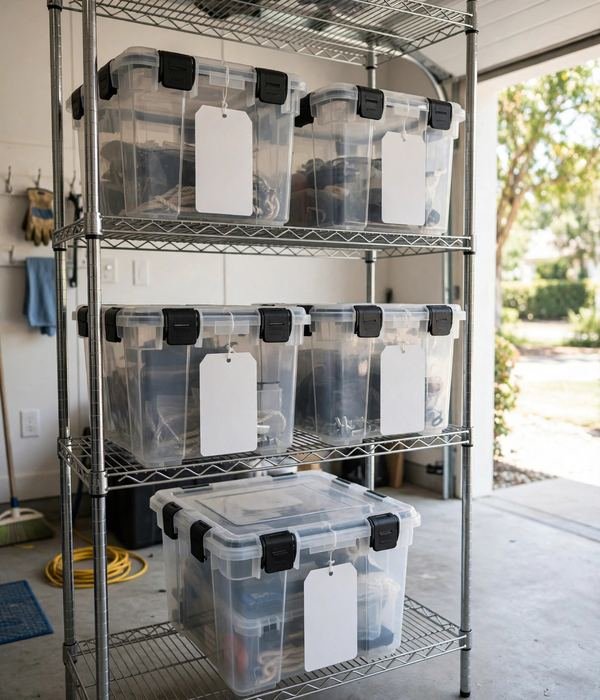
Every family has the third tier: too good to donate, not used enough to keep. These leave the house’s active storage for labeled overflow bins in the garage or attic. The anti-black-hole system: label with CONTENTS and DATE. “LEGO Duplo, stored Oct 2026” beats “toys??”, the date tells future-you whether it’s worth keeping.
Climate rules are non-negotiable: no batteries (leak risk), no crayons (melt), no unsealed plush (moisture, pests) in unconditioned spaces. Hard plastic, Duplo, wooden trains, and board games in sealed bins do fine. Use gasket-sealed totes ($12–20 for 27-gallon). The two-year rule: unopened for two years = donation, unopened.
What you can do with it:
- Gasket-sealed totes for garage/attic; label contents + date stored
- No batteries, crayons, or unsealed plush in unconditioned spaces
- Two-year rule: unopened that long = donation, no re-audit
28. The Gift-Entry Rule: One In, One Out
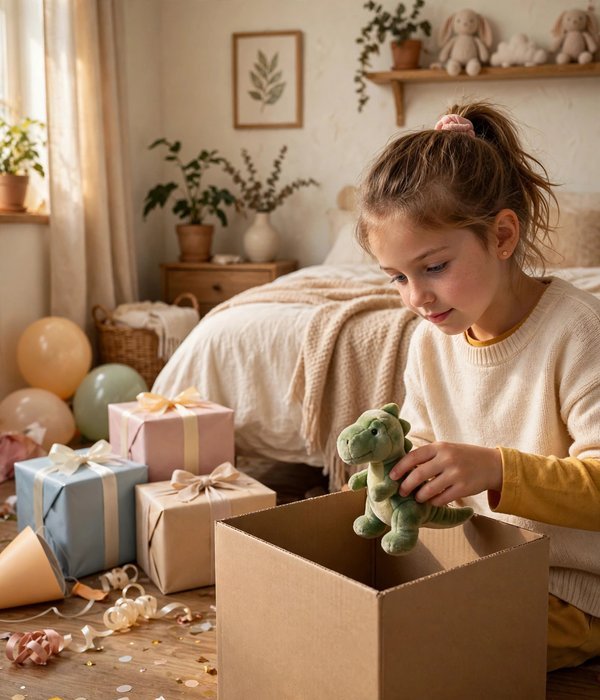
Birthdays and holidays break every system, 10–20 toys arrive in a day, capacity doesn’t change. The gift-entry rule, enforced at opening: for every gift that stays, one existing toy goes to the donation box. Announce it BEFORE the party: “we’re making room for the new favorites.” Pre-stated rules beat post-party ambushes.
Make it ceremonial: after opening, the child tours their room picking the outgrown ones, “choosing which toys make another kid happy.” Empty donation box waiting before the party. For the sentimental ones, the photo trick: picture of child with toy, print for the memory box, donate the toy.
Send grandparents a 3–4-item wish list, and mention the rule when you do, they’ll usually comply happily.
Tips for best results:
- Announce one-in-one-out BEFORE the event
- Empty donation box waiting before every birthday and holiday
- The photo trick: memory preserved, shelf freed
29. Stuffed-Animal Containment: The Zoo, the Hammock, the Cull
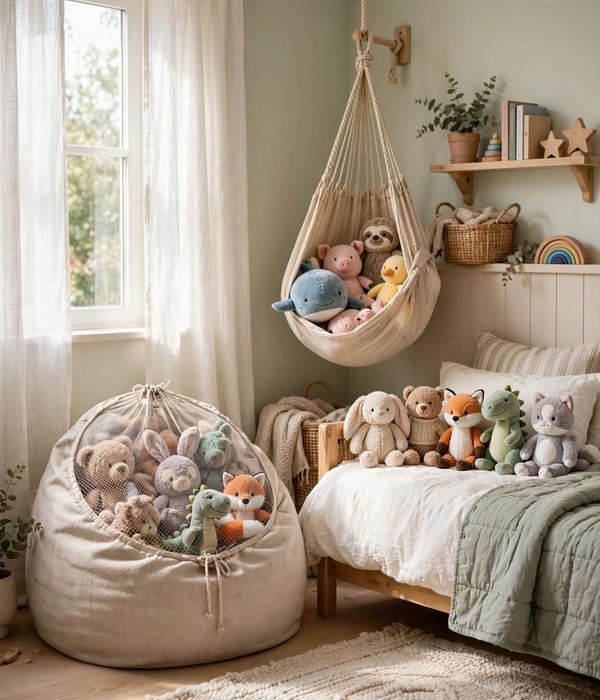
Stuffed animals reproduce on their own, or so it seems at forty on one bed. Three tiers. Tier one, daily drivers (5–8 favorites): on the bed, that’s their job.
Tier two, liked-but-not-daily (10–15): the “zoo”, a mesh hamper, a bean-bag storage pouf (38-inch, holds 15–20 AND seats a kid, $40–70), or a corner hammock ($10–15, real capacity 10–15, not the advertised 30). Tier three: rotation bins or donation.
The storage pouf is the small-room standout, converts 15–20 animals from floor clutter into seating. The hammock is cheapest but sags when overloaded. And the honest tier: beyond zoo + hammock + rotation capacity, it’s cull time with the photo trick. A child with 60 animals plays with eight; the other 52 are dust collectors with feelings.
What you can do with it:
- Tier 1: 5–8 bed favorites, no storage needed
- Tier 2: storage pouf ($40–70, seats a kid, holds 15–20) or hammock ($10–15, 10–15 max)
- Tier 3: rotation bins or donation, photo trick for sentimental ones
30. The “Toy Library” Shelf: Checkout, Don’t Own the Chaos
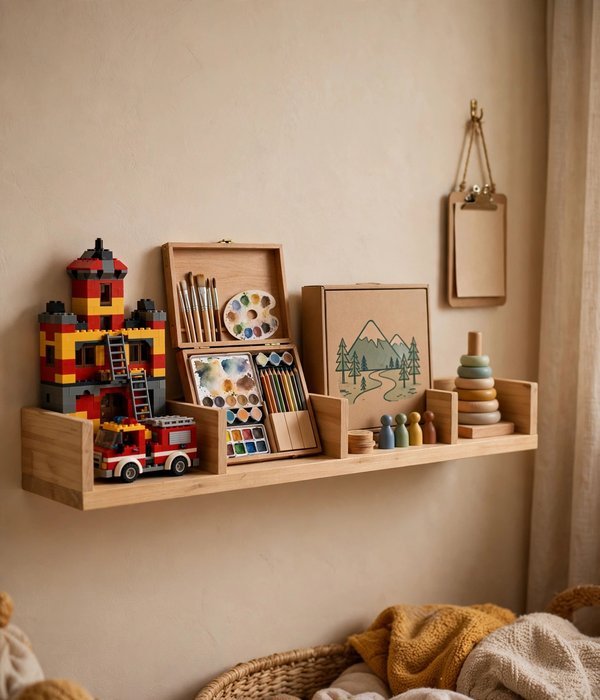
Borrow from libraries: one 24-to-36-inch shelf at kid height operates as the house toy library, 4–6 “special” toys: the big LEGO set, the fancy art kit, the too-nice board game. Rule: check one out, play, check it back in. The shelf stays styled, the special toys stay complete, kids learn care habits.
Scarcity creates value: the same toy on the library shelf gets treated like treasure. Restock monthly from the rotation bins. Shelf at 24–36 inches with dividers keeping 4–6 slots defined. The clipboard checkout log (ages 5–8): sign out your toy, responsibility training disguised as fun, and it ends the “who lost the pieces” arguments before they start.
Tips for best results:
- One shelf, 4–6 slots, kid height, scarcity is the feature
- Checkout/check-in: one out at a time, returned complete
- Monthly restock from rotation bins keeps novelty alive
Conclusion
Thirty ideas is a lot, so here’s the one I’d start with, my Best family sanity saver: the 2×4 cube unit (point 1), anchored to the stud, loaded with one-category-per-bin, photo-labeled for pre-readers.
It’s $40–80, fits a bedroom wall, survives every age from toddler to tween, and it’s the only piece of toy furniture that has never let a family down. Everything else here is an upgrade to that foundation.
But the real pick isn’t furniture, it’s the system: containment where the toys land (not where you wish they lived), one category per bin, the 5-minute nightly reset, and the outflow habits (donation box, rotation, one-in-one-out) that keep the input tide from drowning the storage. Buy the cube unit this weekend. Set the donation box out the same day.
Start the reset tonight. In two weeks the house will feel different.
- the 18 playroom organization ideas kids can actually keep up with
- 12 toy storage ideas for small kids’ bedrooms
- 10 stuffed animal storage ideas that look cute doing it
- 10 LEGO storage ideas for bricks, sets and builds
- 20 kids room organization ideas for small spaces
- how to set up a toy rotation system step by step
- 15 DIY living-room toy storage ideas from the existing guide
- the 30-idea bedroom storage pillar for the grown-up side of the room
Frequently Asked Questions (FAQ)
How many toy bins does a kid actually need?
If you have one child with a typical collection, plan on 6–10 bins across the rooms they play in, not 6–10 per room. If the bins you own are constantly overflowing, you don’t need more bins; you need the outflow habits (donation box, rotation, quarterly audit) because the input rate exceeds the system’s capacity.
If adding bins is genuinely the answer, add them one category at a time, never as a bulk “more storage” purchase.
What’s the safest way to anchor a cube unit or dresser?
If you’re anchoring to drywall, first find a wall stud with a $10–15 stud finder, drywall anchors alone are not rated for tip-over loads. Then use the furniture’s included anti-tip strap, or a $8–15 aftermarket kit: screw one end into the stud, the other into the furniture’s back rail (not the thin back panel).
Then test it: an adult pulling firmly on the top front edge should not move the piece.
At what age can kids manage lidded bins and sorting systems?
If your child is under 3, stick with open bins at floor level, lids are a barrier at this age, and small parts are a choking hazard regardless of the bin. If they’re 3–4, introduce one lid style and picture labels.
If they’re 5+, they can run lidded bins, the color-sort LEGO system, and the checkout shelf, and this is the age the rotation system starts delivering its full “new toy” magic.
How do I store toys in the living room without it looking like a playroom?
If your priority is a calm adult room, the answer is closed storage only: lidded baskets, a storage ottoman, closed media-console compartments, nothing open, nothing labeled “TOYS” in big letters. If you have the space for one open element, make it the styled library shelf (point 30), which reads as decor.
And if the living-room basket fills two days running, treat it as a declutter signal, not a cue to buy bigger living-room storage.
Where should the rotation bins live?
If you have a hall closet, garage shelf, or under-bed space, that’s ideal, rotation bins should be accessible to you but invisible to kids, or the “new toy” surprise evaporates. If you’re in a small home with no spare closet, under-bed rolling bins with lids work.
If kids discover the stash, don’t panic, just rotate sooner and let them help choose.
How do I get my kids to actually put toys back?
If they’re under 5, make it a game (timed races, the cleanup song, “find all the red ones”) and keep the system at their height with picture labels, compliance follows ease. If they’re 5–8, give them ownership of one zone each and run the 5-minute nightly reset as a non-negotiable routine.
If they’re older and still resisting, the system is too complicated, simplify until putting away is faster than arguing.
What do I do with toys my kids have outgrown but I can’t part with?
If it’s genuinely sentimental (the first teddy, the handmade doll), keep a small memory box, one 16-quart bin per child, and that’s the entire archive. If it’s “maybe for the next kid,” it goes in a labeled, dated overflow bin, subject to the two-year rule.
If it’s neither, take the photo, keep the memory, and let the toy go, your child won’t remember the toy, but they’ll remember a home that wasn’t buried in stuff.