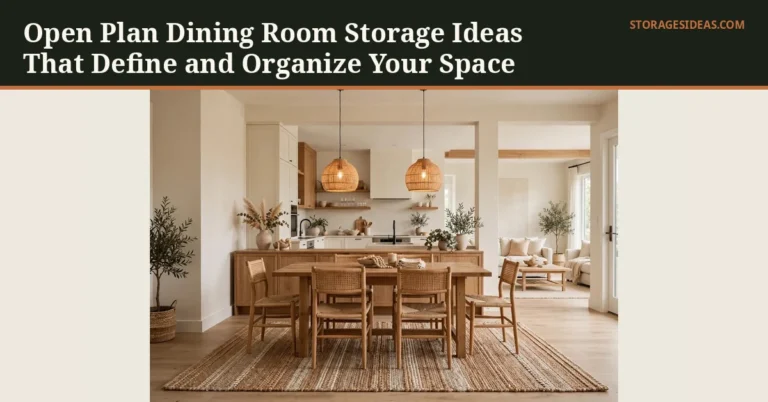
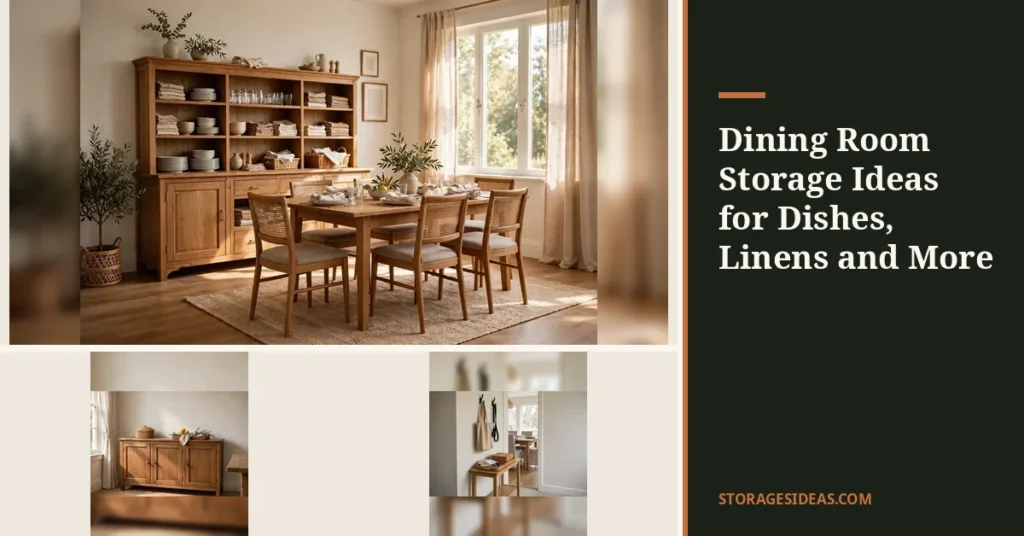
Be honest: right now your dining room is probably a mail-sorting station, a backpack parking lot, and a place you occasionally eat. The table you bought for holiday dinners spends its life buried under keys, chargers, and yesterday’s paperwork, while the good dishes sit trapped in a cabinet nobody can comfortably reach.
This guide fixes that with 20 dining room storage ideas built around one principle: every dining zone gets its own home.
Dishes, linens, glassware, and serving pieces each get a dedicated spot sized to the real thing, dinner plates 10 to 12 inches wide, tablecloths that refuse to fold small, and the serving pieces that only appear twice a year.
No renovations required. Most of these ideas take a single weekend, several are renter-friendly, and each one carries exact measurements and price bands so you can buy once and buy right. Your table can finally go back to being a table.
One more promise: nothing here needs a carpenter. The biggest project on this list is a banquette bench, and most of these ideas are an afternoon, a tape measure, and one shopping trip. Let’s start with the piece that does the most work.
Why Dining Room Storage Ideas Fail in Real Dining Rooms
Dining rooms don’t fail for lack of furniture, they fail for lack of zones. The average dining room has one cabinet doing five jobs: dishes, linens, candles, batteries, and the mail nobody sorted. When everything shares one space, nothing has a home, so everything migrates to the table.
The fix is zone math: give each category a dedicated spot sized to its largest item, and the dumping ground clears itself. Measure before you buy, because dining storage lives or dies on fit, a sideboard an inch too wide blocks the chair swing, and a charger that won’t fit the organizer never gets put away.
Small dining rooms benefit most, because every inch is spoken for. When zones are sized to the actual objects, the 13-inch charger, the 90-inch cloth, a 10-by-12-foot dining room holds the same entertaining kit as a room twice its size. Renters get the same math: freestanding and adhesive options throughout need zero holes in the walls.
Dining zone math (save this before you buy):
- Dinner plates: 10–12 inches across, plate racks and risers need 12 inches of clearance
- Tablecloths: most are 60–90 inches long, roll them on 30-inch tubes instead of folding
- Wine glasses: roughly 3 inches of spacing per stem on an under-cabinet rack
- Sideboard: 60–72 inches wide × 30–36 inches tall × 18–22 inches deep is the standard wall run
- Serving pieces: plan 1–2 cubic feet per set, and measure your biggest platter first
- Under-sideboard baskets: 10–12 inches tall fits most cabinet clearances
Measure-first checklist (the tape-measure routine):
- Wall run: length of open wall, minus 30 inches of chair clearance in front
- Table length: your sideboard should run 12–24 inches shorter than the table
- Drawer depth: 18–21 inches is standard, dividers must match before you shop
- Shelf clearance: tallest item + 1 inch; dinner plates need 13 inches between shelves
- Door swing: open every nearby door fully, storage can’t block it
Dining Room Storage Cabinets: The Big Pieces for Dishes and Serveware
1. Sideboard/Buffet With Cabinet Storage: the dining room’s workhorse
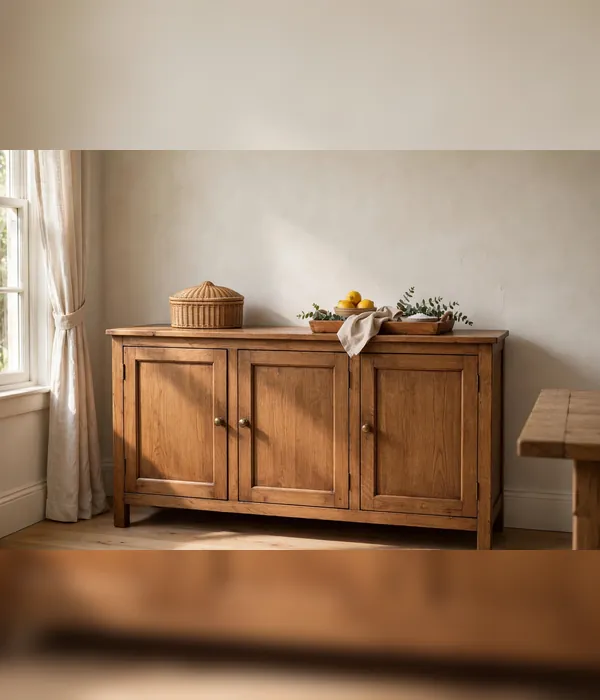
A sideboard works because it stores at the height and distance where dining actually happens. The standard footprint, 60 to 72 inches wide, 30 to 36 inches tall, 18 to 22 inches deep, sits near chair-rail height, so serving pieces travel from cabinet to table in one step and leftovers go back just as fast.
Closed cabinets are the whole point. Every door hides the mismatched reality, the gravy boat from 2019, the serving bowl with the chipped rim, so the room reads calm even when it’s full.
Measure your wall run first: aim for 12 to 24 inches shorter than your dining table, and keep 30 inches of clearance in front so chairs pull out without scraping.
What you can do with it:
- Store a full serving set: a 60-inch sideboard holds a 12-person dinnerware service plus folded linens
- Park holiday pieces: wide platters and tureens live in the deep cabinets between uses
- Add a drawer line: flatware, napkins, and place cards belong in the shallow top drawers
- Double it as a serving station: 30–36 inches is counter height, ideal for buffet lines
- Shop right: adjustable shelves, 100-plus-pound load ratings, solid back panels, typical price bands run $150–$400 for engineered wood, $500-plus for solid hardwood
2. China Cabinet Organization: make every shelf earn its rent
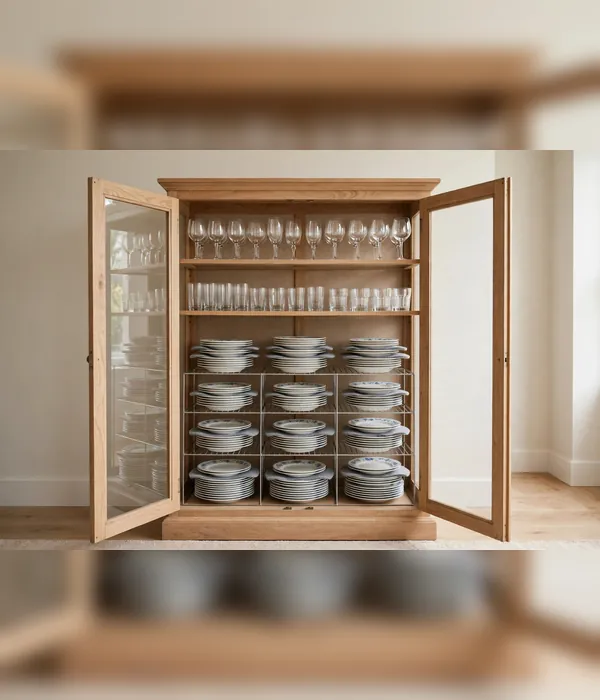
The classic china cabinet wastes its glass-front shelves on four plate stacks and a dusty tureen. Its real value is vertical: 16 to 20 inches of depth with adjustable shelves means one cabinet can hold a full service for twelve plus glassware, if you stop treating each shelf as a single flat layer.
Plate risers are the unlock. Stepped wire or acrylic risers lift the back rows so every plate is visible and reachable.
Park dinner plates (10–12 inches across) where shelves have at least 13 inches of vertical clearance, float salad plates and bowls on risers above, and line glassware in rows by type so stems never touch. Felt plate separators between stacked pieces prevent the chips that ruin heirlooms.
For a deeper dive, see china cabinet organization ideas.
Where it works best:
- Households with real china or heirloom sets that need dust-free, visible storage
- Tall narrow walls: 48–60 inches wide fills 72–84 inches of height without a big footprint
- Renters: freestanding, zero screws, moves with you
- Dining rooms that double as the “pretty room”, glass fronts show off the good pieces
- Shop right: built-in plate grooves beat loose racks; soft-close doors protect glass from slams
3. Table Linen Storage: crease-free cloths, no ironing
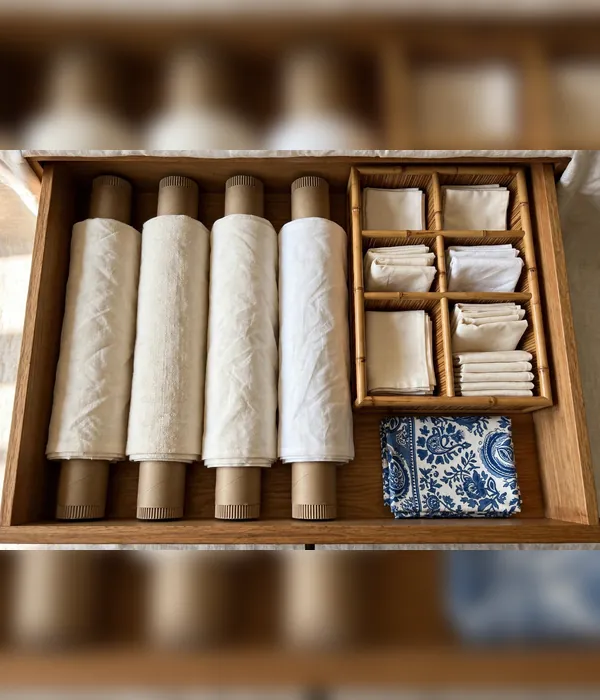
Folding is the enemy of table linens. Every fold becomes a crease you iron out on Thanksgiving morning, and stacked cloths weld themselves into a wrinkled mass at the bottom of the pile. Rolling ends it: a tablecloth rolled around a 30-inch cardboard tube lies flat, pulls smooth, and slides back into storage in seconds.
Most cloths run 60 to 90 inches long, so a 30-inch tube fits every standard cloth with margin, no cutting, no special orders.
Store rolled cloths horizontally in a wide sideboard drawer or a lidded bin, napkins folded once in drawer dividers beside them, and keep one “everyday” set of placemats out while the holiday cloths stay rolled and clean.
See table linen storage ideas for the full linen system.
What you can do with it:
- Roll tablecloths on 30-inch tubes: crease-free, grab-and-go hosting
- Divide a wide drawer: napkins in one section, runners in another, place cards in the third
- Store seasonal cloths separately: the Christmas damask never buries the everyday cotton
- Protect damask and linen: acid-free tissue between layers for pieces you keep for decades
- Shop right: cardboard mailing tubes are free at most shipping stores; fabric storage bags run under $15
4. Drawer Dividers for Serving Pieces: every utensil finds a home
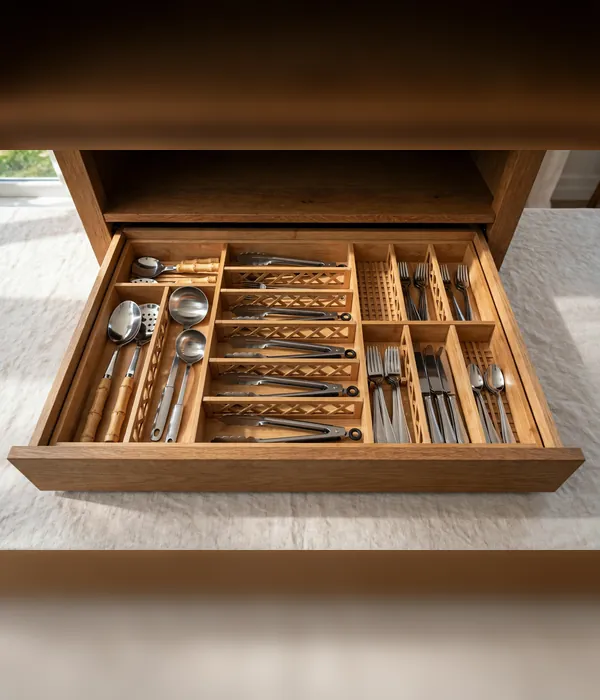
Serving pieces die in the junk-drawer model: ladles tangled with tongs, the pie server under the corkscrew, everything sliding to the back. Dividers turn one 18- to 21-inch-deep sideboard drawer, the standard depth, into a parking grid where each piece has a marked slot, which is the only system that survives a household with more than one cook.
Expandable bamboo dividers are the renter’s best friend: they press-fit to the drawer width, no screws, no adhesive, and they come out when you move. Give long serving spoons and ladles the full-depth slots, corral flatware in the narrow front section, and reserve one square for the small chaos, place cards, candle clips, the table-number holders.
Where it works best:
- Sideboard drawers 18–21 inches deep, measure first, because 17-inch dividers swim in a 21-inch drawer
- Households where serving pieces multiply: the divided drawer absorbs growth without re-organizing
- Renters: zero-damage, fully portable, and they fit kitchen drawers at the next apartment too
- Small dining rooms: one divided drawer replaces a whole cabinet of loose pieces
- Shop right: bamboo dividers run $12–$25 for a set; look for spring-loaded sides that grip without hardware
5. Bar Cart as Mobile Storage: the serving station that moves
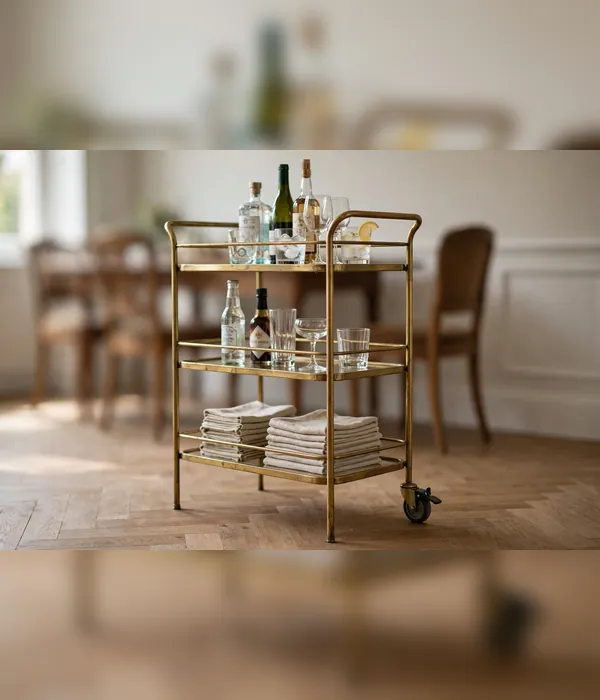
A bar cart solves the distance problem: the bottles, glasses, and napkins live on a 3-tier cart roughly 16 by 34 inches, 34 to 37 inches tall, smaller than a nightstand footprint.
It rolls to wherever the party is, holds the whole drink station in about 4 square feet of floor, and doubles as the serving table during dinner.
The mechanism is mobility replacing square footage. A small dining room can’t spare a dedicated bar zone, so the cart borrows floor space only while needed: parked against the wall between parties, rolled beside the table when guests arrive. Two tiers hold bottles and glassware; the third carries napkins, a corkscrew, and serving pieces.
If your dining room is tight overall, pair this with small dining room storage for the full small-space playbook.
What you can do with it:
- Store 8–12 bottles plus glassware on two tiers, the third holds linens and tools
- Roll it to the table as a serving station, then back to its parking spot against the wall
- Lock the casters: most carts brake on two wheels, which matters on hard floors
- Go vertical in tiny rooms: narrow 2-tier carts under 15 inches wide fit gaps a sideboard can’t
- Shop right: look for 40-plus-pound per-shelf ratings and lockable casters, typical price bands run $50–$120
Glassware, Wine and Vertical Storage
6. Wall-Mounted Glass Racks: stemware off the shelves
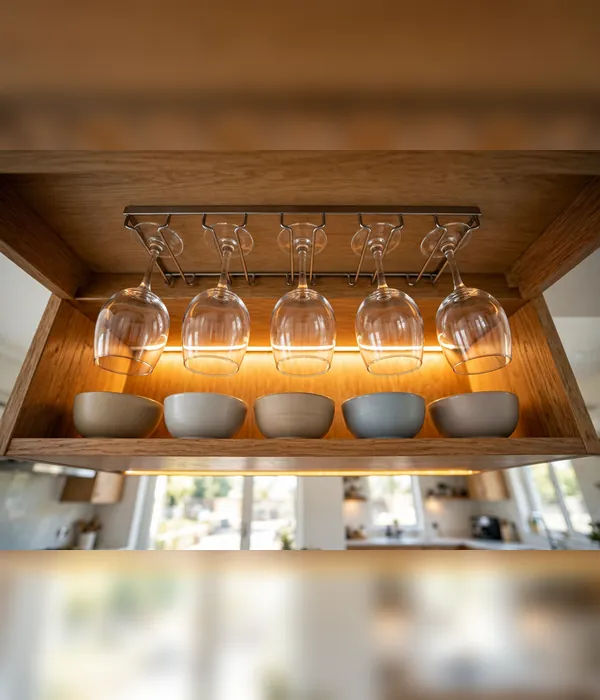
Stemware wastes cabinet shelves: glasses stand tall, wobble in rows, and chip when you fish one from the back. An under-cabinet stemware rack hangs them by the foot, rims never touch, every glass visible, and the shelf below becomes usable storage again. The spacing math is simple: about 3 inches per glass, so a 24-inch rack holds eight stems.
This also solves the dust problem. Glasses hanging under a cabinet stay cleaner than glasses standing on open shelves, because the cabinet above shields them from the airborne grease and dust that coats a dining room. You’ll wash them for use, not for storage.
- Measure your cabinet base first: the rack needs a flat, solid surface at least 2 inches wider than the rack itself.
- Mount a 1×3 wood cleat if the cabinet base is thin, screws must bite into solid wood, never just the floor panel.
- Space rack rows 3 inches apart and hang glasses by the foot; rims should clear each other by a finger’s width.
- Load heaviest first: fill the rack nearest the cabinet’s center supports so weight sits over structure.
- Renter version: adhesive-mounted stemware racks exist, prep with rubbing alcohol, cure a full 24 hours, and keep them to light everyday stems, not heavy crystal.
7. Vertical Plate Racks With Hidden Storage: the chip-proof drawer
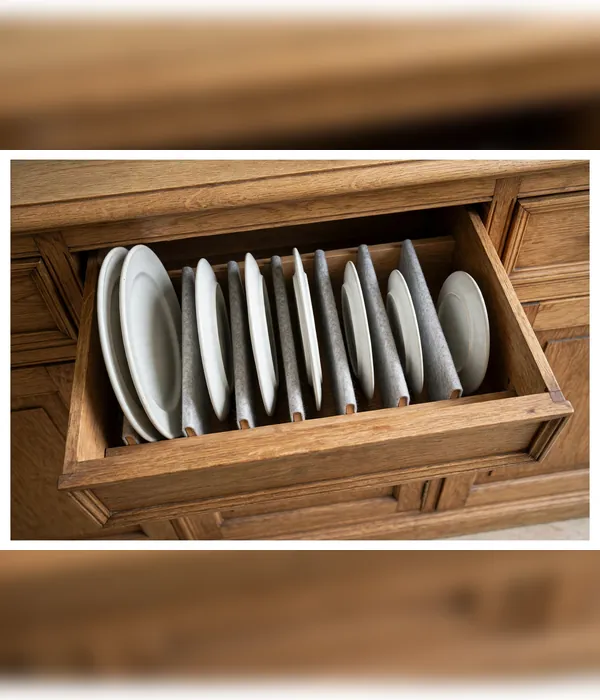
Plates stacked flat chip at the rims, every slide of the top plate grinds against the one below. A vertical plate rack flips the geometry: plates stand on edge like records, separated by felt or silicone dividers, so you pull one plate without touching the rest.
It fits inside a deep sideboard drawer or a low cabinet, which means the good plates hide in plain sight.
- Measure your tallest plate plus 1 inch, the drawer or cabinet interior must clear it standing upright.
- Set the rack in a drawer 18 inches or deeper so plates sit fully inside with the drawer closed.
- Slot felt or silicone separators between every plate: felt pads run under $10 for a 48-pack.
- Group by size: dinner plates in one rack, salad plates in another, mixing sizes crowds the slots.
- Reserve the top slots for everyday plates and bury the holiday china at the back; daily use never disturbs it.
Felt matters more than the rack itself. Bare wire dividers still let plates rattle and chip at the contact points; adhesive felt strips on every slot turn the rack into a padded cradle. A 48-pack of felt pads costs under $10 and protects a whole drawer of dinnerware.
8. Banquette Seating With Lift-Up Storage: seats that swallow the mess
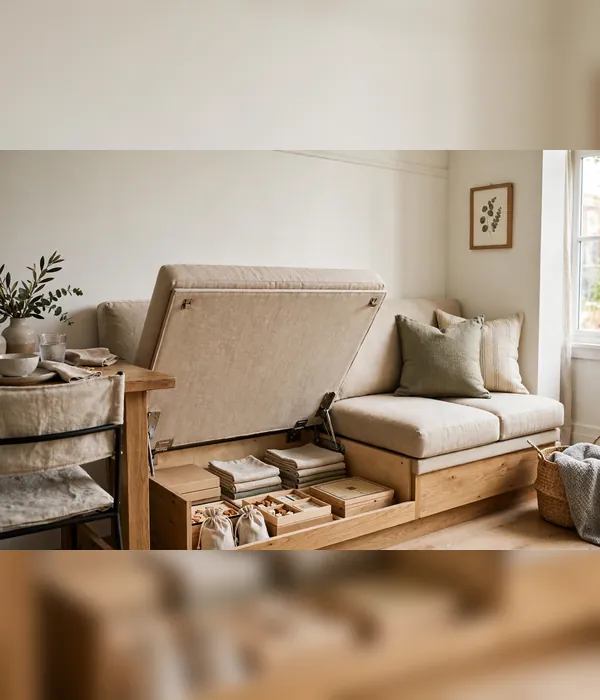
A banquette converts the room’s biggest dead volume, the air under the bench, into a linen vault.
Hinged seats lift to reveal a full-length cavity that swallows folded tablecloths, the holiday runner collection, and the board games that used to live on the dining table. In a small dining room, it’s the difference between a linen closet and nothing.
- Check the weight rating: quality banquettes support 250-plus pounds per seat, sit-test before you commit.
- Choose slow-close hinges: standard hinges slam on fingers, and the cavity gets opened daily.
- Line the cavity with a washable mat, spilled candle wax and sticky game pieces wipe off, bare wood doesn’t.
- Zone the interior: linens in the left bay, games and candles in the right, so one lift doesn’t mean digging.
The bench depth is the comfort spec. A 16- to 18-inch-deep seat fits most adults; shallower and you perch, deeper and you slouch away from the table. Pair the banquette with a 60-inch table and you seat three per side, six diners in the footprint where four chairs used to fit.
- Renters: skip the built-in and shop freestanding storage benches with the same lift-up design, see banquette seating with hidden storage for both routes.
9. Over-Sideboard Floating Shelves: display that also stores
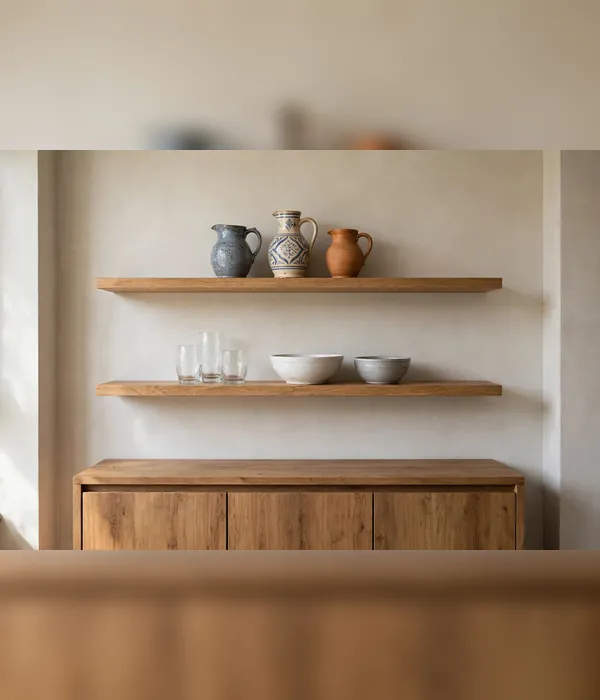
The 24 inches of wall above a sideboard is the dining room’s most wasted real estate. Two floating shelves, 10 to 12 inches deep, turn it into the display-and-storage layer: everyday glassware and serving bowls on the lower shelf where hands reach them, the pretty-but-rarely-used pieces up top where eyes reach them.
Finish the shelves to match the sideboard. A shelf stained two shades off the cabinet reads as an afterthought; the same finish, or a clean contrasting black, reads as one designed unit. Keep the shelf styling sparse: three to five objects per shelf, grouped tight, so the storage underneath stays the star.
- Anchor into studs, a shelf of glassware weighs 30 to 50 pounds, and drywall anchors alone won’t hold it.
- Keep shelves 10–12 inches deep: deep enough for serving bowls, shallow enough that nothing hides in the back.
- Space shelves 12–14 inches apart so pitchers and tall vases clear without tilting.
- Put daily pieces on the lower shelf and display-only pieces up top, the split keeps the pretty stuff pretty.
- Renter version: a tall leaner shelf in the same spot needs zero screws; see open-plan dining room storage if your dining zone shares walls with the living room.
10. Wine and Champagne Storage Nook: bottles done right
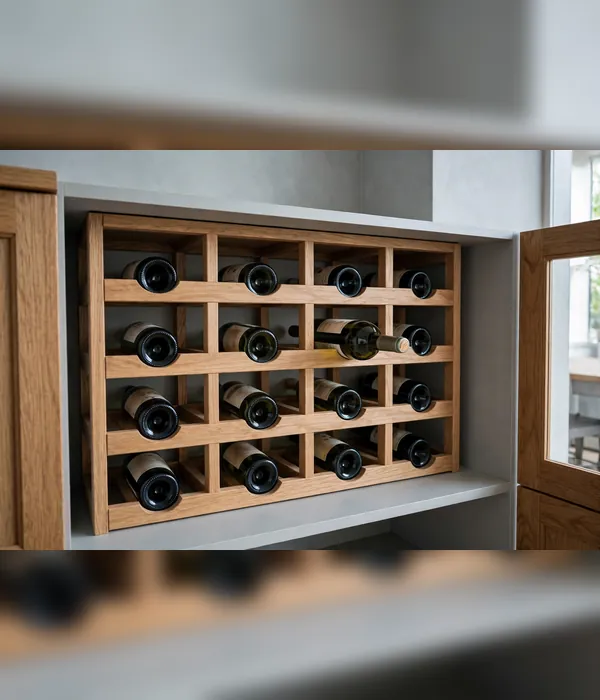
Wine stored upright dries its cork, and wine stored hot cooks in the bottle.
The dining room wine nook fixes both: bottles rest horizontal so corks stay wet, in the coolest stable corner you have, aim for 55 to 65°F, away from the oven wall and direct sun. A 12-bottle rack runs about 16 inches wide and fits inside most sideboard cabinets.
Vibration is the silent killer. A wine nook beside the dishwasher or under a frequently slammed cabinet ages wine faster through constant micro-agitation. The quietest corner of the dining room, the interior wall, away from appliances, keeps both temperature and vibration stable for the bottles you plan to keep.
- Pick the coolest dining-room corner: an interior wall beats the window wall by 5–10 degrees.
- Store every cork-finished bottle horizontal; screw caps and Champagne can stand upright.
- Size the rack to your real buying: a 12-bottle rack covers most households; collectors should plan 24-plus.
- Keep bottles off heat sources, above the radiator or beside the oven ages wine years in months.
- Renter-safe: a countertop 6-bottle rack needs zero installation and moves with you.
Table Linens and the Things You Only Need Twice a Year
11. Fold-Down Table Leaves: store them where they live
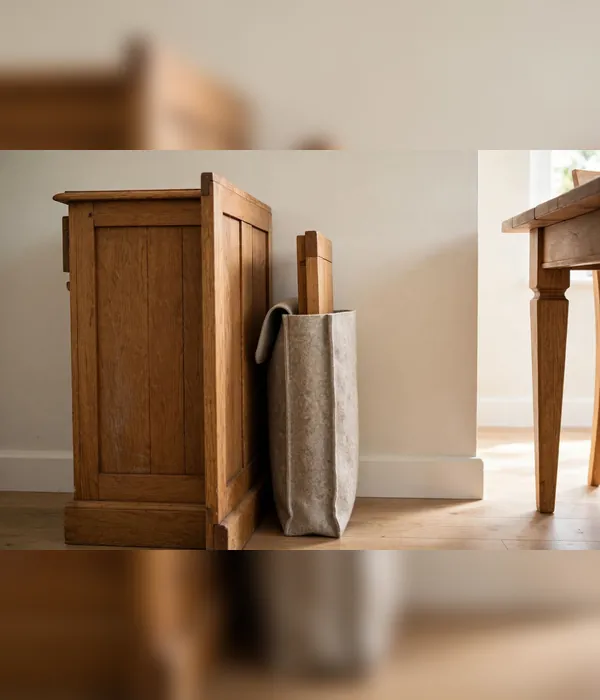
Extension leaves vanish. They slide behind the water heater, lean in the garage until they warp, and surface scratched on Thanksgiving morning. The fix costs almost nothing: a felt leaf bag, the padded sleeve most table makers sell for under $30, and a parking spot within arm’s reach of the table, like the gap behind the sideboard.
A standard leaf runs 12 to 18 inches wide and full table depth, so the bag protects both faces from scratches while the felt breathes, unlike plastic that traps moisture against the finish. Label the bag with the table name if you own more than one table, in January, all felt bags look identical.
Tips for best results: Stand the bagged leaf upright, never flat under heavy objects, flat stacking warps the panel over time. Slide it into the 3- to 4-inch gap behind the sideboard or between the sideboard and the wall. If your table has two leaves, bag them back-to-back in one sleeve.
Watch out: Never store a leaf in the garage or attic. Temperature swings warp solid wood and delaminate veneer in one season; the leaf must live in the same climate-controlled room as the table.
12. Under-Sideboard Baskets: the clearance you forgot
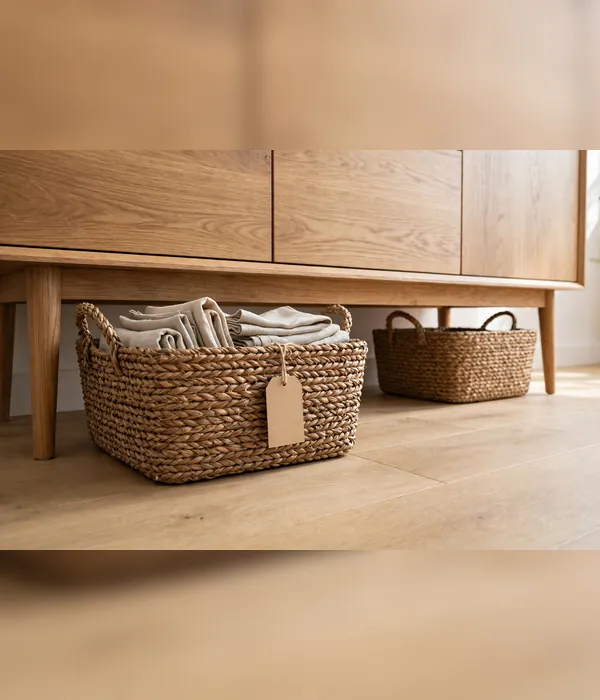
Most sideboards sit on 4- to 6-inch legs, leaving a dust-collecting gap that holds nothing.
Raising the piece, or buying one with a 10- to 12-inch clearance, creates a slide-in lane for flat woven baskets that swallow the overflow: extra napkins, the candle collection, the placemats that missed their organizer. The baskets pull out like drawers and the dust gap becomes storage.
Measure the clearance before you shop: baskets 1 inch shorter than the opening slide freely, baskets flush with it jam. Woven seagrass or water hyacinth reads as decor while hiding the decidedly un-decorative contents, and a simple paper label on each basket ends the “which one has the napkins” hunt.
Tips for best results: Choose baskets with handles, you’ll pull them out weekly, and handle-less baskets become permanent fixtures. Line them with a washable insert if they hold anything sticky, like candle wax or honey jars. Two 12-inch baskets usually fill a 60-inch sideboard’s under-lane exactly.
Watch out: Skip open-top baskets in homes with cats, they become napkin shredders. Lidded baskets or a fabric liner tucked over the contents keeps paws out. And vacuum the lane monthly; basket gaps collect more dust than closed cabinets.
13. Placemat and Charger Organization: flat things, flat storage
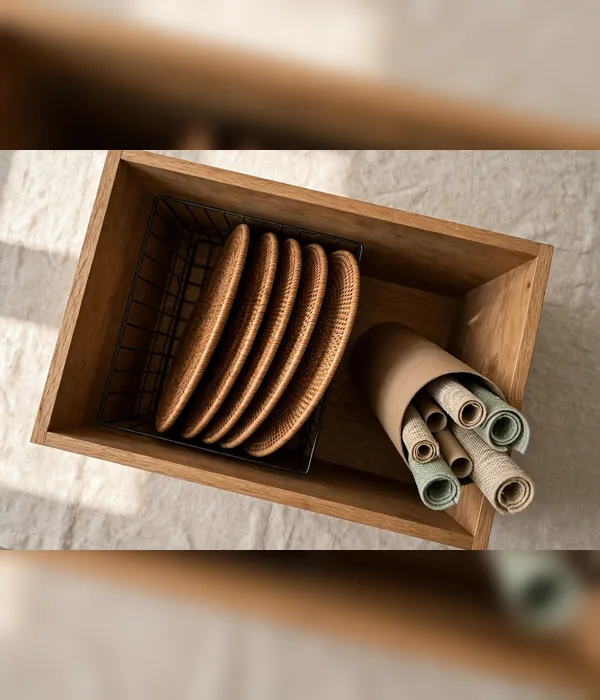
Chargers and placemats are the dining room’s awkward flatware: 13-inch rounds and 12-by-18-inch rectangles that slide off every stack and jam every drawer. They need flat, vertical storage, not a pile.
A vertical file organizer, the desk kind, turns out to be the perfect charger rack: the 13-inch rounds slot in like folders and pull out one at a time without disturbing the rest.
Placemats roll instead of stacking: a 6-inch-diameter tube (a wrapping-paper tube works) keeps a dozen mats crease-free and corralled in one sideboard cubby. Keep the everyday set in the organizer, the holiday chargers in a lidded 14-inch box on the high shelf, and the two never mix on a busy weeknight.
Tips for best results: Sort chargers by occasion, everyday in front, holiday in back, so the Tuesday setup never requires the Christmas box. Wipe chargers before storing; dried food welds stacked chargers together. If placemats curl, roll them reverse-direction overnight and they lie flat by morning.
Watch out: Don’t stack more than 8 chargers in one slot, the weight scratches the bottom ones and the whole file tips forward. Heavy ceramic chargers belong in a low cabinet, not on a high shelf where a slip means seven broken pieces.
14. Seasonal Tableware Rotation: the holiday china has a home
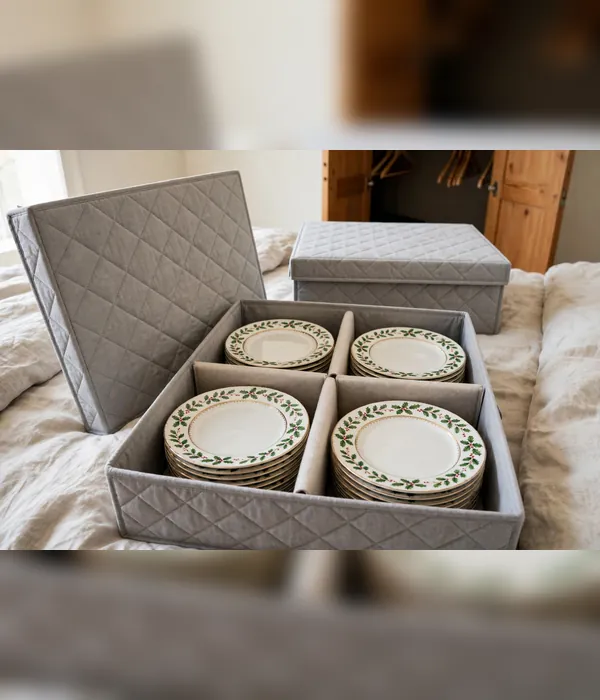
Holiday china earns its shelf space exactly twice a year, yet it usually occupies the best cabinet real estate all twelve months. The rotation system evicts it: padded storage boxes, 12-by-16-inch quilted cases sized for a place setting, hold the full holiday service in a closet or under-bed space, and the everyday dishes reclaim the prime cabinet shelves.
Swap twice a year: holiday pieces come out for the November–December stretch and the spring gatherings, then go back into their boxes. The quilted dividers prevent the chips that happen when seasonal pieces rattle loose in a closet, and labeling each box with its contents (“Christmas salad plates ×8”) means you never open four boxes to find the gravy boat.
Tips for best results: Photograph the packed arrangement before the first swap, next year you’ll repack in half the time. Toss a silica packet in each box if your storage closet runs humid. Keep one “holiday serving” box separate from the place-setting boxes so the platters don’t bury the plates.
Watch out: Don’t store seasonal china in the attic or garage. Heat and freeze-thaw cycles craze glazes and loosen gold trim over a few seasons. A bedroom closet or under-bed space stays in the safe temperature band year-round.
15. Dining Bench With Drawers: seating plus napkins
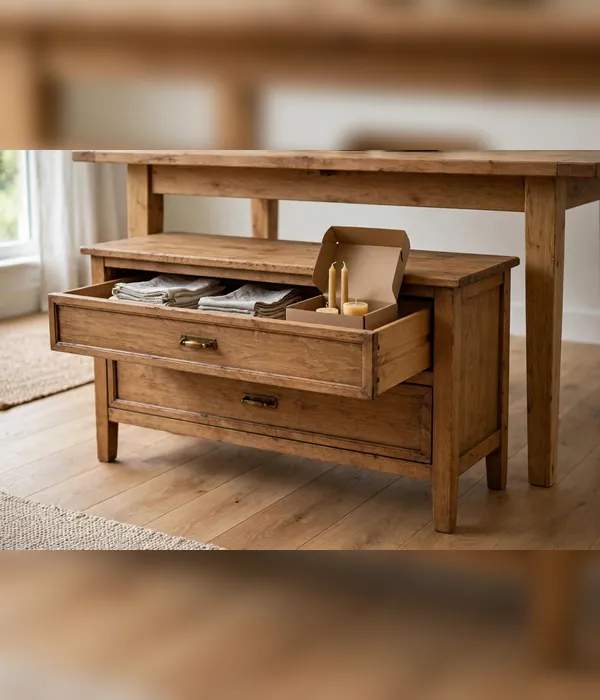
A dining bench already saves the 24 inches of pull-out space that chairs demand, drawers underneath make it storage too. Two to three shallow drawers under a standard 17- to 19-inch seat height hold the napkin collection, the candle box, and the table games, all within arm’s reach of the table and invisible when closed.
The seat height matters more than it looks: 17 to 19 inches matches standard dining chairs, so the bench tucks fully under the table and nobody sits noticeably higher or lower than the chair crowd.
Soft-close drawer slides are worth the small premium, bench drawers get yanked open by kids and slammed by guests, and standard slides die within a year.
Tips for best results: Dedicate one drawer per category, napkins, candles and table decor, games, and the bench organizes itself. Choose a bench 6–12 inches shorter than the table so it slides fully underneath. Felt pads on the feet protect hard floors when the bench gets dragged out daily.
Watch out: Check the drawer depth before buying: some “storage benches” have 4-inch-deep drawers that fit nothing but placemats. You want at least 6 inches of usable depth for folded napkins and candle boxes. And skip the bench if your table has a center pedestal, knees and drawers fight for the same space.
The Finishing Storage That Keeps the Room Working
16. Hutch Lighting: battery pucks vs hardwired
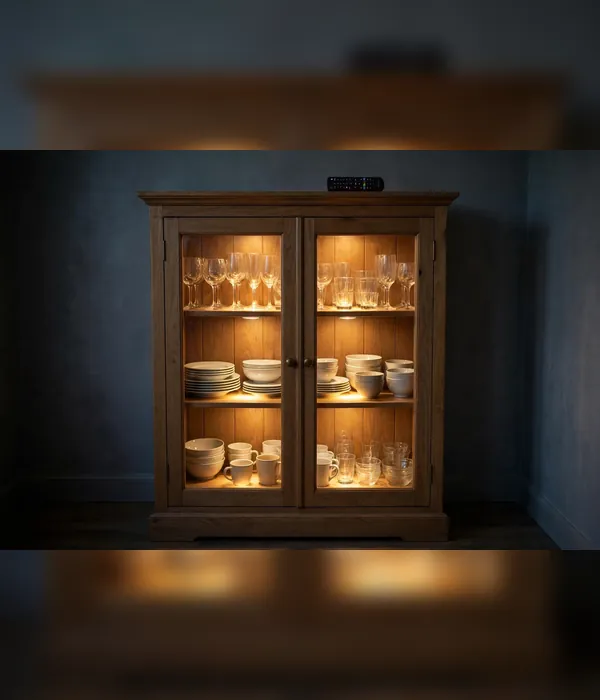
The darkest cabinet in the house is the one with glass doors: a china hutch lit only by the room becomes a cave, and the pieces inside might as well be in boxes.
Light changes everything, lit shelves turn stored dishes into display, and you stop opening every cabinet hunting for the serving bowl because you can actually see it.
Battery puck lights are the renter-safe answer: peel-and-stick LED pucks under each shelf, remote-controlled, no electrician, no holes. They run 50-plus hours on a set of batteries and cost under $20 for a six-pack. Hardwired LED strips are the permanent upgrade, brighter, even, and always on, but they need an outlet inside the cabinet and, usually, an electrician.
Where it works best:
- Glass-front hutches and china cabinets where the contents deserve to be seen
- Deep sideboard cabinets: one puck per shelf ends the flashlight hunt
- Renters: battery pucks peel off clean when you move, hardwired is a landlord conversation
- Dark dining rooms: lit shelves bounce light and make the whole room feel larger
- Shop right: look for 3000K warm-white LEDs, cool white makes wood furniture look gray
17. Sideboard-Top Styling That Stores: decor with a job
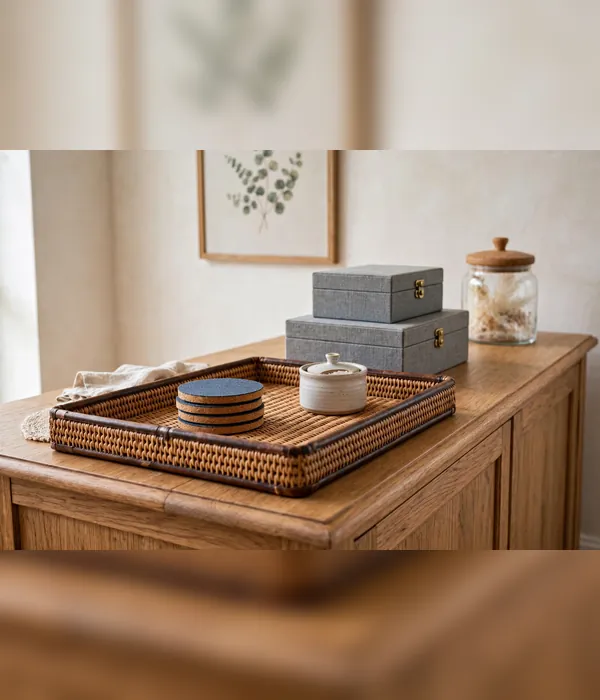
The sideboard top is prime real estate, and most of it gets spent on a candle and a plant that hold nothing.
The trick is decor that stores: lidded boxes that read as sculpture, a tray that corrals the everyday carry, a lidded jar for the wrapped mints. Every object earns its footprint by holding something the room would otherwise scatter.
A large tray, 18 by 24 inches is the sweet spot, defines the “active zone”: coasters, the salt cellar, today’s napkins. Behind it, two lidded boxes stack the place cards and the candle stash.
Nothing sits loose, everything has a lid or a rim, and the whole arrangement lifts off in one tray when the sideboard becomes a buffet line.
For the full styling system, see sideboard styling that hides clutter.
What you can do with it:
- Corral the daily scatter: one tray holds coasters, salt, and napkins, the three things that migrate
- Hide the ugly-useful: lidded boxes swallow place cards, extra batteries, and the table-number set
- Keep one “party tray” empty: when guests come, it becomes the serving tray, dual duty
- Go lidded over open: open bowls become catch-alls; lids force a decision about what belongs
- Shop right: lidded boxes in wood or woven textures run $15–$40; trays with raised rims beat flat ones
18. Centerpiece Storage Bins: vases without the avalanche
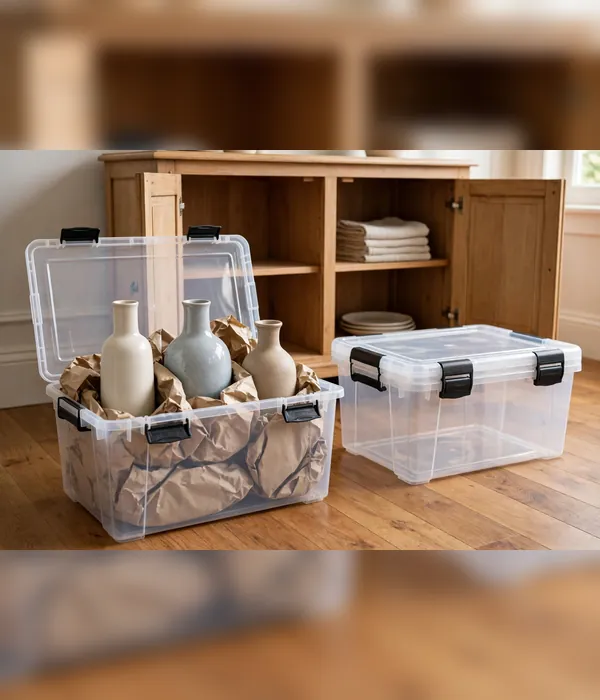
Vases multiply. The tall one from the wedding, the short fat one, the three bud vases, they stack inside each other until the whole tower avalanches every time you need the bottom one. Clear 16-quart bins end it: vases stand upright, visible through the bin, packed with a layer of packing paper between heights so nothing nests and wedges.
One 16-quart bin holds roughly 6 to 8 medium vases; the taper candle box and the table runners fit in a second. Store the bins in the sideboard’s deep cabinet or the nearest closet, never the garage, where temperature swings craze ceramic glazes.
Clear bins matter: you grab the tall vase without opening three boxes, which is the difference between a system you use and one you abandon.
Where it works best:
- Households that change centerpieces seasonally, the bin is the whole seasonal kit in one grab
- Small dining rooms: two stacked bins fit in a single sideboard cabinet
- Candle hoarders: taper boxes and pillar candles share the second bin without melting together
- Anyone who’s ever opened a closet to a vase avalanche, this is the permanent fix
- Shop right: 16-quart clear latching bins run $8–$15; latching lids beat snap lids for stacked storage
19. Kids’ Dining Supplies Zone: one drawer, adult room
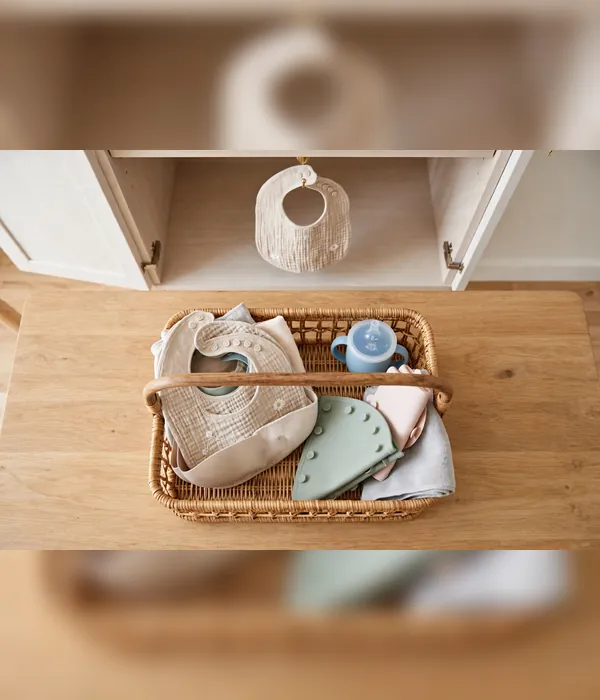
Kids’ dining gear has a way of colonizing the entire room: the bib draped over the chair, the sippy cup on the sideboard, the placemat permanently stuck to the table.
The zone system contains it: one drawer or one handled caddy holds every kid item, bibs, suction placemats, cups, the spill cloth, and the rest of the room stays adult.
The mechanism is containment plus access. A caddy with a handle lives in the sideboard drawer or on a low shelf; at mealtime it comes out, after mealtime it goes back, and the cleanup takes thirty seconds because nothing migrated.
Bibs hang on a single hook inside the cabinet door, visible, reachable, and off every chair back in the house.
What you can do with it:
- Dedicate one drawer or caddy: bibs, cups, placemats, spill cloths, the complete kid kit
- Hook bibs inside the cabinet door: off the chairs, off the floor, always findable
- Keep 2–3 of each item, not 12: the zone stays small enough to actually maintain
- Store the high-chair tray cover with the kit, it’s the piece that always goes missing
- Graduate the system: when the kids outgrow it, the caddy becomes the everyday napkin station
20. Entry-to-Dining Drop Zone Control: stop the dumping ground
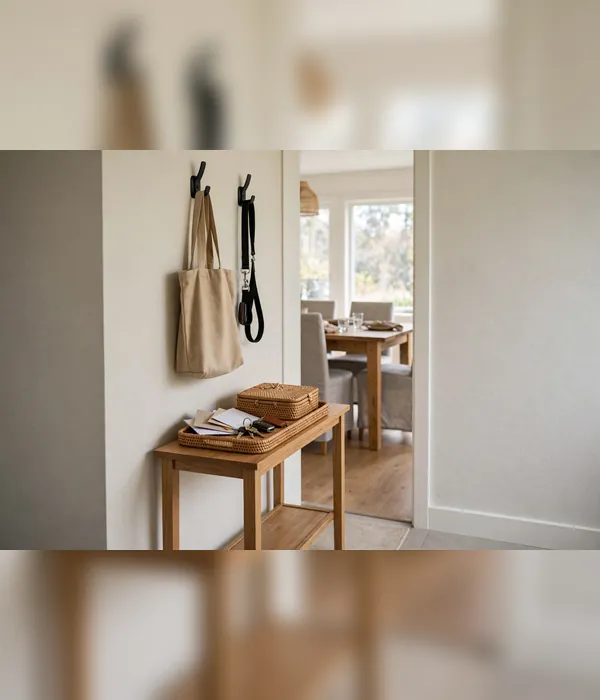
Every dumping-ground dining room has an entry point where the mess begins, the doorway from the hall, the arch from the living room, where mail, keys, and bags land on the nearest flat surface, which is the dining table.
A micro drop zone at that threshold intercepts the flow: a small tray for keys and mail, two hooks for the bags, and the table never sees any of it.
The tray should be no bigger than 12 by 8 inches, large enough for keys, a wallet, and today’s mail, small enough that junk can’t accumulate.
Mount two hooks at 60 inches for bags and the dog leash. Sort the mail tray weekly: anything older than seven days gets filed or recycled, which keeps the zone a transit point instead of a second dumping ground.
Where it works best:
- Open-plan homes where the dining table is the first flat surface from the front door
- Households with kids: their school papers get a tray slot instead of the table
- Small apartments: the drop zone doubles as the entryway when there isn’t one
- Anyone whose dining table currently holds more mail than meals, start here, today
- Shop right: a lidded mail tray plus two adhesive hooks runs under $25 and needs zero drilling
Conclusion
Twenty ideas, one principle: every dining category gets a home sized to its largest item, and the table stops being the household’s junk drawer. Start with the biggest win, the sideboard, then add the zones that match your actual clutter: linens, glassware, the kid gear, the mail.
The one piece that does the most: the sideboard/buffet, and it isn’t close. A china cabinet shows off twelve plates beautifully and stores little else; a 60- to 72-inch sideboard with closed cabinets swallows the serving pieces, the linens, the flatware, the candles, and the holiday overflow, then doubles as the buffet line when guests arrive.
If your dining room gets exactly one storage purchase this year, make it the closed-cabinet sideboard, measured to your wall run, and build every other zone around it.
The 4-zone buy list (pin this before you shop):
- Zone 1, Dishes and serveware: the sideboard, plus dividers for the top drawer
- Zone 2, Glassware and wine: stemware racks and a 12-bottle rack sized to your buying
- Zone 3, Linens and flat things: 30-inch roll tubes, a charger file organizer, padded seasonal boxes
- Zone 4, The dumping ground: a 12-by-8-inch entry tray and two hooks at the threshold
If the dining room shares its makeover energy with a small-space refresh, small dining room makeover storage ideas covers the furniture-scale side of the same project.
Frequently Asked Questions (FAQ)
What are the best dining room storage ideas for a small dining room?
Start with the pieces that do double duty: a bar cart instead of a bar zone, a dining bench with drawers instead of chairs plus a cabinet, and wall-mounted glass racks that free entire shelves. In rooms under 120 square feet, skip the china cabinet, its footprint stores far less per inch than a 60-inch sideboard.
Measure the chair pull-out (30 inches minimum) before buying anything, because one oversized piece can freeze the whole layout.
Should I buy a sideboard or a china cabinet?
Buy the sideboard if you need storage; buy the china cabinet if you need display. A closed-cabinet sideboard hides serving pieces, linens, and flatware in one 60- to 72-inch run, while a china cabinet’s glass shelves suit heirloom pieces you want visible.
If you already own heirloom china, get the cabinet and add risers so every shelf earns its rent. Most households use the sideboard daily and the cabinet twice a year, budget accordingly.
How do I store tablecloths without ironing them every holiday?
Roll, don’t fold. Wrap the cloth around a 30-inch cardboard tube and store it horizontally in a wide drawer or lidded bin, the roll relaxes creases instead of pressing them in. Keep everyday placemats separate from holiday cloths so the Christmas damask never gets buried and wrinkled under daily use.
For heirloom linen, add acid-free tissue between layers. The whole system costs under $15 if you source free mailing tubes.
Can I keep wine in the dining room, or does it need a cellar?
Everyday wine is fine in the dining room if you respect two rules: bottles with corks rest horizontal so the cork stays wet, and the spot stays 55–65°F away from heat and sun. Pick an interior wall over the window wall, and never park bottles above a radiator or beside the oven.
If your dining room runs hot in summer, store the good bottles elsewhere and keep only the weeknight rotation in the dining nook.
How do I stop my dining room from becoming a dumping ground?
Intercept the clutter at the threshold, not at the table. Put a 12-by-8-inch tray and two hooks at the dining room’s entry point so mail, keys, and bags land there instead of on the table, then sort the tray weekly.
Inside the room, give every category its own zone, the kid caddy, the labeled baskets, so nothing is homeless. A table with nowhere else to put things will always collect them.
What dining storage works for renters who can’t drill into walls?
Everything freestanding: a sideboard, a bar cart, a china cabinet, and storage benches all need zero screws. For walls, use adhesive-mounted stemware racks (prep with rubbing alcohol, cure 24 hours, light stems only) and leaner shelves instead of floating ones. Battery puck lights replace hardwired hutch lighting and peel off clean.
Expandable bamboo drawer dividers press-fit with no hardware. When you move, the whole system moves with you.