Most living room cabinet ideas break down by price, and the price tag tells you exactly what you’re buying. Under $100 buys you a flat-pack tall cabinet in particleboard that does the job if you anchor it and don’t overload it. That honesty matters, because the wrong cabinet at any price wastes money.
The $150 to $400 tier is the sweet spot for most of us. Engineered-wood sideboards, media consoles, and drawer chests here carry real veneer, metal drawer slides, and shelves that hold books without bowing. You get 60 to 80 inches of storage width and surfaces that survive daily life.
Above $500 you’re paying for solid wood, dovetail drawers, and furniture that survives three moves. This guide orders the 12 picks by configuration, from closed-door cabinets through drawer-heavy ones to display and combo pieces, so you can match the cabinet to your clutter and your budget.
Why Living Room Cabinet Ideas Beat Open Shelving for Clutter Control
Open shelves keep everything visible, and visible means maintained. A closed-door cabinet breaks the sight line, so the board games, chargers, and half-finished craft projects disappear the second you shut the door. The room looks calm even when the inside of the cabinet absolutely is not.
Dust is the second mechanism. Open shelves in a living room collect a visible film within days, while anything behind a door or a drawer needs attention quarterly at most. If you’ve ever dusted the same shelf twice in one week, you already understand why closed storage wins.
Then there’s the math. A typical two-door sideboard at 60 inches wide, 16 deep, and 32 tall gives you roughly 12 cubic feet of hidden storage in about 7 square feet of floor.
Drawers do the same job for small items, since a 4-inch-deep drawer gives remotes and batteries a home that a shelf never could. If you’re still weighing broad living room storage ideas options, cabinets are where most of the real capacity lives.
1. The Flat-Pack Tall Cabinet: Closed Doors Under a Hundred Bucks
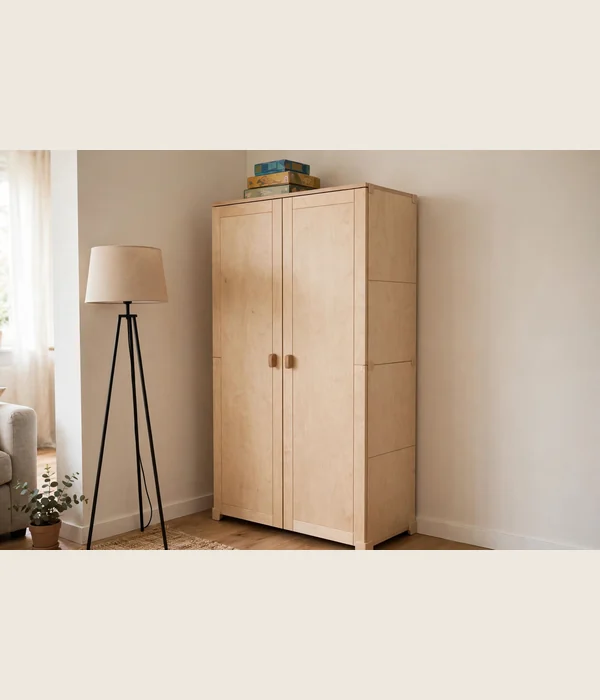
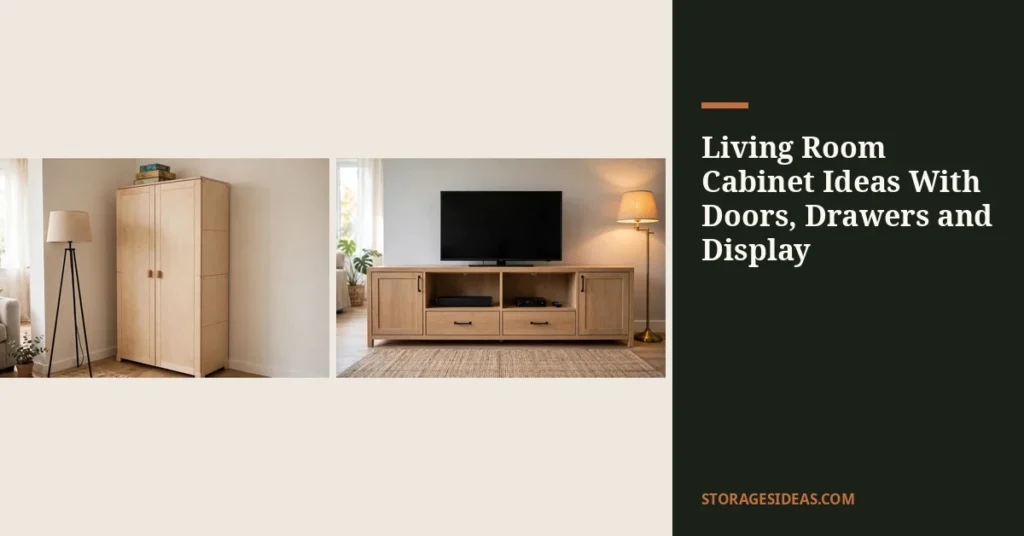
A flat-pack tall cabinet is the cheapest way to buy vertical storage. At roughly 31 inches wide, 16 deep, and 75 tall, it holds five or six adjustable shelves of board games, linens, and craft supplies inside 3.5 square feet of floor. Closed doors do the visual work, so nothing inside has to look pretty.
This is the piece I’d hand a renter furnishing a first apartment on a tight budget. It’s freestanding, so there’s no damage beyond the tiny holes from the anti-tip anchor, which spackle fixes in minutes. Two people can carry it up a flight of stairs, and assembly runs about an hour with a screwdriver.
Tips for best results: Screw the anti-tip strap into a stud, not just drywall. Load the two bottom shelves with the heaviest items, games and photo albums first, and leave the top shelf for light seasonal stuff. Stick felt pads under the feet so it slides out for cleaning.
Watch out: Particleboard shelves start to bow past 20 to 25 pounds per shelf, so a full row of hardcovers is too much. The two doors each need about 16 inches of swing clearance in front. Cheap hinges loosen over time, so retighten them twice a year.
2. The Closed-Door Media Sideboard: Hide the Tech, Keep the Calm
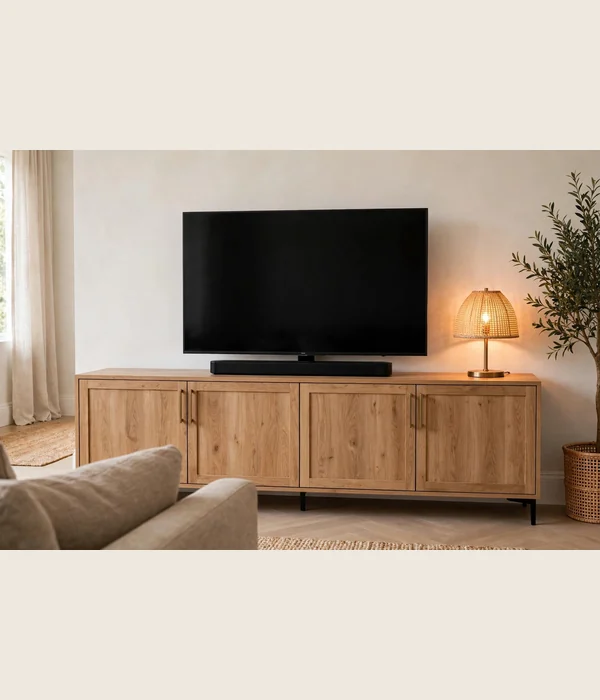
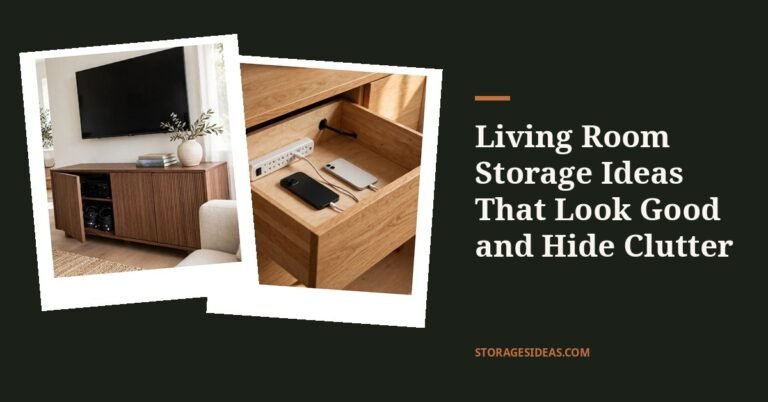
A closed-door sideboard is the media cabinet that hides the mess technology makes. Streaming boxes, routers, game consoles, and a tangle of chargers all live behind doors, while the top holds your TV at the right height. The room reads calm because the electronics are invisible.
Sizing is the whole game here. A 55-inch TV measures about 48 inches wide, so your console should run 60 to 65 inches. A 65-inch TV is roughly 57 inches wide, which wants a 70 to 78-inch console. That extra 6 to 12 inches on each side keeps the setup stable and leaves room for a soundbar.
What you can do with it:
- Stash the router and streaming box behind a door with a 2-inch cable hole in the back panel, so remotes still work and heat escapes.
- Use the center drawer for remotes, controllers, and the batteries that always go missing.
- Park vinyl records on an adjustable shelf, since 12-inch sleeves need a full 13 inches of height.
- Set the TV on top, since most sideboards hold 40 to 60 pounds up there without complaint.
- Leave 3 feet of walkway in front, because 16 to 20 inches of depth plus open doors eats more room than you’d guess.
3. The Living Room Armoire: Full-Length Doors for the Overflow a Closet Can’t Hold
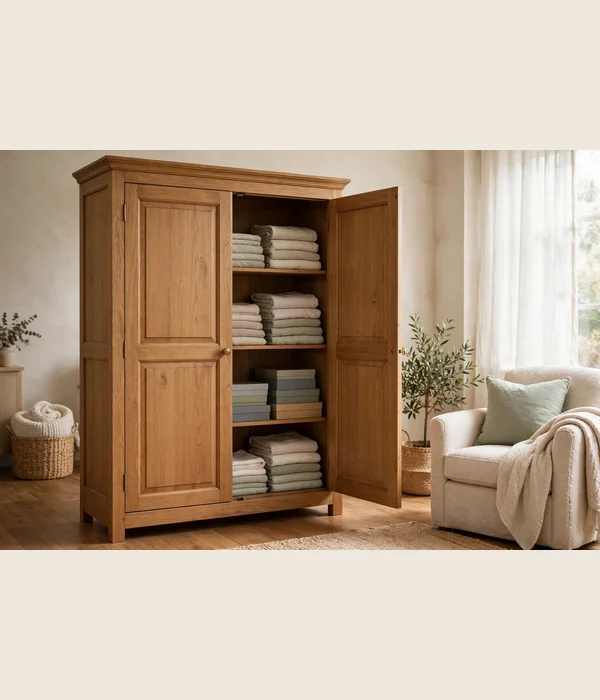
An armoire is a closet that happens to stand in your living room, and that’s exactly the point. At 36 to 40 inches wide and 20 to 24 inches deep, it swallows the overflow a coat closet can’t hold: board game boxes, wrapping paper, photo albums, the good linens. Full-length doors mean no middle rail blocking a tall item.
The 24-inch depth is the magic number. A standard board game box is 12 inches square, so you can shelve games two deep and still close the doors. One side with a hanging rod handles tablecloths and guest bedding on padded hangers. It’s the highest-capacity piece on this list, which is why it anchors small apartments.
Tips for best results: Line every shelf with non-slip liner so stacks don’t slide when you open the doors. Put the heaviest boxes on the bottom shelf and the light seasonal stuff up top. If it has a hanging rod, keep it to one side so folded items fit beside it.
Watch out: Open doors need the full 20 to 24 inches of depth plus another 20 to clear, so leave about 44 inches in front. Anything over 72 inches tall gets tippy, so anchor it. And measure your interior doorways: a 38-inch-wide assembled armoire won’t pass a 30-inch doorway, so buy flat-pack or assemble it in the room.
4. The Apothecary Drawer Cabinet: Shallow Drawers for Small Living-Room Chaos
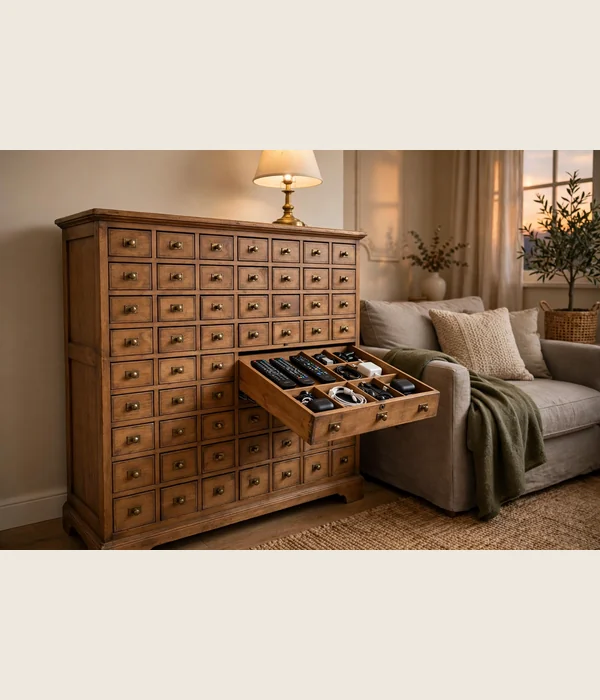
Shallow drawers solve the small-item problem that deep drawers create. Drop a remote into a 10-inch-deep drawer and it disappears into the rummage zone. An apothecary-style cabinet gives you a dozen drawers at 4 to 6 inches deep, so batteries, chargers, reading glasses, coasters, and craft supplies each get a visible home.
The footprint stays apartment-friendly at roughly 30 to 36 inches wide and 14 to 18 inches deep. That’s narrower than most sideboards, so it tucks against a sofa-side wall or into a hallway nook. Drawers glide on simple rails, which is fine because each one holds 8 to 10 pounds of light items.
Where it works best:
- Beside the sofa, where one drawer holds remotes and another holds the charging cables.
- In a craft corner, with each drawer labeled for thread, glue, scissors, and spare buttons.
- As a hallway catch-all near the living room, keys and sunglasses in the top row.
- Under a window, since the 36 to 42-inch height keeps the sill clear.
- Topped with a lamp, because the flat surface doubles as an end table.
- In a work-from-home corner off the living room, where each drawer swallows a category of supplies.
5. The Fabric-Drawer Dresser: Five Drawers of Renter-Friendly Storage
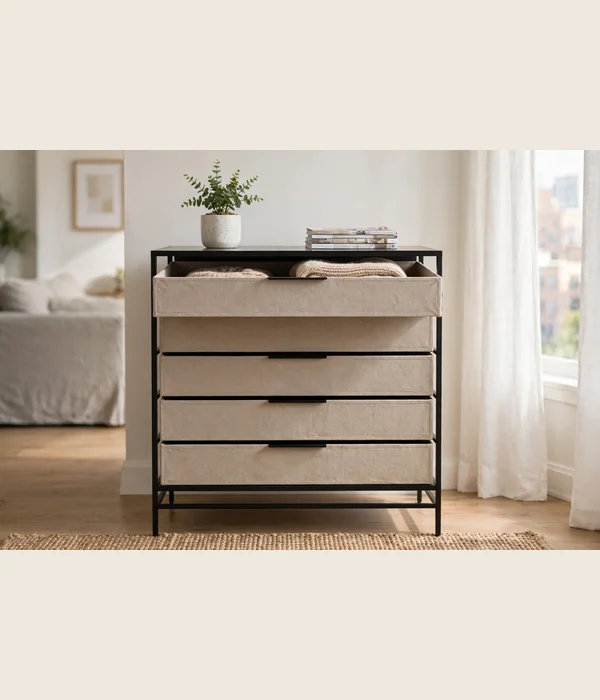
Five fabric drawers on a steel frame is the renter’s cheat code for apartment living room storage. A typical unit runs about 33 inches wide, 12 inches deep, and 38 tall, weighs under 30 pounds, and costs less than a nice dinner out.
You can carry it up three flights of stairs alone and rearrange the room on a whim.
Each drawer holds 10 to 15 pounds of soft goods, which makes them perfect for throw blankets, magazines, kids’ toys, and spare chargers. The flat top takes a lamp or a stack of coffee-table books. It’s not heirloom furniture, but for a first apartment or a room you’re still figuring out, it’s honest storage at an honest price.
Tips for best results: Keep books and anything dense out of the drawers, since fabric sags past 15 pounds. Pull drawers straight out instead of yanking, and the frames last longer. Rotate the busiest drawer to a lower slot if the top one starts to loosen.
Watch out: Fabric holds moisture, so skip this for damp basements or steamy corners. The whole unit is light enough to tip if a toddler climbs it, so anchor it if you have small kids. Expect a few years of service, not a few decades.
6. The Wide Solid-Wood Drawer Chest: Furniture That Outlives the Trends
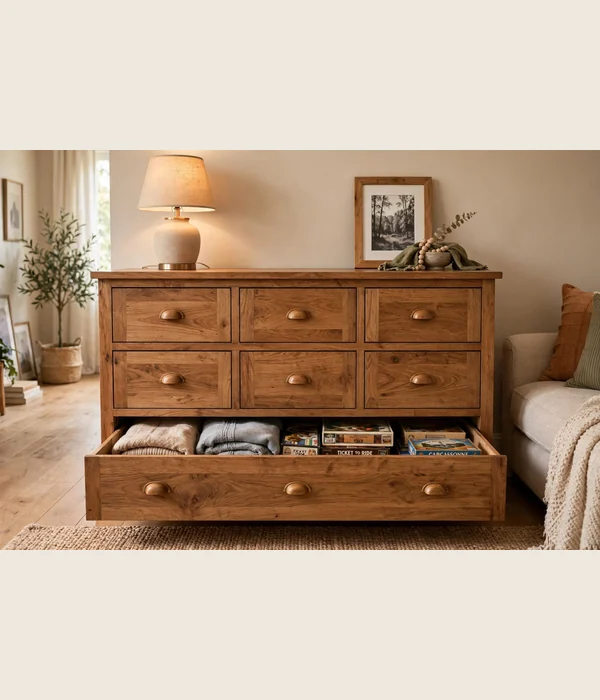
This is the piece you buy once. A solid-wood six-drawer chest at about 47 inches wide, 16 deep, and 31 tall gives you six 40-pound-capacity drawers on metal ball-bearing slides. Dovetail joints mean the drawers survive decades of daily yanks, and the top holds over 100 pounds, which is a 55-inch TV with room to spare.
The 31-inch height is the sweet spot for a living room. It’s low enough that a lamp and a row of framed photos sit at eye level from the sofa, and tall enough that you don’t bend double to reach the bottom drawer.
At 16 inches deep it keeps walkways clear while still swallowing folded throws and 12-inch board game boxes.
What you can do with it:
- File photo albums and board games in the deep bottom drawers, since 40 pounds each means no compromises.
- Corral the living room’s paper trail, manuals, warranties, and takeout menus, in the top drawers.
- Set a 55-inch TV on top, because the 100-pound-plus load rating handles it with margin.
- Stage a lamp, a plant, and one framed photo up top, since the 47-inch width gives you styling room.
- Slide baskets into two drawers for kids’ toys, so cleanup is one pull and one push.
7. The Glass-Front Display Cabinet: Your Collections, Minus the Dusting
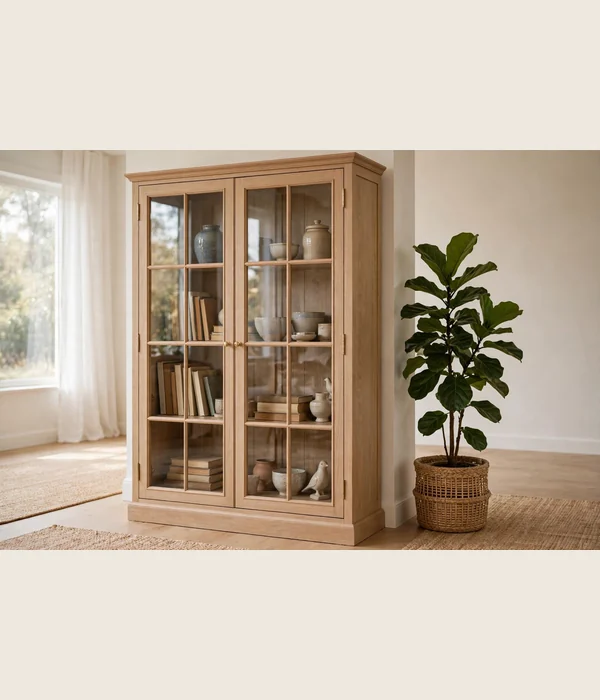
Glass doors give you the look of open display with about a quarter of the dusting. A typical display cabinet runs 32 to 40 inches wide and 70 to 78 inches tall, with tempered-glass shelves that show off books, ceramics, and collectibles from every angle. You get the styled look without the weekly feather-duster routine.
The glass is also a barrier. It keeps little hands off fragile pieces, keeps cat paws off the ceramics, and some models lock, which matters for anything valuable. Because everything stays visible, you’re forced to curate, which is secretly the best part: a glass cabinet with five great objects beats open shelves with fifty random ones.
Tips for best results: Leave 2 inches of breathing room between objects so nothing looks crowded. Press a dab of museum putty under anything wobbly, since glass shelves transmit every tremor. Dust the glass quarterly with a microfiber cloth, and skip the spray near wood frames.
Watch out: Check each shelf’s weight rating before loading heavy ceramics, since most tempered-glass shelves top out around 15 to 20 pounds. Keep the cabinet out of direct sun, because UV fades book spines and photographs. Glass shows every fingerprint, so teach the household the handle-only rule.
8. The Open-Back Bookcase: Books You Grab, Shelves You See
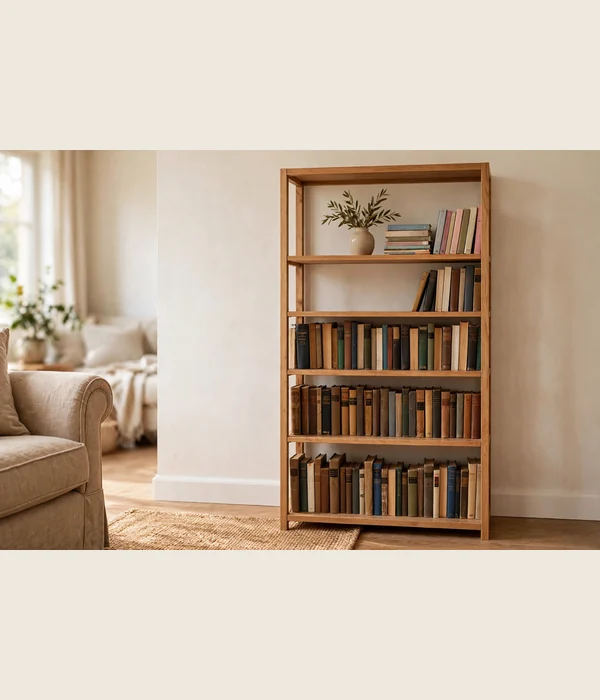
An open-back bookcase is the fastest-access storage in the living room. No doors to open, no drawers to slide, just grab the book. At roughly 31 inches wide, 12 deep, and 72 tall with five shelves, it holds a serious library in under 3 square feet of floor. The open back keeps it feeling light against the wall.
Here’s the honest math on weight. Engineered-wood shelves hold about 20 to 30 pounds each, and a single foot of hardcovers weighs roughly 15 to 20 pounds. So a full 28-inch row of hardcovers can hit 40 pounds and bow the shelf.
Put the heavy books on the bottom two shelves, which are usually fixed and stronger, and keep the upper shelves for paperbacks and decor.
Where it works best:
- Against a reading-chair wall, where the books you actually finish live within arm’s reach.
- In a hallway nook off the living room, since the 12-inch depth barely dents the walkway.
- With baskets on the bottom two shelves, which fakes the look of closed storage for toys and clutter.
- Styled with 20 percent of each shelf left empty, so the eye rests instead of racing.
- Flanked by a floor lamp, because good light is what turns shelves into a reading spot.
9. The Corner Display Tower: Reclaim the Deadest Square Footage in the Room
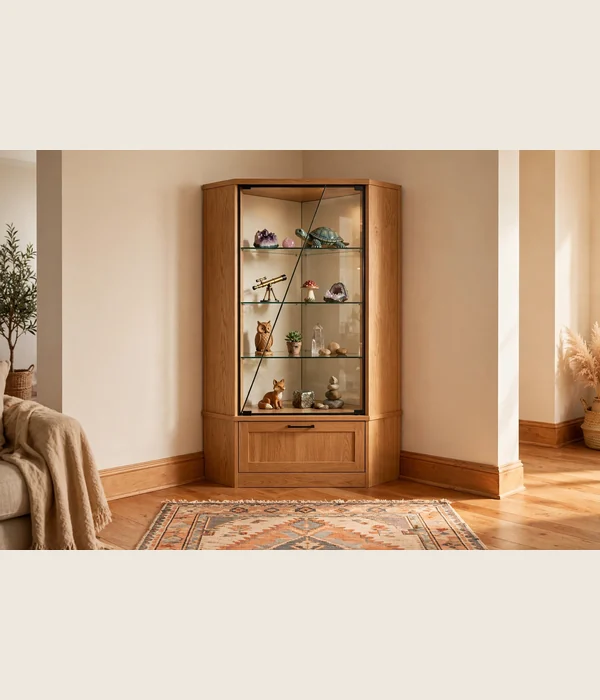
Corners are the deadest square footage in a living room, usually 4 to 6 square feet of nothing. A corner display tower with a diagonal glass front turns that dead zone into storage and a focal point at once.
Typical units span 24 to 30 inches on each wall face and rise 68 to 78 inches, so they draw the eye up and make low ceilings feel taller.
The diagonal front is the clever part. It faces the room instead of facing a wall, which means your display actually gets seen from the sofa. Inside you get three or four glass shelves for collectibles plus a closed base cabinet for the clutter. It’s freestanding, so renters can use it with zero wall damage.
Tips for best results: Drop in battery-powered puck lights, since they make glass shelves glow with no wiring. Rotate the display seasonally, because a corner tower is the room’s jewelry box and deserves fresh pieces. Anchor it if you have kids, since tall and narrow means tippy.
Watch out: Measure both walls, not just one, since the unit needs equal clearance on each face. The diagonal door swings out into the room, so don’t park it in a walkway. Confirm the glass is tempered before buying, especially with kids or pets around.
10. The Open-Center Sideboard: Display in the Middle, Secrets on the Sides
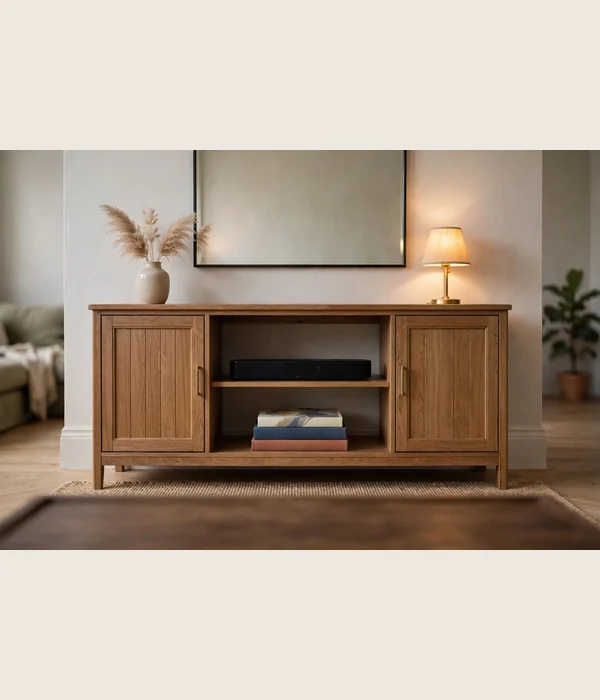
The open-center sideboard is the best of both configurations in one piece. At 60 to 72 inches wide, you get closed cabinets on both ends and an open niche in the middle, usually 20 to 40 inches across. The styled center draws the eye, the clutter hides on the sides, and the room gets both display and secrecy.
This layout earns its keep as media storage. The center niche fits a soundbar or a stack of art books, while the closed ends swallow the router, game consoles, and disc collections. Because the niche is open, streaming boxes and remotes work without opening a door, and heat from electronics vents instead of building up.
What you can do with it:
- Center a soundbar in the open niche, since most run 36 to 40 inches wide and fit a 72-inch unit’s center bay.
- Style the niche with three art books and one object, because the rule of odd numbers works here.
- Hide the router and charging station in a closed end, with a cable hole in the back panel.
- Store board games two-deep in the 16 to 20-inch-deep side cabinets.
- Top it with a mirror or art, since the 30 to 36-inch height puts both at sofa eye level.
11. The Doors-Below, Shelves-Above Hutch: The Classic Combo That Fits Anywhere
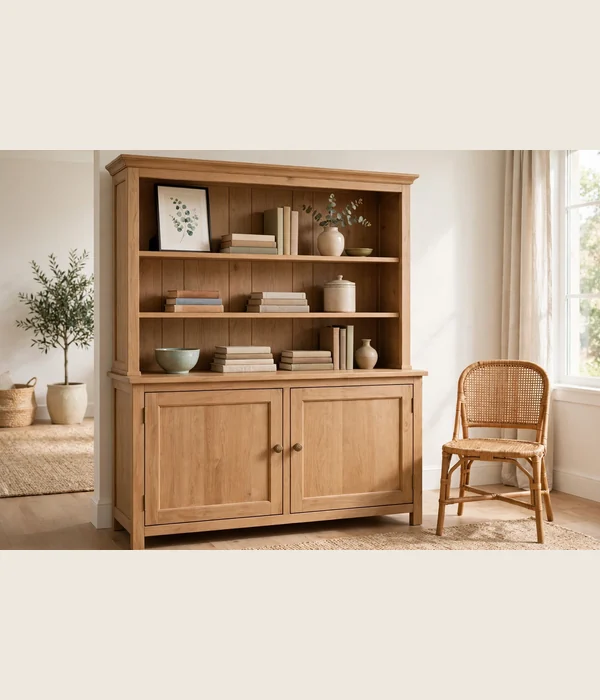
A hutch, closed cabinet below and open shelves above, is the configuration that refuses to go out of style. The base runs 36 to 48 inches wide and 16 to 18 deep, with doors hiding 8 to 10 cubic feet of games, linens, and tech. Above it, three open shelves show off the pieces worth seeing. One footprint, both jobs.
If you’re weighing built-in shelves for living room, start here instead. A hutch gives you most of the look for a fraction of the cost, and it moves with you. The top-heavy profile means you must anchor it to the wall, but that’s a two-hole job, not a renovation.
Tips for best results: Anchor the top section into a stud, since hutches are top-heavy by design. Keep the open shelves to things you dust quarterly, and hide the dusty stuff below. Line the base shelves so stacks of games don’t slide.
Watch out: The combined 72 to 80-inch height needs a ceiling that clears it with margin. Don’t load the top shelves with heavy ceramics, because the upper section is for display weight only. Check that the base doors clear any baseboard heating before you buy.
12. The All-in-One Media Cabinet: Drawers, Doors, and Open Niches in One Piece
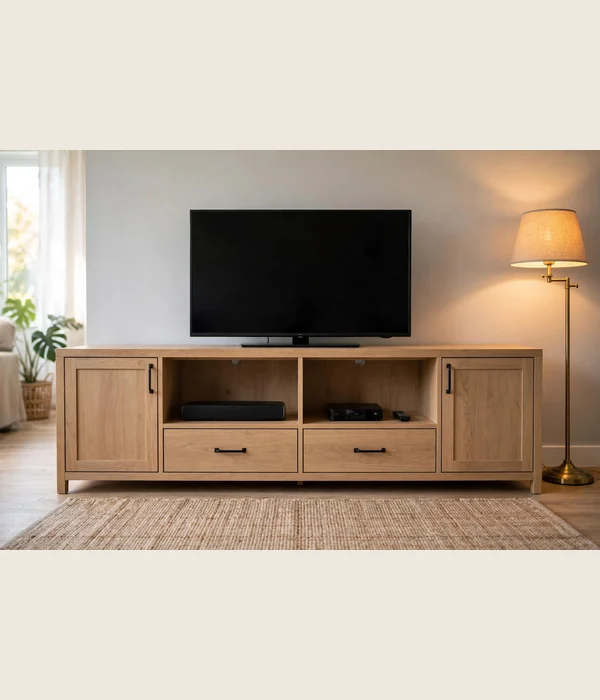
The all-in-one media cabinet is what happens when a sideboard grows up. At 65 to 84 inches wide, it packs drawers, closed cabinets, and open niches into a single 16 to 20-inch-deep piece. One furniture footprint replaces the console, the disc tower, and the side table you were using for overflow.
The sizing rule from earlier still applies: pick a console at least 12 inches wider than your TV. A 65 to 84-inch unit handles TVs up to 75 inches with breathing room on each side.
At 30 to 36 inches tall it puts the screen near sofa eye level, and the mix of closed and open storage means every piece of tech has a ventilated home.
What you can do with it:
- Run two drawers for remotes, controllers, and the spare cables nobody admits to owning.
- Close the cabinet doors on the game console and cable box, drilling a 2-inch cable hole per bay.
- Park the streaming stick and soundbar in the open niches where signals and heat escape.
- Use the top’s 16 to 20-inch depth for the TV feet plus a soundbar, with room to spare.
- Keep 3 feet of clearance in front, because drawers and doors both swing into the room.
Conclusion
Worth the splurge: the doors-below, shelves-above hutch in the best wood your budget allows. It’s the only piece on this list that hides the mess and shows off the good stuff in about 5 square feet of floor, and a solid-wood one survives every move you’ll ever make.
If the budget doesn’t stretch there, the flat-pack tall cabinet from point one does 70 percent of the job for under a hundred bucks. Either way, measure twice, anchor the tall ones, and buy the cabinet for the clutter you actually have, not the living room you wish you had.
Frequently Asked Questions (FAQ)
What size living room cabinet do I need for my space?
Measure the wall, subtract 6 inches of breathing room on each side, and match depth to your walkway: 16 to 20 inches is standard. For a TV, add 6 to 12 inches to the screen’s width. If the cabinet is taller than 72 inches, confirm your ceiling and your ability to anchor it first.
Are closed cabinets or open shelves better for a small living room?
Closed cabinets win in small rooms, because they hide visual clutter and cut dusting. Open shelves only work if you commit to styling and maintaining them. The compromise is a combo piece: closed storage below, one or two open shelves above, which is why hutches keep showing up in small apartments.
Can a living room cabinet double as a TV stand?
Yes, if the math works. The cabinet should be at least as wide as the TV, ideally 6 to 12 inches wider, and rated for the TV’s weight on top. Ventilate any closed bay holding a console or cable box with a cable hole, since heat builds up fast behind closed doors.
How do I stop a tall cabinet from tipping over?
Anchor every cabinet taller than 72 inches to the wall with the included anti-tip strap, screwed into a stud. If you rent and can’t find a stud, a toggle bolt in drywall plus spackle on move-out is the standard fix. Load the heaviest items on the bottom shelves, and never let kids climb open drawers.
Will a fabric drawer dresser hold up in the living room?
For light duty, yes. Fabric drawers handle 10 to 15 pounds each, which covers throw blankets, magazines, and toys. They sag under books and wear out in a few years. If you need daily-use storage for heavy items, step up to a wood drawer chest instead.
How much should I spend on a living room cabinet?
Under $100 buys a flat-pack tall cabinet that works if you anchor it and keep loads light. The $150 to $400 range is the value sweet spot: real veneer, metal slides, and shelves that hold books. Above $500 you’re buying solid wood and dovetail drawers, which is worth it for the one piece you’ll keep for decades.