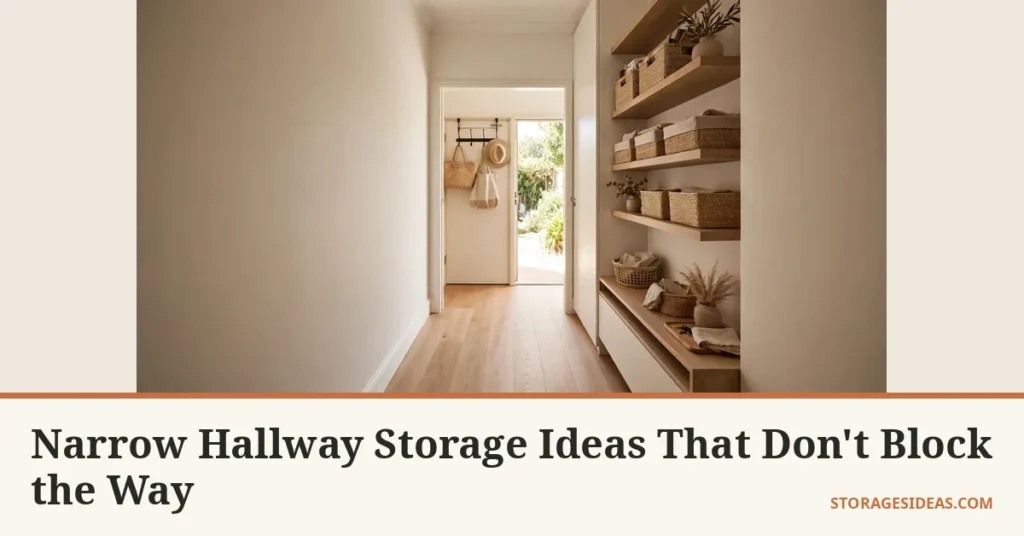
The best narrow hallway storage ideas keep at least 30 inches of walking space untouched while stealing room from the walls, the doors, and the air above your head. This list gives you 12 of them, with exact depths, weight limits, and typical price bands for every idea.
The classic mistake is buying furniture first and measuring later. A 16-inch-deep bookcase shoved into a 36-inch hallway leaves you 20 inches to walk through, which is narrower than an airplane aisle. Hooks mounted at head height turn every trip to the bedroom into a game of dodge.
The second mistake is treating every wall like free space. A fixed hook that juts out 4 inches is fine until a bag strap catches it for the third time. This list sticks to shelves 8 inches deep or less, hooks that fold flat, and floor pieces 10 inches or less, grouped by placement: walls, doors, floor pieces, and overhead.
Why Clearance Math Comes First in Narrow Hallway Storage
Here is the mechanism that decides whether a storage idea works in a hallway: your walkway is the hallway width minus everything sticking out from both sides. Two 4-inch shelves on opposite walls eat 8 inches off a 36-inch hallway, leaving 28 inches of walking room, which is too tight for carrying a laundry basket.
Most interior hallways run 36 to 44 inches wide, with 36 inches the minimum in many building codes. Aim for 30 to 32 inches of clear walking space. That lets two people pass with a sideways shuffle and leaves margin for open cabinet doors.
Keep this cheat sheet on your phone when you shop:
- 36-inch hallway: wall items 3 inches deep per side, or one floor piece 6 inches deep on one side only.
- 42-inch hallway: a 9 to 10 inch shoe cabinet fits on one side and still leaves 32 inches of walkway.
- 48-inch hallway: a slim console table up to 12 inches deep works if nothing sits opposite it.
- Overhead: anything suspended or shelved above the walk must clear 80 inches, the standard door height, or tall people will find it with their foreheads.
- Coats on hooks eat 8 to 12 inches of air, so wall hooks only make sense where the walkway stays above 30 inches even with a coat hanging.
This works the same way in a tight entryway, so pair these ideas with our full roundup of entryway storage ideas for the full drop-zone system.
1. Slim Floating Shelf Row: Storage That Lives Above the Bumps
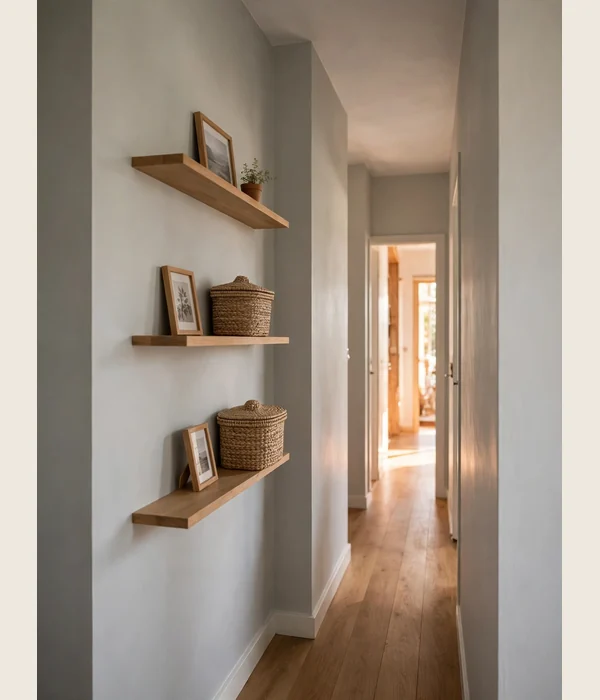
Floating shelves work in hallways because they hold their load at heights your body never occupies. A shelf mounted at 60 inches sits above shoulders, above swinging bag straps, and above the zone where a carried laundry basket scrapes. The floor keeps its full width.
Look for shelves 6 to 8 inches deep, which the sizing guides recommend for hallways. A typical set runs three shelves around 15.7 by 6.7 inches, rated for about 25 pounds each when screwed into studs, for roughly $20. That is enough for framed photos, small plants, and lidded catch-all bins.
Hang the lowest shelf with its top surface 58 to 62 inches from the floor. This clears the head-swipe range for most adults while staying within easy reach.
- Measure the hallway width and subtract the shelf depth. If the answer stays at 30 inches or more, your walkway is safe.
- Find the studs with a stud finder and mark them with painter’s tape, because a floating shelf’s stated weight rating assumes at least two screws bite into solid wood.
- Hang the lowest shelf first and level it. Then space the next shelves 12 to 14 inches apart so frames, plants, and bins slide in without scraping.
- Load the heaviest items closest to the wall and the light decor at the front edge. This keeps the load near the brackets, where the shelf is strongest.
- Put daily-use bins on the lowest shelf and decor higher up. If you stretch for it every morning, it will end up on the floor.
2. Picture Ledge Drop Zone: Keys and Mail in One Spot
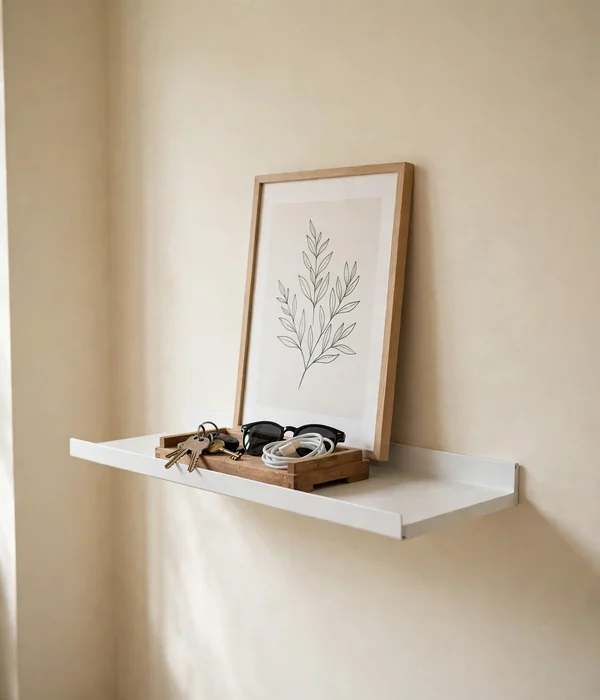
A picture ledge with a raised front lip does double duty in a narrow hallway. It holds the keys-and-mail bowl at grabbing height, and the lip stops everything from sliding off when the front door slams. Because a ledge is only about 4 to 5 inches deep, it barely dents the walkway math.
The usual pick is a 24-inch ledge. Metal no-stud mounts rated around 40 pounds sell near $45, while a wood pair lands closer to $39. Either version mounts at 48 to 54 inches, which is the natural reach height for dropping keys as you walk in.
No-stud versions use a cleat that spreads the load across the drywall, which matters for renters. If you ever move, you patch two small holes instead of re-plastering.
What you can do with it:
- Corral the daily carry: keys, sunglasses, and a wallet in one shallow tray per person.
- Park a small charging brick and cable on the end for the phone that always dies by dinner.
- Hang the dog leash on a hook screwed into the ledge’s front lip, if your leash clip fits.
- Line up sunscreen, bug spray, and the spare mask in summer, then swap for gloves and a hat in winter.
- Lean one framed photo or print against the wall so the drop zone feels finished instead of purely functional.
- Keep a tiny lidded bin for the receipts, batteries, and spare keys that otherwise colonize the floor.
3. Fold-Down Hook Rail: Hooks That Vanish Flat
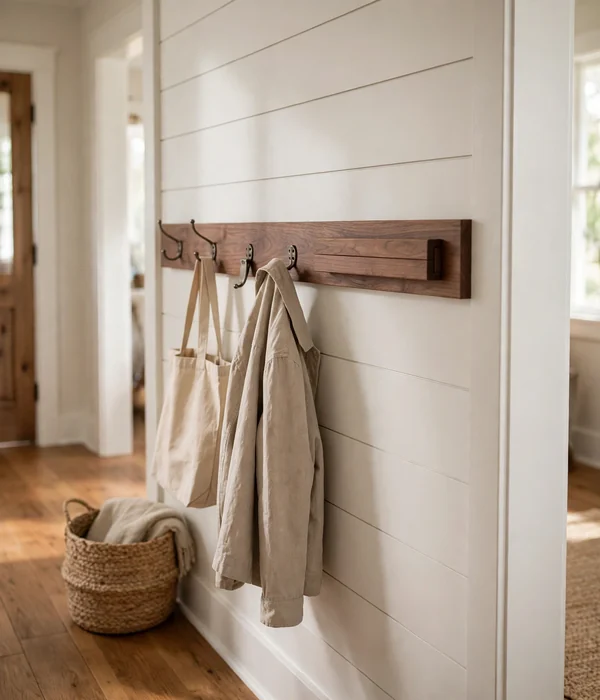
Standard hooks are storage that fights you. They jut out 3 to 4 inches all day, every day, whether something hangs on them or not. A fold-down rail fixes that: the hooks flip up flat against the board when empty, collapsing to about 1.75 inches of depth, and drop down only when they have a job to do.
Look for a rail around 15 by 6.5 inches with five hooks. The well-known wooden versions hold about 5 pounds per hook and run near $55, while budget fold rails land in the $20 to $30 range. Heavy-duty metal fold hooks can carry 30 pounds or more apiece for wet winter coats.
Mount the rail with its hooks at 64 to 68 inches. A 40-inch coat hangs to about 24 inches off the floor from that height, clearing dust and pet traffic.
- Pick a wall section where 30 inches of walkway survive even with a coat hanging, since a loaded hook eats 8 to 12 inches of air.
- Drive the mounting screws into studs, not just drywall. A fold rail takes repeated yanking as hooks flip down, and anchors work loose over a season.
- Assign one hook per person or per category (your bag, their coat, the umbrella). Unassigned hooks breed the pile-of-stuff look.
- Flip the hooks flat when the hallway is in heavy use, like moving day or a party, to reclaim every inch of clearance.
- Keep one hook reserved as the guest hook. Visitors hang their coats instead of stacking them on your stairs.
4. Pegboard Panel Wall: Endless Hook Layout
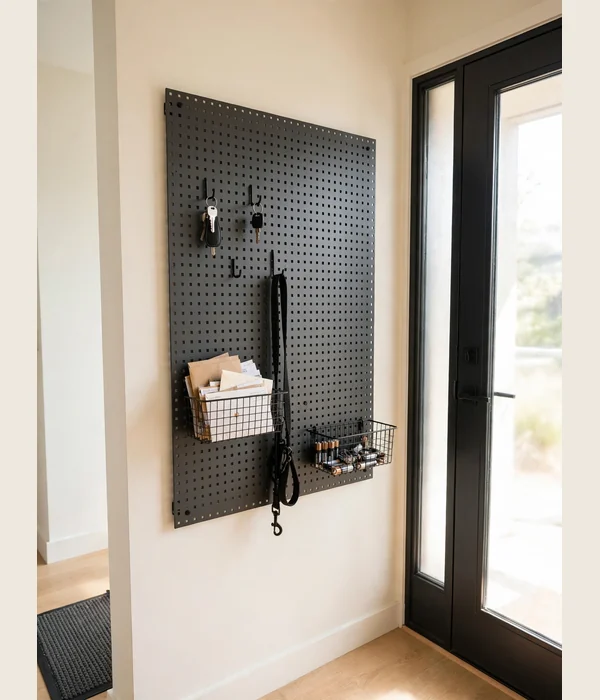
A pegboard turns one rectangle of wall into storage you can rearrange forever. Hooks, small baskets, and shelves plug into the holes anywhere, so the layout changes when your stuff does. The hooks project only 2 to 4 inches, which keeps the sleeve-grab problem small.
The standard panel is 24 by 36 inches, and two panels typically run $15 to $30. Use 3/4-inch standoff spacers behind the board so hooks have room to seat. Metal panels cost more but take heavier loads when screwed into studs.
Renters have one honest option: four to six large adhesive strips (rated about 5 pounds each) will hold a small panel loaded with keys, mail, and a light basket. Anything heavier deserves two screws, and two screw holes are a five-minute patch job.
Where it works best:
- The wall strip right inside the door, for keys, the leash, and the sunglasses that live in a small wired basket.
- Tall hallway walls with a panel mounted high for out-of-season gear and one at mid height for daily items.
- Kids’ hallway zones, with a low panel at 40 inches so little arms can reach their own hooks and bins.
- Rental hallways, where one small panel replaces four separate nail holes and looks intentional.
- Hallways that double as supply runs, with small bins for batteries, tape, and the spare light bulbs.
- Narrow stretches with zero floor space, where even a 6-inch cart cannot squeeze in.
5. Over-the-Door Hook Rack: Borrow the Door’s Thickness
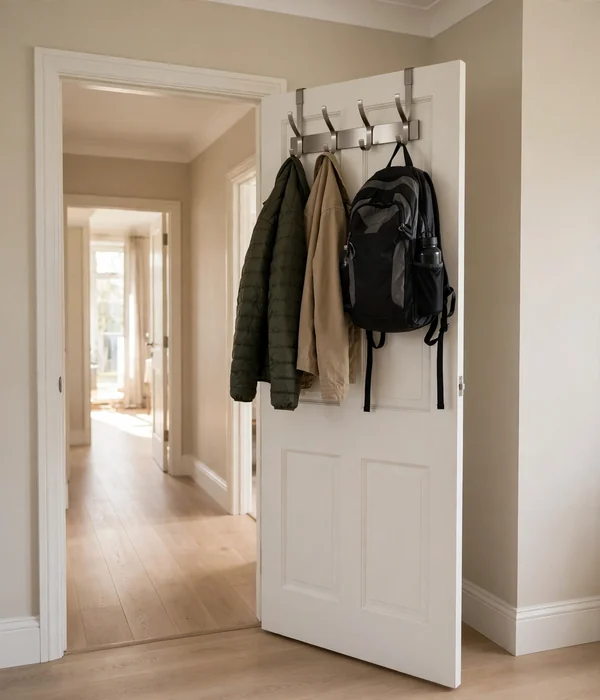
Every interior door in your hallway carries free real estate on its face. An over-the-door rack hangs off the door’s thickness, adds zero inches to the hallway’s footprint when the door is closed, and needs no tools or holes. The mechanism is simple leverage: the bracket drapes over the door’s top edge and gravity does the rest.
A standard five-hook steel rack runs about 15 inches wide and 5 inches deep, fits doors up to 1 5/8 inches thick, and is rated near 50 pounds total. Basket versions run about 17 by 11 by 4 inches with the same rating, but need 4.7 inches of clearance between the door and the wall to swing.
- Measure the door thickness and the gap above the door frame before you order, because a bracket made for 1 3/8-inch doors wobbles on thicker slabs.
- Hang the bracket and swing the door through its full arc. Confirm the hooks and anything on them clear the hallway wall and the door trim on both sides.
- Slide the foam or felt pads into place along the bracket so bare metal does not chew the paint off the door’s edge over a season.
- Load the heaviest coats on the center hooks, closest to the door face, and stay under the stated 50-pound rating so the bracket never strains.
- Skip damp towels on these racks. The door face slows airflow, and mildew shows up within days on anything that stays damp.
6. Slim Over-Door Pocket Organizer: 4 Inches That Hold 40 Pounds
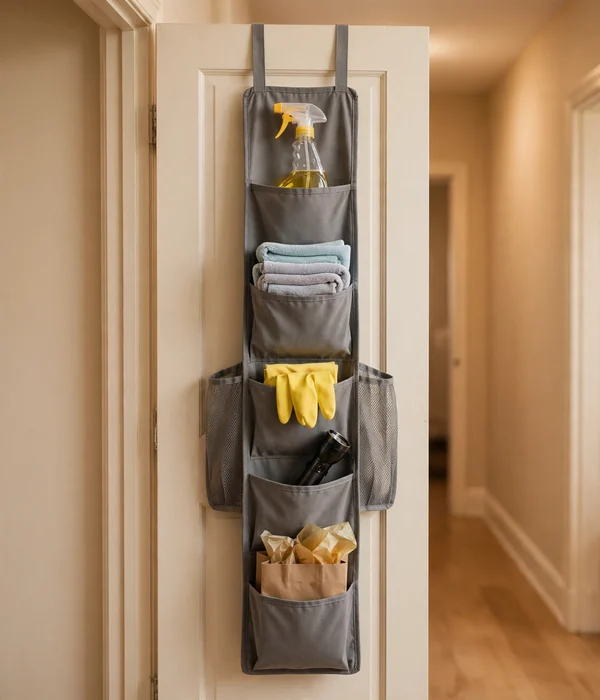
The pocket organizer moves into the door itself. These run about 57 inches tall, 14.4 inches wide, and only 4.7 inches deep, with five large pockets and side mesh pockets. Sturdier versions carry about 44 pounds evenly distributed, mount tool-free, and fit doors under 2 inches thick for roughly $25 to $40.
The pockets are about 10 inches tall, so they swallow cleaning supplies, winter accessories, and pet gear whole. Pick a version with reinforced shelf inserts rather than soft fabric, because floppy pockets sag and their contents hide from you.
Hang it on the hallway side of a closet or bedroom door so the pockets face the walk. If the door barely misses the wall, flip it to the room side instead.
What you can do with it:
- Build a cleaning station: duster, glass spray, microfiber cloths, and the spare vacuum bags, one pocket each.
- Stash the walk-out kit: sunscreen, bug spray, the spare leash, and poop bags by the door you actually use.
- Run a winter pocket with gloves, scarves, and hats for every person, labeled if your household mixes them up.
- Keep wrapping paper, gift bags, and tape rolls upright in the tall pockets so they stop leaning in the closet corner.
- Dedicate the bottom pocket to shoes you grab on the way out, like slip-ons and dog-walking sneakers.
- Slide a flashlight, spare batteries, and the fuse list into a side mesh pocket for the outages you never plan.
7. 6-Inch Rolling Gap Cart: The Dead Gap Payback
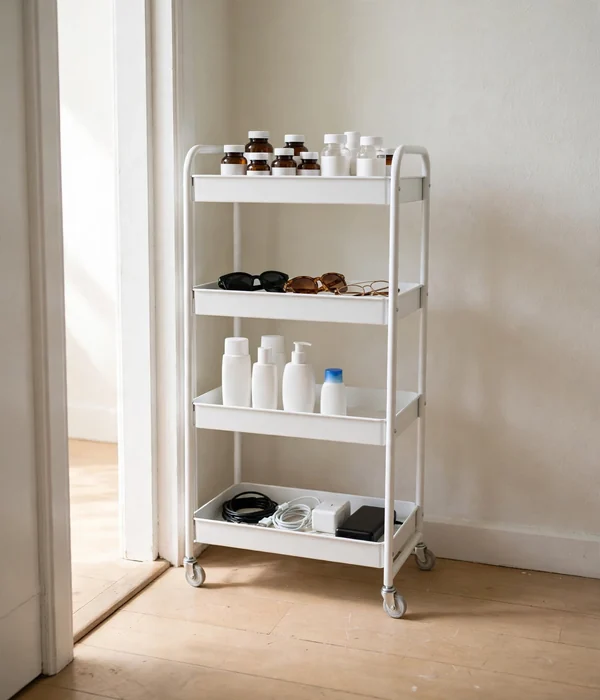
Every hallway has a dead gap: the 6 to 9 inches between a door frame’s trim and the nearest wall, where nothing fits and dust collects. A slim rolling cart is built exactly for that slot. It stands about 40 inches tall, runs 4 or 5 tiers deep, and rolls out on 360-degree casters when you need what is inside.
These carts usually measure around 6.3 inches wide, with three-tier versions near $20 and four-tier versions to about $60. They are designed as tucked-in organizers, most stable slid between two solid surfaces rather than standing free.
Stock it with the small daily items that otherwise migrate to every flat surface. Vitamins, spare chargers, sunglasses, and the sunscreen bottle all live here.
- Measure the gap between the door trim and the nearest wall or furniture. If it falls between 6 and 9 inches, the cart’s wheels clear the baseboards.
- Assemble it with the tallest tier at the bottom and the shortest at the top, because a top-heavy cart tips the first time you roll it across a rug edge.
- Sort by grab frequency: daily items at hand height, weekly items one tier down, and rarely touched stock at the bottom.
- Roll the cart fully out once a week and vacuum the slot. Gap carts attract dust like nothing else in the hallway.
- If it wobbles when you pull it, wedge the foam pads most kits include between the cart and the wall until it rides straight.
8. 8-Inch Deep Console Table: A Real Table, Zero Floor Hog
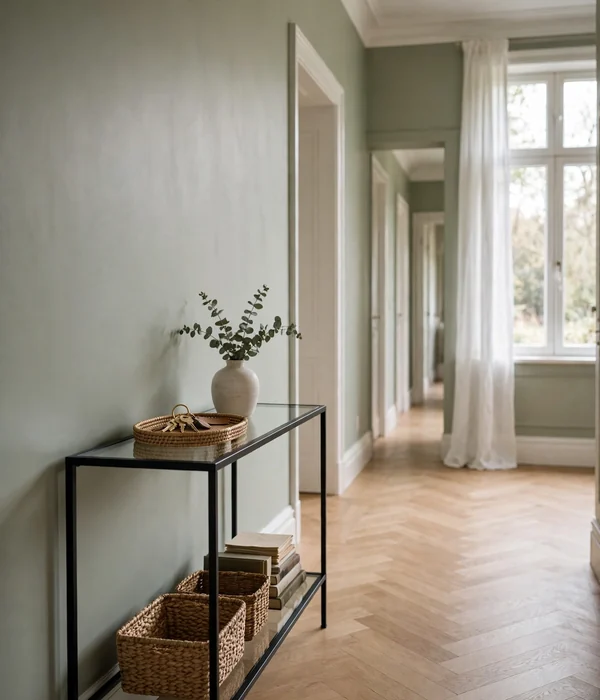
Sometimes the hallway needs a real surface: a landing strip for keys, a spot for the entryway tray, a home for the lamp that lights the walk. An 8-inch-deep console does that job on roughly half a standard console’s footprint. At 70 inches long, common versions sell in the $120 to $180 range.
Two-tier glass-and-metal versions run about 8.7 inches deep with each shelf rated near 22 pounds, usually $60 to $90. The top holds the daily landing zone while the lower shelf takes baskets, a row of books, or the shoe overflow.
Anchor it if your household has toddlers or big dogs. A long, shallow table tips easier than a deep one, and the included anti-tip strap takes ten minutes.
Where it works best:
- Hallways 42 inches or wider with a flush wall and nothing opposite, so the 8 inches never pinch the walk.
- Right inside the front door, where the table becomes the official landing strip for keys, mail, and sunglasses.
- Under a long mirror, which doubles the light and makes the shallow depth look deliberate.
- In rental apartments, because it is freestanding with zero holes and moves out in one piece.
- Beside a runner rug that cushions the floor, since the narrow feet concentrate weight on small spots.
- In hallways that double as the mail station, paired with a wall file or a small entryway idea or two borrowed from tight foyers.
9. Tilt-Out Shoe Cabinet: 15 Pairs in 9 Inches
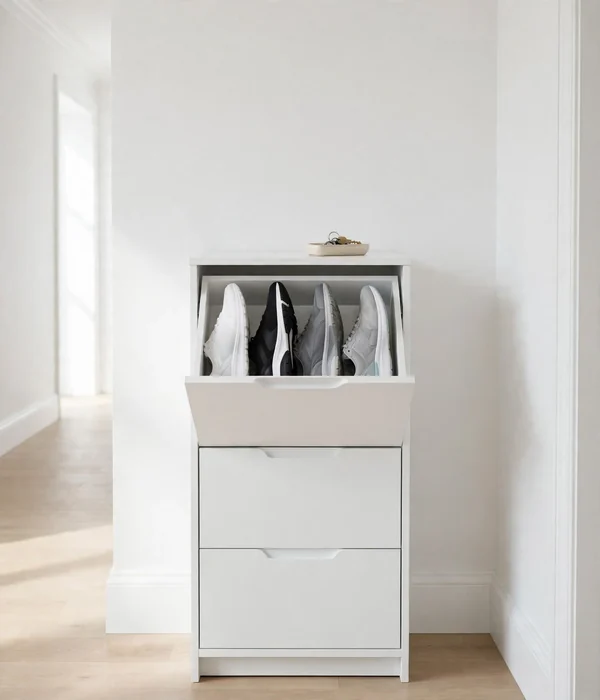
Shoes are the hallway’s number-one floor thief. A tilt-out cabinet stores them vertically: each drawer tilts open, shoes stand heel-down on the angled shelf, and the drawer closes flush at about 9 inches. The flat top doubles as the landing strip.
The common three-drawer model measures about 21.3 by 9.4 by 46.3 inches, holds up to 15 pairs of sneakers and flats, and carries roughly 88 pounds total for $50 to $70. Two-drawer versions run about 31 by 9 by 36 inches and hold around 12 pairs, with anti-tip hardware in the box.
This only works for low-profile shoes. Hiking boots, high-tops, and tall winter boots do not fit the tilt, so they need a separate spot or a shelf with the divider removed.
For more footwear systems that stay slim, see our guide to entryway shoe storage.
- Measure your tallest everyday shoes before buying, because flip drawers suit sneakers and flats but not boots or high-tops.
- Stand the cabinet in place and run the anti-tip strap to a stud. A hallway cabinet with drawers swinging open is a real tip risk when kids climb it.
- Pull each drawer and set the adjustable inner dividers before you load shoes, since dividers are a wrestling match once shoes are in.
- Put the pairs you wear daily in the top drawer. Bending in a hallway with someone trying to pass is a maneuver worth avoiding.
- Keep the top clear except for a small tray for keys and mail, because a cluttered landing strip defeats the cabinet’s whole tidy purpose.
10. Slim Corner Tower Shelf: Vertical Square Feet
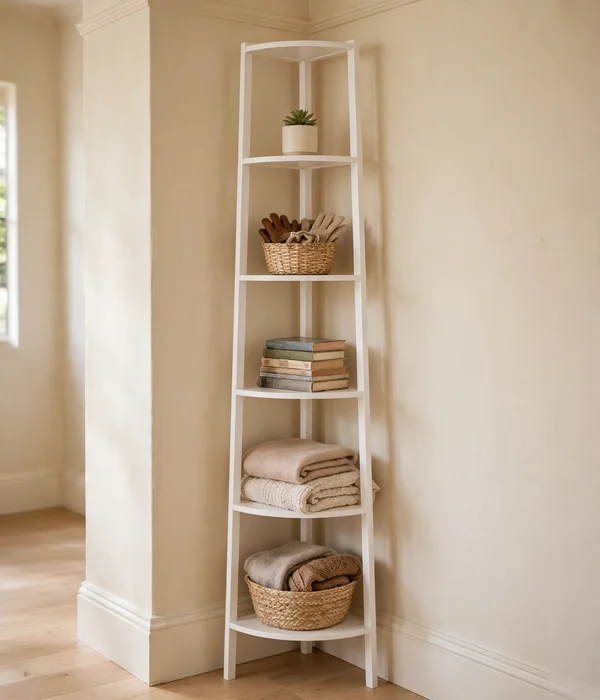
Hallway corners are dead air. Two walls meet, nothing hangs there, and the floor space is too small for furniture. A slim corner tower turns that dead air into five or six shelves of storage on a footprint as small as 10 by 10 inches, rising 60 to 72 inches tall for roughly $30 to $60.
The tower’s strength is verticality. Books, folded throws, baskets of gloves, and the umbrella all stack upward instead of spreading across the walk. Most versions anchor to both walls with two screws, which makes a tall skinny tower safe in a bump-prone hallway.
Fill it from the bottom with the heaviest baskets and work upward to the lightest decor. A tower loaded heavy on top sways when someone brushes past.
What you can do with it:
- Give each family member one basket on the tower for the gloves, hats, and scarves they actually wear.
- Store the umbrella collection upright in a tall bin on the bottom shelf, where drips land on a tray, not the floor.
- Stack folded throws and the guest blankets on the middle shelves for the living room overflow.
- Park a small lidded bin per shelf for the categories that drift: batteries, tape, spare keys, and the sewing kit.
- Line up paperbacks and the magazines on one shelf to build a tiny hallway library.
- Set a small plant or a framed print on the top shelf so the tower reads as furniture, not just storage.
11. Above-Door Shelf: The 80-Inch Line
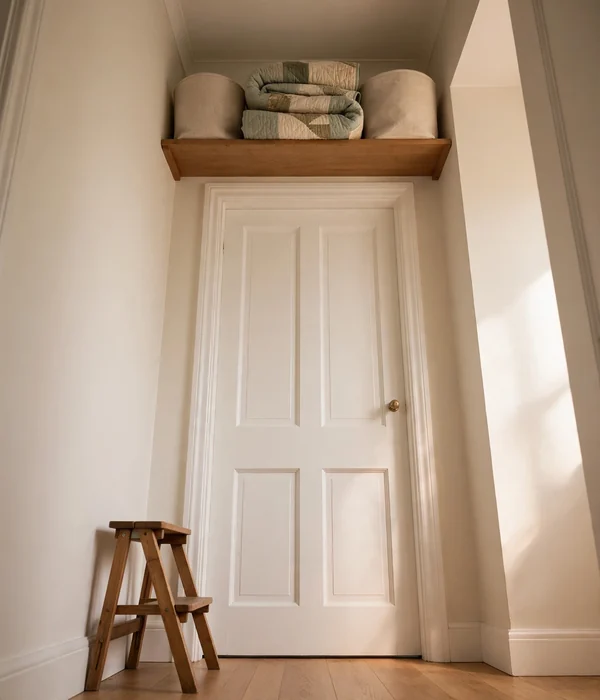
The space above a door is the hallway’s most overlooked storage zone. It sits above the sight line, out of the traffic path, and spans the doorway’s full width, usually 28 to 36 inches. The rule: keep the shelf’s bottom at 81 inches or higher, one inch above the standard 80-inch door opening.
Use a 10 to 12 inch deep board spanning the doorway or running the hallway’s length. Two brackets rated at least 25 pounds each, driven into the door header or the studs, carry a combined 50 to 80 pounds of linens, photo albums, or seasonal bins. A shelf-and-bracket setup typically runs $15 to $30.
Store things you need monthly, not daily. This shelf is a planned two-step reach, so daily items will migrate to the floor within a week.
- Find the header above the door frame, because the solid wood there holds screws far better than the drywall a few inches higher.
- Mark the shelf’s bottom edge at 81 inches and check it with a level across the full span, since a slanted high shelf telegraphs every tilt.
- Mount two brackets rated at least 25 pounds each into the header or the nearest studs, never into drywall alone.
- Load it with lidded bins, one category per bin, so every retrieval is one reach instead of a rummage.
- Keep a folding step stool in the nearest closet. If reaching this shelf feels like too much of a stretch, the wrong items live there.
12. Ceiling-Suspended Shelf: Storage That Hangs in Air
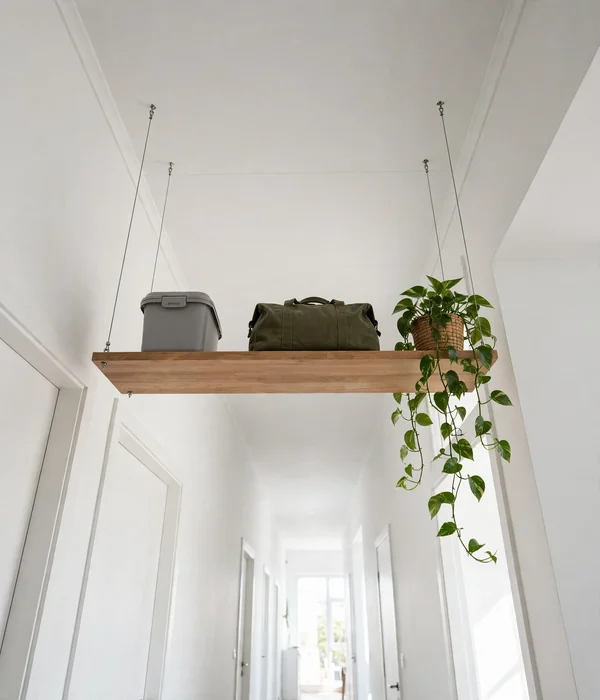
When the walls are spoken for and the floor is off limits, the ceiling offers one more plane. A cable-suspended shelf hangs from the ceiling joists on adjustable steel cables, holds a 24 by 12 inch platform about 25 pounds of rarely used items, and costs roughly $30 to $50. The whole assembly floats above the walk with zero footprint.
The clearance rule is the same as the above-door shelf: the platform’s bottom must sit at 80 inches or higher. In a standard 8-foot ceiling, that leaves about 16 inches of cable, which is enough for one shelf of bins. Nine-foot ceilings give you room for two staggered shelves.
Find the joists first. They run every 16 inches in most homes, and the shelf’s ceiling plate must screw into solid wood, never into drywall alone. A stud finder with deep-scan mode locates them through standard ceiling drywall.
Where it works best:
- Hallways with 9-foot or higher ceilings, where a suspended shelf never threatens anyone’s head.
- The dead zone beside a door swing, where nothing can stand on the floor but airspace goes unused.
- Seasonal storage, like the holiday linens, the gift wrap, and the decorations that come out twice a year.
- Luggage and duffel bags, which are bulky, light, and exactly the wrong shape for shelves.
- Trailing plants in light pots, hung high where the vines drape without brushing anyone.
- Rental hallways only if your lease allows ceiling anchors, since the four screw holes need patching at move-out.
Conclusion
If this list feels like a lot, start with the single move that adds the most storage for the least hallway: the over-door pocket organizer from idea 6. It is 4.7 inches deep, carries about 44 pounds, needs no tools, and costs under $40.
Do this first: Hang the pocket organizer on the hallway-side of your most-used interior door this weekend, and sort five categories into its pockets: daily grab items, cleaning supplies, winter gear, the walk-out kit, and one junk pocket you promise to empty monthly. That one move usually clears the floor pile and the flat surfaces in the same afternoon.
For the walls, my second pick is the fold-down hook rail from idea 3. It gives every person a coat spot for about $20 to $55 and folds to under 2 inches when empty, so the hallway never feels narrower than it is.
Then round out the system with this shopping checklist before you buy anything:
- A tape measure, because every idea here starts with one number: your hallway’s width.
- A stud finder with deep-scan mode for shelves, rails, and ceiling plates.
- A 24-inch level, since crooked shelves in a hallway are visible from every angle.
- Painter’s tape for marking heights and walkway lines before any hole gets drilled.
- Anti-tip straps for every tall floor piece, screwed into a stud.
- A folding step stool, because ideas 11 and 12 live above comfortable reach.
Work from the clearance math upward and the hallway stays a hallway. For the rest of the drop-zone system, our entryway storage ideas guide covers the pieces these twelve ideas do not.
Frequently Asked Questions (FAQ)
What is the best narrow hallway storage idea for a very tight hallway?
If your hallway is 36 inches or narrower, skip floor furniture entirely and go vertical plus door-mounted. A fold-down hook rail, a 24-inch picture ledge, and an over-door pocket organizer add real capacity while costing zero floor inches. If you add one floor piece, make it the 6-inch gap cart, and only if 30 inches of walkway survive.
How much walkway should I leave clear in a narrow hallway?
Aim for 30 to 32 inches of clear walking space. If your hallway is 36 inches wide, that means all storage on both sides combined can take at most 4 to 6 inches. If you carry laundry baskets or a stroller through it daily, hold the 32-inch line strictly and measure again with cabinet doors open.
Will a tilt-out shoe cabinet fit in my 36-inch hallway?
It can, if the math works. A 9-inch-deep cabinet leaves 27 inches of walkway, which is below the 30-inch target but acceptable if nothing sits on the opposite wall. If your hallway also carries hooks or shelves on the other side, the shoes will need to live elsewhere, like a closet or the over-door organizer.
Are over-door organizers renter friendly?
Mostly, yes. Over-door racks and pocket organizers need no holes at all, so the door side is fully renter safe.
Wall-mounted shelves, hook rails, and the anti-tip straps do need screws, but each one is two to four small holes that patch with spackle in minutes. If your lease bans all holes, stick to the door-mounted and freestanding ideas.
Can I put a console table in a 36-inch hallway?
Honestly, probably not. An 8-inch table in a 36-inch hallway leaves 28 inches of walkway, which feels pinched every time you carry something.
If your hallway is 42 inches or wider, a slim console works with nothing opposite it. In a true 36-inch hallway, a picture ledge and a fold-down rail give you the same landing zone without the footprint.