
Introduction
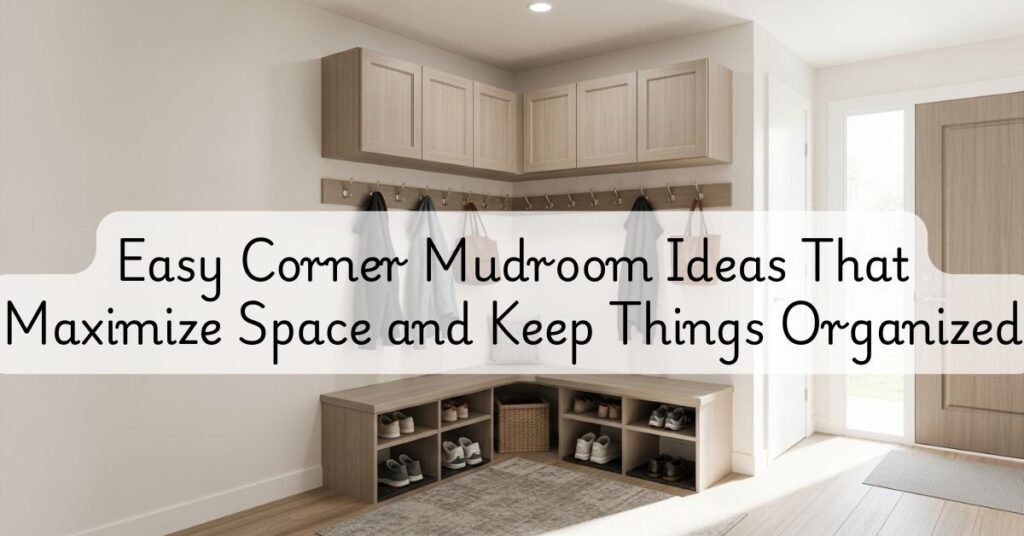
Most homes have at least one of them, that awkward corner near the front door or back entry that collects shoes, bags, and random clutter, simply because nobody quite knows what to do with it. If this sounds familiar, you’re not alone. And the good news is that this underused space has far more potential than you might think.
Corner mudroom ideas are one of the smartest solutions for homes that don’t have the luxury of a dedicated mudroom. Whether you’re working with a tight hallway corner, a small entryway nook, or a spare angle near the garage door, the right setup can turn that forgotten space into one of the most functional spots in your entire home.
A well-designed corner mudroom acts as a buffer between the outdoors and your living space. It’s where muddy shoes stay, wet coats hang, backpacks land, and keys don’t get lost. It keeps the chaos of daily comings and goings contained in one spot, which means the rest of your home stays cleaner, calmer, and more organized.
In this guide, we’re sharing 11 easy and inspiring corner mudroom ideas that work for all kinds of homes, layouts, and budgets. Whether you’re planning a full built-in or simply pulling together a few smart pieces, there’s a solution here that will work for you.
This is the same idea behind entryway storage ideas for small spaces, where even compact areas are designed to handle daily clutter efficiently.
Why Corner Mudroom Ideas Are a Smart Use of Space
Before we get into the ideas, it’s worth taking a moment to appreciate why corners are such an underrated opportunity in home design.
Corners are often treated as dead zones, spaces that are too awkward for standard furniture and too small to do anything meaningful with. But the truth is, corners offer a unique structural advantage: two walls meeting at an angle give you the opportunity to anchor storage on both sides, creating a wrap-around system that’s both secure and surprisingly spacious.
When you combine that structural benefit with smart furniture choices and vertical thinking, a corner can deliver an enormous amount of organized storage in a very small footprint. You don’t lose floor space the way you would with a freestanding unit placed in the middle of a wall, and the result feels intentional and built-in rather than improvised.
Add to that the fact that corners are typically located near entry points exactly where a mudroom needs to be, and it becomes clear why corner mudroom ideas are such a worthwhile investment of thought and effort.
1. The Corner Bench with Built-In Storage
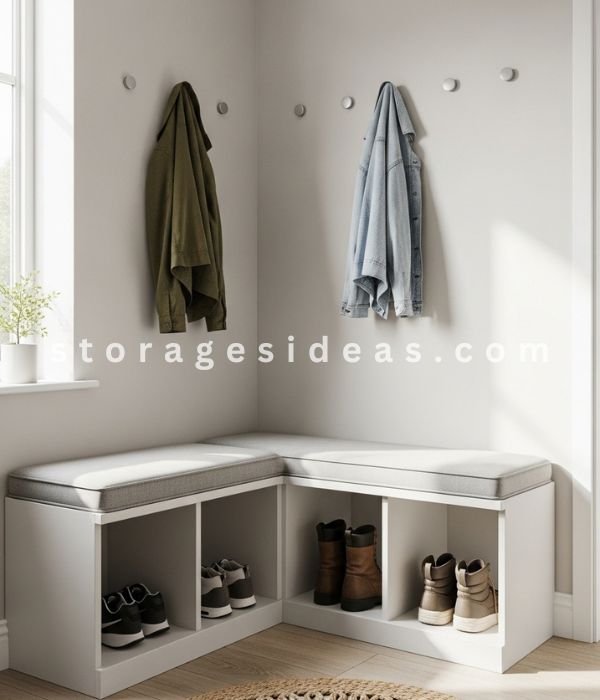
If there’s one element that defines a great mudroom, it’s the bench, and a corner bench with built-in storage underneath is one of the most practical and space-efficient corner mudroom ideas you can implement.
A corner bench sits snugly into the angle of two walls, using space that would otherwise be completely wasted. The seating surface gives you somewhere to sit while pulling on shoes or boots, which is something you don’t realize you desperately need until you have it. And the storage space below, whether open cubbies, drawers, or a hinged lid that opens to reveal a deep storage compartment, is invaluable for corralling shoes, sports equipment, pet supplies, and seasonal accessories.
Making it work:
- Choose a bench depth of at least 40–45cm so it’s comfortable to actually sit on
- Open cubbies underneath work well for shoes that get used daily
- A hinged-lid storage bench is ideal for items you access less frequently — extra dog leads, seasonal items, or sports gear.
- Add a cushion on top for comfort and to make the space feel more welcoming
Budget tip: Many flat-pack furniture retailers sell corner bench kits that are relatively inexpensive and can be assembled without professional help. Alternatively, a confident DIYer can build a simple corner bench from basic timber and plywood for very little outlay.
This works especially well when combined with benches and ottomans for the living room, where seating also doubles as hidden storage.
2. Corner Hooks and Wall-Mounted Coat Rail
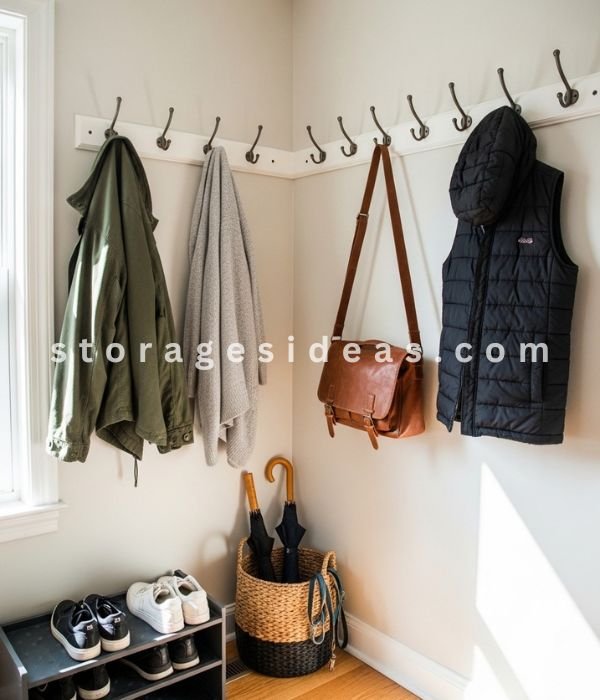
Sometimes, the simplest corner mudroom ideas are the most effective. A row of sturdy wall-mounted hooks installed along both walls of a corner running from one side across the angle and down the other creates a generous amount of hanging space for coats, bags, hats, and scarves without taking up any floor space at all.
Why it works: Wall-mounted hooks are inexpensive, easy to install, and immediately functional. By using both walls of the corner rather than just one, you effectively double the amount of hanging space available in a small area. Mount hooks at different heights, higher ones for adult coats, lower ones within easy reach of children, to make the system work for the whole family.
Styling tips:
- Choose hooks that complement your home’s interior style: black matte metal for a modern look, brass for something warmer and more traditional, or painted wooden pegs for a farmhouse feel
- Add a small floating shelf just above the hook rail for hats, sunglasses, and everyday accessories
- Keep a small basket or bin at the base of the corner for shoes or umbrellas to complete the system
This setup works particularly well in narrow entryways where floor space is truly at a premium, but wall space is available on both sides of the corner.
3. Vertical Shelving Units That Make the Most of a Corner
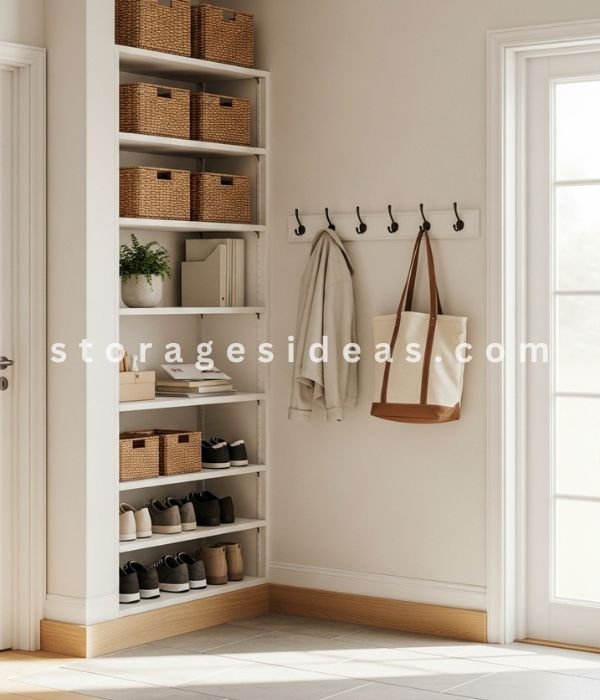
Vertical shelving is one of the most powerful tools in any small space organization project, and it’s equally effective in a corner mudroom setup. A tall, narrow shelving unit positioned in or beside the corner gives you multiple levels of organized storage in a very compact footprint.
What to store on each level:
- Top shelves (out of easy reach): Seasonal items, rarely used accessories, spare bags
- Mid-level shelves: Everyday items, hats, gloves, scarves in labeled baskets
- Lower shelves: Shoes, boots, and items that family members need to access independently
Corner shelving units: Dedicated corner shelving units designed specifically to fit into the 90-degree angle of a corner make the absolute most of the space and look beautifully intentional. They typically have a triangular footprint that fits flush into the corner without any wasted gaps.
Standard units placed beside a corner: If a dedicated corner unit isn’t available in the style you want, a standard tall shelving unit placed immediately beside the corner works almost as well. Pair it with wall-mounted hooks on the adjacent wall to create a cohesive, wrap-around system that uses both walls effectively.
4. A Built-In Corner Locker System for Families
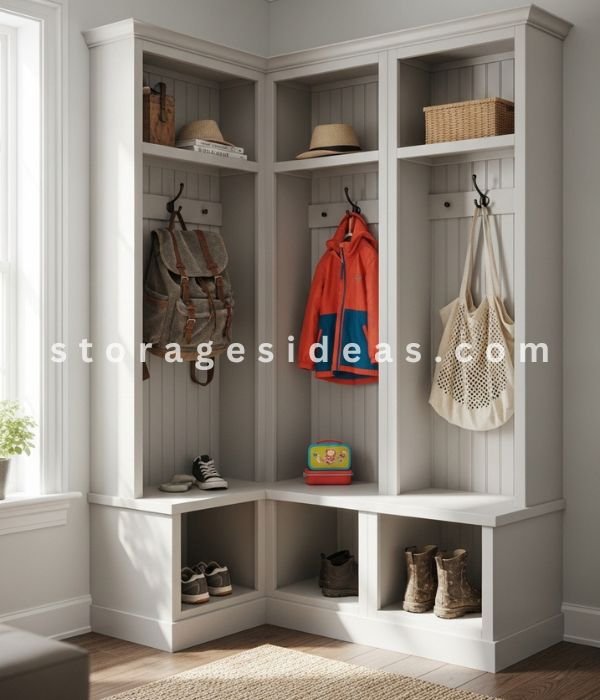
For families with multiple children, one of the most organized and effective corner mudroom ideas is a built-in locker system where each family member gets their own dedicated vertical section of storage with a hook, shelf, and cubby assigned specifically to them.
Why individual lockers work so well: When everyone has their own designated zone, there’s no confusion about where things belong and no disputes about whose bag is on whose hook. Each child can take ownership of their space, which makes them far more likely to actually use it correctly. And from a parent’s perspective, it’s immediately obvious whose section needs tidying without having to sort through communal clutter.
What a corner locker system typically includes:
- A coat hook at the top of each section (at adult or child height as appropriate)
- A shelf above the hook for hats, helmets, or sports accessories
- A small cubby or drawer for smaller items like gloves, keys, and sunglasses
- A shoe section at the base, either an open shelf, cubbies, or a pull-out drawer
Built-in vs. freestanding: A built-in system gives the most seamless, architectural look and uses every inch of space efficiently. However, modular locker-style units are available from furniture retailers that provide a similar look and function at a lower cost and without professional installation.
5. Corner Mudroom with a Pegboard Feature Wall
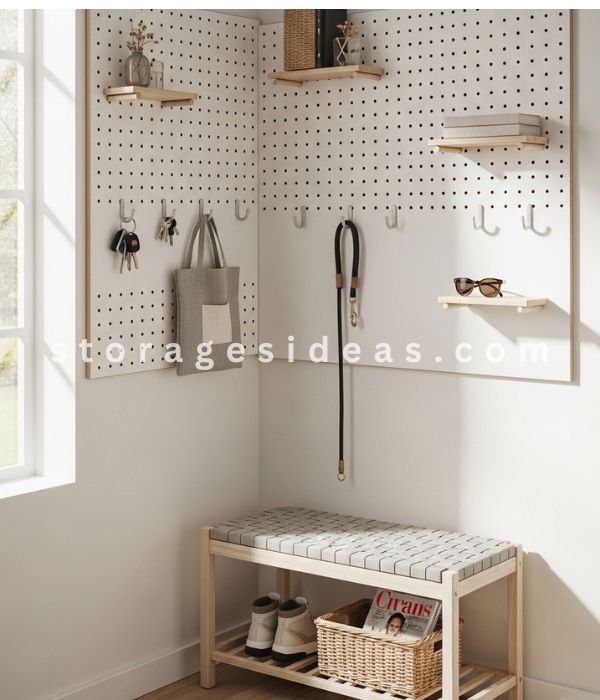
A pegboard mounted in the corner of your mudroom running across both walls and meeting at the angle is one of the most flexible and budget-friendly corner mudroom ideas available. The pegboard system allows you to hang and rearrange hooks, shelves, bins, and organizers in any configuration you like, making it endlessly adaptable as your family’s storage needs change.
What makes pegboards so practical in a mudroom:
- Hooks can hold coats, bags, dog leads, and umbrellas
- Small shelves can hold keys, sunglasses, and mail
- Baskets and bins can store gloves, scarves, and seasonal accessories
- Everything is visible and accessible, nothing gets lost at the back of a drawer
Styling the pegboard: Paint the pegboard in a color that complements your home’s palette before installing it. This immediately elevates it from purely functional to a genuine design feature. A dark navy or forest green pegboard with brass hooks, for example, looks considered and stylish rather than improvised. Add a small plant or two on the shelves to soften the look and make the corner feel welcoming.
6. A Corner Drop Zone with a Small Console Table
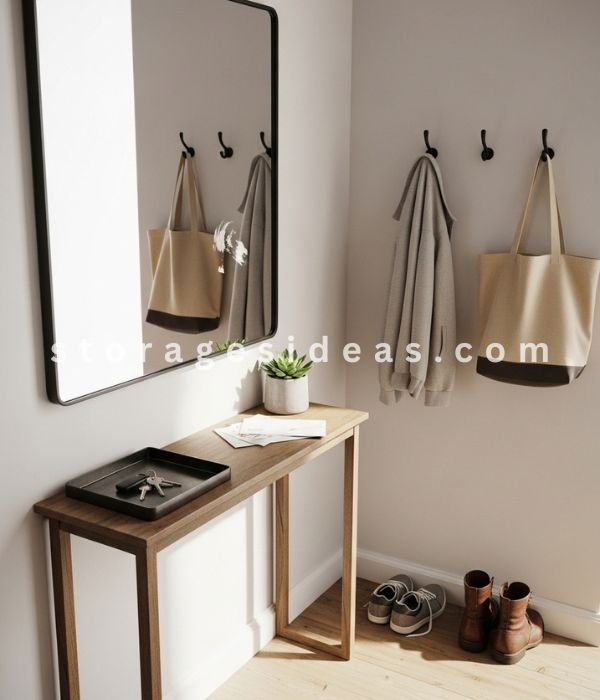
Not every home needs a full mudroom setup; sometimes a smaller, more streamlined approach is all that’s required. For apartments, smaller homes, or entryways where space is genuinely tight, a narrow console table placed in or beside the corner creates a simple but effective drop zone that handles the most essential mudroom functions.
The basic drop zone setup:
- A slim console table for landing keys, mail, sunglasses, and everyday carry items
- A mirror mounted on the wall above for a last-minute appearance check on the way out
- A small basket or tray on the tabletop for corralling small items
- A hook rail mounted on the adjacent wall for coats and bags
- A shoe rack or boot tray on the floor below
This type of setup is particularly well-suited to homes where aesthetics matter as much as function. A beautiful console table, a stylish mirror, and a few well-chosen accessories can make your corner drop zone look like a deliberate, designed feature of the home rather than a practical afterthought.
This setup aligns perfectly with drop zone storage ideas, where entry points are designed to catch everyday items before they spread through the home.
7. Under-Stair Corner Mudroom Storage
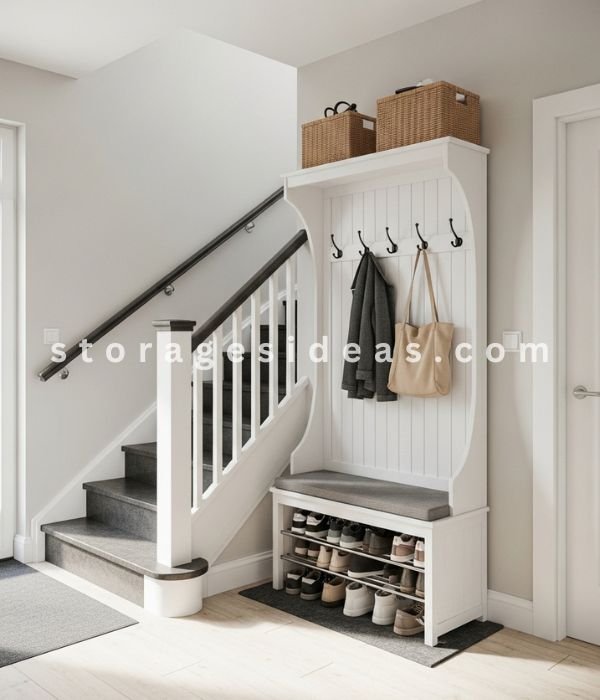
If your staircase happens to meet a corner near your home’s entrance, you have one of the most exciting mudroom opportunities available, the under-stair corner. The varying height of the space beneath a staircase, combined with the corner angle, creates a uniquely shaped zone that can be fitted out with a combination of storage solutions to create a hardworking, hidden mudroom.
How to make the most of under-stair corners:
- Place a bench in the tallest section of the under-stair space. This is where there’s enough headroom to comfortably sit
- Add hooks on the wall alongside the staircase for coats, bags, and dog leads
- Use the lower, shallower sections of the under-stair space for shoe storage, pull-out baskets, or built-in cubbies
- Install a slim cabinet or shelving unit in the deeper sections for less frequently accessed items
The result: A completely self-contained mudroom that sits entirely within the structural footprint of the staircase, taking up zero additional floor space in the rest of the home and looking beautifully integrated.
8. Budget-Friendly DIY Solutions That Actually Work
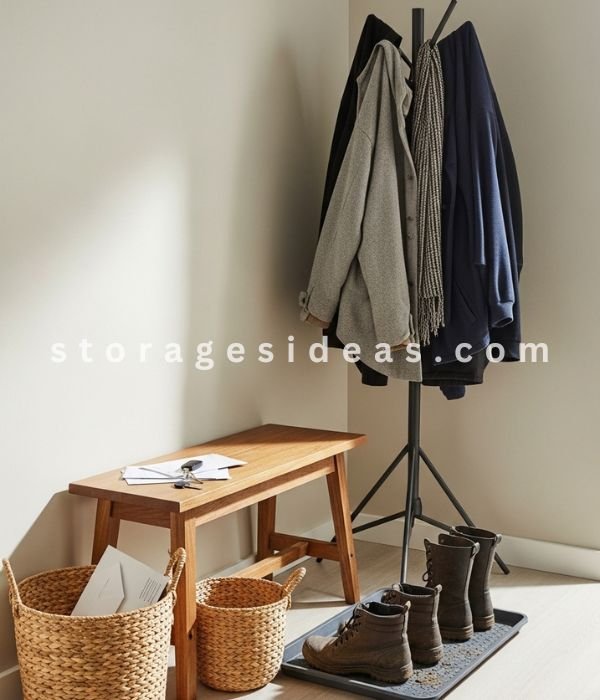
You don’t need a big budget or a professional contractor to create a functional and stylish corner mudroom. Some of the most effective corner mudroom setups are assembled entirely from affordable off-the-shelf pieces and simple DIY elements.
Budget-friendly corner mudroom essentials:
- Freestanding coat rack: A simple corner coat rack with hooks at multiple heights is one of the most affordable and instantly effective mudroom additions available
- Cube storage units: Affordable cube storage units (like IKEA KALLAX) can be placed side by side in a corner configuration and topped with a cushion to create a bench-and-storage combination for very little cost
- Adhesive hooks: For renters or those who can’t drill into walls, high-quality adhesive hooks provide a no-damage solution for hanging coats and bags.
- Boot trays: A simple boot tray on the floor keeps muddy footwear contained and off the surrounding flooring, one of the cheapest and most effective mudroom additions
- Wicker baskets: Label a few wicker baskets and stack them on a shelf for an immediately organized and visually appealing storage system
The key with budget mudroom setups is consistency. Choose pieces that share a similar color palette or material finish so the corner looks cohesive and intentional rather than assembled from random pieces.
9. A Tiled Corner Mudroom for Easy Cleaning
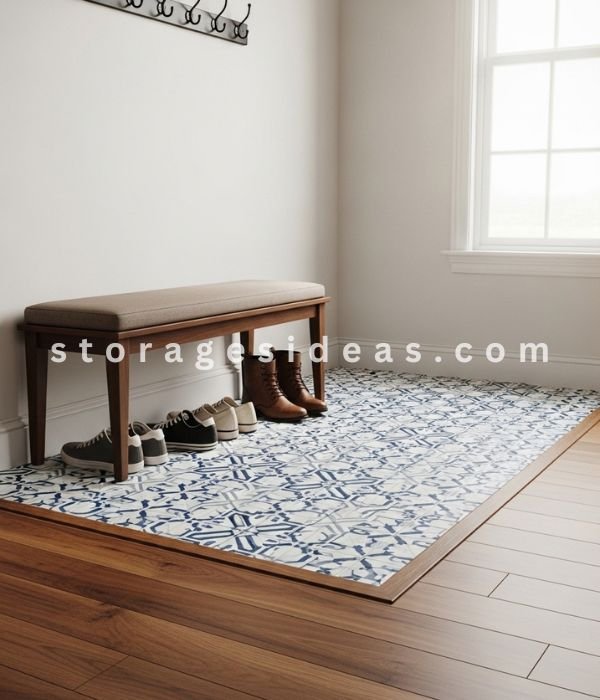
One of the most practical considerations in any mudroom design is flooring, and if you’re planning a more permanent corner mudroom setup, extending a durable, easy-to-clean tile into the mudroom zone is one of the most functional choices you can make.
Why tile works so well: Mudrooms take a lot of abuse. Wet boots, muddy paws, dripping raincoats, and tracked-in dirt are a daily reality, and tile handles all of it far better than carpet, hardwood, or laminate. It’s waterproof, easy to mop, and essentially indestructible in a high-traffic area.
Defining the zone with tile: Even in a home that uses hardwood or laminate throughout the rest of the entryway, a defined tile section in the corner mudroom area creates a clear visual boundary that signals “this is where the outdoor stuff lives.” It makes the functional zone obvious without needing a physical wall to separate it from the rest of the space.
Best tile choices for mudrooms: Large-format porcelain tiles are a popular choice. They’re durable, low-maintenance, and available in a huge range of styles and finishes. Slip-resistant tiles are an important consideration, especially for households with young children or elderly family members.
Durable, easy-to-clean flooring is essential in high-traffic areas like entryways, according to home flooring and maintenance guidelines.
10. A Corner Mudroom Bench with Chalkboard or Message Board
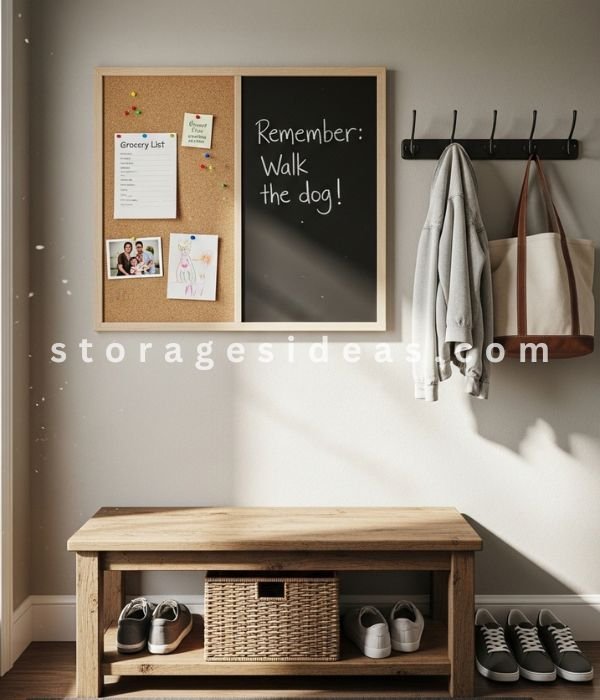
A corner mudroom doesn’t just have to be about storage; it can also serve as a family communication hub. Adding a chalkboard wall panel, a corkboard, or a framed whiteboard to the mudroom corner turns it into a practical message center where schedules, reminders, shopping lists, and notes can be tracked and communicated.
Why it works so well in the mudroom: The mudroom is the one place every family member passes through at least twice a day on the way out and on the way in. That makes it the perfect location for a message board. Important reminders are impossible to miss, and schedules are visible to everyone at exactly the moment they’re most relevant, right as they’re putting on their shoes or grabbing their bag.
Implementation ideas:
- A chalkboard panel mounted on one wall of the corner, paired with chalk in a small cup on the nearby shelf
- A corkboard for pinning school notices, permission slips, and weekly schedules
- A magnetic whiteboard for dry-erase notes and a place to stick important documents with magnets
- A combination board that includes sections for each family member
This addition costs very little but adds a layer of functionality to the corner mudroom that families with school-aged children in particular find genuinely invaluable.
11. A Seasonal Corner Mudroom That Adapts All Year Round
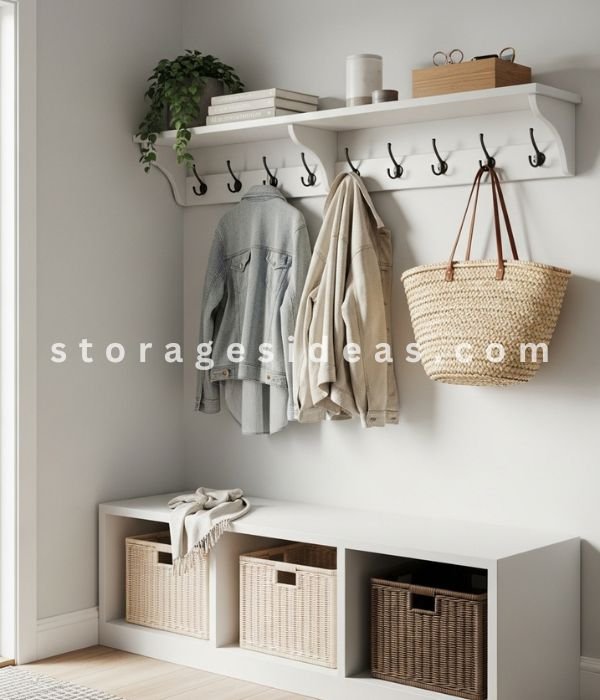
One of the most overlooked aspects of mudroom design is seasonality. The storage needs of a mudroom in the depths of a US winter, when the space needs to handle heavy coats, snow boots, gloves, scarves, hats, and wet gear, are very different from its summer needs, when the priority shifts to sandals, sunscreen, sunhats, and sports equipment.
Building a flexible corner mudroom: The most successful corner mudroom ideas are those designed with seasonal adaptability in mind. Here’s how to build that flexibility in:
- Adjustable shelving: Shelves that can be repositioned allow the storage configuration to change with the season, more space for bulky winter gear in cold months, reconfigured for lighter summer items when the weather warms
- Seasonal basket swap: Keep a set of clearly labeled baskets for each season, “winter accessories,” “summer sports,” and so on and simply swap the active set in and out of the mudroom as the seasons change
- Off-season storage: Use a higher shelf or a separate storage area for out-of-season items. Winter coats don’t need to live in the mudroom during July. Storing them elsewhere frees up significant space for the items that are actually in use.
- Hooks for all seasons: A generous hook rail accommodates both heavy winter coats and lightweight summer jackets without any reconfiguration needed
A corner mudroom that adapts seamlessly through the year is one that truly earns its place in your home, serving your family efficiently and keeping the space from feeling overcrowded as needs change.
Conclusion
A corner doesn’t have to be wasted space. With the right approach, it can become one of the hardest-working spots in your entire home. Whether you opt for a built-in bench and locker system, a simple DIY setup assembled from affordable furniture pieces, or something in between, any one of these corner mudroom ideas can transform a neglected angle into a space that saves you time, reduces clutter, and makes every single day a little bit smoother.
Start with the basics: a bench, some hooks, and a spot for shoes and build from there as your budget and needs allow. You’ll quickly discover that a well-organized mudroom corner is one of those home improvements that pays back every single day.
If you’re improving other areas of your home, these small space transformation ideas can help you apply the same smart approach throughout.
Frequently Asked Questions (FAQ)
How much space do I need for a corner mudroom?
One of the great advantages of corner mudroom ideas is that they work in very small spaces. Even a corner with just 90–120cm (3–4 feet) of wall space on each side can accommodate a bench, hooks, and basic shoe storage. The key is choosing furniture and storage solutions that are proportionate to the space rather than trying to fit in too much.
What are the must-have elements of a corner mudroom?
The three essentials of any mudroom corner or otherwise are a place to sit (bench), a place to hang things (hooks), and a place for shoes (cubbies, shelf, or boot tray). Everything else, such as baskets, chalkboards, message boards, and lighting, adds function and style but isn’t strictly necessary to get started.
Can I create a corner mudroom in a rented home?
Absolutely. Many of the best corner mudroom ideas require no permanent installation at all. Freestanding corner benches, freestanding coat racks, adhesive hooks, freestanding shelving units, and boot trays all create a fully functional mudroom setup without drilling a single hole or making any changes to the property.
What flooring is best for a corner mudroom?
Tile is the most practical choice for a mudroom due to its durability and ease of cleaning. Vinyl plank flooring is an excellent budget-friendly alternative that’s also waterproof and low-maintenance. If you can’t change the flooring, a heavy-duty boot tray or a washable rug in a durable material like cotton or jute provides a practical and easy-to-clean surface for the mudroom zone.
How do I keep a small corner mudroom from looking cluttered?
The key is to give every single item a specific home. When everything has a designated spot, each coat on its own hook, shoes in their own cubby, accessories in a labeled basket, the space stays organized naturally. Regular decluttering (especially at the change of seasons) prevents the mudroom from gradually accumulating items it doesn’t need. Choosing closed storage like baskets and lidded bins also keeps the visual noise to a minimum.
Looking for more home organization inspiration? Browse our other articles on entryway storage ideas, small space hacks, and smart storage solutions for every room in your home!