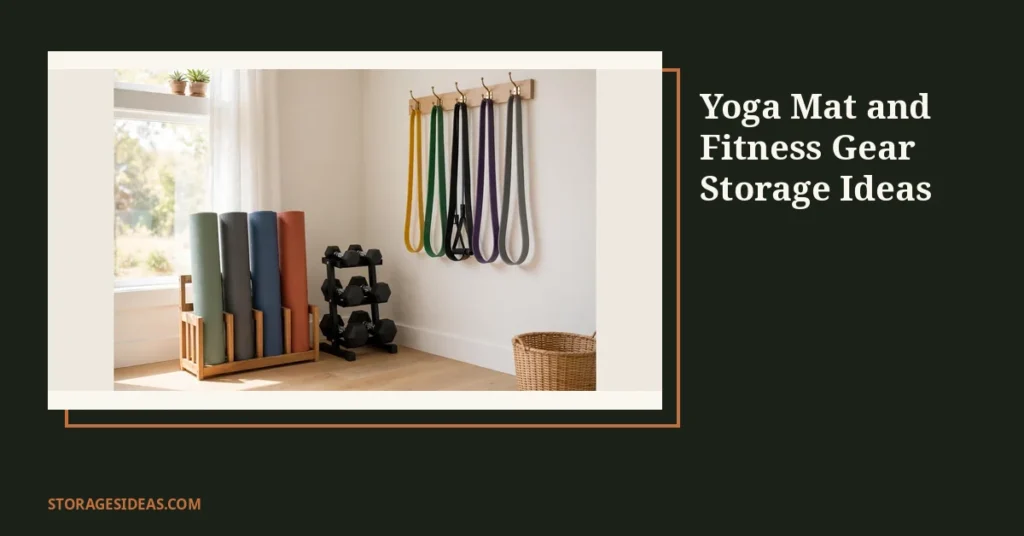
Your yoga mat is unrolling itself in the corner again. A dumbbell is sitting exactly where your foot wants to land. And your resistance bands have knotted themselves into a drawer you dread opening.
The fix is not a bigger room. It is yoga mat storage that keeps rolls standing upright, parks weights in a rated rack, and gets loose gear off the floor in under 3 square feet.
These 8 ideas are a complete workout storage system for mats, dumbbells, bands, blocks, and rollers, with real dimensions and renter flags so you buy once and it fits.
Why Yoga Mat Storage Fails (and How to Fix It)
Mats fail in storage for two physical reasons. Roll one tight and the outer layers stretch while the inner layers compress; leave the roll unsupported and the edges curl and never relax flat. Store it flat under a pile of stuff and the surface takes dents.
Vertical storage fixes this only when the roll stands fully supported. A rolled 6mm mat runs about 4.7 inches across, so tubes and baskets sized near that diameter hold it straight and the edges keep their shape. Standing air also matters: a mat that dries upright beats the mildew that thrives in closed garages.
Gear has a weight problem, not a space problem. A pair of 25-lb dumbbells is 50 lbs pressing into carpet fibers; on a rated A-frame rack it becomes part of 440 lbs of engineered capacity in a 21-by-16-inch footprint. The mechanism is simple: rated hardware carries load vertically instead of spreading it across your floor.
This article handles the workout corner; the rest of the garage needs the same thinking. If your mats live next to bikes and bins, garage organization ideas lays out the full system: zones, wall tracks, and bins that keep every category findable.
1. Freestanding Vertical Mat Rack: mats stand straight in a 2-foot corner
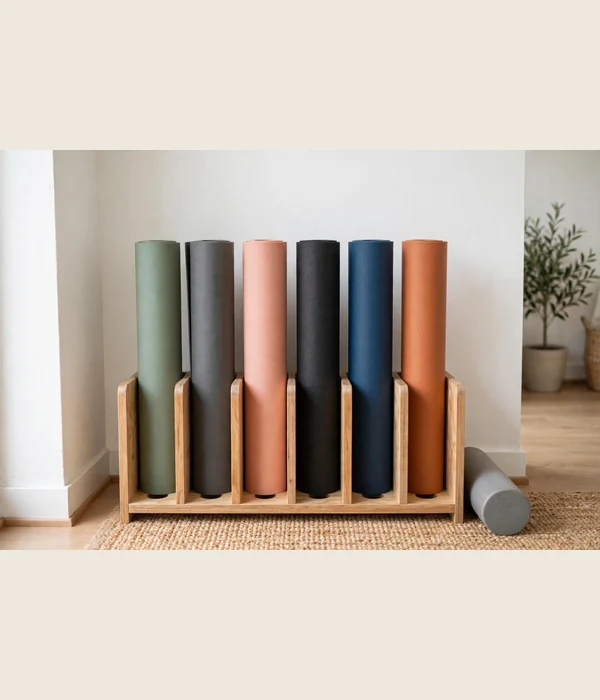
A tube-style floor rack holds each rolled mat upright in its own slot, so rolls can’t sprawl or uncoil across the floor. Shop for a frame about 20 to 24 inches wide and under 12 inches deep, sized for 4 to 8 mats. At roughly 5 inches of roll diameter per mat, a 2-foot corner does all the work.
The nicer versions act like furniture, with wood frames and open sides that air mats out after sessions. One popular style runs 42 inches tall, about 29 inches wide, and 12 inches deep, and hangs two mats while the base holds blocks and hand weights. That airflow is the hidden win: mats that dry upright stay fresh far longer.
Shopping spec: plain steel tube racks run under $40; furniture-style stands run $100 to $175. Measure your thickest rolled mat before ordering, since 8mm mats need slots at least 6 inches across. Renters can use these with zero wall damage, which makes them the safest mat bet for a lease.
What you can do with it:
- Slot 4 to 8 rolled mats upright in separate tubes
- Park a foam roller or two beside the mats
- Tuck it behind a door or beside the couch
- Hang bands from side hooks on models that include them
- Let furniture-style stands double as room decor
2. Wall-Mounted Mat Brackets: zero floor space, stud-strong
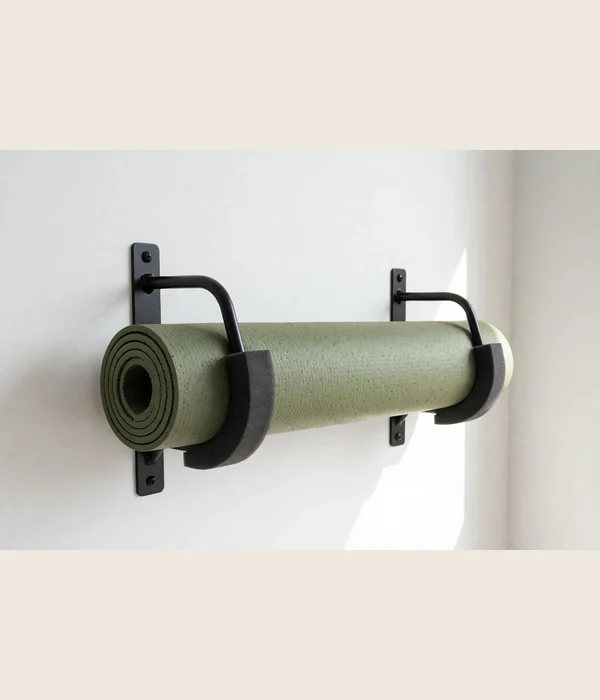
Wall brackets move all the weight to your studs and give the floor back entirely. A pair of angled hooks spaced 18 to 24 inches apart cradles a rolled mat like a shelf, and the roll hangs in free air so both faces dry fast. Once it’s up, the wall that held nothing now stores up to four mats.
The contact rule matters more than the bracket brand. Your mat should rest on several inches of support width, not one thin hook, or the edges pinch and crease over time. Pad bare metal with foam pipe insulation so rubber mats don’t scuff, since that small step is what keeps a pricey mat looking new.
Shopping spec: simple steel hook-and-shelf sets run under $30, and many include foam roller and band hooks for about the same price. Plan on 5 wall holes and about 15 minutes with a stud finder and a level. This is not the renter pick: everything here needs screws into studs.
- Find two studs 18 to 24 inches apart with a stud finder, and mark both at the same height.
- Drive the screws into the studs, never drywall alone; a mat plus bracket can top 10 lbs.
- Stack multiple pairs of brackets vertically, leaving 20 inches of clearance between rows.
- Slide each rolled mat in with the loose edge facing out so it can’t unroll.
3. Rolling Fitness Gear Cart: the whole workout kit in one movable corner
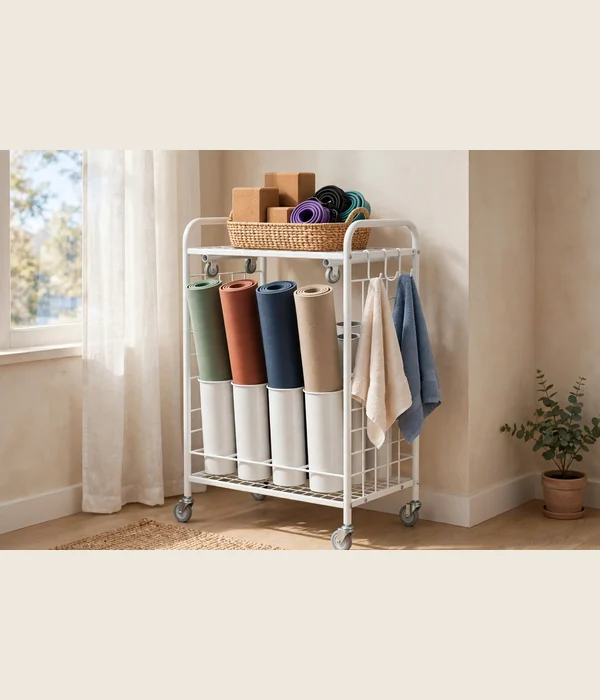
A rolling cart turns scattered gear into one mobile station. Mats stand in the tube slots, blocks and bands drop into the basket, and towels hang from the hooks, all in about 20 inches of width. The wheels matter more than they sound: you can roll the entire workout out of sight between sessions.
A typical unit runs about 20 inches wide, 10 inches deep, and 31 inches tall, so it parks in a closet or beside the washer. Iron frames carry the load without wobbling, and most carts ship with four casters, two of them locking. Price lands in the $50 to $65 band for the common models.
Lock the casters before you load it, or the cart drifts when you pull a mat out. This suits small apartments best, since one cart replaces a rack, a bin, and a hook strip. Fully renter-safe too: nothing attaches to any wall.
Tips for best results: park the cart where you actually work out so setup takes seconds; keep heavier mats low in the slots; wipe the frame dry after sweaty sessions to protect the finish.
Watch out: a tall load gets top-heavy, so keep the base near a wall; hard casters can dent softwood floors, so roll it onto a thin mat if your floors are wood.
4. A-Frame Dumbbell Rack: weights off the floor in stepped, readable rows
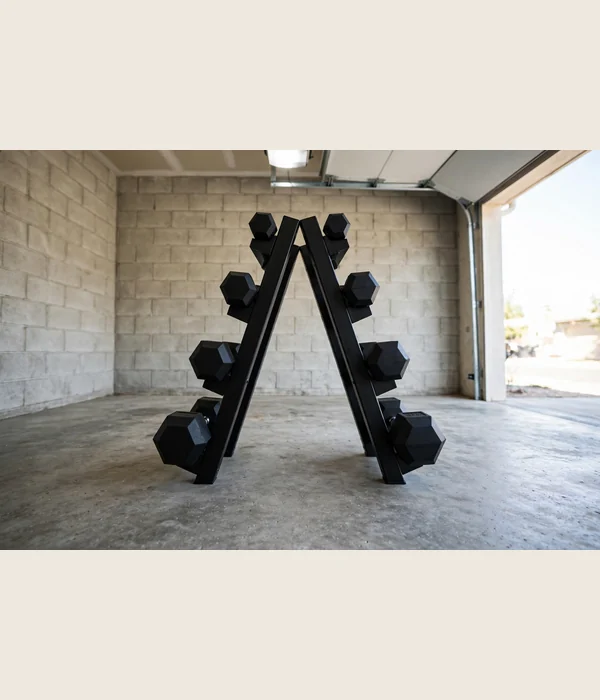
Dumbbells belong in a rack rated for them, not stacked on carpet. An A-frame stand holds pairs in stepped rows so you can read the sizes at a glance and grab without the clang. The common 5-pair size runs 21 by 16 inches and 38 inches tall, with a 440-lb rating that covers pairs up to 50 lbs each.
The mechanism is load concentration. Ten pairs of dumbbells might total 300 lbs, and a rack rated for 440 lbs carries that on a footprint smaller than a bath mat. If you run a full home setup, workout equipment storage at home covers the rest of the system.
Shopping spec: 3-pair racks rated 220 lbs run under $50; 5-pair at 440 lbs run $60 to $90. Match the per-slot spacing to your dumbbell heads: slots run 3.6 to 4.5 inches apart, and wide rubber hex heads need the wider end. Not the renter-friendly corner if your lease bans heavy loads, but no wall mounting is required.
Where it works best:
- A 5-lb to 25-lb pair set, the most common home range
- Garage gyms where every floor inch is claimed
- Bedrooms that double as workout corners
- Homes with toddlers or pets: weights off the floor are safer
5. Tall Woven Floor Basket: the cheapest decent mat storage that exists
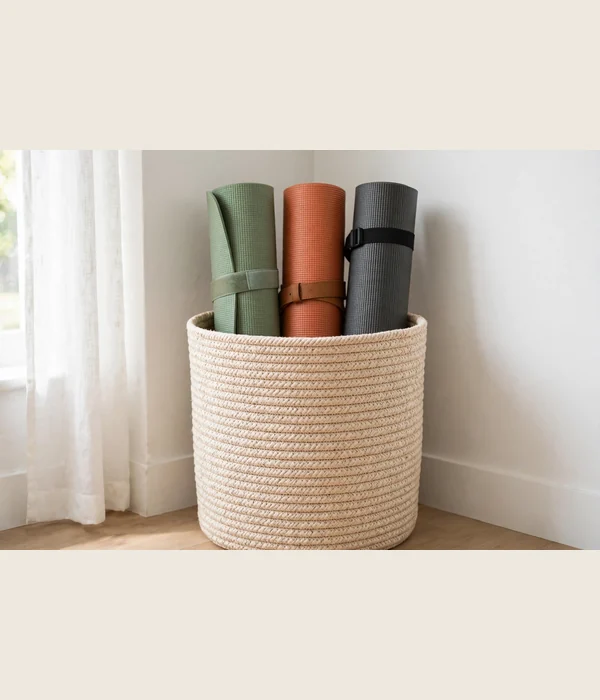
A tall basket is the lowest-effort mat storage that actually works. Rolled mats stand upright in a 15-by-15-inch footprint, 20 inches tall, and the rigid sides keep them from slouching sideways. At roughly 58 liters, one basket swallows two to three rolled mats plus straps and a jump rope.
The trick is roll diameter math. A standard 6mm mat rolls to about 4.7 inches across, so two rolls need 10 inches of basket mouth and three need 15. Cheap collapsible bins slump under that load, so pick structured walls of cotton rope, woven seagrass, or reinforced canvas, which keep rolls vertical for years instead of months.
Price runs under $40 for a large structured basket, which makes this the budget pick of the whole list. Fully renter-safe and movable in seconds, it also works as the holding spot for bands and blocks you grab mid-workout. Foldable models collapse flat when you don’t need them.
- Roll each mat tightly and strap it; loose rolls telescope and jam in the basket.
- Stand the tallest items at the back so shorter gear stays reachable.
- Confirm the basket mouth clears your thickest roll by at least an inch.
- Park it where you stretch, not where you wish you stretched.
6. Pegboard Band Wall: every band visible, zero drawer digging
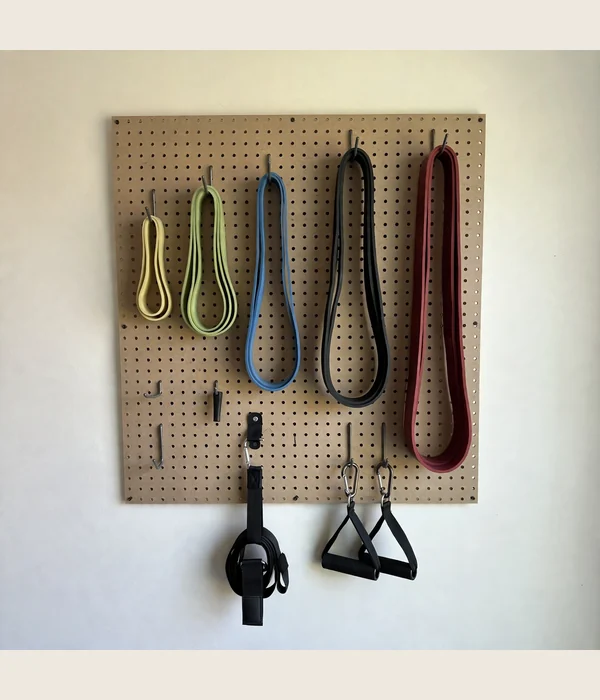
Bands stored in a drawer fuse into a knot; hung on a pegboard, each one hangs straight and stays visible. A 24-by-24-inch panel mounts flush to the wall with zero floor footprint and holds about a dozen bands on J-hooks, plus handles and door anchors. Rubber-coated hooks matter because bare metal abrades latex over time.
The real payoff is visibility. Bands hung by resistance level, lightest to heaviest, let you grab the right tension without unfolding a tangled pile, while coiled tube bands go flat on the panel with Velcro ties and mini loops hang doubled on a single hook. Mount the panel at eye level so a grab takes one second.
Shopping spec: a 24-by-24-inch panel plus a hook multipack runs under $40. Standard panels need screws into studs, so they’re not renter-native; tension-rod or over-door pegboard versions work for leases but hold less weight. Keep bands out of direct sun to protect the latex from cracking.
Tips for best results: hang bands by resistance level, not color, since colors vary by brand; keep tube bands coiled flat with Velcro ties; leave one hook free for the band you’re currently using.
Watch out: loop bands left knotted or doubled lose elasticity faster, so always return them to relaxed length before hanging.
7. Over-Door Gear Organizer: renter-safe storage on a door you already own
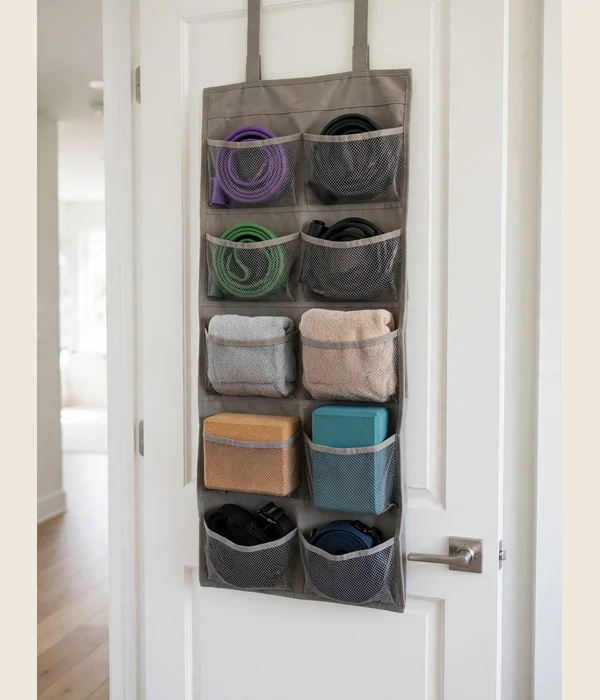
An over-the-door organizer is the renter’s loophole: no drilling, no damage, just a hook over the top of a door. Typical units run about 52 by 15 inches with tiered mesh pockets that swallow bands, straps, blocks, and towels. Weight spreads across the door, with most designs holding 40 lbs distributed.
This is the one pick that hides itself. Hang it on the inside of a closet or pantry door and everything vanishes when the door closes. Mesh pockets beat solid fabric here because sweaty bands and towels air out instead of stewing, but check your door still closes: you need clearance equal to the organizer’s loaded depth.
Shopping spec: fabric organizers run $12 to $25, with premium versions rated to 100 lbs on thick-door hooks. Most fit doors up to about 1.98 inches thick; standard interior doors are 1-3/8 inches, so measure first. Keep dumbbells off it: even sturdy fabric organizers are for light gear, not iron.
What you can do with it:
- Pocket bands, straps, and jump ropes in tiered rows
- Stash yoga blocks in the deep bottom bins
- Hang towels in mesh so they air between sessions
- Roll a thin mat behind the door for the full kit
- Keep foam rollers in tall side pockets on wide models
8. Wall-Mounted Garage Cabinet: heavy gear behind closed doors
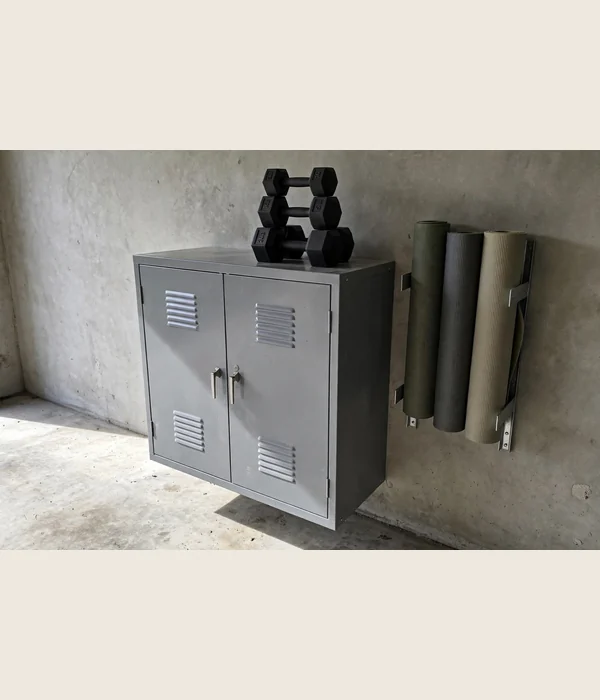
In a garage, open gear collects dust, sawdust, and spiders. A wall-mounted cabinet with closed doors keeps mats, bands, and hand weights clean and off the concrete. A typical steel unit runs 28 by 28 by 12 inches, with shelves rated at 40 lbs each, so hand weights and kettlebells stay comfortably within spec.
Closed storage changes garage math by keeping the floor clear for cars and projects, and a single 40-lb-rated unit handles everything short of bumper plates. Paired with wall brackets for your mats, one wall becomes a full gym corner. For the bikes leaning nearby, garage bike storage ideas sorts that wall out.
Shopping spec: a 28-by-28-inch steel wall cabinet runs in the $150 to $200 band with a 10-year warranty on the common models. This is a screws-into-studs project, never a renter pick. In humid garages, choose powder-coated steel so the finish resists rust season after season.
- Mount the rail into studs or concrete; drywall alone will not carry a loaded cabinet.
- Load the heaviest items on the lowest shelf and the lightest up top.
- Keep a folded mat on a wall hook beside the cabinet, not crammed inside.
- Leave an inch of clearance so the flip-up door swings fully open.
Conclusion
Best first buy: the rolling fitness gear cart. It’s the only idea on this list that stores mats, bands, blocks, and towels in one movable spot, needs no drilling, and works in a rental, a bedroom, or a garage. Add an A-frame dumbbell rack next, and the whole workout corner is solved for roughly $150.
If your garage also swallows bikes, bins, and garden gear, fold these picks into the bigger system. The point is the same either way: gear with a home gets used, and gear on the floor gets tripped over.
Frequently Asked Questions (FAQ)
How should I store my yoga mat so the edges don’t curl?
Stand it upright in a tube rack or a tall basket sized near the roll’s diameter. A rolled 6mm mat runs about 4.7 inches across, so slots and baskets near that width keep the roll supported and the edges flat. Avoid hanging a mat from a single thin hook, and let it air dry before rolling.
Can I combine yoga mat storage and dumbbell storage in one unit?
Yes, if the unit is built for both. Furniture-style mat stands often hang two mats up top while the base shelf holds hand weights, and rolling carts pair mat tubes with a basket for blocks and bands. Check the weight rating before loading iron: a 40-lb base handles light pairs, but leave heavy dumbbells to a dedicated A-frame rack.
What’s the best way to store resistance bands so they last?
Hang them straight on rubber-coated pegboard hooks, one band per hook, sorted light to heavy. Hanging keeps latex from creasing and makes the right tension grabbable in a second. Always return bands to relaxed length before storing, and keep them out of direct sun, since UV cracks latex faster than anything else.
Is it safe to store fitness gear in the garage?
It is, with two conditions. Control moisture, since rubber mats and latex bands degrade in damp heat, and keep gear off the concrete: a dehumidifier or airflow helps, while wall-mounted cabinets and racks protect equipment from dust and flooding. Closed doors keep pests out, and if your garage freezes, bring bands inside for winter.
How do I store fitness gear in a rental without drilling?
Pick freestanding or hanging solutions that need no holes: tube racks, rolling carts, and tall baskets all store mats with zero wall damage. For small gear, an over-the-door organizer holds about 40 lbs of bands, straps, and towels. Tension-rod pegboards are the one wall option that leaves no marks, though they hold less weight.
How many yoga mats can I fit in a small corner?
A 2-foot corner holds more than you’d expect. A tube rack that size stores 4 to 8 rolled mats; 6mm mats roll to about 4.7 inches across and 8mm mats to about 5.5, while a 15-by-15-inch basket fits 2 to 3 rolls. If you need more, go vertical: four bracket pairs hold four mats with zero floor used.