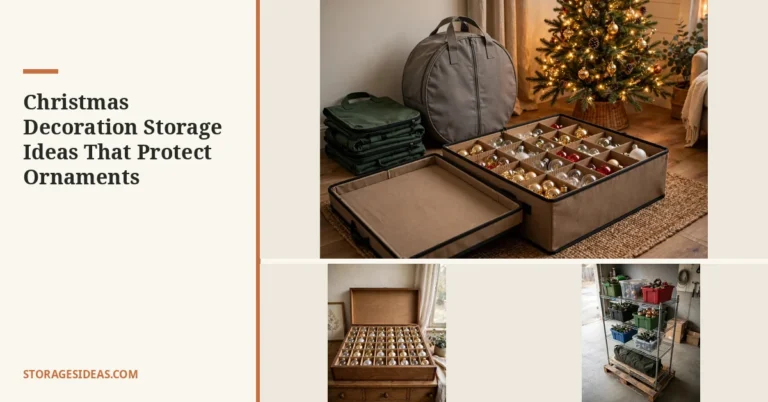
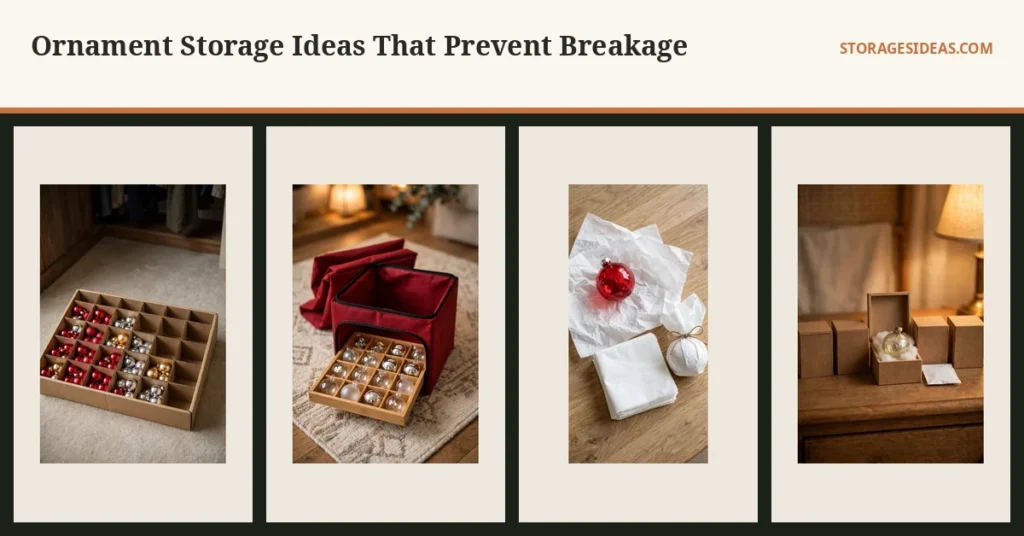
The tree is down, the needles are swept, and now you are looking at the real danger zone. Most ornaments do not break on the tree. They break in the eleven months nobody thinks about them.
January is when ornament storage either happens or gets postponed until the box of tangled glass tips over in the garage. These eight ideas stop breakage before it starts. Most need nothing more than a box with the right cells and ten minutes of packing.
Why Ornament Storage Fails in the Off-Season
An ornament is glass thin enough to see through, hung on a branch all December, and then it survives the takedown. What kills it is the box it sleeps in. One heavy ornament stacked on a thin one is all it takes.
Breakage comes from three places: impact, crush, and movement. Impact is the box getting knocked in the attic. Crush is weight settling on glass for months.
Movement is ornaments rolling into each other every time the box shifts.
Heat and humidity are the slow killers. An uninsulated attic can swing from below freezing to over 130°F across a year, and that expansion loosens glue on caps and finishes.
Damp basements grow mildew on felt-lined trays and stain paint. Store ornaments where you would store a photo album, not where you store the lawn tools.
The fix is separation plus padding, sized to the ornament. A cell or a wrap keeps each piece from touching its neighbor, and the right box keeps the weight off. If you are planning the whole seasonal swap, our seasonal decor storage guide lays out the bigger system this fits into.
1. 64-Cell Cardboard Ornament Boxes: The One Box Most People Need
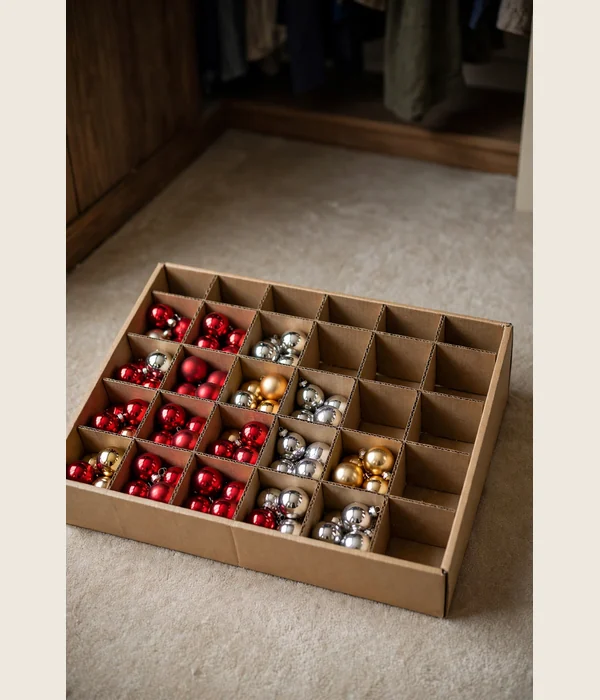
This is the classic for a reason. A 12-inch cube box with 64 cells, each about 3 inches square, swallows a standard tree’s worth of round ornaments with room to spare.
The cardboard grid is the mechanism. Each cell walls off its ornament, so nothing touches, nothing rolls, and a bump to the box stops at the first divider. Acid-free or coated cardboard resists the moisture that plain recycled stock can hold, which matters if the box lives in a garage.
What you can do with it:
- One 64-cell box holds the ornaments from a typical 6 to 7-foot tree. If your tree is bigger, buy two and sort by color or by room.
- Cells fit standard 2.5 to 3-inch balls. Pull out one divider to merge two cells for a 4-inch ornament or a finial.
- Buy boxes with lids that sit flat so a second box stacks on top. Two stacked cubes still fit most closet shelves.
- Look for acid-free or coated cardboard, which resists moisture better than plain recycled stock. Skip boxes with a musty smell.
- Label the outside with the year or theme. When December comes, you grab the right box without opening three.
- Keep the box indoors in a closet or spare room. Cardboard and damp basements do not mix.
Price bands run $15 to $25 for a single 64-cell box and $30 to $50 for a two-pack with trays. Start here if you own one tree and no storage system yet.
2. Stack-and-Carry Plastic Compartment Bins: For Damp or Rough Storage Spots
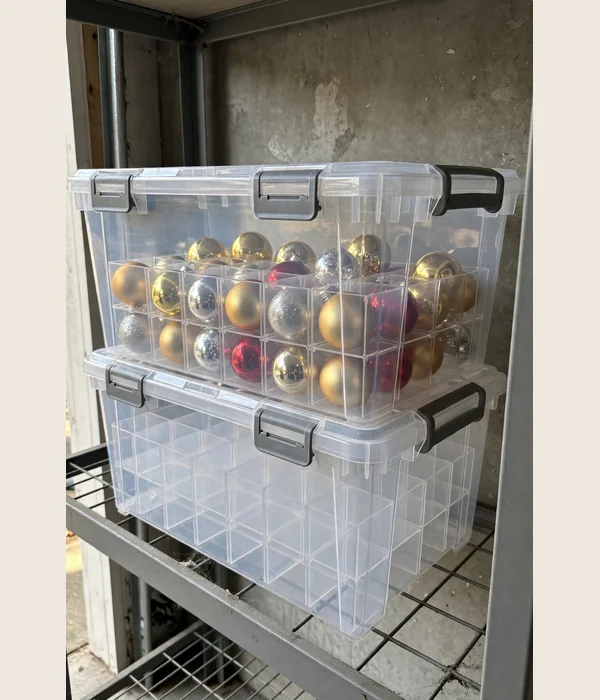
Cardboard loses when storage gets rough. These are the clear plastic bins with adjustable dividers, sold as 24-compartment duos or big 60-quart boxes with 75 cells, and they shrug off damp garages, dusty attics, and the annual trip down the stairs.
The mechanism is the hard shell plus air gaps. Rigid walls take the knock so the ornament inside never does, and the latching lid keeps out dust and the occasional spider. Stack-and-carry designs lock one bin to the next, so a two-bin tower rides like one box.
Tips for best results:
- Adjust the dividers before you pack, not after. Slide two cells together for long icicles, or halve a wide cell for a fat round ball.
- Wrap each glass ornament in a tissue sheet first, then set it in the cell. The divider stops collisions, but tissue stops the rattling.
- Stack no more than three bins high. The bottom bin’s lid is rated for the stack, but a fourth adds crush risk.
Watch out:
- Clear bins in a sunny attic turn into greenhouses. Heat builds fast, so keep them out of direct sun or in a shaded corner.
- Cheap thin-walled bins crack at the latches in cold garages. Flex the latch in the store; if it feels brittle, walk away.
Expect $20 to $30 for a 24-compartment duo and $35 to $50 for a 60-quart, 75-cell box. Buy these when your storage spot is the garage, attic, or anywhere damp.
3. Removable-Tray Ornament Boxes: Carry One Layer at a Time
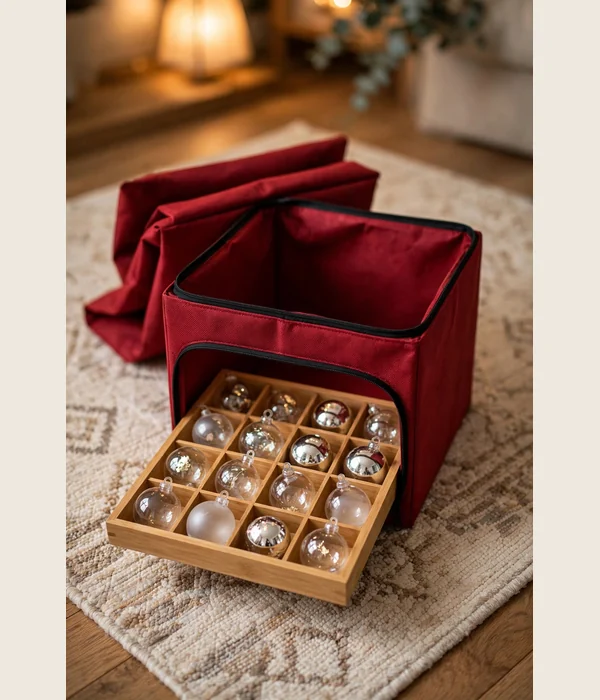
These are the fabric cubes with four drawer-like trays that pull out separately. The standard size runs about 13 inches on each side and holds 64 ornaments in 3-inch slots, with cardboard dividers you can move around.
The mechanism is tray-by-tray access. Instead of digging through layers, you pull the tray you need and carry it to the tree, which means less handling and fewer drops. The trays stack back inside the cube, and the cube itself folds flat after the holidays if you want it out of the way.
What you can do with it:
- Carry one tray to the tree and leave the rest packed. If the tree is across the room, you are making four light trips instead of one heavy one.
- Use the adjustable dividers to group by color or tree zone. Trays with handles make sorting feel like sorting laundry, not defusing glass.
- Stack two cubes in a closet corner. At 13 inches tall each, a pair still clears most closet rods.
- When the season ends, fold the empty cube flat. It slides behind a dresser until November.
- Pick the 600D Oxford fabric versions for the sturdiest walls. Thinner non-woven shells sag when the trays are full.
Typical price bands run $20 to $35 for a 64-count cube with four trays. Do not overload them: most are rated for about 6 to 7 pounds of ornaments total.
4. Under-Bed Ornament Boxes: Storage That Hides Itself
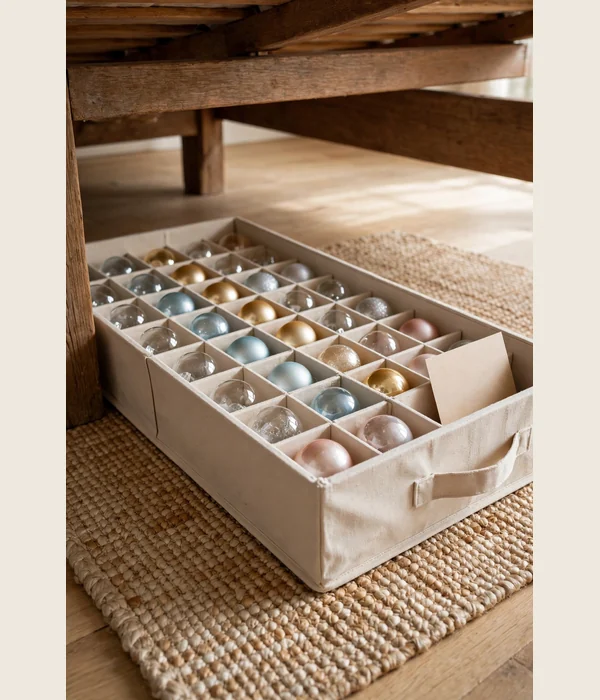
If your closets are full, the bed is the closet. Under-bed ornament boxes run about 36 inches long, 12 wide, and under 7 tall, and the bigger ones hold up to 96 standard ornaments in divided rows.
The mechanism is dead-space storage. The gap under most beds sits empty all year, and a slim box there never competes with daily-life storage. A label slot on the end tells you which box is ornaments and which is off-season clothes without pulling either one out.
Tips for best results:
- Measure your bed clearance before buying. You need at least 7 inches under the frame for the standard boxes, and some platform beds give you less.
- Load the box where you pack it, then slide it under. A full 96-count box gets heavy, and dragging it across carpet twists the dividers.
- Put a card in the label slot with the ornament count and year. Next January you will know what you own before you open anything.
Watch out:
- Under-bed boxes are not for heirlooms. They sit close to floor drafts and the occasional spill, so keep the irreplaceable pieces upstairs.
- Cheap zippers fail on long boxes. Test the zipper twice in the store, and skip any box that snags on day one.
Under-bed ornament boxes usually cost $20 to $30. They are the cheapest way to add storage without buying furniture, if your bed has the clearance.
5. Rolling Ornament Chests: For Collections Over 100 Pieces
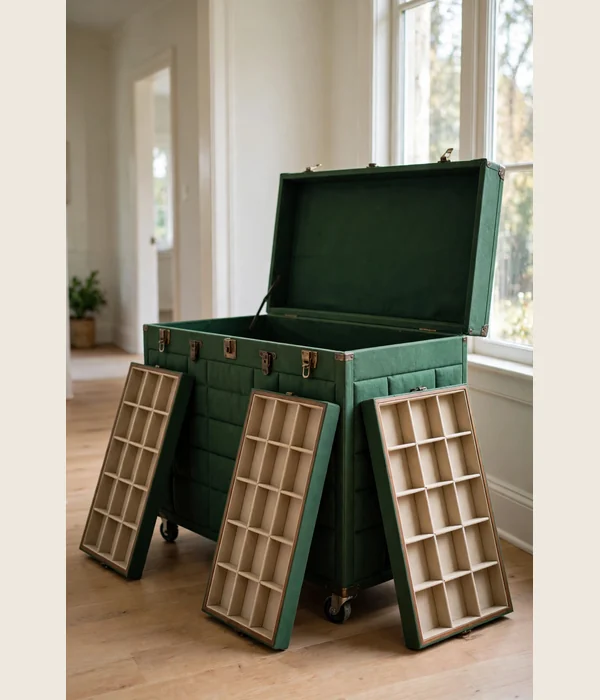
Past about 100 ornaments, small boxes turn into a Tetris problem. Rolling chests hold 100 to 120 ornaments in removable trays with fabric-lined dividers, and the built-in wheels mean you roll the collection to the tree instead of carrying it box by box.
The mechanism is tray mobility plus a frame. A steel or telescoping frame keeps padded trays from shifting, the fabric lining cushions each piece, and wheels take the full weight so your back never does. Some models expand upward so you can see every tray without unloading the whole chest.
Where it works best:
- Store up to 120 ornaments in one footprint of about 25 by 20 inches. The chest stands roughly 24 inches tall when closed.
- Pull out individual trays and carry them to the tree. The tray handles turn decorating into a relay, not a scramble.
- Sort trays by tree: living room, kids’ tree, mantel. Label each tray so January packing takes half the time.
- Use the front pocket for hooks, caps, and spare ribbon. Small hardware gets lost fastest in big chests.
- Keep the chest in a dry room. Most models are water resistant at best, and padding plus dampness is a bad pairing.
These chests usually run $60 to $120 depending on capacity and frame quality. Respect the load limit, most top out around 15 pounds, and the trays will last for years. For everything else on the tree, see our Christmas decor storage ideas.
6. Acid-Free Tissue Wrapping: The Cheapest Insurance Per Ornament
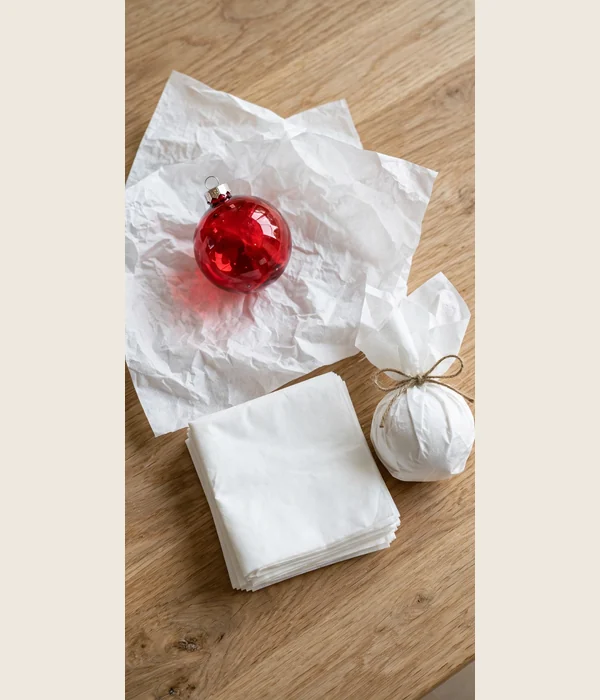
Dividers stop collisions, but wrapping stops the small stuff: rattling, scratches, and paint transfer between ornaments. A 20 by 30-inch sheet of acid-free tissue, the pH-neutral kind around 17 grams per square meter, wraps one large ornament or two small ones.
The mechanism is a buffer layer. Tissue fills the air gap inside each cell so the ornament cannot build momentum, and acid-free stock means no yellowing or dye transfer during eleven months of contact. Regular gift tissue can stain painted finishes, so the acid-free label matters.
Tips for best results:
- Lay the ornament in the center of the sheet, fold two corners over, and roll. Tuck the ends under so the package does not unroll in the box.
- Double-wrap anything hand-painted or with glitter. One sheet for cushioning, a second for the outside, and the finish survives intact.
- Crumple a few sheets into loose balls to fill empty cells. Dead space lets boxes shift, and shifting is what breaks things.
Watch out:
- Do not use newspaper. The ink transfers to light-colored ornaments within weeks, and you will not notice until December.
- Do not wrap damp ornaments. Pack the day the tree comes down, while everything is dry and dust-free from a month on display.
A pack of 96 to 100 acid-free sheets costs about $8 to $15. If you are buying wrap for the whole holiday pack-up, our wrapping paper storage ideas covers the rolls, bags, and bows too.
7. Repurposed Egg Cartons and Wine Shipper Boxes: The Free Option
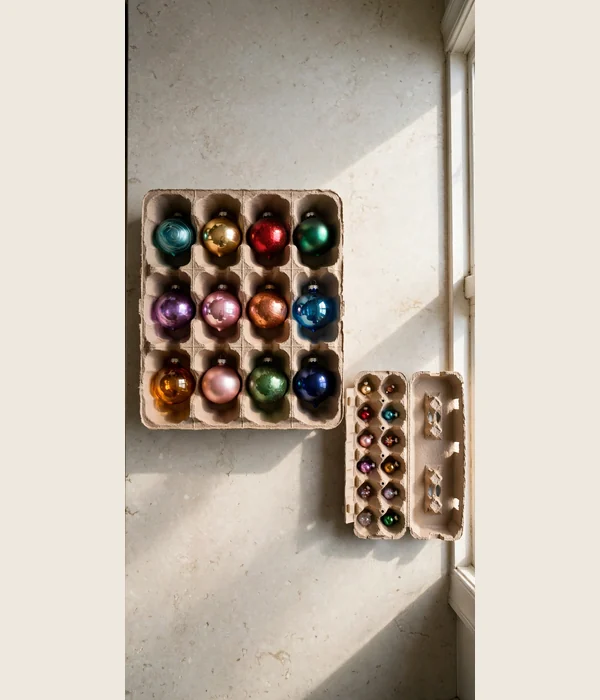
Before you buy anything, check the recycling. A pulp egg carton holds 12 small ornaments in 12 snug cells, and a 12-bottle wine shipper box holds a dozen larger ones in cells about 3.5 inches across.
The mechanism is the same as a bought box: molded pulp walls that grip and separate. Wine shippers are built to survive shipping trucks, so they handle attic stairs just fine. The pulp is naturally soft and slightly springy, which cushions better than hard plastic dividers.
Where it works best:
- Kids’ craft ornaments and plastic balls. Nothing here is fragile, so a free box is all the protection you need.
- Attic and garage storage where boxes get beat up. You will not cry over a free wine shipper the way you would over a $40 organizer.
- Overflow when you buy one ornament too many. Ask a liquor store for an empty shipper; most give them away.
- Dorm rooms and first apartments. If the budget went to the tree, the storage can cost nothing.
- Gift-wrap stations and craft rooms. A stack of egg cartons sorts small decorations by project better than any drawer.
Cost is free to about $5 if you buy a shipper new. Add a sheet of tissue per ornament and this free option protects nearly as well as the store-bought boxes.
8. Individual Keepsake Boxes: For the Ornaments You Could Never Replace
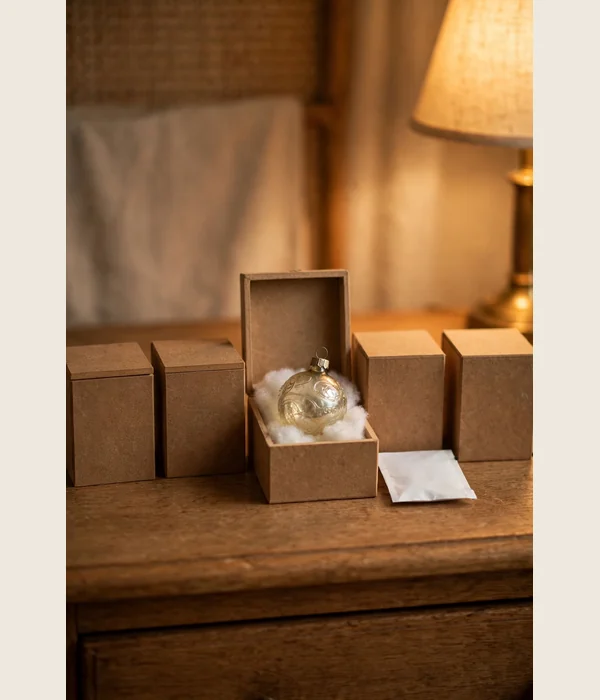
Every collection has a few that matter more: the baby’s-first ornament, the grandmother’s glass bird, the one from the trip. Those deserve their own box. Small acid-free chipboard boxes, usually 4 inches on each side, hold one ornament each with cotton lining.
The mechanism is total isolation. No shared cells, no shared padding, nothing touching the heirloom but clean cotton and its own walls. If a box falls, only one ornament is at risk, and the rigid chipboard takes the hit first.
Tips for best results:
- Drop one silica gel packet in each box before you close it. Ornaments stored for 11 months can pick up ambient dampness, and the packet buys insurance.
- Write the ornament’s story on the box lid: year, who gave it, which tree it hung on. Future-you will be glad you did.
- Store keepsake boxes together in one larger tote, upright, with the lids on top. They should never ride loose in a moving box.
Watch out:
- Cotton batting can shed fibers that cling to glitter. Use smooth cotton fabric or unbleached muslin instead of fluffy batting.
- Replace silica packets yearly. Once saturated they stop absorbing, and a spent packet in a sealed box is just decoration.
Sets of 6 to 12 keepsake boxes cost $10 to $25. For five minutes of wrapping and a labeled box, the irreplaceable pieces get the protection they deserve.
Conclusion
Start here: Buy one 64-cell cardboard box and a pack of acid-free tissue. That pair handles a standard tree for under $40, and it is the setup I would hand to anyone starting from zero.
If your storage spot is damp, go plastic. If your collection tops 100, go rolling. Everything else is a refinement on those two answers.
Pack the day the tree comes down, while the ornaments are clean and dry. Next December, every box you open should feel like a gift, not a repair project.
Frequently Asked Questions (FAQ)
Can I store ornaments in the attic or garage?
If your attic or garage is insulated and stays dry, then yes, but choose plastic bins over cardboard. If the space swings between freezing and baking, then no: temperature swings loosen glue on caps and finishes, and humidity stains paint. Ornaments belong in climate-stable spots like closets or spare rooms.
Should I wrap every ornament, or are divided cells enough?
If your ornaments are glass, hand-painted, or glittered, then wrap each one in acid-free tissue first and let the cell be the second layer of defense. If they are shatterproof plastic, then the dividers alone do the job and wrapping is wasted effort. Wrap the fragile, skip the sturdy.
How many ornament boxes do I need for my tree?
If your tree is 6 to 7 feet with standard ornaments, then one 64-cell box usually covers it. If you have two trees or a big collection, then count the ornaments and divide by the cell count, rounding up, and buy boxes in pairs so stacks stay even. Always leave 10 percent of the cells empty for next year’s finds.
What is the best ornament storage method for oversized ornaments?
If the ornament is wider than 4 inches, then pull dividers out of a compartment bin to merge cells, or give it its own keepsake box with tissue padding. If it is long and skinny like an icicle, then wrap it well and lay it diagonally across two merged cells. Never force a big ornament into a small cell.
Do I really need acid-free tissue, or will any tissue work?
If you are storing ornaments for 11 months, then yes, use acid-free. Regular gift tissue can transfer dye and yellow against painted finishes over long contact. If the ornaments are shatterproof plastic going into a dry closet, then plain tissue or even clean packing paper does fine.