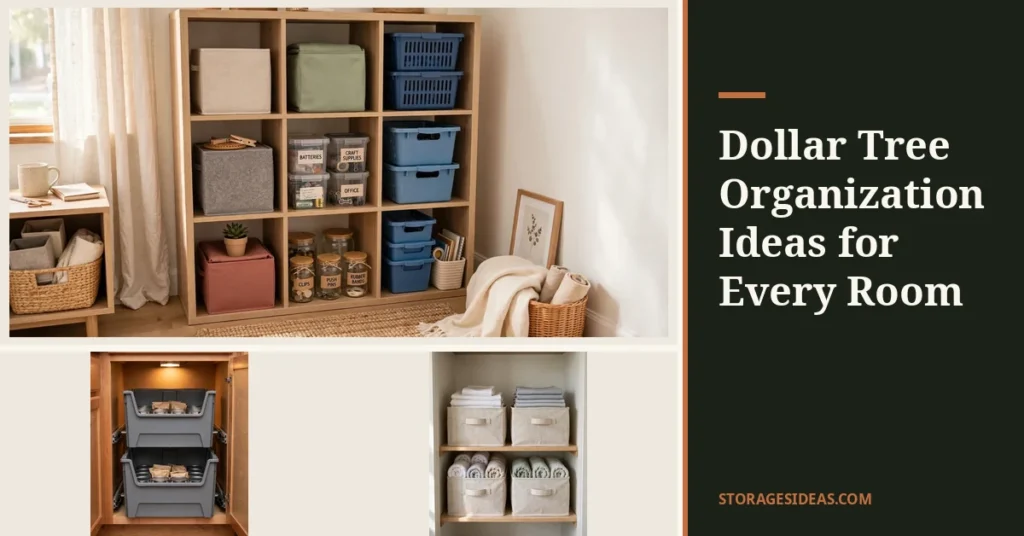
Most of the dollar tree organization ideas in this list cost $1.25 to $1.50 per item, with a few heavy-duty pieces at $3 or $6. That is the real 2026 price picture at Dollar Tree: the old flat dollar is gone, and the store now runs on $1.25, $1.50, $1.75 and the multi-price $3/$5/$7 tiers.
Here is the budget math that matters. A kitchen cabinet overhaul that would run $60 at a big-box store costs about $9 here. A closet floor that needs structure costs $12 to $18 instead of $50-plus. This is the pillar guide for the whole budget-organizing approach, so before you spend a cent, run this declutter checklist and clear the dead weight first. Bins organize what you keep; they cannot fix what you should not own.
Every idea below is grouped by room, priced with its real price band, measured where it counts, and flagged honestly when a Dollar Tree version is flimsy and something else in the same aisle does better. You will know exactly what to grab, what it fits, and what to skip.
Why Dollar Tree Organizing Beats Expensive Systems
The mechanism is simple: clutter in a small home is almost never a stuff problem, it is a container problem. Loose items migrate, stacks collapse, and cabinets become black holes because nothing gives each category a boundary. A $1.50 bin creates that boundary just as well as a $14 one, because the physics are identical. What you pay for in expensive systems is finish and load rating, not the basic function of keeping like with like.
That said, Dollar Tree plastic has limits, and this guide calls them out. Thin snap lids warp, suction cups fail on textured tile, and adhesive hooks hold a robe but not a backpack. The rule is: buy Dollar Tree for containment and sorting, spend up (or grab the $3/$5 Plus-tier pieces) for anything that bears weight, touches heat, or needs a real seal. Follow that split and you get roughly 90 percent of the result for a fraction of the cost.
One more habit that multiplies every idea here: measure before you shop. Carry a tape measure and the inside dimensions of your cabinets, drawers and shelves. Most returns happen because someone guessed. A $1.50 mistake is cheap, but twenty of them is a $30 pile of clutter with store branding.
Kitchen Organization
1. Stack & Nest Bins: Turn Deep Cabinets Into Pull-Out Drawers
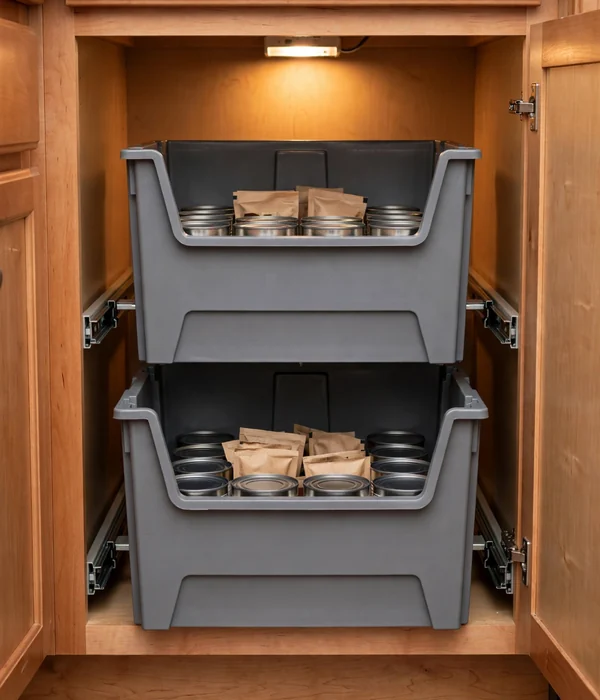
Deep kitchen cabinets are the number one place supplies go to die. You push cans to the back, forget them, and buy duplicates. The Stack & Nest bins ($1.50 each) fix this by turning a 24-inch-deep cabinet into a row of pull-out drawers. Each bin measures 12.65 inches wide, 7.57 inches long and 5.84 inches tall, weighs about 4.5 ounces, and comes in black, gray, blue or white. Two bins side by side fit a standard 24-inch cabinet with room to slide.
The mechanism is dead-space recovery. A deep cabinet’s back 10 inches are functionally unreachable without kneeling, so this bin brings the back to you. It stacks and nests, so extras store inside each other when not in use. At $1.50, outfitting a full cabinet costs $6 to $9, and the pull-out habit it creates is the same one $40 cabinet organizers sell.
What you can do with it:
- Canned goods sorted by type: soups in one, beans and tomatoes in another, no more double-buying
- Spice packets, gravy mixes and seasoning envelopes corralled in a single shallow bin
- Snack bars, granola and lunchbox supplies in the pantry section of a deep cabinet
- Under-sink cleaning bottles under 6 inches tall, grouped by task so you grab and go
- Medicine and first-aid overflow from a crowded bathroom cabinet
2. Under-Shelf Wire Baskets: Double Your Cabinet Space Overnight
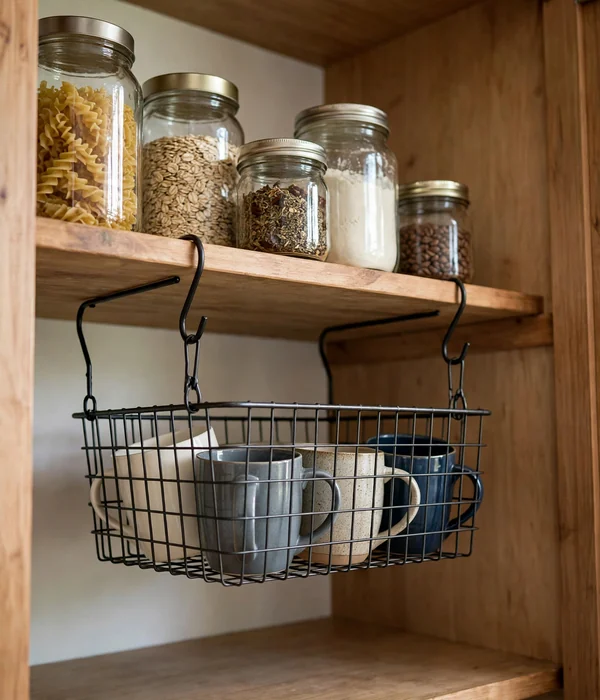
Most cabinets waste 6 to 8 inches of vertical air above short items like mugs and bowls. These wire baskets ($1.50) hook over a shelf and hang below it, creating an instant second tier. They fit standard shelves three-quarters of an inch to one inch thick, and run about 11 to 12 inches wide, 5 inches deep and 5 inches tall. One basket under a pantry shelf holds a full row of soup cans or spice jars that used to sit on the counter.
The win here is vertical volume, the cheapest space in your home because it is already paid for. In a small kitchen where every cabinet counts, two baskets effectively add a shelf without a drill, a screw or a landlord conversation. They also work in bathroom cabinets for cotton balls and in desk hutches for supplies.
Tips for best results: Measure the clearance under your shelf first; you need the basket’s full height plus finger room to slide items in. Keep them to light goods like mugs, packets and cans under a few pounds each. Hook them near the shelf’s front edge for the easiest reach.
Watch out: These are light-duty by design. Loading one with heavy glass jars or a stack of plates will bow the wire and stress the shelf. If you need to store anything dense, put it on the shelf itself and keep the basket for the light stuff.
3. Over-Cabinet-Door Wire Baskets: Free Counter Space for Wraps and Bags
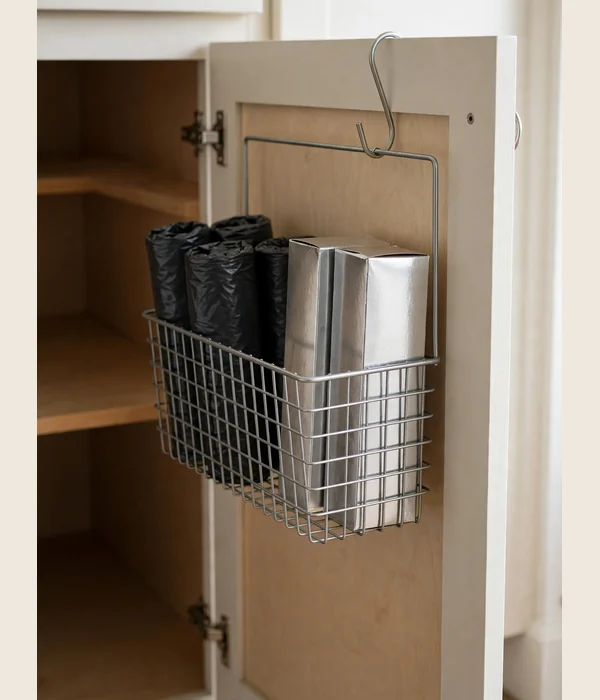
The inside of a cabinet door is renter-safe storage that most kitchens ignore completely. These wire baskets ($1.50) hook over standard cabinet doors up to about three-quarters of an inch thick, giving you a 9-to-10-inch-wide caddy for the flat, annoying items that eat counter space: trash bags, foil, plastic wrap and zip bags. Because nothing screws in, your deposit is safe.
The mechanism is door-swing reclamation. A cabinet door’s interior face is otherwise wasted, and these are the exact items that slide around drawers and jam them. Keeping wraps vertical also keeps boxes intact, so the tear-off edge stays usable instead of crushed. One basket per kitchen usually covers it; two if you are a serious meal prepper.
What you can do with it:
- Trash bags and recycling bags, rolled and standing upright for one-hand pulls
- Foil, plastic wrap and parchment boxes lined up like files instead of stacked
- Extra sponges, dish brushes and scrub pads in the under-sink cabinet door
- Sandwich and freezer bags sorted by size so the right box is always on top
- Cleaning wipe canisters kept off the counter but within arm’s reach
4. Dish Drainers as Vertical Sorters: End the Baking-Sheet Avalanche
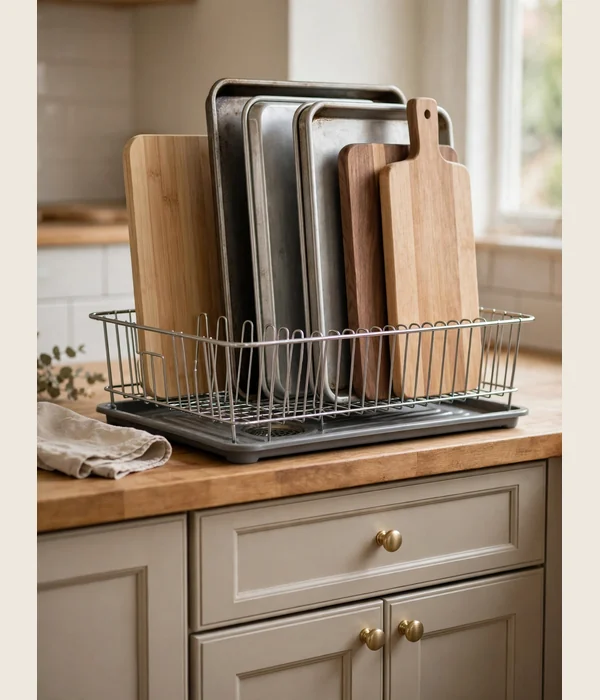
Every kitchen has a cabinet where baking sheets, cutting boards and muffin tins lean in a pile that collapses weekly. A standard Dollar Tree dish drainer ($1.50, roughly 13 by 9 inches) repurposed as a vertical file turns that pile into a neat row. Stand it on a cabinet shelf or in a lower cabinet, and each slot holds one sheet or board upright. Retrieval becomes a one-hand job with no avalanche.
The mechanism is vertical filing, the same principle offices use for paper. Flat items stored horizontally need the whole stack moved to reach the bottom one; stored vertically, each item slides out independently. It holds the typical home set: two half-sheet pans, a cutting board or two, and a muffin tin, all within a 13-inch footprint.
Tips for best results: Place it near the oven or prep zone so the sheets live where they are used. Put the heaviest cutting board in the center slot for stability. If your cabinet shelf is adjustable, raise it one notch to give tall boards full clearance.
Watch out: Cheap drainers flex under a full load of cast iron or stoneware. Keep it to sheet pans, boards and tins. If the cabinet gets humid, wipe the drainer dry now and then; standing water in the drip tray gets musty fast.
5. Uniform Spice Jars: A Pro-Looking Spice Drawer for About Ten Dollars
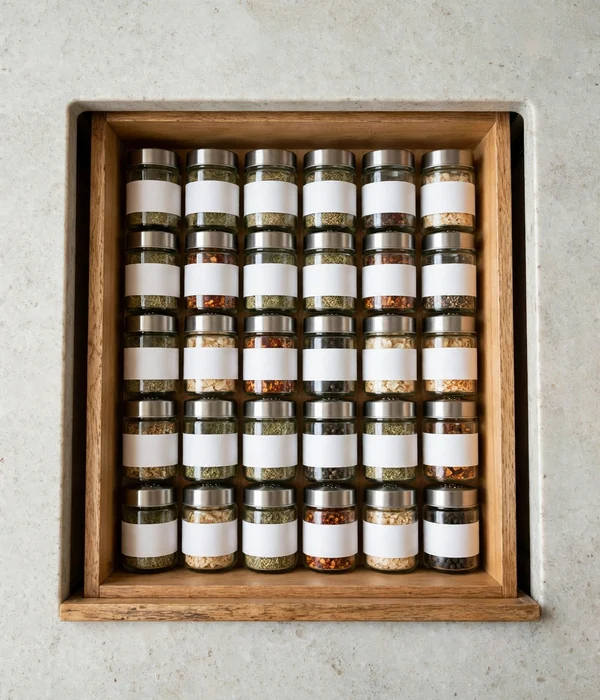
Mismatched spice jars are a small visual chaos that makes a kitchen feel cluttered no matter how clean it is. Dollar Tree’s glass spice jars with shaker lids ($1.25 each, 4 ounces) let you decant everything into matching vessels. Eight jars cost $10, and the drawer transforms from a rummage zone into something that looks like a magazine photo.
The mechanism is visual uniformity plus decanting discipline. Identical jars stack and line up; identical lids mean identical heights, so no more wobbly towers. The shaker tops give you sprinkle and pour options, and 4 ounces fits a standard spice refill bag exactly. Add a $1.25 pack of blank labels and you have a labeled, uniform system for under $12 total.
What you can do with it:
- Decant bulk spices from bags into uniform jars that actually fit a drawer in rows
- Use the shaker side for everyday seasoning and the pour side for measuring spoons
- Line jars in a shallow drawer on a $1.25 drawer liner so they never slide
- Keep duplicates out: one jar per spice forces the one-in-one-out rule
- Gift a starter set: six jars with labels in a small bin makes a solid housewarming gift
Bathroom & Laundry Organization
6. Over-the-Door Shoe Organizer: A Vertical Bathroom Cabinet for $1.50
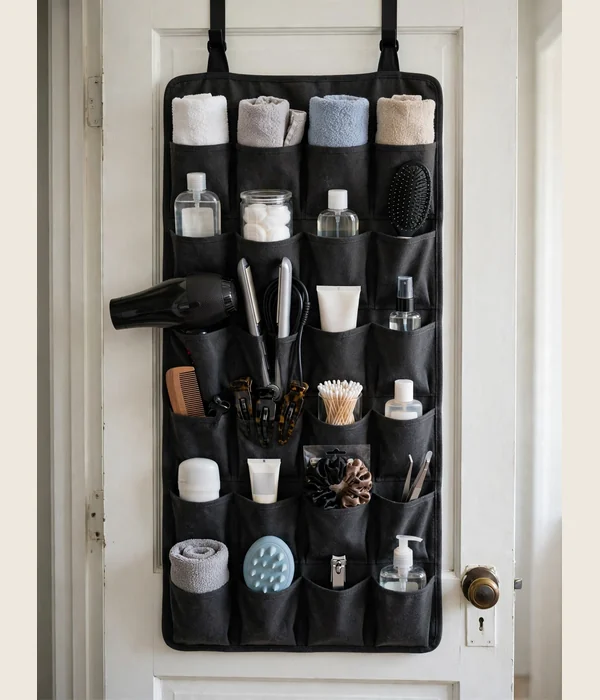
The back of a bathroom door is the most underused square footage in a small home. This 24-pocket organizer ($1.50, about 64 inches tall and 19 inches wide) hangs over any standard interior door and gives you two dozen visible pockets for the small stuff that clutters counters: toiletries, hair tools, washcloths and first aid. Each pocket is roughly 5 inches wide, sized for a bottle or a folded towel.
The mechanism is vertical real estate plus visibility. Bathroom counters fail because everything sits in one flat layer; pockets lift storage into the unused door plane, and clear or mesh fronts mean you see inventory at a glance. No more buying a third tube of the same cream. It also keeps damp items like washcloths aired out between uses instead of balled on the counter.
Tips for best results: Hang it on the inside of the door so it stays out of sight when the door is open. Put daily items at chest height and backstock up high. If pockets sag, slip a piece of cardboard inside as a stiffener.
Watch out: Check door clearance before you hang it; a thick organizer can stop a door from closing fully in tight bathrooms. Never store a hot flat iron or curling wand in a plastic pocket; let tools cool on the counter first. For heavy bottles, use the bottom rows where the weight sits closest to the door.
7. Stackable Containers: Zone Your Under-Sink Cabinet
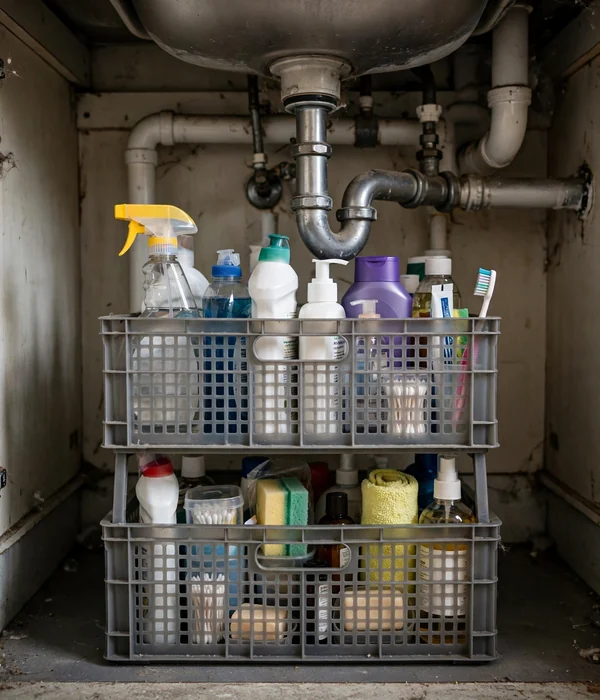
Under-sink cabinets are shaped by pipes into awkward L-shaped dead zones where bottles pile up and leak unnoticed. These stackable containers (about $1.25 each, 17 inches long, 14 inches wide and 10 inches tall) turn that chaos into zones. The perforated sides let you see contents, the open front with a raised edge keeps bottles from sliding out, and the side handles double as supports so a second container stacks on top without crushing what is below.
The mechanism is zoned containment with vertical stacking. One container becomes cleaning supplies, one becomes personal care backstock, one becomes first aid; stacking doubles the usable footprint in the same pipe-dodging space. A pair under the sink typically ends the bottle avalanche for under $3. They are also the right call under a kitchen sink for the same reason.
What you can do with it:
- Cleaning zone: all-purpose spray, scrub brushes and gloves in one pull-out unit
- Backstock zone: extra shampoo, soap and toothpaste bought on sale, visible and counted
- First-aid zone: bandages, ointments and thermometers together instead of scattered
- Hair zone: dryer, brushes and styling products in a stack beside the sink cabinet
- Linen overflow: rolled hand towels and washcloths in a container slid into a bathroom corner
8. Adhesive Hook Multipacks: Renter-Safe Hanging Everywhere
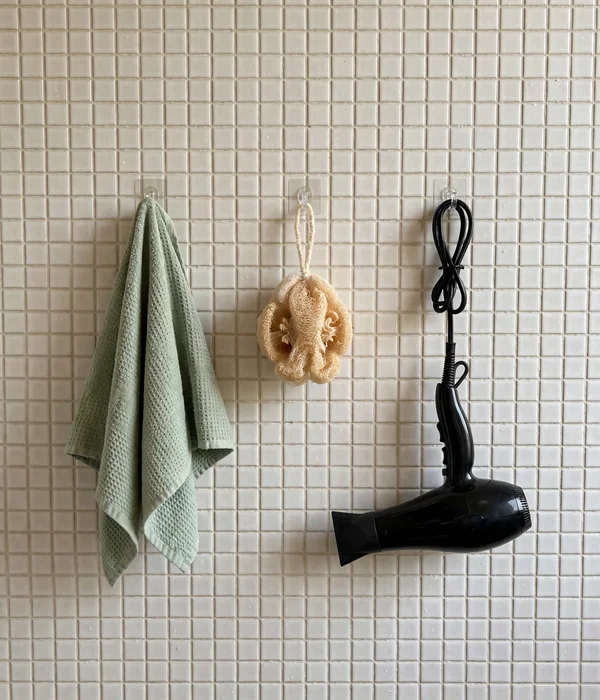
Drilling is off the table in most rentals, which makes adhesive hooks ($1.25 for a multipack of 6 to 10) the renter’s best friend. Each small hook holds roughly 1 to 2 pounds: enough for a hand towel, a robe, a hair dryer by its cord loop, or a loofah. Place them inside cabinet doors, on tile, on the back of the bathroom door, or beside the laundry machines for the lint bin.
The mechanism is damage-free vertical storage. Hooks convert blank wall and tile into hanging space with zero tools, and in bathrooms and laundry rooms they keep damp textiles aired instead of mildewed in a pile. The full technique matters more than the hook itself: clean the spot with rubbing alcohol, press firmly for 30 seconds, then let the adhesive cure for a full hour (overnight is better) before hanging anything.
Tips for best results: Always prep with rubbing alcohol; dust and soap film are why hooks fail. Hang items by their loops, not draped over the hook tip, so weight pulls straight down. In humid bathrooms, give the adhesive a full 24-hour cure before first use.
Watch out: These are 1-to-2-pound hooks, not 10-pound hooks; a wet bathrobe or full backpack will pull them off, and a bad removal can peel paint. For anything heavy, switch to an over-the-door hook rack instead. Test one hook in a hidden spot first if your paint is old.
9. Pop-Up Hampers and Mesh Bags: A Three-Bin Laundry Sort Station
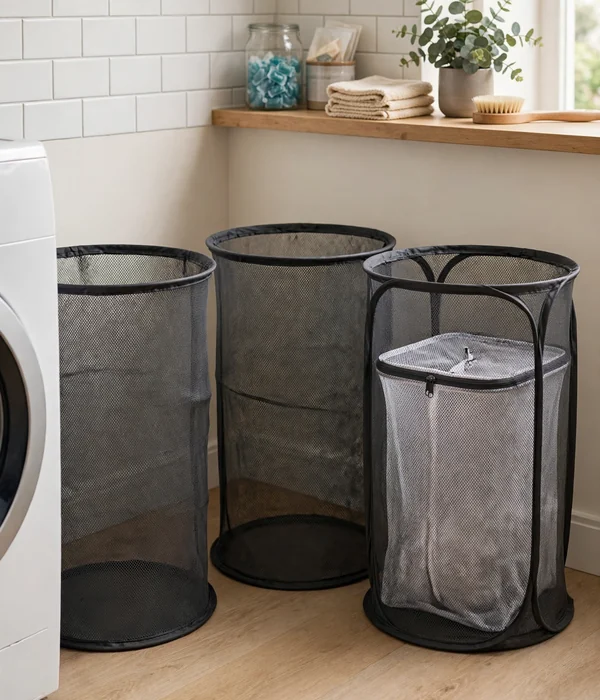
Laundry piles up because sorting feels like a chore that needs a system. Three mesh pop-up hampers ($1.50 each, about 18 inches in diameter and 24 inches tall) lined up in a laundry corner create an instant sort station: lights, darks, delicates. Add mesh laundry bags ($1.25 for a 2-pack) and delicates go straight into a bag that travels from hamper to washer to dryer untouched.
The mechanism is decision-point sorting. When every dirty item lands pre-sorted, wash day becomes grab-and-load instead of a 20-minute sort on the floor. The pop-up hampers collapse flat when empty, so the system disappears in a small laundry closet. The mesh bags protect delicates and keep sock pairs together, which quietly ends the missing-sock problem.
What you can do with it:
- Lights, darks and towels each get their own hamper, so a load is always ready to wash
- Delicates go straight into zip mesh bags at toss-in time, never fished out later
- Sock pairs ride in a small mesh bag from hamper to dryer, no more orphans
- Collapse empty hampers flat to reclaim the corner between wash days
- Use a fourth hamper as the clean-laundry folding station on wash day
10. Shower Caddies: Get Bottles Off the Tub Edge
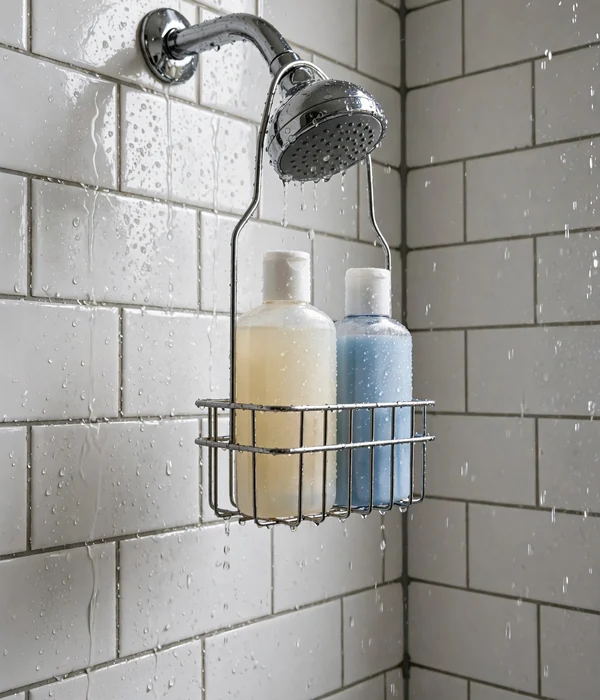
Bottles lined on the tub edge or shower floor are a slip hazard and a mildew farm. Dollar Tree’s shower caddies come in two styles: over-the-showerhead wire caddies ($1.50) and suction-cup corner caddies ($1.25). The over-arm style is the one to buy; it hangs on the shower arm, holds 4 to 6 full-size bottles plus a soap dish, and cannot fall because gravity is doing the holding.
The mechanism is drainage plus elevation. Bottles stored upright in a wire caddy drain and dry between uses instead of sitting in puddles, which cuts the pink mildew ring dramatically. Everything is also visible and reachable mid-shower, so nobody is bending for the conditioner. For a $1.50 fix, it is one of the highest-impact bathroom upgrades on this list.
Tips for best results: Choose the over-the-showerhead style over suction every time; it is mechanically secure with no adhesive to fail. Put the heaviest bottles in the center compartments for balance. Rinse the caddy monthly; shampoo residue builds up in wire joints.
Watch out: This is the flimsy-flag item of the bathroom aisle. Suction-cup caddies will eventually drop a full load at 2 a.m. on textured tile or fiberglass; if you already own one, use it only for light items like a single soap bar. Skip the suction style for heavy shampoo bottles entirely.
Bedroom, Closet & Kids’ Stuff
11. Six-Cube Storage Rack: A $1.50 Shoe and Closet Workhorse
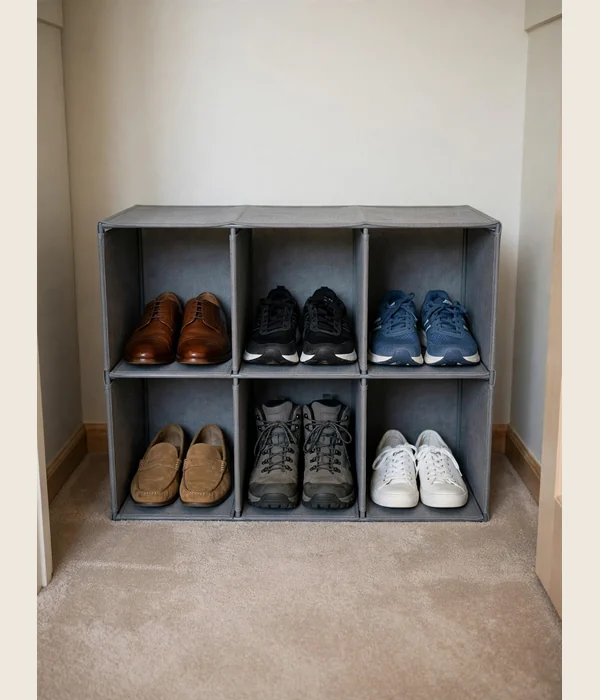
Closet floors are where shoes go to form a tangled drift. This six-cube storage rack ($1.50) assembles in minutes into a unit 12.01 inches wide, 35.04 inches tall and 23.43 inches long, weighing just 1.71 pounds but rated for 40 pounds total. Each cube fits one pair of adult shoes, and units stack or sit side by side, so the system grows with the collection. It even ships with a tie for anchoring to the wall.
The mechanism is cubby discipline. Shoes stored in defined cells stay paired and visible; shoes in a pile migrate and get buried. Six cubes handle the daily rotation for one person or the overflow for a couple, and at $1.50 you can build a full closet wall for the price of one coffee. Reviewers also use it for folded towels, handbags and craft supplies.
What you can do with it:
- One pair of adult shoes per cube, daily rotation visible at a glance
- Stack two units for a 12-cube wall that holds a serious collection for $3
- Folded jeans and sweaters in cubes instead of a leaning shelf stack
- Handbags stored upright, one per cube, so straps never tangle
- Kids’ shoes and school supplies sorted by child, one column each
12. Stackable Drawers: See-Through Storage That Stacks
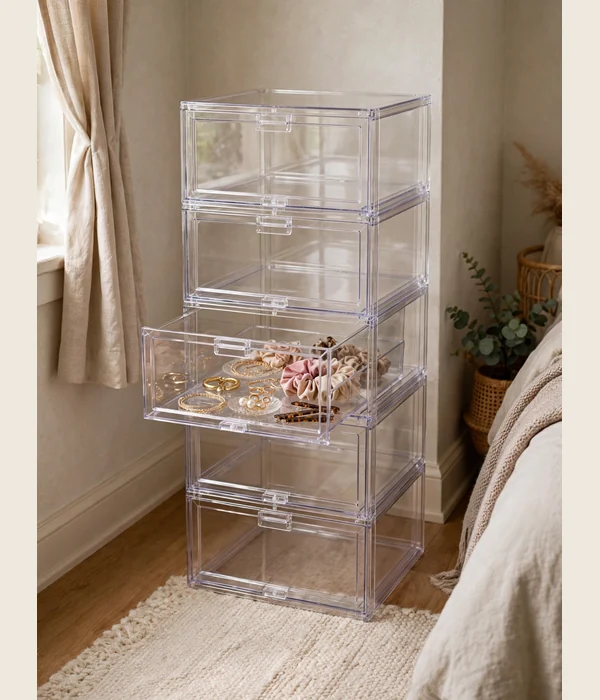
These clear stackable drawers ($6 each, 12.5 inches long, 8.1 inches wide and 5.8 inches tall) are the most-reviewed storage item Dollar Tree sells, with shoppers rating them 4.7 stars for quality and value. Each drawer pulls out independently, so unlike lidded bins you never unstack to reach the bottom one. They are sized for one pair of shoes, a full medicine stash, or a complete accessory collection per drawer.
The mechanism is visible, accessible density. Clear fronts end the label-everything chore because you see contents instantly, and the drawer format means the bottom of a stack is as reachable as the top. That combination is why people buy seven or eight at a time: they work in bedrooms, offices, craft rooms, linen closets and pantries with equal ease.
Tips for best results: Buy them in one trip if you can; stock is inconsistent and viral items sell out. Use one drawer per category (medicines, chargers, socks) so the system stays intuitive. They also work beautifully as shoe storage: one pair per drawer, stacked four high in a closet corner.
Watch out: The $6 price changes the math. Eight drawers cost $48, which is real money in a budget build, so plan the count before you shop and start with your worst clutter zone. They are also a Plus-tier item, so confirm your store carries the multi-price section before making a special trip.
13. C.O.S. Stackable Basket Towers: Build Closet Shelving on the Floor
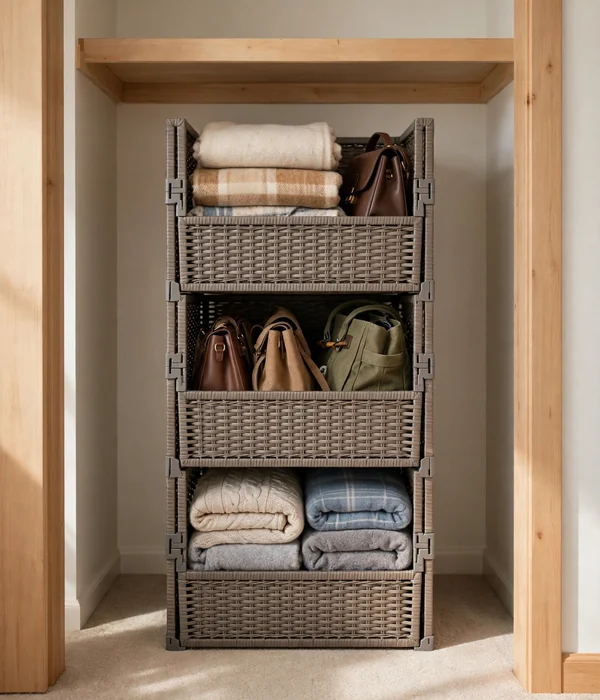
When closet shelves are full and the floor is a drift of bags and shoes, these C.O.S. stackable container baskets ($6 each, 19 inches long, 14 inches wide and 10 inches tall) build you new shelving from the floor up. They lock together into a rigid tower, each basket rated sturdy by reviewers at 4.8 stars. Two or three stacked create a dresser-height unit that holds the bulky stuff shelves cannot: handbags, boots, folded blankets and off-season clothes.
The mechanism is floor-to-ceiling conversion. Closet floors waste the vertical column above them; a locking basket tower reclaims it without a single screw, which renters will appreciate. The open fronts mean each basket works like a drawer, and the 19-by-14 footprint fits standard reach-in closets with room to spare on either side.
What you can do with it:
- Handbag storage: one bag per basket, upright and uncrushed, no more strap tangles
- Boot and shoe overflow for pairs too tall for standard shelves
- Off-season clothes folded in a basket per category, stacked out of the way
- Kids’ closet floor: toys and dress-up clothes in reachable low baskets
- Linen closet overflow: extra blankets and sheet sets in labeled towers
14. Stackable Deep Bins: Toy Control for $3 a Bin
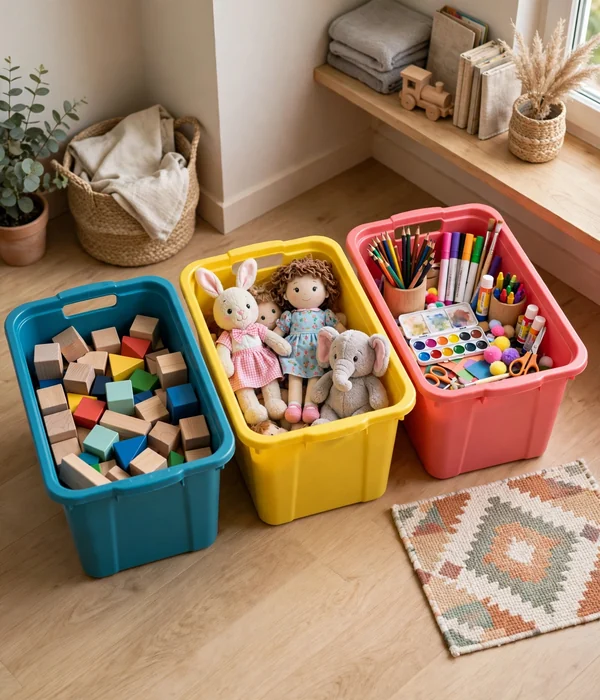
Kids’ toys defeat most organizers because the categories are big and the pieces are bulky. These stackable deep bins ($3 each, 13.78 inches long, 10.63 inches wide and 8.78 inches tall) are sized for exactly that: blocks, action figures, dolls and art supplies. The click tabs lock stacked bins together, the open fronts make cleanup a toss-in job a four-year-old can do, and the colors (black, blue, white, gray) keep a playroom from looking like a daycare explosion.
The mechanism is right-sized containment with kid-level access. Toy systems fail when bins are too deep to see into or too tall to reach; at under 9 inches tall with an open front, these match a child’s reach and sightline. One bin per category also makes the cleanup rule enforceable: everything has a named home, so “put your toys away” is finally a completable instruction.
Tips for best results: Assign one bin per toy category and put a picture label on the front for pre-readers. Keep the stack to three bins high in a playroom so the top stays reachable. Use the nesting feature to collapse extras during a toy rotation.
Watch out: These are sturdy but not indestructible; a tower of four fully loaded with wooden blocks gets top-heavy, so anchor tall stacks or keep them at three. This is also the item to pair with decluttering kids’ clothes first, because outgrown clothes are usually half the closet chaos anyway.
15. Drawer Organizer Trays: End the Dresser Rummage
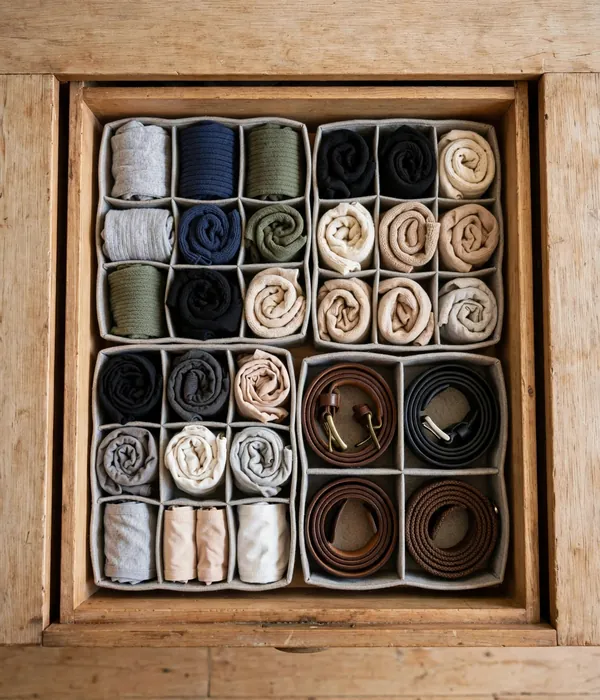
Dresser drawers fail when small items share one big space: socks, underwear, belts and accessories become a single tangled layer. Dollar Tree’s drawer organizer trays ($1.25 each, in assorted sizes) divide any drawer into compartments in about two minutes. Measure the drawer, buy the trays that tile it, and every category gets a cell. The classic win is the sock and underwear drawer, where rolling plus compartments turns a rummage into a grab.
The mechanism is compartmentalization at the smallest scale. A drawer is just a box; trays turn it into a grid, and grids are searchable while boxes are not. Rolling clothes into the compartments (instead of folding flat) adds visibility: you see every option at once, which means you actually wear what you own. Before you buy a single tray, though, run these decluttering tips and clear the drawer first; organizers cannot fix overflow.
What you can do with it:
- Sock and underwear drawers tiled with small trays, one category per cell
- Belt and accessory drawers with long narrow trays keeping everything unrolled
- Junk drawer rescue: four small trays turn chaos into batteries, tools, tape and misc
- Bathroom vanity drawers with trays for makeup, brushes and daily essentials
- Desk drawers with compartments for pens, clips, stamps and chargers
Home Office, Desk & Craft Corner
16. Stackable Desk Trays: A Paper System That Actually Gets Used
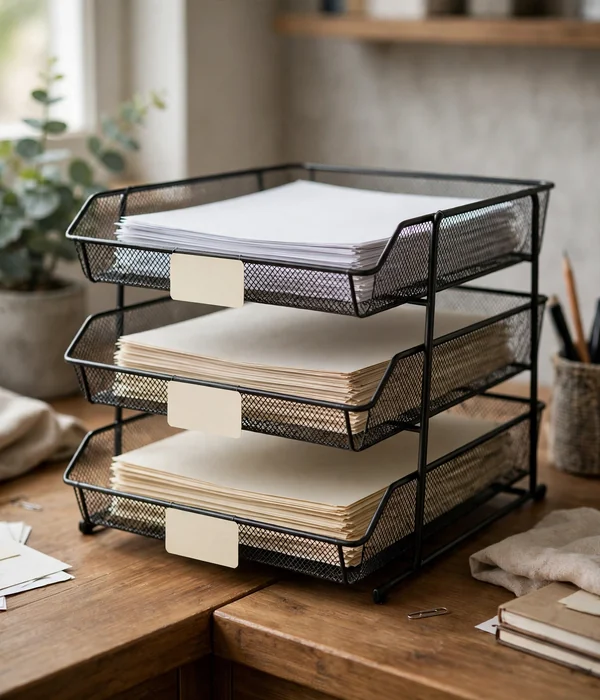
Paper clutter persists because most people have no landing zone between “mailbox” and “dealt with.” Stackable desk trays ($1.50 each, about 12 inches long, 9 inches wide and 2.5 inches tall) build a three-tray system in one purchase: inbox, action, file-out. They stack vertically on a desk corner, taking up one tray’s footprint, and the open fronts mean papers slide in and out without lifting the stack.
The mechanism is a defined paper workflow. Loose paper on a desk is a to-do list you cannot read; paper in labeled trays is a queue with a next step. The three-tray minimum works because it mirrors reality: new stuff arrives, some needs action, some needs filing. Anything more complex gets ignored, which is why the simple stack wins.
Tips for best results: Label the trays with a $1.25 label pack: Inbox, Action, File. Process the inbox tray weekly and the system stays honest. Keep the stack at the desk corner nearest your dominant hand so filing is frictionless.
Watch out: Trays only work if the file-out tray actually empties into a filing spot; otherwise it becomes a prettier pile. Pair the trays with magazine holders (point 17) as the filing end of the system. And do not buy trays for paper you should shred; junk mail goes straight to recycling, never into the system.
17. Magazine and File Holders: Vertical Paper, Upright Everything Else
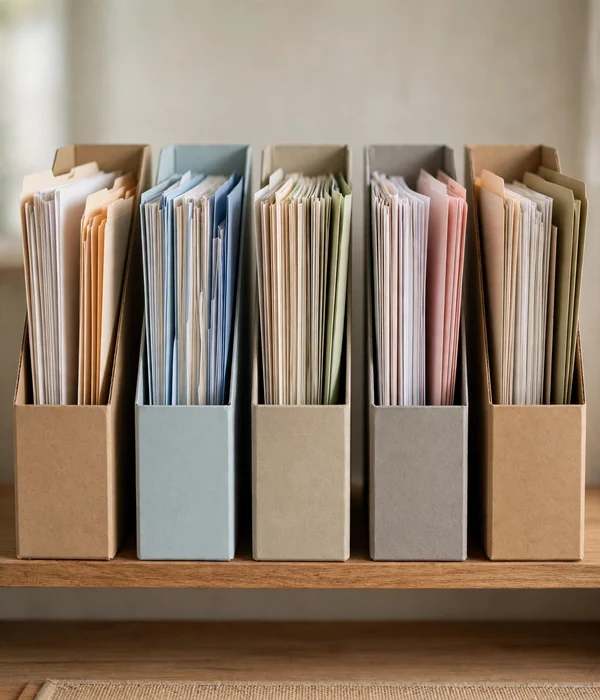
File holders ($1.50 each, about 9.5 inches tall, 3.5 inches wide and 12 inches deep) store paper vertically the way libraries store books, which means every file is visible from the spine and retrievable without moving a stack. A row of five on a desk or shelf holds the entire active-paper life of a household: bills, school forms, warranties, medical records and tax documents, each in its own labeled slot.
The mechanism is spine-out visibility. Horizontal paper stacks hide everything below the top sheet; vertical files show every category at once. The same holders moonlight all over the house because the dimensions fit so many flat things: gift wrap rolls, freezer bags, cutting boards and even clutch purses. At $1.50 each, a full household paper system costs under $10.
What you can do with it:
- Active files sorted by category, one holder per topic, spines labeled and visible
- Gift wrap and tissue paper stored upright in a closet instead of crushed in a corner
- Freezer bags, foil and parchment standing in a pantry cabinet like files
- Kids’ school papers and art sorted by child in a homework station
- Purses and clutches stored upright on a closet shelf, one per slot
18. Utensil Caddies as Mobile Cleaning Stations: Carry, Don’t Fetch
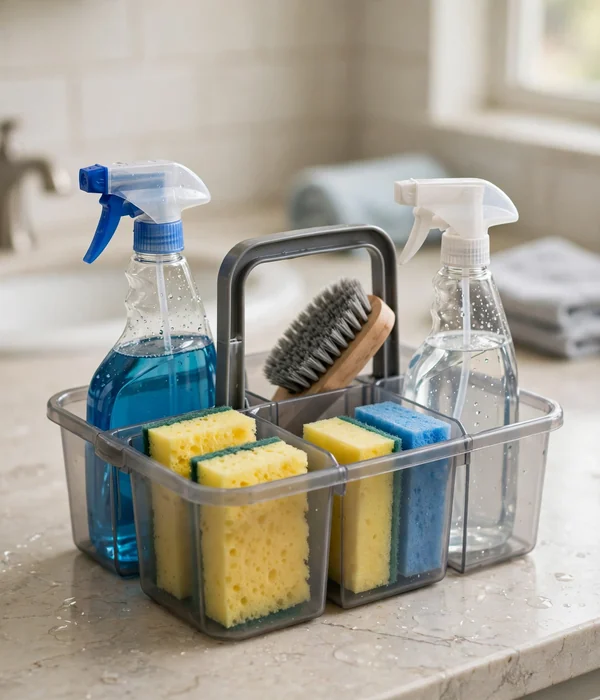
Cleaning supplies scattered across the kitchen, bathroom and laundry room mean every cleaning session starts with a gathering expedition. A plastic utensil caddy ($1.25) with its divided compartments becomes a mobile cleaning station: all-purpose spray, glass cleaner, scrub brush, sponges and gloves ride together from room to room. Grab the handle, clean the bathroom, carry it to the kitchen, done.
The mechanism is task batching through portability. The friction in cleaning is rarely the cleaning; it is the setup and the mid-task trips for the forgotten bottle. A caddy eliminates both by keeping the full kit together and mobile. It also ends the duplicate-buying problem, because you can see at a glance that you already own glass cleaner.
Tips for best results: Build one caddy per floor if you have two stories; the stairs are where motivation dies. Keep a microfiber cloth roll and a trash bag in the caddy so you never leave the room mid-task. Restock from a backstock zone (point 7) instead of buying duplicates.
Watch out: Never mix chemical cleaners in the same caddy compartment, and never combine bleach with ammonia-based products; store them upright and separate. Keep the caddy out of reach of kids and pets, ideally in a latched under-sink cabinet. If a bottle leaks, rinse the caddy immediately; dried cleaner residue gets gummy.
19. Cord Clips and Velcro Ties: Tame the Cable Nest
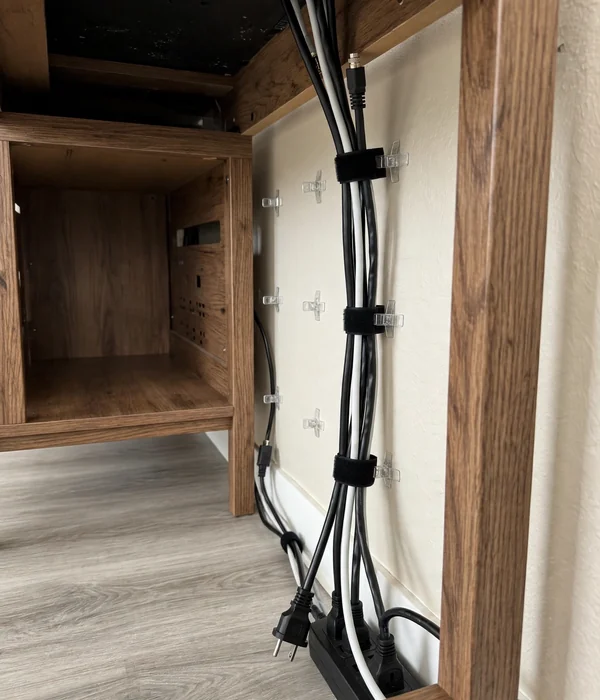
The space behind a TV or under a desk collects cables into a dust-covered nest that makes every unplug a guessing game. Dollar Tree’s adhesive cord clips and velcro cable ties ($1.25 per pack) fix it for pocket change. Clips stick to the desk edge or wall and route each cable along a defined path; velcro ties bundle the slack into neat loops. A $2.50 investment ends the nest behind most setups.
The mechanism is path definition plus identification. Cables tangle because they hang free; clips give each one a route, and ties remove the slack that causes the tangling. The real payoff comes when something needs unplugging: labeled, routed cables mean you pull the right one on the first try instead of tracing through the nest by hand.
What you can do with it:
- Phone chargers clipped to the nightstand edge so they never slide behind the bed
- TV and console cables routed along the stand’s back edge in labeled bundles
- Desk cables tied into one trunk line from computer to power strip
- Christmas light and extension cord storage: coiled, tied and hung instead of knotted
- Kitchen counter appliance cords clipped to the backsplash to reclaim counter space
20. The Two-Dollar Label System: Make Every Bin Self-Explanatory
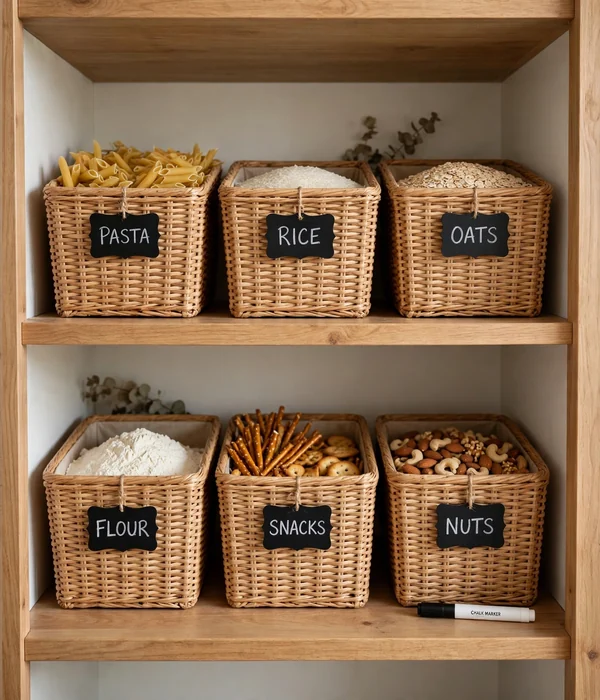
An unlabeled bin is a mystery box; a labeled bin is a system. Dollar Tree’s chalkboard labels and chalk markers ($1.25 per pack) turn every container in this guide into a self-explanatory unit. Peel, stick, write the category, and anyone in the house can put things back correctly, which is the actual test of an organizing system: it has to survive other people.
The mechanism is shared mental models. You know what is in each bin because you filled it; your family does not, so they guess, and guessing is how systems die. Labels externalize the system so a partner, a kid or a houseguest maintains it without asking. Rewritable labels matter because categories evolve; permanent marker on a bin is a commitment you will regret.
Tips for best results: Label both the bin and the shelf spot it lives in, so empties return to the right home. Use big, simple category words (Snacks, Batteries, Winter) rather than clever ones. Keep a marker with the label pack in your junk drawer for relabeling day.
Watch out: Chalk marker on chalkboard labels smudges if the bin lives somewhere handled daily, like a pantry; let it dry fully and avoid rubbing. For high-touch bins, grab Dollar Tree’s vinyl write-on labels instead; they wipe clean and survive handling. This labeling habit pairs perfectly with the 30-day declutter challenge if you are resetting a whole house room by room.
Pantry, Entryway & Utility Spaces
21. Clear Canisters: Pantry Dry Goods You Can Actually See
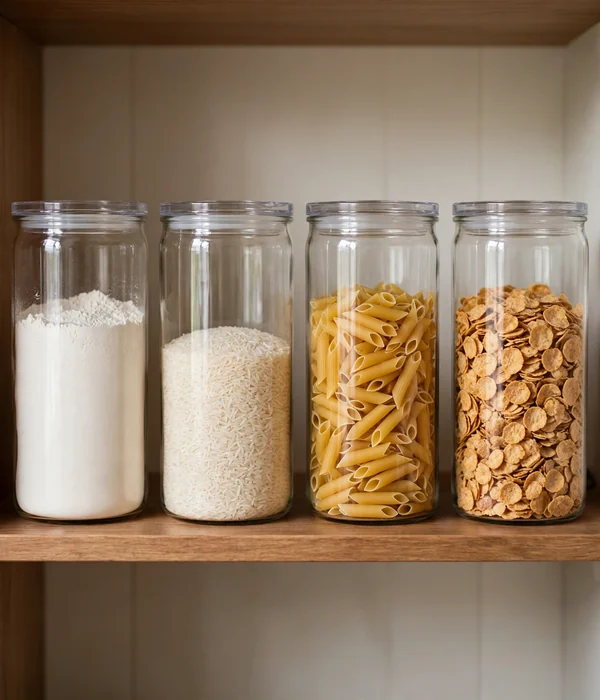
Pantry chaos is mostly an inventory problem: half-empty bags and boxes hide what you own, so you buy duplicates and food goes stale. Clear canisters ($1.25 to $1.50 each, in sizes from about 32 to 64 ounces) fix it by making every staple visible. Flour, sugar, rice, pasta and cereal decanted into matching canisters turn a jumbled shelf into a scannable inventory where low levels are obvious at a glance.
The mechanism is transparent inventory plus decanting discipline. You see the actual level instead of guessing by bag weight, and uniform canisters stack and line up where random boxes do not. A 64-ounce canister holds a standard 4-pound bag of sugar; a 32-ounce holds a pound of pasta. Outfit the top ten staples for roughly $15 and the duplicate-buying stops.
What you can do with it:
- Flour, sugar and rice in large canisters with the level visible from across the pantry
- Pasta, cereal and snacks in medium canisters that stack two high on a shelf
- Baking supplies (baking soda, powder, cocoa) grouped in small canisters on one shelf
- Pet food and treats decanted so you see when a refill is actually due
- Bulk-bin purchases portioned into canisters with the date written on the label
22. Over-the-Door Hook Racks: An Entryway Coat Closet for $1.50
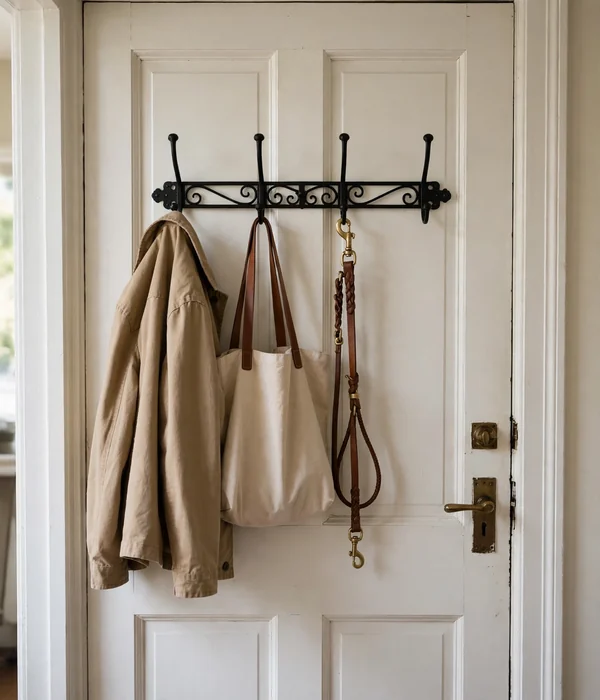
Not every home has an entryway closet, and even those that do fill up fast. This iron over-the-door rack ($1.25 to $1.50, four sturdy hooks on a metal frame) hangs over any standard interior door and instantly creates coat, bag and leash storage. It holds what adhesive hooks cannot: a winter coat, a loaded backpack, a dog leash and tomorrow’s tote, all without a screw or a wall anchor.
The mechanism is load-rated hanging on wasted door space. Entryway clutter is really a landing-zone problem: coats and bags need a defined drop spot within arm’s reach of the door, or they colonize chairs and floors. Four hooks cover one person’s daily carry; two racks on a closet door cover a couple. Because it lifts off, renters keep their deposit and movers keep their sanity.
Tips for best results: Hang it on the inside of a coat closet door to double that closet’s hook capacity invisibly. Put the heaviest item on the centermost hooks for balance. Add small S-hooks to each hook to split one hook into two for leashes and keys.
Watch out: Check that the door still closes and latches with the rack on; thick racks can bind in tight frames. Look for padded or coated backs on the frame so the metal never scratches the door face. This is the heavy-duty answer wherever adhesive hooks (point 8) would fail; use each for what it is rated for.
23. Fabric Cubes: Soft Storage for Living Room Clutter
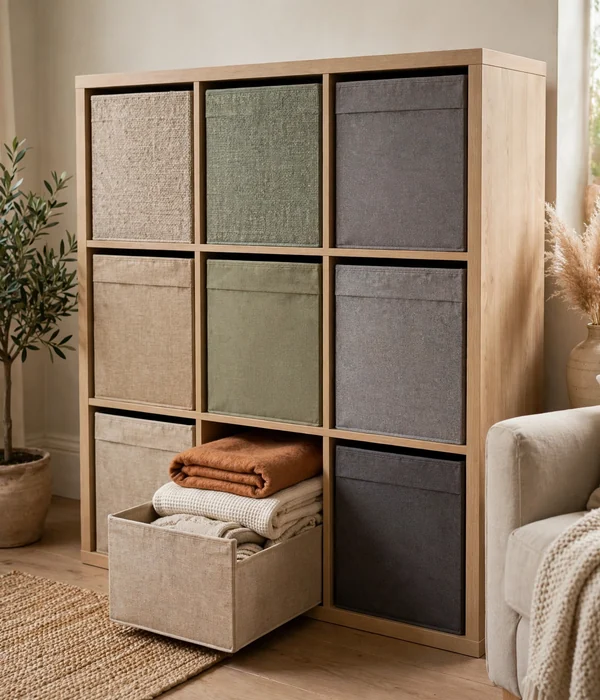
Living rooms collect the soft clutter: throw blankets, remotes, chargers, kids’ toys and the magazines nobody reads. Fabric storage cubes ($1.50 each, about 10.5 to 11 inches square) drop into standard cube shelving and swallow all of it. One cube per category turns an open shelf from a display of chaos into a clean grid, and the fabric collapses flat when not needed.
The mechanism is visual simplification. Open shelves show everything, which reads as clutter even when items are grouped; fabric cubes hide the contents behind a uniform face while keeping them one pull away. A four-cube shelf unit organized this way costs $6 in cubes and looks like a deliberate design choice instead of a storage compromise.
What you can do with it:
- Throw blankets and spare pillows in one cube per couch, tossed in, not folded
- Remotes, chargers and controllers in a single electronics cube by the TV
- Kids’ toys sorted by type in labeled cubes that make cleanup a sorting game
- Entryway overflow: hats, gloves and scarves in a cube by the door each winter
- Craft and hobby supplies in cubes on a living room shelf, hidden but handy
24. Tension Rods: The Adjustable Divider for Sinks and Shelves

Tension rods ($1.25 to $1.50, typically adjusting from about 16 to 28 inches) are the most versatile $1.50 in the store because they create a divider anywhere two surfaces face each other. Under the sink, a rod mounted front-to-back becomes a hanging rail for spray bottles, lifting them off the cabinet floor and freeing the space below. In a linen closet, a vertical rod between shelves becomes a divider that keeps stacks of towels from toppling sideways.
The mechanism is friction-fit division. No screws, no adhesive, no damage: the rod’s spring pressure holds it between two solid surfaces, creating a rail or a divider in seconds. Under-sink spray bottles hung by their triggers are the signature use, because they convert the pipe-crowded floor into hanging storage and leave the floor clear for bins.
Tips for best results: Measure the exact span before you shop; rods only work within their stated range, and a rod at full extension holds less weight. Twist to lock firmly, then test with a gentle tug before loading. Under the sink, mount the rod high enough that bottle bottoms clear the cabinet floor.
Watch out: Tension rods need two solid, parallel surfaces; they will not hold on textured walls, inside flimsy cabinets, or across spans wider than their rating. They are for light loads only: spray bottles and towel stacks, not paint cans. If a rod slips, the surfaces are the problem, not the rod; reposition or choose a shorter span.
25. Collapsible Fabric Bins: Flexible Shelving for Linens and Overflow
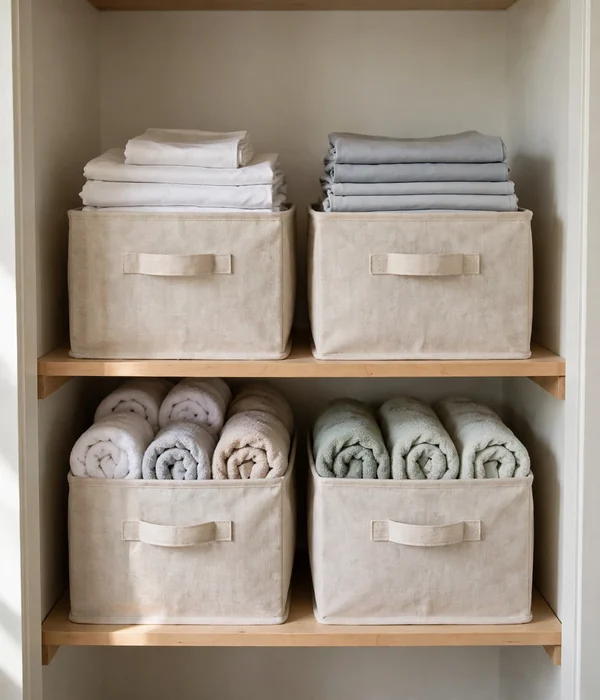
Linen closets and deep shelves need containers that adapt, because the contents change with the seasons. Collapsible fabric bins ($1.25 to $3 depending on size) fold flat when empty and pop into structured boxes when needed. They are the right call for sheets, towels, seasonal clothes and the overflow that does not deserve a permanent hard bin. A linen closet outfitted in matching fabric bins looks calm and stays sortable.
The mechanism is right-sized soft containment. Linens are bulky but light, which is exactly what fabric bins handle best: they conform slightly, they do not crack, and they slide on shelves without scratching. When the guest room empties out, the bins collapse flat instead of becoming empty plastic clutter. Buy them in one color for the visual calm that makes a closet feel organized even before it is perfect.
What you can do with it:
- Sheet sets stored as complete sets in one bin each, no more hunting for pillowcases
- Towels rolled and filed in bins by size: bath, hand and washcloth each get one
- Seasonal clothes (sweaters in summer, shorts in winter) in labeled bins on high shelves
- Gift wrap and bag overflow in a tall bin in the closet instead of a crumpled pile
- Kids’ outgrown clothes staged in a bin per size for hand-me-downs or donation
Conclusion
Twenty-five rooms, zones and clutter types, and the through-line is the same: containment beats willpower, and a $1.50 boundary works like a $14 one as long as you respect what cheap plastic can and cannot do. Buy Dollar Tree for sorting and containing, spend the Plus-tier dollars on the pieces that bear weight, and measure everything before you shop. That is the whole budget-organizing philosophy in three sentences.
Best first buy: the Stack & Nest bins from point 1. If you buy one thing on your next Dollar Tree run, make it a half-dozen of these at $1.50 each. They fix the single most frustrating storage zone in the average home (deep cabinets), they work in kitchens, pantries, bathrooms and offices, and at $9 for six you will feel the difference the same day you load them. Everything else on this list is excellent, but these are the highest impact per dollar in the entire store.
One last habit before you shop: clear first, contain second. Run the declutter checklist room by room, and if you want company doing it, the 30-day declutter challenge breaks the whole house into daily wins. Then buy the bins with a tape measure in hand.
Frequently Asked Questions (FAQ)
Are dollar tree organization ideas actually durable enough for daily use?
It depends on the job. For containment and sorting, yes: bins, trays and baskets last years because they bear almost no load. For weight-bearing, heat or airtight sealing, the $1.25 versions are often flimsy, and that is when you step up to the $3 to $6 Plus-tier pieces or shop elsewhere. Match the product to the load and you will rarely be disappointed.
How much should I budget to organize a whole room with Dollar Tree finds?
For a kitchen or bathroom, $15 to $25 covers it: a handful of $1.50 bins, a couple of specialty pieces and labels. A closet with the $6 stackable pieces runs $25 to $40. If your total creeps past $50, pause and declutter first, because you are probably buying containers for things you should not keep.
Do I need to measure before shopping, or can I eyeball it?
Measure, every time. If your cabinets are standard 24-inch depth and 12-inch height, most items here fit, but older homes and apartments vary wildly. Bring the inside dimensions of your worst cabinet, drawer and shelf on your phone. Guessing is how $1.50 mistakes become a $30 pile of returns.
What are the best Dollar Tree organizers for renters?
Anything damage-free: over-the-door racks and organizers, tension rods, adhesive hooks (used within their weight rating), stackable bins and under-shelf baskets. If your lease forbids even adhesive products, stick to freestanding pieces like the 6-cube rack and stackable drawers. When in doubt, photograph the wall before you hang anything.
Which Dollar Tree items should I avoid for heavy or important storage?
Skip suction-cup caddies for full-size bottles, thin snap-lid canisters for anything needing an airtight seal, and adhesive hooks for anything over a couple of pounds. The better alternatives are in the same store: over-the-showerhead caddies, latching canisters and over-the-door hook racks. Cheap is only a deal when it holds.
Can Dollar Tree organizers work in a very small apartment?
They are arguably best in small apartments, because the whole system is built on vertical space and door backs that small homes waste. Over-door organizers, under-shelf baskets and stackable pieces add storage without adding footprint. If floor space is truly zero, start with points 6, 8 and 22, which use only doors and walls.
How do I keep the organizing system working after the first month?
Label everything (point 20), keep one empty bin as overflow so strays have a home, and do a five-minute reset each evening. Systems die when putting things back takes thought, so make every spot obvious. If a zone keeps failing, the category is wrong, not you; relabel and try again.
Should I declutter before buying any organizers?
Yes, always, and this is the hill the whole guide stands on. Organizers multiply whatever you put in them, including junk. Work through these decluttering tips first, clear each room with the declutter checklist, and only then buy containers for what survived. Your wallet and your shelves will thank you.