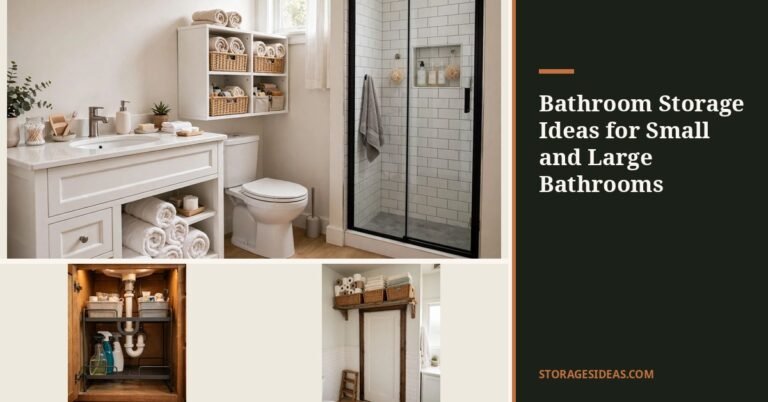
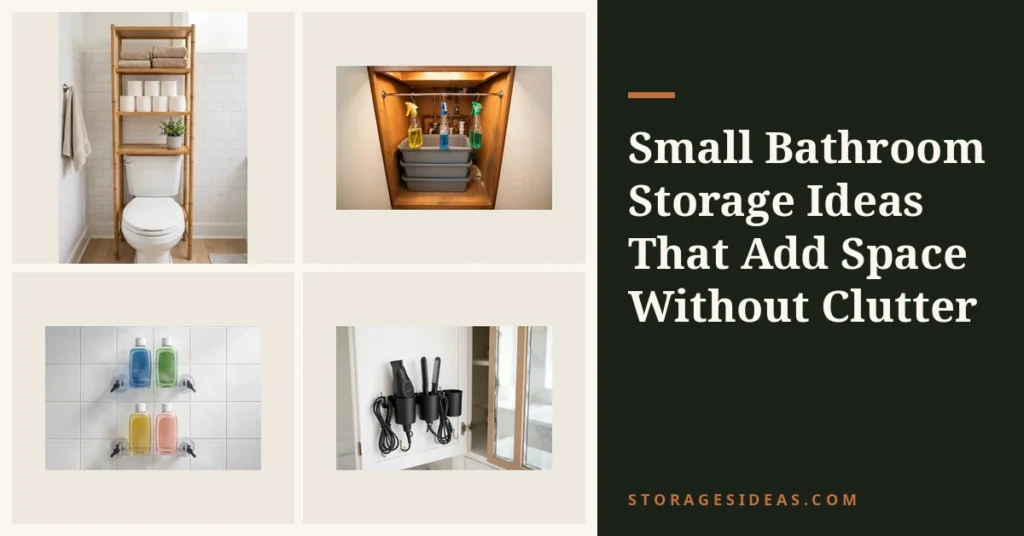
Six bottles crowd the sink edge, the towel lives on the floor, and there is nowhere to set down a contact lens case. If your mornings start with moving stuff before you can wash your face, your bathroom does not lack space. It lacks assigned places for things.
These 22 small bathroom storage ideas work in the bathroom you have, even a 40-square-foot box with a pedestal sink and a landlord who forbids drilling. Every idea below carries exact sizes, what it actually holds, a rough price band, and whether a renter can use it. Measure your gaps once, pick the zone that hurts most, and start there.
Why a Small Bathroom Feels Full Before It Is Full
A small bathroom fails differently than a small kitchen. Kitchens run out of shelf length; bathrooms run out of flat surfaces, because the room is mostly fixtures. Sink, toilet, tub, door: what is left is vertical air and dead corners nobody assigned a job.
That is why the same 35 square feet can feel either chaotic or calm. The fix is not buying more containers. It is putting storage where your hands already go: over the toilet you stand at twice a day, inside the cabinet door you open every morning, on the door that is currently a blank wall.
This list walks the room zone by zone: walls and above-toilet first, then the vanity and under-sink, then the shower and tub edge, and finally the door and dead-space zones. That order is deliberate. The wall zone alone usually frees up the counter, which solves half of most bathroom clutter problems before you touch a single cabinet.
1. Over-the-Toilet Tower: Turn the Dead Zone Above Your Tank Into a Full Closet
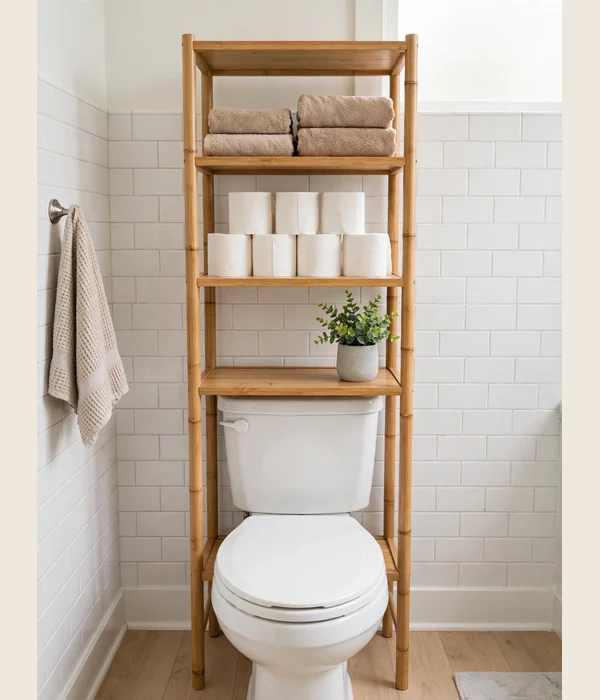
The wall above the toilet is the biggest unused rectangle in most small bathrooms. A freestanding tower, also sold as an etagere or space-saver, stands on two legs that flank the tank, so it borrows zero floor space you were actually using.
Standard units run 23 to 26 inches wide, 8 to 11 inches deep, and 60 to 68 inches tall. That clears a tank lid sitting about 28 to 30 inches off the floor. If you want the room-wide plan first, my bathroom storage ideas guide walks every zone of the bathroom in one place.
Where it works best:
- Spare toilet paper rolls, a stack of hand towels, and the cleaning spray, all in one column you can reach from the toilet or the sink.
- Open-shelf versions keep daily items visible; cabinet-door versions hide the plunger, the spare soap stash, and anything ugly.
- Bamboo or powder-coated steel survive bathroom humidity far better than raw MDF, which swells at the edges within a year.
- Most shelves hold 20 to 30 pounds each, so put the heavy bottles low and the pretty towels up top.
- Price band: under $40 for simple open shelves, $60 to $90 for cabinet-door versions with adjustable shelving.
Renter flag: fully freestanding, no screws. Many ship with an anti-tip strap; use a removable adhesive version or skip it if the unit is wide and stable.
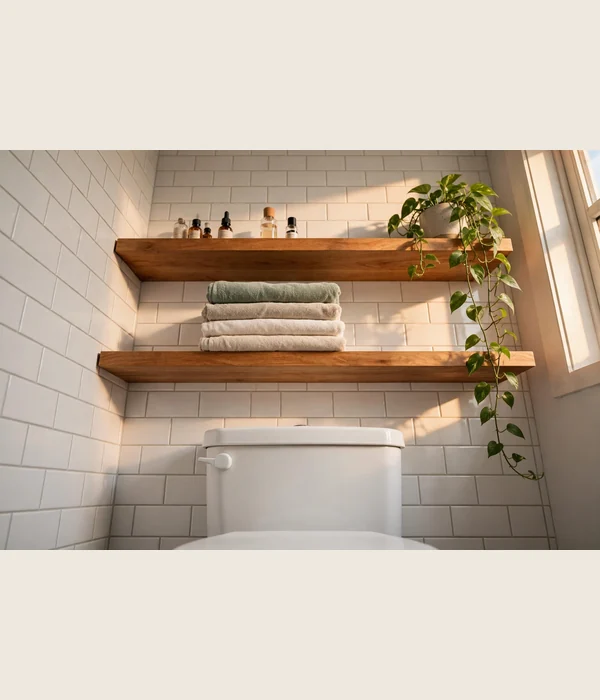
2. Floating Shelves Above the Toilet: Display and Stash in Six Inches of Depth
Two short boards above the toilet can hold as much as a tower if you pick the right depth. Six-inch-deep shelves clear the tank lid, keep bottles from wobbling into the flush handle, and look lighter than a full unit, which matters in a bathroom that is already visually tight.
Aim for boards 24 inches wide, which span the toilet and line up with most tanks. Space them 12 to 14 inches apart vertically: enough room for a stack of folded towels on the lower shelf and taller bottles below the upper one.
Wood with a sealed finish or metal brackets both survive humidity if you wipe them down now and then.
Tips for best results: Find a stud with a cheap stud finder before you drill; drywall anchors alone will sag under a shelf of full shampoo bottles within months. If your toilet sits against tile, use masonry drill bits and plastic anchors rated for tile, and keep the top shelf at eye level so you can read labels.
Watch out: This one needs screws, so it is not renter-friendly unless your lease allows small wall holes. If drilling is off the table, lean a narrow ladder shelf against the same wall instead, or use point 1’s freestanding tower.
3. Recessed Medicine Cabinet: Steal Three Inches of Wall Depth Nobody Notices
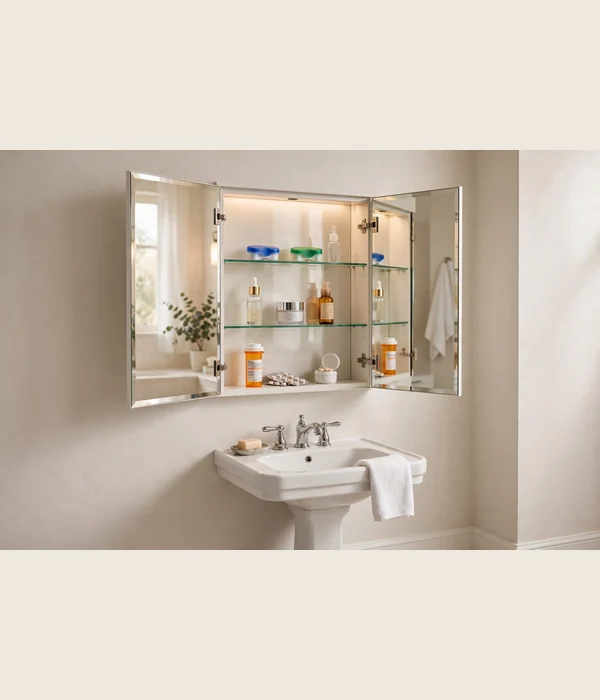
A recessed medicine cabinet gives you a mirror plus storage without pushing anything into the room. The standard size, 16 by 26 inches, fits between studs spaced 16 inches on center, and the box sinks 3 to 4 inches into the wall cavity.
That is a full shelf row for contact lens cases, medication, and the skincare bottles that currently own your counter.
Buy the cabinet before you cut anything. Open the wall, confirm there is no plumbing or wiring in the bay, then frame the opening. Most units come with a mounting template, and the whole job takes an afternoon if the wall is drywall.
What you can do with it:
- Store daily face and dental items behind glass shelves you can wipe clean; adjust the shelf pins to fit tall serum bottles.
- Choose a mirrored cabinet with a beveled edge if you want it to read as a design upgrade, not just storage.
- Interior depth of about 4 inches fits standard bottles but not bulk shampoo; reserve it for small things.
- Add a small battery puck light inside if the vanity lighting leaves the cabinet interior dark.
- Surface-mount versions exist at the same footprint if you cannot cut the wall, and they still look intentional.
This is a homeowner project, not a renter one: it needs wall cutting and screws into studs. Renters should look at point 4 instead.
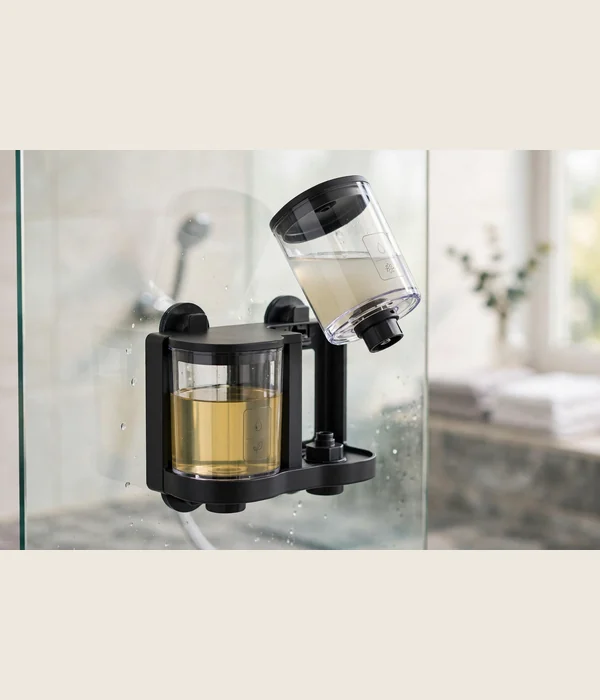
4. Wall-Mounted Dispensers: Get Three Bottles Off the Tub Edge for Good
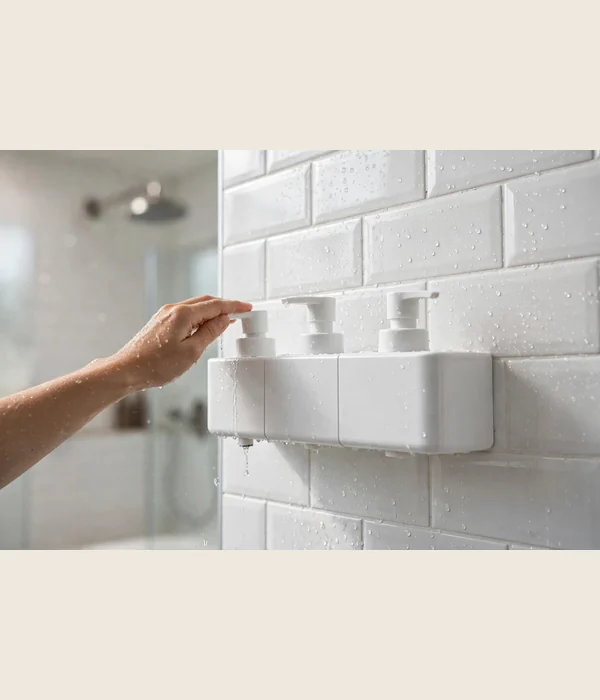
Every shower collects a lineup of half-used bottles, and every one of them eats the same 4 inches of tub edge. A wall-mounted dispenser set, usually two or three chambers of 12 to 16 ounces each, moves shampoo, conditioner, and body wash onto the wall in one unit about 4 inches wide and 10 inches tall.
The mechanism is simple: pumps meter a fixed dose, so you use less product per shower and the bottles stop migrating around the rim. Most sets mount with heavy-duty adhesive pads or a bracket that slides over glass, which makes them renter-friendly.
Tips for best results: Mount it at chest height in the shower, away from the direct blast of water, so soap does not dilute inside the chambers. Fill each chamber only three-quarters full so the pump primes cleanly. Clean the pump nozzles with hot water once a month; dried product is the only real failure point.
Watch out: Adhesive pads need a full 24-hour cure on a clean, dry surface before you load the bottles. Prep the tile or glass with rubbing alcohol first. Do not mount on textured or porous tile; the seal will fail within weeks.
5. Leaning Towel Ladder: Store and Display Towels With Zero Holes in the Wall
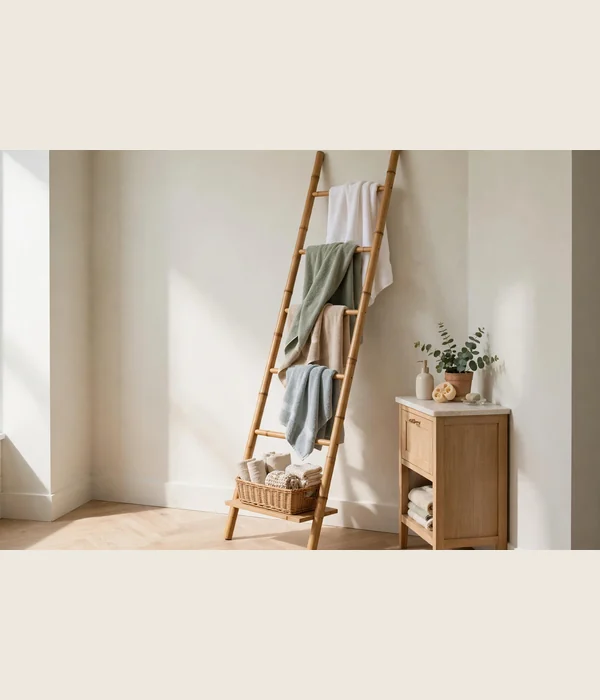
A leaning ladder is a towel rack, a shelf, and a decor piece in one, and it needs exactly zero fasteners. The standard size runs about 18 inches wide and 60 inches tall with four or five rungs, which holds four to six bath towels plus a hand towel draped over the top.
The trick is placement. It leans against any open wall, but it works hardest beside the vanity or at the foot of the tub, where wet towels can air-dry with airflow on both sides. Some versions add a small shelf board across two rungs for folded washcloths or a plant.
Where it works best:
- Bath towels you use daily, draped over separate rungs so they dry fully between showers.
- The top rung or a hooked basket for the hand towel guests actually use.
- A small tray on the shelf board for rolled washcloths, which reads tidy even when it is full.
- Spare rolls of toilet paper stacked on the lower shelf board, within reach of the toilet.
- Price band: under $30 for bamboo, $40 to $60 for metal with a shelf board.
- Rubber or silicone feet protect the floor and keep the ladder from sliding on tile.
Best for renters and anyone who rearranges furniture on a whim: pick it up and move it.
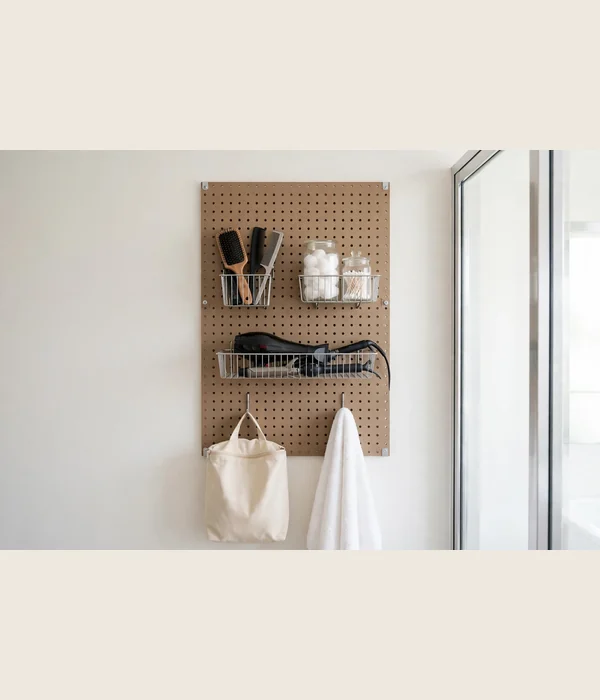
6. Pegboard Strip: Hang Baskets and Hooks Exactly Where You Reach
A pegboard strip above the toilet or beside the vanity turns blank wall into fully adjustable storage. A 24 by 12 inch panel with standard 1-inch hole spacing takes wire baskets, single hooks, and small shelves, and you rearrange them in seconds when your routine changes.
The mechanism is pure adjustability. Unlike fixed shelves, which lock you into one layout, pegboard lets a basket for hair tools become a hook for a wash bag next season. Small baskets hold about 2 pounds each; hooks hold 2 to 5 pounds depending on the mount.
Tips for best results: Buy a sealed or metal pegboard; raw hardboard softens in bathroom humidity within a year. Hang baskets with S-hooks rather than the stock pegs, which work loose when you yank a towel. Keep the heaviest items, like full bottles, at the bottom so the panel does not flex.
Watch out: The panel itself needs screws into a stud or hollow-wall anchors rated for the total load. On smooth tile, heavy-duty adhesive strips can hold a light load (under 5 pounds total) in a renter bathroom, but test for a week before trusting it.
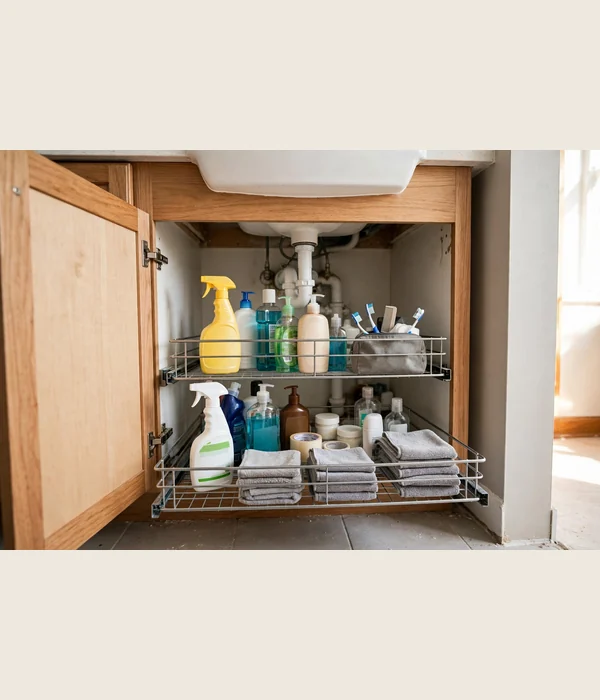
7. Sliding Under-Sink Drawers: Pull-Out Access Around the Pipes
The cabinet under the sink is the deepest storage in a small bathroom and the least used, because everything vanishes behind the pipes. Two-tier sliding organizers fix that: stacked pull-out drawers that glide forward so the back row comes to you.
Look for stackable units with adjustable height, roughly 11 to 14 inches tall and 8 to 12 inches wide, with a U-shaped cutout or offset column that clears the P-trap. If you want the deep dive on this zone, my under-sink bathroom storage covers every under-sink layout I have tested.
What you can do with it:
- Bottom tier for cleaning supplies and spare toilet paper; top tier for daily toiletries, so the most-used items sit at hand height.
- Measure the cabinet interior and the pipe position before buying; leave 3 to 4 inches of clearance around the trap.
- Choose drawers with a lip or rail on each tier so bottles do not slide off when you pull hard.
- Line each drawer with a wipe-clean mat, because under-sink leaks happen eventually.
- Price band: $15 to $25 for a two-tier set in plastic or wire; metal frames cost more and last longer.
- Skip this if your cabinet is under 10 inches wide inside; a single narrow caddy fits better.
Fully renter-friendly: it sits on the cabinet floor, no screws, no adhesive.
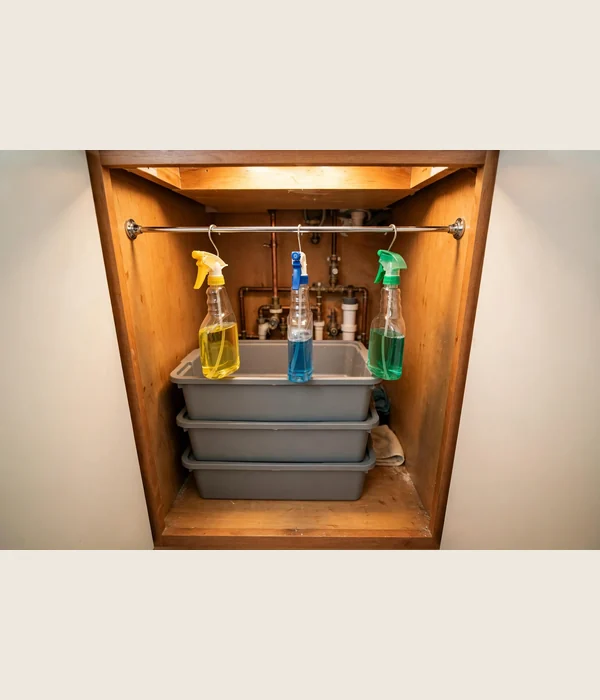
8. Under-Sink Tension Rod: Hang Spray Bottles on Dead Air
The vertical strip of air between the top of the cabinet and the pipes is wasted space in almost every under-sink cabinet. A spring tension rod spanning 15 to 28 inches turns it into a hanging rail for spray bottles, which you hook by their trigger handles.
This works because spray bottles are the tallest, most awkward items under a sink, and hanging them removes the whole category from the floor of the cabinet. That frees roughly a third of the footprint for bins and drawers. The rod itself costs under $10 and installs in seconds.
Tips for best results: Extend the rod until the spring is firmly compressed, then give it a hard tug to confirm the grip before loading. Hang only trigger-spray bottles, not screw-cap ones, which can crack under the load. Keep the total under about 5 pounds, since the rod holds by friction, not screws; if it slips after a week, wrap a rubber band around each end for extra friction.
Watch out: It needs two parallel walls or solid cabinet sides to grip. Open pedestal sinks have nowhere to mount one, so this idea is for vanity cabinets only.
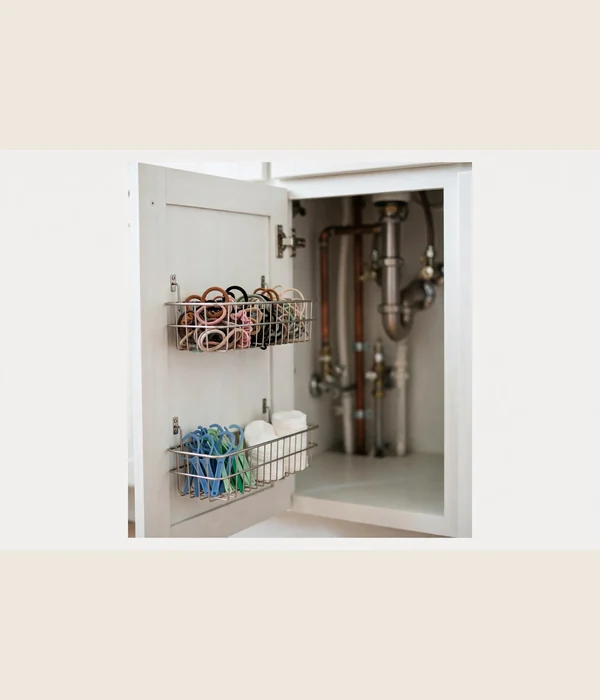
9. Cabinet-Door Baskets: Store on the Back of the Door You Open Daily
The inside of the under-sink cabinet door is a flat surface you touch every day and store nothing on. Slim wire baskets mounted there, about 4 inches deep and 8 to 10 inches wide, hold the small items that get lost in the cabinet: hair ties, floss picks, spare blades, cotton pads.
Mounting is either two small screws or heavy-duty adhesive strips, depending on how much you trust your door. Screws hold up to 5 pounds and survive years of door slams; adhesive holds about 2 pounds and suits renters.
What you can do with it:
- One basket for hair accessories, one for dental extras, labeled so everyone in the house returns things to the right spot.
- Check that the door still closes with the plumbing in place; swing the door shut slowly on the first test.
- Keep a finger of clearance between the basket and any shelf inside so nothing catches.
- Metal mesh baskets wipe clean; fabric ones stain from toothpaste and lotion within months.
- Price band: under $15 for a pair of wire baskets with hardware.
- If the door is hollow-core and thin, use adhesive rather than screws, which can poke through.
It is the smallest install in this list for one of the biggest daily payoffs.
10. Turntable Under the Sink: Spin to Reach the Back Row
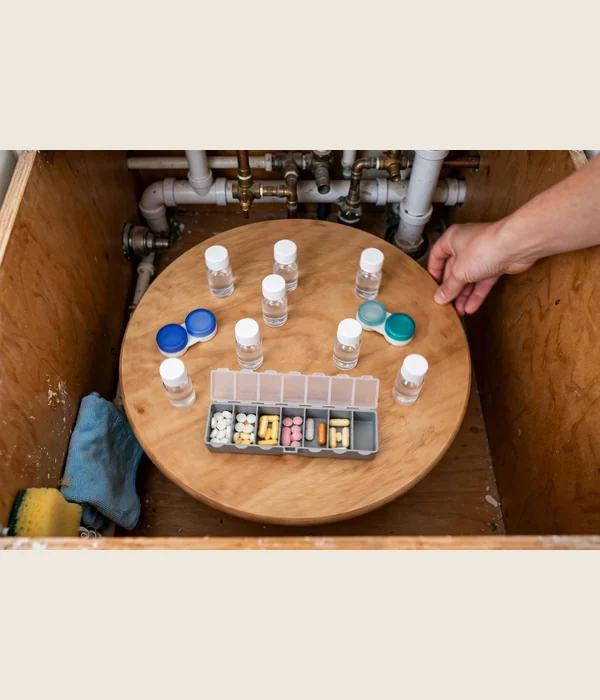
A lazy susan under the sink does the same job as a sliding drawer for about a third of the price. A 10 to 12 inch diameter turntable with a 1 to 2 inch lip spins the back row of bottles to the front with one hand.
That means the sunscreen and the spare contact solution actually get used instead of expiring in the dark.
The mechanism is reach, not volume. Deep under-sink cabinets fail because the back 8 inches are unreachable, so people keep buying duplicates, and one spin fixes that. It works best for short items, contact cases, pill organizers, sample bottles, because tall things topple on a spinning base.
Tips for best results: Measure the cabinet depth before buying; a 12-inch turntable needs a full 13 inches of clear depth to spin without catching the pipes. Put a non-slip liner under the bottles so they do not migrate to one side and jam the spin. Wipe the track monthly, since toothpaste grit is the main cause of sticky rotation.
Watch out: Do not use a turntable for glass bottles on a smooth base without the lip; one enthusiastic spin sends them flying. And skip this idea for very narrow cabinets under 11 inches deep, where nothing can spin at all.
11. Two-Tier Countertop Tray: Corral the Daily Lineup in One Corner
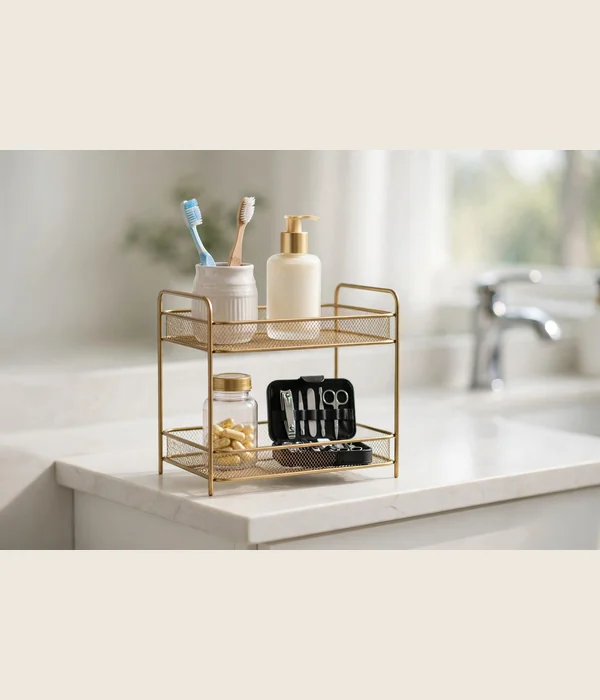
The real reason counters look cluttered is not the number of items, it is the sprawl. A two-tier tray with a 10 to 12 inch bottom tier and an 8 inch top tier gathers your daily lineup, the moisturizer, the toothbrush holder, the vitamins, into one defined footprint in a single corner of the vanity.
Because the footprint stays fixed, the counter reads tidy even when the tray is full. Vertical stacking doubles capacity in the same square inches: the tall bottles go on top, the short daily items below. If the whole room feels chaotic, my bathroom organization ideas post has the full routine that pairs with this.
What you can do with it:
- Daily skincare and toothbrush on the top tier where your hands land; backup bottles and the nail kit below.
- Choose metal or sealed wood over raw bamboo, which warps near a wet sink within a year.
- Keep the tray at least 2 inches from the faucet so splashes do not pool underneath.
- Wipe the tiers weekly; toothpaste and serum drips harden into concrete if ignored.
- Price band: $12 to $25 for metal or ceramic; avoid painted wood, which chips.
- If your counter is under 16 inches deep, pick a single-tier tray instead so it does not crowd the faucet.
No install, no commitment, and it survives every renter lease ever written.
12. Slim Rolling Gap Cart: Fill the Six-Inch Gap Beside Your Vanity
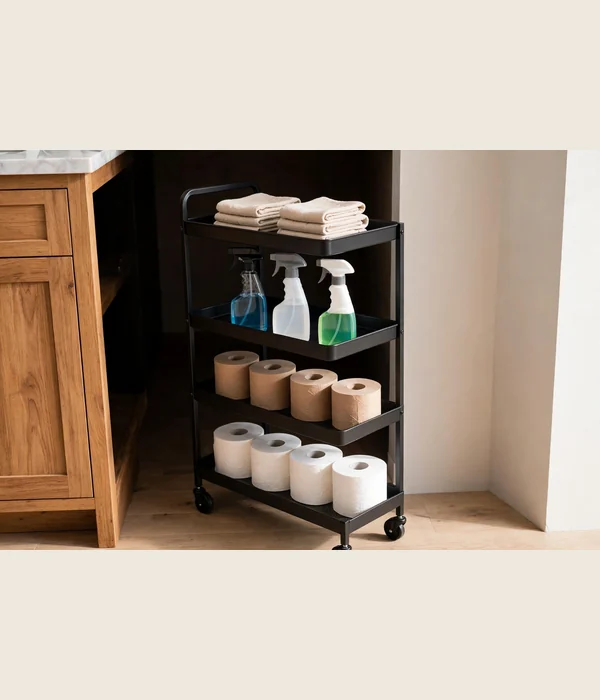
Almost every small bathroom has a dead gap: between the vanity and the wall, the toilet and the tub, the sink and the door. A slim rolling cart, typically 5 to 7 inches wide, 15 to 17 inches deep, and 26 to 32 inches tall with three or four tiers, slides into that gap and turns it into pull-out shelving.
This works because the gap was never usable floor space; you could not stand in it or clean it. The cart converts it into storage you can roll out, grab from, and roll back in one motion. Each tier holds roughly 5 to 8 pounds in the plastic versions, more in metal-framed ones.
Tips for best results: Measure the gap at the floor, the middle, and the wall, then subtract half an inch for clearance; gaps are rarely perfectly straight. Choose mesh or open-grid tiers so water does not pool in a humid bathroom. Lock at least one caster if the cart sits near a doorway, so it does not drift into traffic.
Watch out: Cheap plastic carts get wobbly above three tiers when fully loaded; keep heavy bottles on the bottom tier. And if your gap is under 5 inches wide, no standard cart fits; try a flat rolling under-bed-style bin instead.
13. Sink Skirt: Hide Clutter Behind a Curtain and Stack Bins Behind It
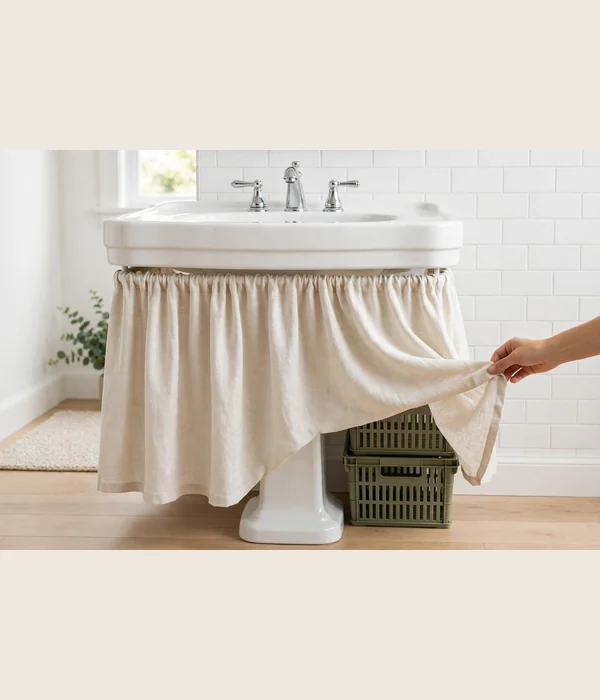
A pedestal sink or exposed-pipe vanity has zero storage underneath, which is where a sink skirt earns its place. A tension rod mounted under the basin rim plus a washable fabric panel hides the whole under-sink zone, and behind the curtain you stack labeled bins like any other cabinet.
The mechanism is concealment plus access. The curtain hides visual clutter, which is half of what makes a small bathroom feel cramped, while the bins behind it give you the equivalent of a 20-inch-wide cabinet. Choose a machine-washable cotton or linen-blend panel; it will need washing every few months.
What you can do with it:
- Two stackable bins behind the curtain for cleaning supplies and paper goods, labeled so guests do not have to ask.
- A small tension rod or adhesive rail inside holds the current cleaning spray at hand height.
- Pick a light fabric; dark skirts make the under-sink zone read as a hole in the room.
- Hem the panel so it clears the floor by about an inch; fabric that drags gets damp and grimy.
- Price band: under $20 for the rod and a ready-made panel; custom panels cost more.
- Fully renter-friendly, and it removes in under five minutes at move-out.
One caution: keep the bins shallow enough that the curtain hangs straight, or the whole thing looks lumpy.
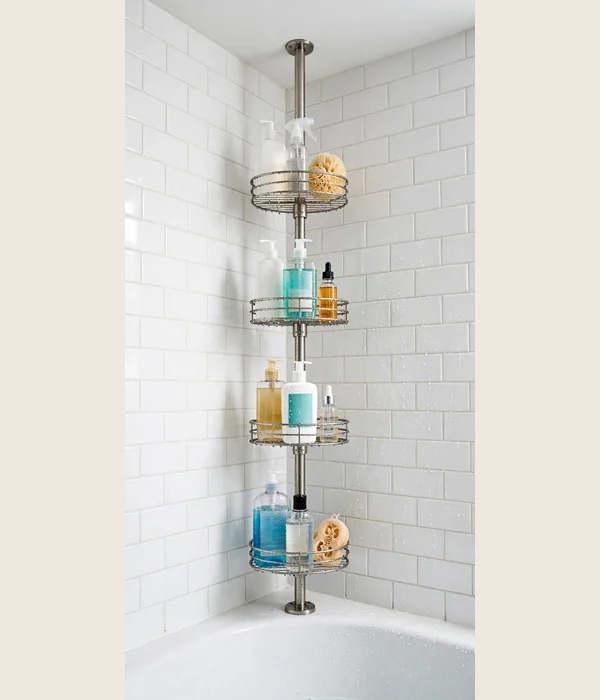
14. Floor-to-Ceiling Tension Caddy: Four Shelves of Shower Storage, No Drill
The corner of the shower is dead space by design; water runs off it and nobody stands in it. A floor-to-ceiling tension pole caddy turns that corner into four adjustable shelves, roughly 12 to 18 inches wide across the corner with shelves 4 to 6 inches deep, holding every bottle the whole household uses.
Standard poles adjust from about 60 to 97 inches, which covers nearly every shower and tub enclosure. Total load is usually around 20 pounds across all shelves, so put the heavy liters on the lowest shelf. Stainless steel poles and solid plastic shelves are the rust-proof combination; coated wire eventually chips.
Tips for best results: Measure floor to ceiling first, then pick the pole sections that land in the middle of the adjustment range; running a pole at maximum extension makes it wobblier. Twist to tension in small increments and shake the pole hard before loading. Position the pole in the corner farthest from the showerhead so bottles are not sitting in the direct stream.
Watch out: It needs a flat ceiling and a flat floor. Sloped ceilings, drop ceilings, and soft vinyl floors will not hold tension safely. Check the pole every few months; humidity loosens the grip over time.
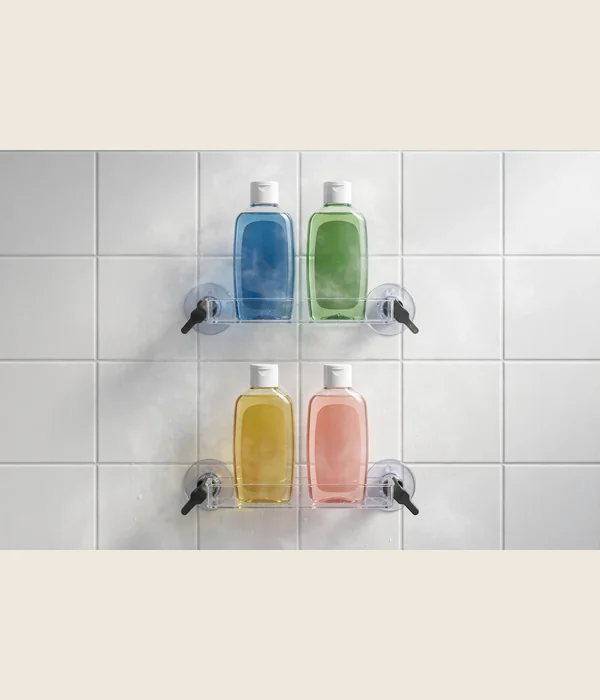
15. Suction Shower Shelves: Glossy Tile Becomes a Shelf in Ten Seconds
If your shower walls are glossy tile or glass, suction shelves turn them into storage with zero tools and zero damage. A typical shelf is 10 to 12 inches wide and 4 inches deep, held by two or three locking suction cups rated for 5 to 11 pounds each on a clean, smooth surface.
The mechanism is vacuum, not glue, which is why placement matters more than the brand. Press each cup onto glossy tile, flip the locking lever, and the seal holds until you release it. That makes them the fastest install in this list: ten seconds per shelf.
What you can do with it:
- One shelf per person at their own height, which ends the shared-bottle wars in a family shower.
- A corner shelf plus a straight shelf gives you the same capacity as a hanging caddy with a cleaner look.
- Rinse under the cups monthly; soap scum breaks the seal slowly and silently.
- Re-seat any shelf that starts to slide before it fails; a loaded shelf falling at 6 a.m. is memorable.
- Price band: $10 to $20 per shelf; buy the locking-lever style, not the push-on kind.
- They only work on smooth, non-porous surfaces: no textured tile, no grout lines, no natural stone.
Perfect for renters and anyone who wants storage today, not this weekend.
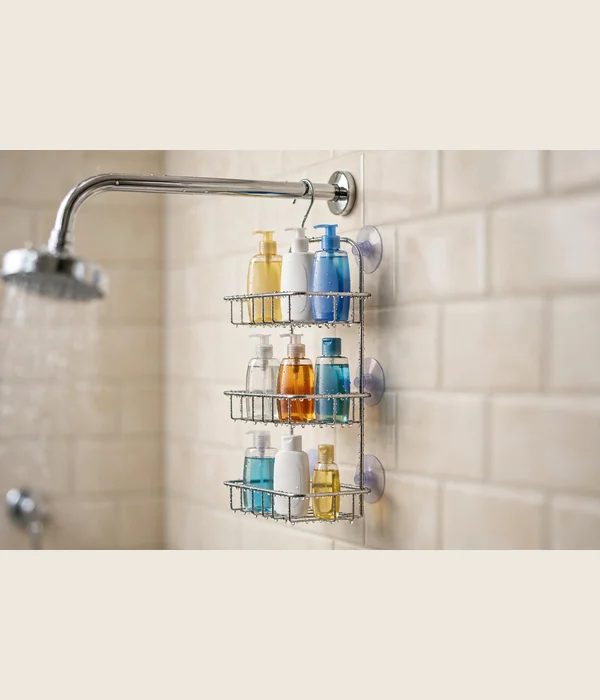
16. Over-the-Shower-Head Caddy: Use the Pipe You Already Own
The showerhead pipe is a load-bearing hook hiding in plain sight. A wire caddy with two hooks slides over the pipe and hangs in the water stream’s dead zone, giving you two or three shelves for the daily bottles without touching a wall or the floor.
Standard caddies fit pipes up to about 1.5 inches in diameter, which covers nearly every residential shower arm. Look for a rust-proof finish, stainless or powder-coated steel, because this item lives in constant spray. Suction stabilizers on the back keep it from swinging when you grab a bottle one-handed.
Tips for best results: Hang it on the pipe arm, not the showerhead itself, so the weight does not stress the head’s joint. Keep the total under about 8 pounds; overloaded caddies tilt and dump bottles into the tub. Rinse it weekly to stop soap film from gluing bottles to the wire.
Watch out: This caddy lives directly in the water stream, so bottles get wet and drippy every shower; wipe them before they go back on a dry shelf. It does not suit handheld showerheads on sliding bars, where the hook has nothing to grab.
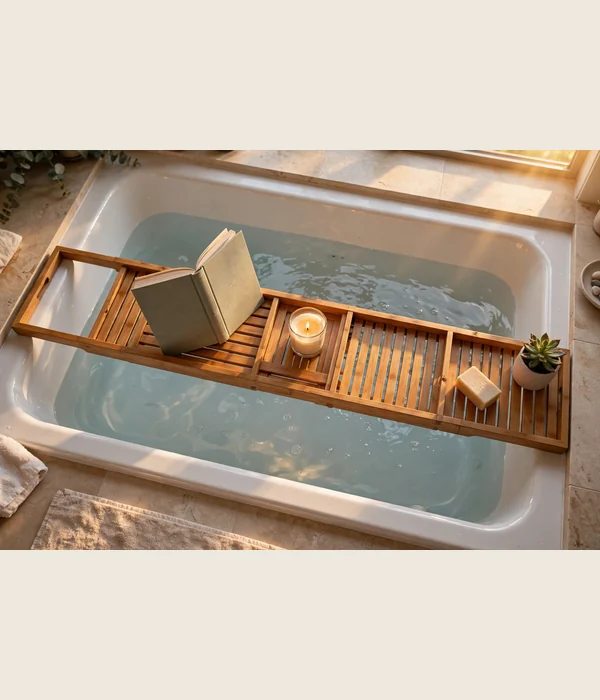
17. Expandable Bath Tray: A Shelf Across the Tub You Can Read On
A bath tray is a shelf, a bookstand, and a candle holder that spans the tub. Expandable bamboo trays adjust from about 29 to 43 inches, which covers standard tub widths, and the slats keep water draining instead of pooling under your things.
The mechanism is access without reaching. Everything you want during a bath, the book, the soap, the phone on its stand, sits at arm’s length instead of on the cold tub rim where it slides.
Many trays include a book rest groove and a wine glass slot, which are the difference between a tray you use and one that lives in a closet.
What you can do with it:
- Reading material propped in the groove, a candle in a stable holder, and soap on the slatted end away from the splash zone.
- Choose bamboo with a sealed finish over raw wood; raw bamboo molds in a steamy bathroom within months.
- Dry the tray standing on edge after each bath so both faces air out.
- Price band: $20 to $35; the metal-handle versions grip the tub rim better.
- It doubles as a shelf for shaving supplies during a standing shower if your tub has a wide rim.
- Measure your tub’s outer width before buying; deep soaking tubs can exceed 43 inches.
If you do not take baths, skip this one. It is a luxury, and this list has plenty of workhorses.
18. Two-Chamber Shower Dispensers: Pump, Don’t Juggle
Point 4 put dispensers on the wall; this one is the shower-specific version with two chambers and a waterproof seal. Two 12 to 16 ounce chambers hold shampoo and body wash, or his-and-hers product pairs, in a unit about 8 inches tall that mounts with adhesive or a bracket.
The payoff is fewer bottles in the wet zone. Two chambers replace four to six bottles, and pumps give a consistent dose, so product lasts noticeably longer. The chambers lift off for refilling at the sink, which is far easier than pouring shampoo into a wall-mounted unit with wet hands.
Tips for best results: Label each chamber with the waterproof stickers most sets include; identical pumps of shampoo and body wash cause unpleasant surprises. Mount at shoulder height inside the shower so the pumps are easy to press with soapy hands. Refill over the sink, not in the shower, to avoid spills down the drain.
Watch out: The adhesive needs its full 24-hour cure before you hang the loaded chambers. Check that the lid gaskets seat properly after each refill; a loose gasket lets shower water dilute the product, which is the most common complaint.
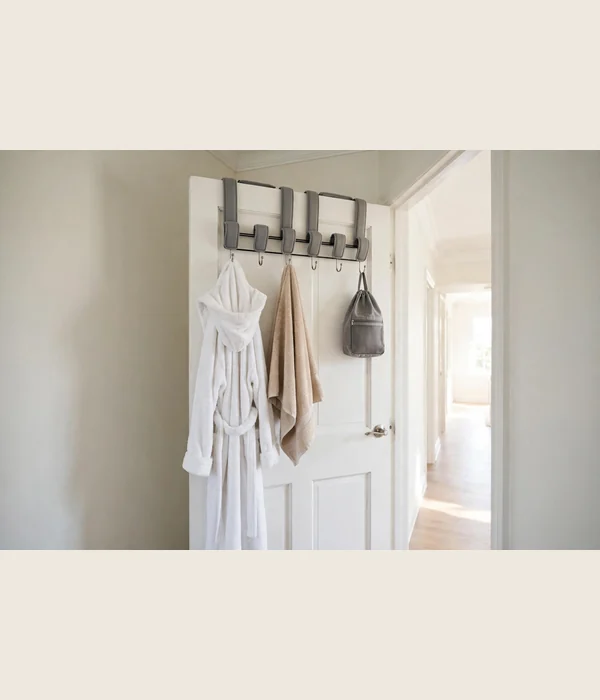
19. Over-the-Door Hook Rack: Six Hooks, Zero Screws
The back of the bathroom door is roughly 20 square feet of unused vertical space. An over-the-door hook rack with five or six hooks, sized for standard 1.75-inch interior doors (many fit up to 2 inches), hangs in seconds and holds robes, towels, and the tomorrow outfit.
The mechanism is pure convenience: the door is the last surface you touch leaving the bathroom, so it is the natural home for the robe and the towel you will need next. Foam or felt backing on the brackets protects the door finish, which matters for renters guarding a deposit.
What you can do with it:
- Top hooks for the bathrobe and the towel currently in use; lower hooks for wash bags and a hairdryer hung by its loop.
- Total load is usually around 15 pounds; spread heavy items across the brackets, not all on one hook.
- Check that the door still latches; thick brackets can stop a door from closing on tight frames.
- Choose flat-profile hooks over ball ends in a narrow bathroom, so nothing snags your shoulder in the doorway.
- Price band: under $20 for metal; wood-and-metal versions run $25 to $35.
- If the door swings against a wall, mount the rack on the hallway side or switch to adhesive wall hooks.
Zero tools, zero holes, and it moves with you to the next apartment.
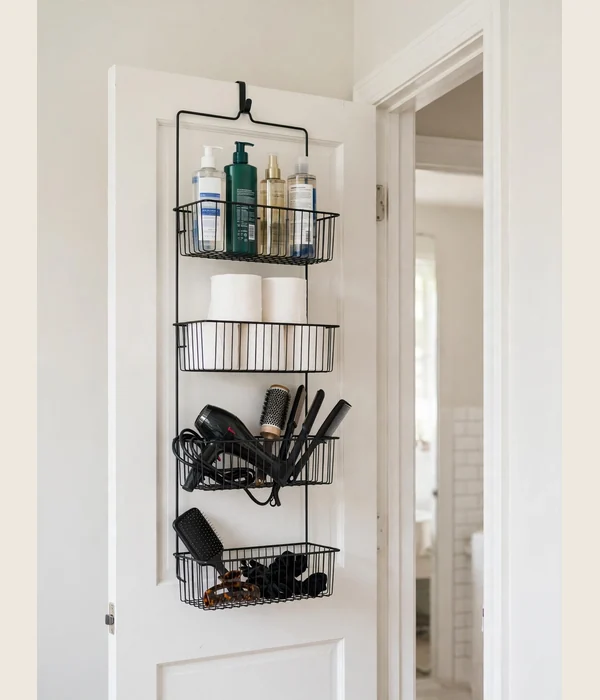
20. Behind-the-Door Wire Rack: A Pantry Shelf for the Bathroom Door
If hooks are not enough, a wire rack that hangs over the door gives you actual shelves: usually three to five baskets, 4 to 6 inches deep, running the height of the door. That is the equivalent of a small pantry shelf for tall bottles, spare toilet paper, and the hair tools that never fit in a drawer.
It hangs the same way as a hook rack, over the door on padded brackets, so it is fully renter-friendly. The baskets keep small items visible, which means things get used instead of expiring. Check the swing clearance: the door needs the basket depth plus a finger of room behind it when it opens.
Tips for best results: Put the heaviest items, full bottles and spare rolls, in the lowest basket to keep the rack stable. Use the top basket for light things like washcloths; weight up high makes the door harder to swing. Line wire baskets with small trays if you store tiny items like bobby pins, which fall through the mesh.
Watch out: Measure the gap between the door and the wall or fixture behind it; less than 7 inches of clearance and the baskets will jam. Hollow-core doors can flex under a fully loaded rack, so keep the total under 20 pounds.
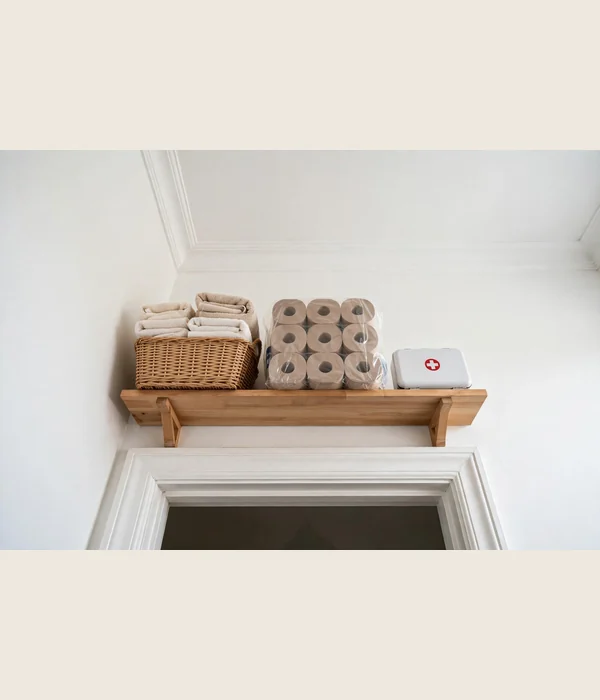
21. Above-the-Door Shelf: The Forgotten Strip Over the Frame
Look up: the strip of wall above the door frame is about 24 to 30 inches wide and 6 to 8 inches deep, and it holds nothing in almost every bathroom. A single shelf there stores the things you need rarely but want close: spare towels, the bulk toilet paper pack, the first-aid kit.
Because it is above eye level, it never adds visual clutter, which is exactly why this zone suits ugly-but-necessary items. Keep the weight under 15 pounds; heavy items up high are a hazard.
One more thing before we leave the door zone: if you only buy one thing from all 22 ideas, make it the gap cart in point 12. It is the pick I will defend in the Conclusion, and it solves more daily friction than anything else here.
What you can do with it:
- Spare hand towels and washcloths in a basket so they look intentional, not stashed.
- The bulk toilet paper pack, which frees a full shelf elsewhere in the room.
- The first-aid kit and the spare light bulbs, the things you hunt for twice a year.
- Price band: under $25 for a board and brackets; floating versions run $30 to $45.
- Needs screws into the frame or studs, so confirm it is allowed if you rent.
Confirm the shelf clears the door’s swing arc with room to spare before you load it.
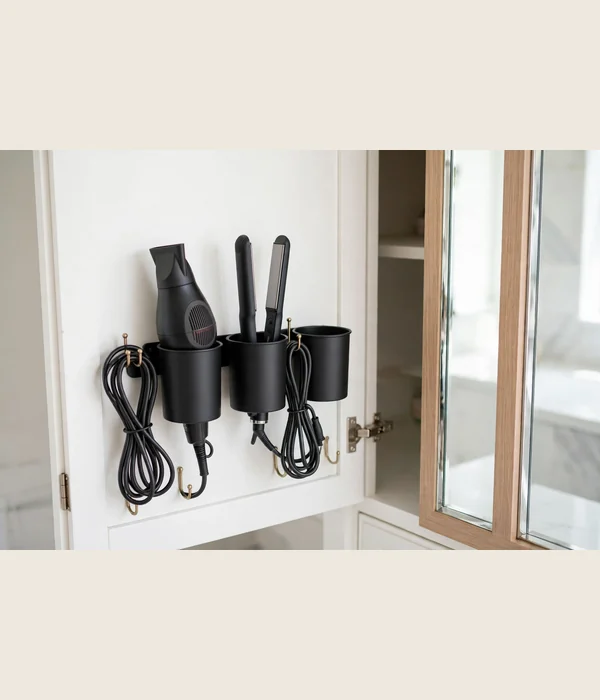
22. Wall-Mounted Styling-Tool Holder: Get the Dryer Out of the Drawer
The hairdryer, straightener, and curling iron are the bulkiest items in a bathroom drawer, and they eat the drawer you need for everything else. A wall-mounted holder, usually three cups or sleeves about 4 to 5 inches across plus a cord wrap, moves the whole styling kit onto the wall or inside the cabinet door.
The mechanism is heat-safe separation. The cups are ventilated or heat-resistant, so you can dock a warm straightener without melting anything, and the cords wrap on hooks instead of tangling with your toothbrush. Mount it inside the vanity cabinet door for a hidden setup, or on the wall beside the mirror for grab-and-go mornings.
Tips for best results: Inside-the-door mounting keeps counters clear and is the tidier look; just confirm the door closes with the tools docked. If you wall-mount, place it within arm’s reach of an outlet so the cord is not stretched across the sink. Let tools cool for a minute before docking if the holder is plastic rather than metal.
Watch out: Adhesive versions hold about 3 to 5 pounds, which suits one dryer; a full three-tool kit needs screws. Never mount it where a cord could drape into the sink basin; that is a real electrical hazard, not a theoretical one.
Conclusion
Twenty-two ideas is a lot, and nobody needs all of them. Here is how I would actually do it: start with the walls and above-toilet zone, because clearing the counter changes how the whole room feels. Then fix the under-sink, where the duplicates and expired bottles live; the shower and door zones can wait for a second weekend.
Start here: the slim rolling gap cart from point 12. If I could only keep one thing from this list, it would be that cart. It costs less than a dinner out, needs no tools, and fits the gap you have been ignoring for years.
You will use it every single day. Measure the gap, subtract half an inch, and order it tonight. Everything else on this list is optimization; the cart is the transformation.
For the room-wide plan that ties these zones together, the bathroom storage ideas guide maps the full bathroom, and the bathroom organization ideas post has the daily routine that keeps it all working.
Frequently Asked Questions (FAQ)
Can I add storage to a small bathroom without drilling anything?
Yes, most of this list is drill-free. Freestanding over-the-toilet towers, leaning towel ladders, suction shower shelves, tension pole caddies, over-the-door racks, and rolling gap carts need zero holes. If your lease is strict, stick to those and skip the floating shelves, recessed cabinet, and pegboard, which need screws or wall cutting.
What actually fits in a 6-inch gap beside the vanity?
A slim rolling cart, typically 5 to 7 inches wide with three or four tiers, is made for exactly this gap. Each tier holds toilet paper rolls, cleaning spray, spare soap, or a stack of washcloths.
Measure the gap at three points and subtract half an inch for clearance, because gaps are rarely straight. Keep heavy bottles on the bottom tier.
Do suction-cup shower shelves really hold heavy shampoo bottles?
They hold if the surface is right and the load is reasonable. On clean, glossy tile or glass, locking-lever cups hold 5 to 11 pounds per shelf, which covers two or three full-size bottles. They fail on textured tile, grout lines, or stone, so rinse under the cups monthly; soap scum quietly breaks the seal.
How much weight can an over-the-toilet shelf unit hold?
Most freestanding towers hold 20 to 30 pounds per shelf, with a total capacity around 60 to 80 pounds across the unit. That covers towels, toilet paper, and everyday toiletries easily. Put the heaviest items on the lowest shelf for stability, and if the unit feels wobbly, use the included anti-tip hardware or an adhesive strap version.
Where do I put towels in a small bathroom with no linen closet?
These small bathroom storage ideas give you three good options. A leaning ladder by the vanity holds four to six bath towels with zero holes in the wall. An over-the-door rack handles the robe and the towel in use.
An above-the-door shelf stores the spare stack you reach for weekly. Together they replace a linen closet in most small bathrooms.
How do I organize under a pedestal sink with no cabinet?
Use a sink skirt: a tension rod under the basin rim plus a washable fabric panel hides the zone, and stackable bins behind the curtain give you cabinet-equivalent storage. Two bins usually do it, one for cleaning supplies and one for paper goods.
Keep the panel hemmed an inch off the floor so it stays dry, and the whole setup removes in minutes.