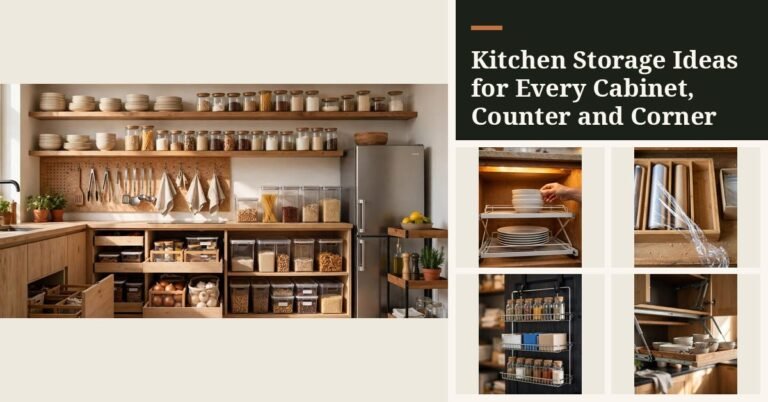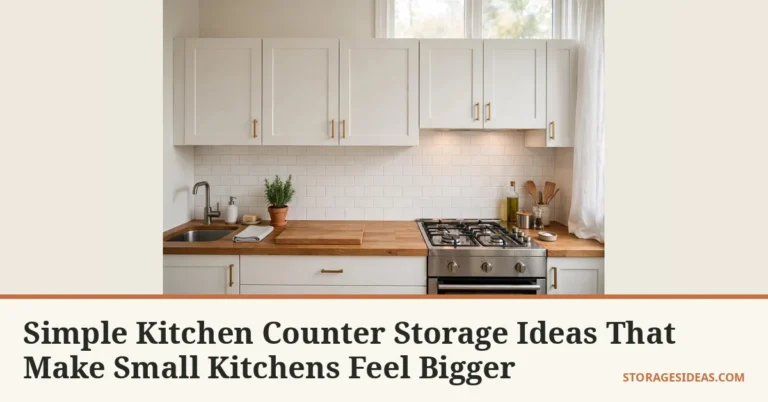
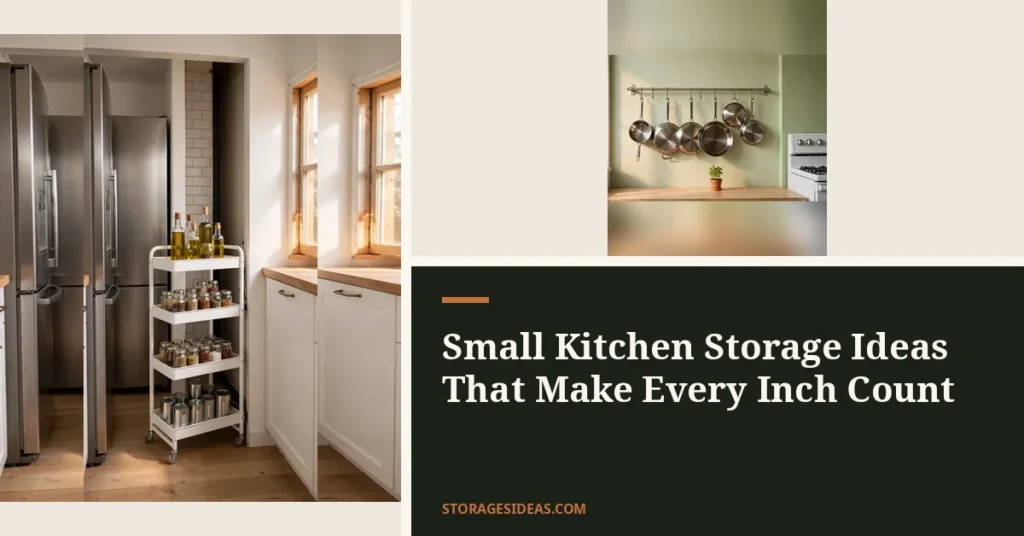
The smartest small kitchen storage ideas don’t start with buying organizers, they start with a tape measure. Most small kitchens fail in the same dead zones: the gap beside the fridge, the backs of cabinet doors, the toe-kick void under base cabinets, and the cabinet above the fridge that everyone ignores.
Measure those zones before you buy anything, and you’ll stop returning organizers that don’t fit.
Why Small Kitchen Storage Ideas Start With the Tape Measure
Small kitchens don’t fail for lack of organizers. They fail because storage gets crammed into cabinet boxes while the dead zones go unused: the six-inch gap beside the fridge, the inside faces of cabinet doors, the 3.5-inch toe-kick recess, and the cabinet above the fridge.
A forty-dollar organizer that fits beats a ninety-dollar system that doesn’t clear the door swing. Measure first, buy once, and spend on exact-fit solutions instead of more bins.
The 5-measurement cheat sheet (take these before ordering anything):
- Cabinet interiors: width, depth, and shelf height, risers and baskets need 10+ inches of vertical clearance
- Fridge-side gap: width at top, middle, and bottom (gaps taper), plus depth to the wall
- Under-sink pipes: clearance from pipe fronts to the door, and your tallest spray bottle
- Counter depth: standard counters run 24 inches deep, over-sink organizers size off this
- Above-fridge cabinet: full depth (usually 24 inches) and interior height, this sets your bin size
1. Slim Rolling Gap Cart: the secret six inches beside your fridge
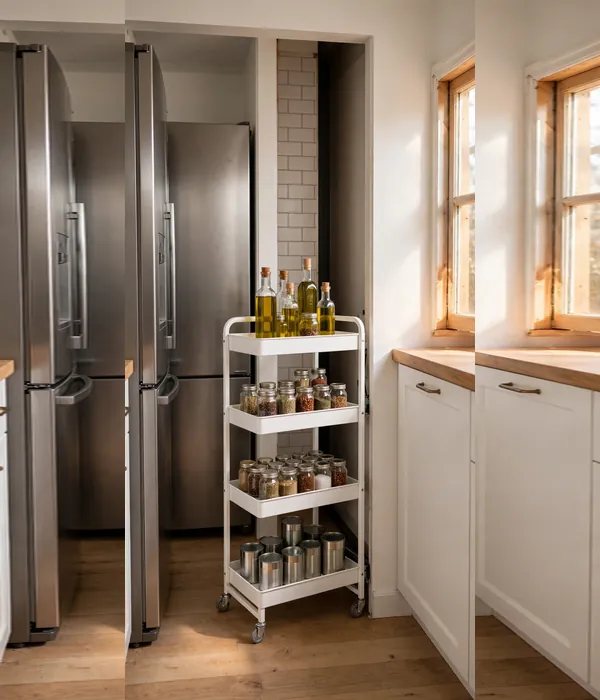
Almost every kitchen has a dead gap, between the fridge and the counter, or between the stove and the wall, usually five to eight inches wide and the full depth of the appliance. A slim rolling cart turns it into three or four tiers of storage on casters.
Oils and spices live up top where you grab them; cans and tall bottles below. Because the cart rolls out to you, nothing hides in a dark back corner the way it does on a fixed shelf. Keep heavy items low, a loaded top tier on a tall, narrow cart is a tip risk.
Where it works best:
- The fridge-to-counter gap, the classic five-to-seven-inch slot for oils, foil, and cans
- Beside the stove, at least two inches off the heat, holds cooking sprays and spice jars
- The dishwasher-side gap, detergent and rinse aid within arm’s reach
- Renters: zero screws, zero holes, it rolls out for cleaning and moves with you
- The pantry-adjacent gap, overflow cans and backstock live here instead of the counter
2. Over-Sink Dish Rack: a drying rack that never touches the counter
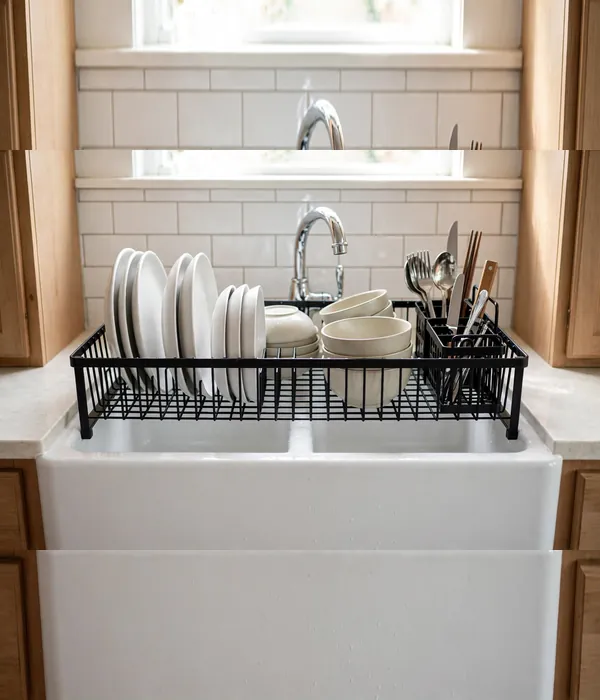
A rack that spans the sink, 24 to 36 inches wide over a standard single or double bowl, drains straight into the basin. It returns four to six square feet of counter to prep work, permanently. In a kitchen under 100 square feet, a traditional rack can eat a tenth of your counter every day.
The mechanism is borrowed airspace: the sink already occupies the width, and the air above it was doing nothing. Framed racks hold plates and a utensil caddy; roll-up versions fold away when you need the full sink. Check faucet clearance first, tall arc faucets need six inches of open space at the mount point.
Tips for best results: Measure the sink’s outer width and buy one inch wider, so rails rest on the counter lip. Choose rust-proof coated steel, painted wire rusts within a year over a steamy sink.
Watch out: Tall plate stacks can drip down your back while you wash. Renters: fully renter-safe, it rests on the counter, no screws. Test-fit with cardboard if your faucet tops 15 inches.
3. Magnetic Knife Strip: sixteen inches of wall that replaces the knife block
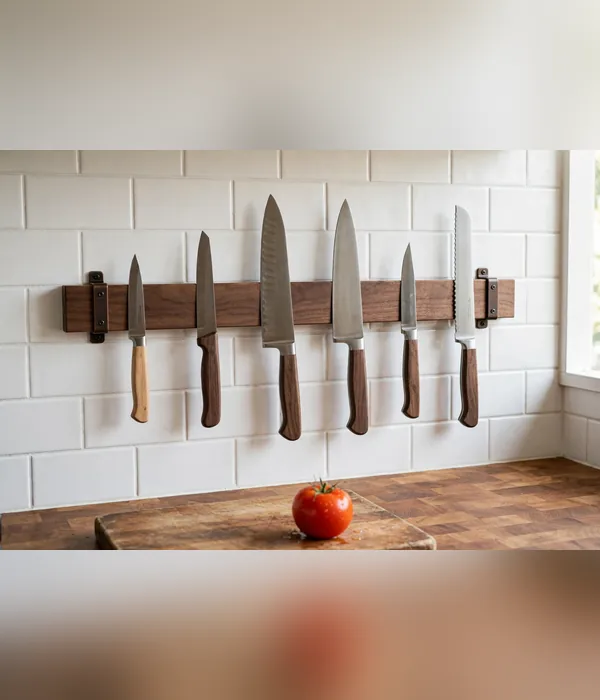
A knife block eats six to eight inches of counter depth, and a drawer of loose knives eats a whole drawer, and your nerves. A 12 to 18-inch magnetic strip on the wall holds six to ten knives in zero counter space, every blade visible and nothing dulling in a slot.
The mechanism is vertical wall volume: 16 to 18 inches of backsplash above the counter, prime real estate that tile was holding for nothing. Choose a continuous magnetic face rather than hidden pucks, full-face contact holds chef’s knives without the slow slide. Mount 16 to 18 inches above the counter: out of small kids’ reach, inside your grab arc.
Where it works best:
- Beside your main cutting zone, one hand grabs, the other is already chopping
- On the side of a tall pantry cabinet when backsplash space is tiled floor-to-cabinet
- Renters: screw-free adhesive strips rated 10+ lbs exist, limit them to five or six knives
- Degrease tile with rubbing alcohol first, and check the bond monthly
4. Inside-Cabinet-Door Racks: the spice rack hiding in the door you already open
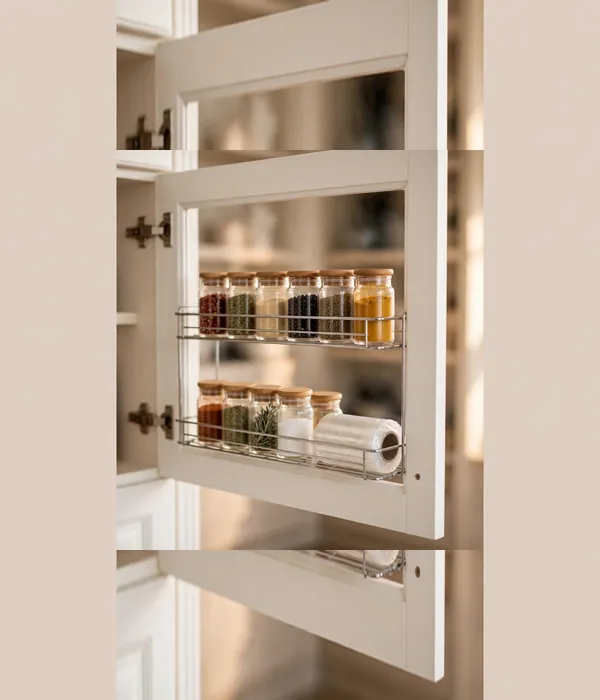
Cabinet doors are 3/4-inch panels with nothing behind them but air. The inside face of a standard 24-inch upper door can carry a two-to-three-tier rack, two to four inches deep, holding the spices, wraps, and lids that were stacked three deep on a shelf, invisible and unreachable.
The mechanism is door-swing space you already paid for. The rack swings with the door, so items ride out to you instead of hiding at the back of a 12-inch-deep cabinet. Single-row racks keep jars one-deep, which kills the “three jars of cumin” problem, buy racks sized for standard 2 to 2.5-inch spice jars.
Tips for best results: Weigh a full rack before mounting, a loaded two-tier rack runs five to eight pounds, which most hinges handle but sagging old hinges won’t. Use short screws into the door’s inner panel, never through the finished face.
Watch out: Fix squeaky hinges first, added weight finds every weakness. Skip doors under microwaves or range hoods, where heat bakes spices into flavorless dust.
5. Pull-Down Cabinet Shelves: the top shelf, brought to your hands
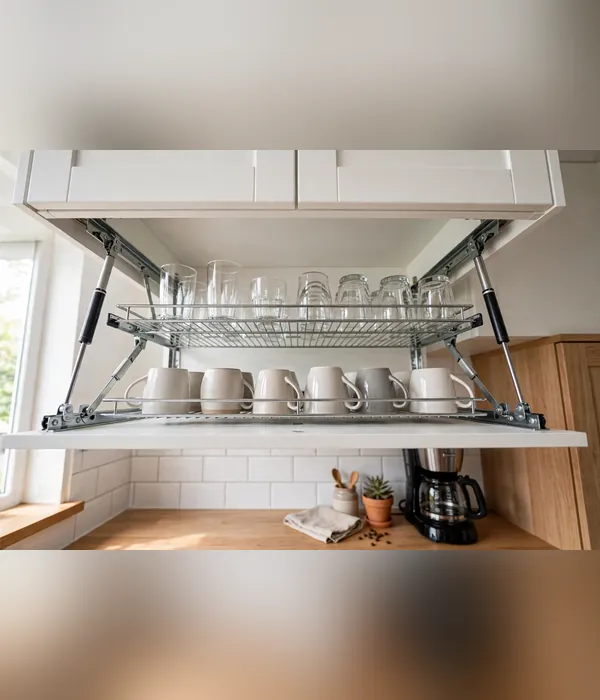
The top shelf of a 24-inch upper cabinet sits 60-plus inches off the floor, reachable only by climbing, which means it stores whatever you gave up on. A pull-down retrofit kit bolts inside on gas-assisted arms: pull the handle and both tiers swing down to counter height, where you can actually see the glasses.
The mechanism is a hinge path that converts height into reach. Good kits move with one hand; gas struts control the descent so a shelf of plates doesn’t come down fast. Most units rate 15 to 30 pounds per shelf, fine for glassware and dry goods, not cast iron, and the 24-inch kit needs a 21-inch-minimum cabinet opening.
Where it works best:
- The dead upper over the coffee station, daily mugs, zero climbing
- Short cooks’ kitchens, where the top two shelves were decorative anyway
- Above a true storage cabinet, not over the microwave or range hood
- Owners only, screws into the cabinet box, so not renter-safe
- Whatever still can’t reach goes up top in bins instead (point 18)
6. Toe-Kick Drawers: 3.5 inches of floor-level storage
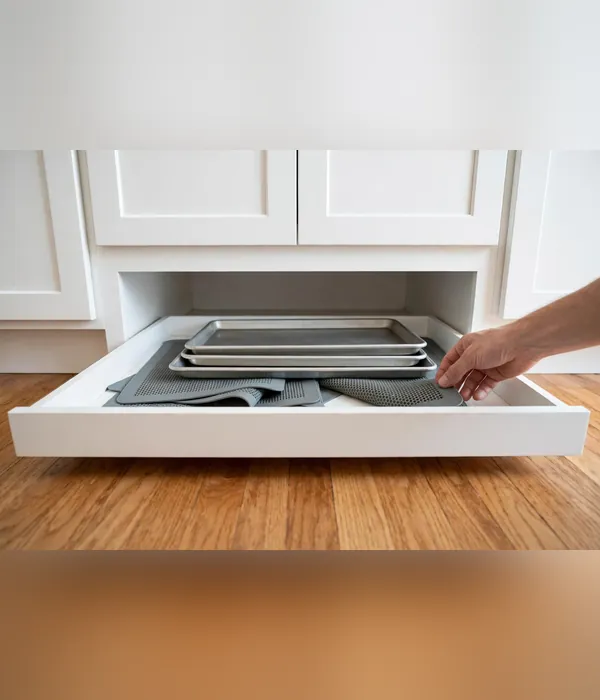
The toe-kick recess under base cabinets, that 3.5 to 4-inch-tall shadow your toes slide into, runs the full length of your cabinetry and holds nothing. Retrofit drawer kits slide into that void on soft-close glides, each drawer 12 to 36 inches wide and 15 to 20 inches deep, ready for baking sheets and trays.
The mechanism is dead-volume conversion at floor level. Flat items are the perfect tenant: nothing rolls, nothing tips, and the shallow height forces you to store exactly the flat things that clutter everywhere else. Most kits install in two to four hours with a drill and a jigsaw, no demolition, no rewiring.
Tips for best results: One 30-inch drawer beats two 15-inch ones, fewer glides, fewer failures. Store only flat, light items: cast iron at floor level is an ergonomic mistake. Choose a kit with soft-close glides, a slamming drawer at floor level gets old fast.
Watch out: Not renter-safe, it needs screws into the cabinet base. Check behind the toe-kick skin before cutting: some runs hide plumbing or electrical.
7. Stackable Shelf Risers: double a cabinet shelf in ten seconds
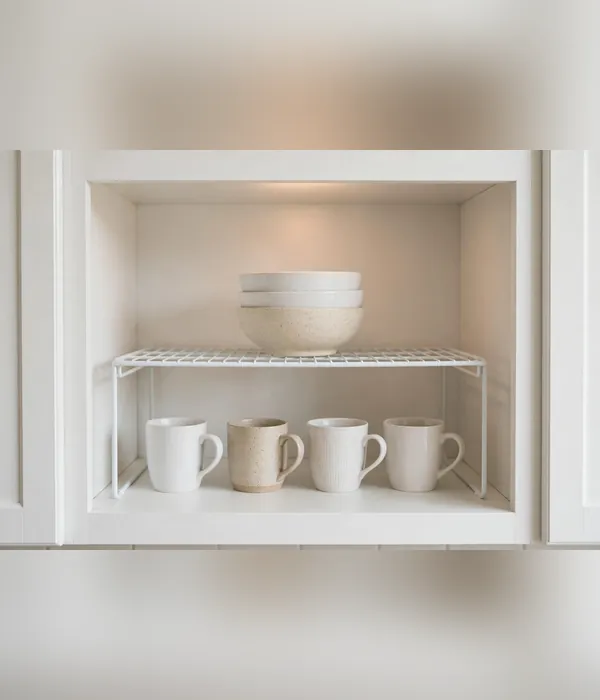
Most cabinet shelves sit 12 to 14 inches apart, and a stack of bowls uses six of them, the rest is heated, lit air. A shelf riser is a 10 by 10-inch platform on legs that creates a second floor: mugs underneath, bowls on top. One shelf now holds two layers of dishes, every piece still visible.
The mechanism is vertical subdivision. A shelf’s value is its square footage, and most of it floats unused above short items. Risers work in cabinets, under the sink away from pipes, and on counters for coffee stations, just measure shelf height first: standard risers need 10 inches of clearance, and expandable models run 16 to 25.6 inches wide.
Where it works best:
- Plate and bowl cabinets, the classic dead-air zone
- Under the sink for cleaning bottles (point 13’s rod handles the sprays)
- The coffee corner: machine on the counter, mugs on the riser above
- Pantry shelves holding cans, one can row becomes two visible rows
- Renters: completely freestanding, moves with you
8. Under-Shelf Hanging Baskets: storage hanging from thin air
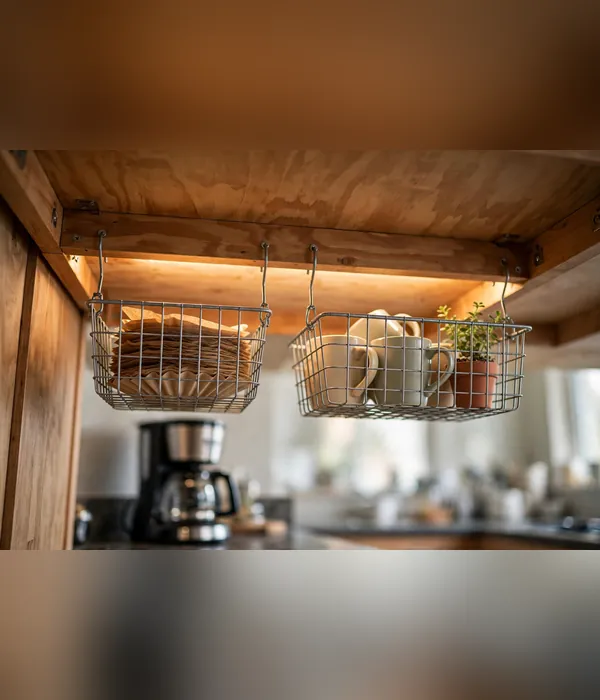
The underside of every cabinet shelf is a ceiling nobody uses. Wire baskets with arms that slide over the shelf, built for the standard 1-inch-thick shelf, hang a second tier below for mugs, cling wrap, and coffee filters. A typical basket rates around 20 pounds, far more than mugs and wrap will ever weigh.
The mechanism is friction and geometry, not hardware. The arms grip the shelf and the basket’s weight keeps it seated; the load hangs in space that had zero value a minute ago. They install in seconds and slide off just as fast, but buy the depth that matches your shelf, since a deeper basket sticks out and catches sleeves.
Tips for best results: Load the heaviest items toward the back arm so the basket can’t tip forward. These shine above the coffee maker: filters and mugs one grab away.
Watch out: Wire pantry shelves can be too thin for the arms to grip, and glass shelves can crack under point loads. Keep contents tidy, baskets are visible from across the room.
9. Corner Lazy Susans: rescue the blind corner
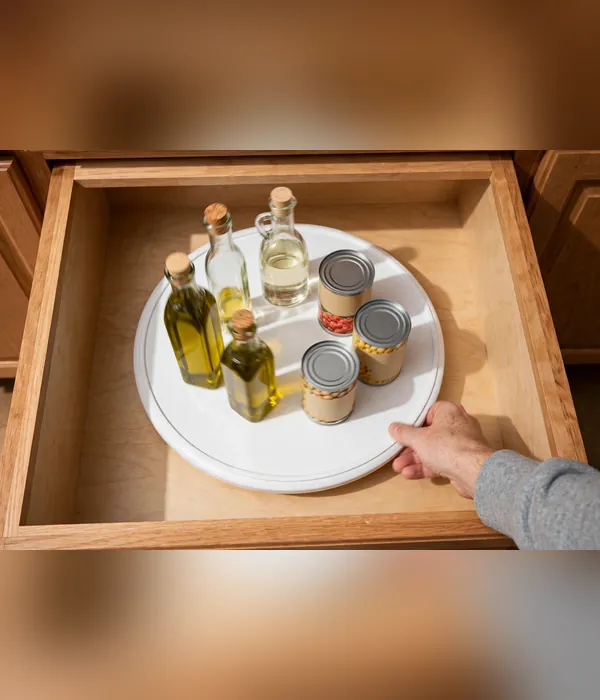
Blind corner cabinets are where small kitchens lose things, a 24-inch-deep cavern where the back half is reachable only by kneeling and groping, until a 12 to 18-inch turntable on the shelf spins the back to the front: oils, vinegars, and cans rotate into reach with one hand. The cheapest rescue for the worst cabinet in the house.
The mechanism is rotation instead of excavation. The corner’s problem was never size; it was access geometry. Measure the cabinet opening width first, an 18-inch turntable won’t pass a 15-inch door frame, the most common return reason, and choose non-skid rims: a turntable that slides is one that spills.
Where it works best:
- The blind corner base cabinet, the canonical use
- Deep pantry shelves where cans go to be forgotten
- Under the sink for cleaning supplies, if pipes allow the footprint
- The condiment cabinet, see the kitchen storage ideas pillar for the full small-kitchen layout plan
- Raised rims keep bottles from walking off during the spin
10. Over-the-Sink Cutting Board: a second counter in twenty inches
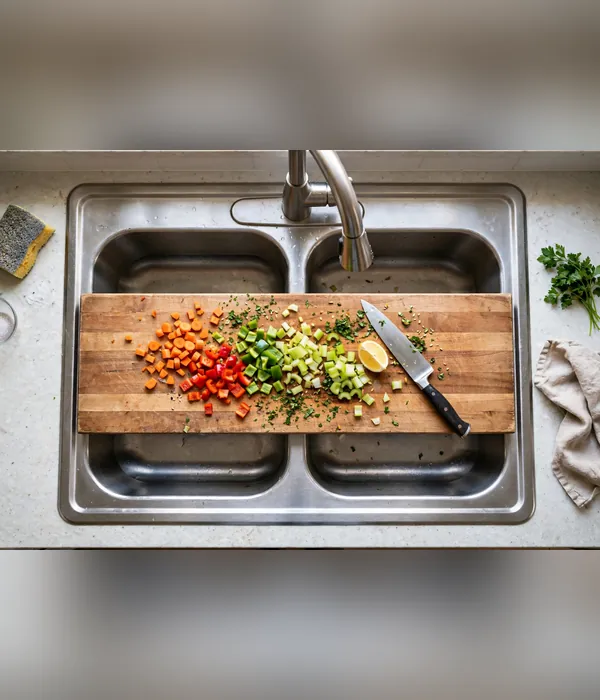
Prep space is the scarcest surface in a small kitchen, and the sink sits in the middle of it. A 20 by 12-inch board that spans the basin, resting on the counter lips or the sink rim, adds an instant second work surface exactly where you wash produce. Chop, slide scraps aside, rinse the board in place.
The mechanism is a bridge over existing void. The sink’s airspace was already inside your work triangle; the board just floors it. Buy to your sink’s inner width minus a quarter inch, with a juice groove and silicone bumpers so it can’t slide on wet rims, wood doubles as a serving piece, and poly goes in the dishwasher.
Tips for best results: Pair it with the over-sink rack from point 2, the sink zone becomes a full prep-and-dry station. Store the board upright in the toe-kick drawer (point 6).
Watch out: A spanning board blocks the faucet, fill pots before you set it down. Rounded or undermounted rims with no lip won’t seat most boards, test with cardboard first.
11. Wall-Mounted Pot Rail: pans on the wall, cabinets set free
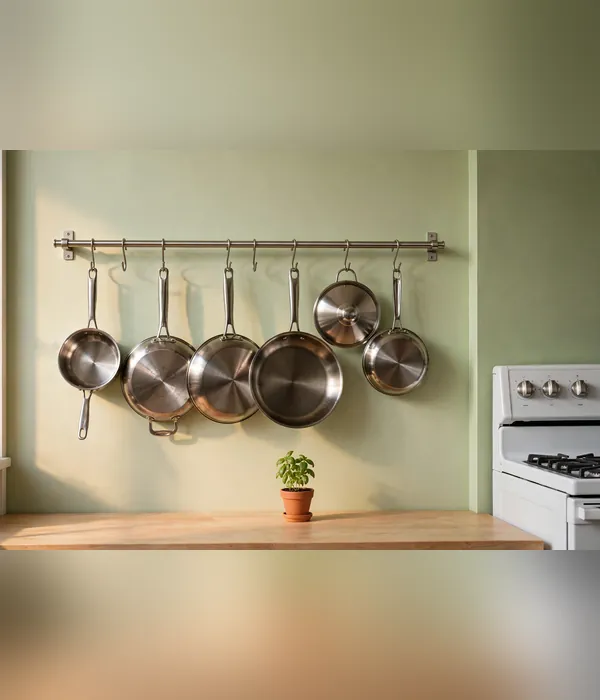
A stack of nested pans in a base cabinet is a daily excavation, the one you want is always third from the bottom. A 24 to 36-inch stainless rail with S-hooks beside the stove hangs skillets, saucepans, and lids by their handles. Every pan visible, grabbable with one hand, and out of the cabinet entirely.
The mechanism is handle-based hanging in vertical wall space. Pans are mostly air and handle; hanging uses the wall’s height while the bodies overlap in the same plane. A 30-plus-pound-rated rail handles cast iron, mount into studs or use toggle bolts, since a loaded rail has real leverage, and keep it at least 18 inches above the cooktop.
Where it works best:
- The wall beside the range, the shortest grab distance in cooking
- Galley kitchens where base cabinets are too narrow for pan stacks
- Small lids hang from the same hooks, no more lid avalanches
- Renters: a rail needs screws, but over-the-door hooks get you halfway there
- Hang the daily drivers only; the turkey roaster lives above the fridge (point 18)
12. Pegboard for Tools: a wall that changes with you
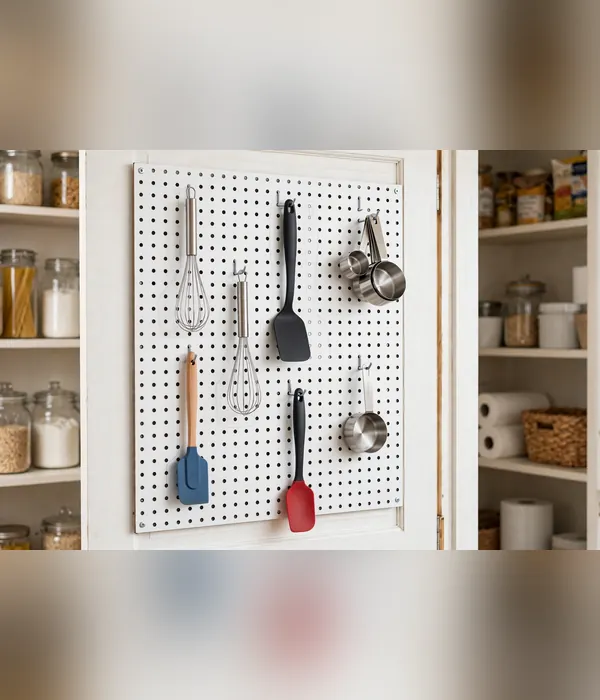
Utensil crocks hog counter corners and junk drawers swallow spatulas. A 24 by 36-inch pegboard on the pantry door or an open wall, hung with hooks, holds every tool at eye level, spatulas, whisks, measuring cups, and reconfigures in minutes when your cooking changes. It ends the crock-versus-drawer dilemma for good.
The mechanism is a hook grid instead of fixed slots. Use 1/4-inch hardboard or metal pegboard with a frame, mounted a half inch off the wall on furring strips so hooks seat fully. Standard 1-inch hole spacing takes every common hook size, trace each tool’s outline in pencil, and the shadows show instantly what’s missing.
Tips for best results: Metal pegboard wipes clean of grease; hardboard needs a yearly wipe-down near the stove. Mount it inside a pantry door and the whole tool wall vanishes when you close up.
Watch out: Pegboard near the stove collects airborne grease, wipe hooks quarterly. It needs screws or a solid over-door mount, so pure renters should use the door-hung version.
13. Under-Sink Tension Rod: the ten-dollar spray-bottle shelf
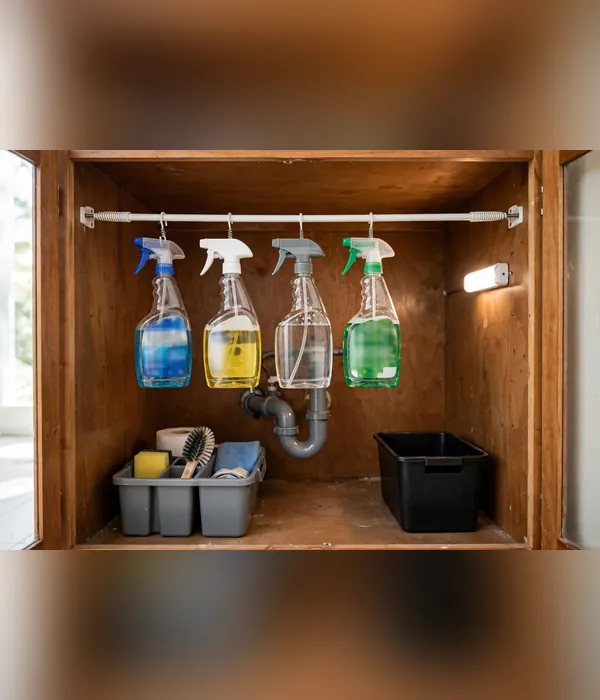
The under-sink cabinet is a plumbing obstacle course: pipes and the disposal eat the middle, leaving spray bottles knocked over in the corners. A spring tension rod, 15 to 24 inches adjustable, spans the cabinet above the pipes and hangs every spray bottle by its trigger. The floor below stays clear for bins.
The mechanism is a shelf with no shelf. The rod wedges between the cabinet walls on spring pressure, creating a hanging bar in airspace the pipes ignore. Most rods hold five to ten pounds, enough for four to six spray bottles, not gallon jugs, set it high enough to clear the pipe tops, and twist until it resists.
Where it works best:
- Any under-sink cabinet with at least 15 inches of clear wall-to-wall span
- Renters, zero holes, zero adhesive, removes in ten seconds
- Above the pipes in a 30 or 36-inch sink base, the most common sizes
- Pair with a drip tray on the cabinet floor for the inevitable leak
- Tall pantry cabinets, the same rod hangs cleaning caddies there
14. Fold-Down Wall Table: dining and prep that disappear
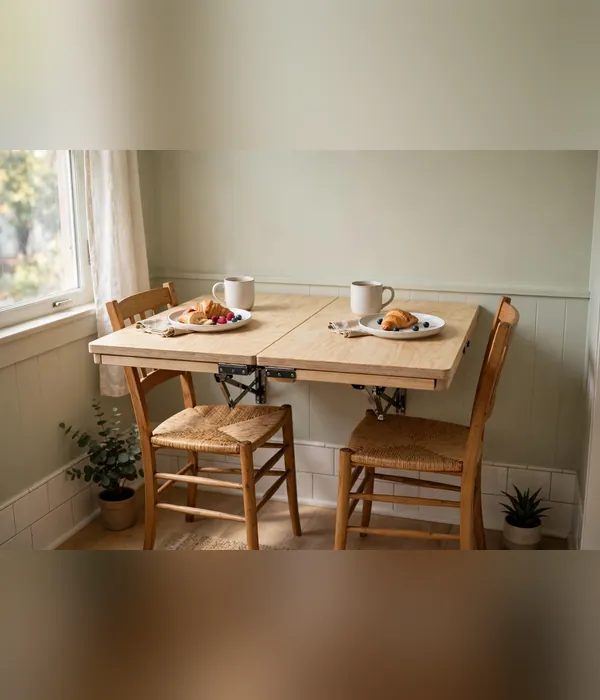
A small kitchen without a table forces every meal onto the counter, or the couch. A 30 by 20-inch wall-mounted table on folding brackets drops flat against the wall when you’re done. Full dining or extra prep surface on demand, six inches of wall the rest of the day.
The mechanism is a bracket hinge rated for real loads. Good folding brackets lock open at 90 degrees and rate 50-plus pounds per pair, enough for dinner plates or a stand mixer in a pinch. Mount into studs with lag screws, never drywall anchors alone, and position it 28 to 30 inches off the floor for standard chair height.
Tips for best results: Put it on the wall opposite the main counter to create a true work triangle. A 30-inch width seats two; 36 inches seats two generously but needs a bigger clear wall.
Watch out: Not renter-safe, lag screws into studs are the whole point. The table needs 20 inches of clear floor when down, so don’t mount it where the fridge door opens.
15. Nesting Cookware: a full set in one pot’s footprint
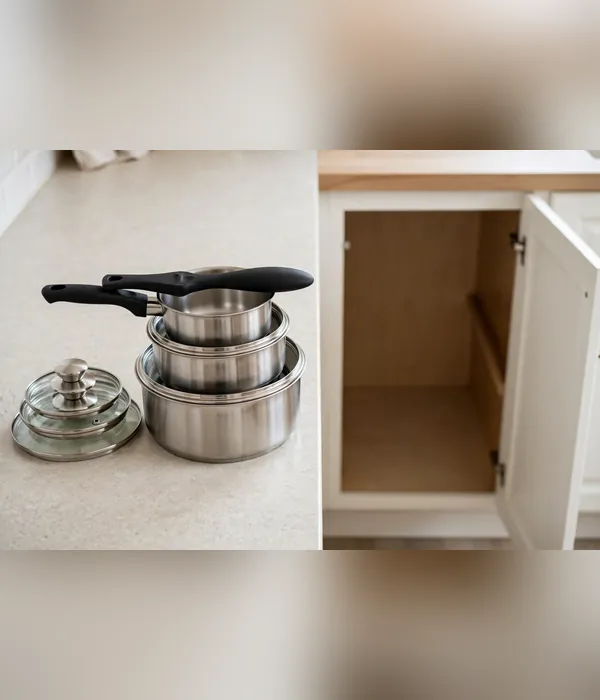
Five pots and pans in a small kitchen eat a base cabinet, or they did before nesting sets. A nesting set stacks inside a single pot’s footprint: the 10-inch skillet nests in the 12-inch, saucepans inside those, lids on top, handles detach or lock flat. One shelf holds what used to sprawl across two.
The mechanism is concentric sizing plus handle design. Traditional sets waste space on fixed handles; nesting sets use removable or folding handles that collapse into a cylinder. Measure shelf height, most nested sets stand eight to ten inches tall, and check the handle-lock: cheap sets get wobbly handles, and a wobbly handle on boiling pasta is dangerous.
Where it works best:
- Base cabinets under 24 inches wide, where a normal set can’t fit at all
- Galley kitchens pairing the set with the pot rail (point 11), daily pans on the rail, the rest nested
- Renters and movers, one box holds the whole kitchen
- Induction cooks: verify the base is induction-compatible; not all nesting sets are
- Keep one dedicated non-nesting skillet if you sear often, nesting coatings scratch faster
16. Clear Airtight Canisters: see-through beats labels every time
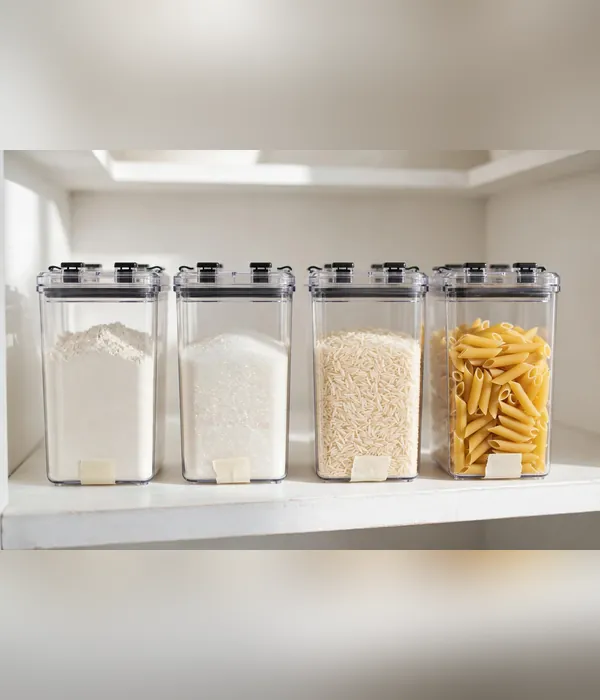
Opaque bags and boxes force you to open everything to find anything, and half-used bags go stale in weeks. Clear airtight canisters, 64 to 128 ounces, put flour, sugar, rice, and pasta behind a silicone seal you can see through. A 128-ounce canister swallows a standard 5-pound bag of flour; the 64-ounce size handles sugar and rice.
The mechanism is visibility plus preservation. Clear walls end the open-every-bag search; the airtight seal keeps flour fresh months longer than a folded bag and locks pantry moths out. Measure shelf height before buying, tall canisters need 12-plus inches, the most common sizing mistake, and prefer square canisters, which waste 25 percent less shelf space than round ones.
Tips for best results: Decant the day you shop, a five-minute habit that ends bag clutter. Label the bottom with the purchase date on painter’s tape.
Watch out: Canisters don’t create space, five half-bags in five canisters is the same volume, just prettier. For the pantry-wide system these belong to, see pantry organization ideas.
17. In-Drawer Knife Dock: knives off the counter, fingers safe
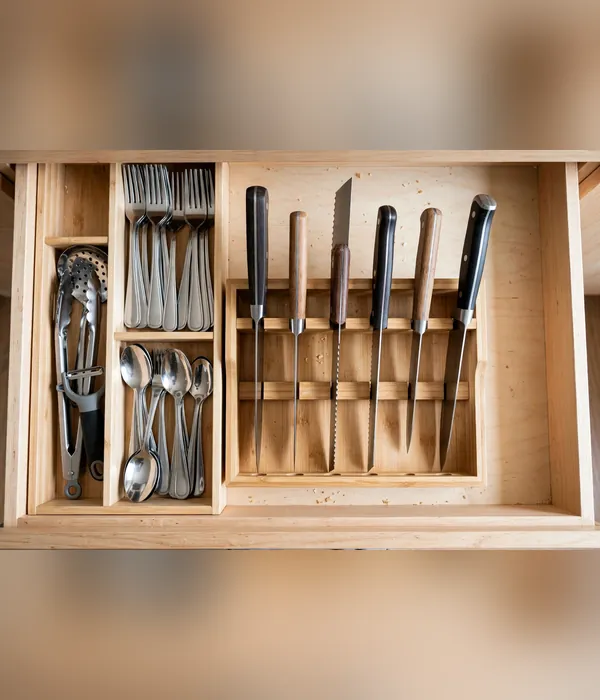
Loose knives in a drawer are the small kitchen’s most dangerous clutter, every blind reach risks a cut, and the blades dull each other. An in-drawer knife dock is a slotted block that lies flat in the drawer: blades down and protected, handles up and grabbable. It fits 3.5-inch-deep drawers and holds five to eight knives.
The mechanism is protected slots at drawer level. Unlike a counter block, the dock uses horizontal drawer space that was already storing the knives badly; the angled slots keep edges from touching anything. Universal docks with flexible dividers fit odd blade shapes, while fitted docks hold sets more securely, keep it in the drawer nearest your prep zone.
Where it works best:
- Homes with kids, a latched drawer beats any counter block for safety
- Renters, it just lies in the drawer, zero installation
- Narrow galley drawers where a block would eat the only prep surface
- Daily drivers on the magnetic strip (point 3), the rest docked
- Wooden docks outlast plastic ones and won’t dull edges
18. Above-Fridge Storage: the 24-inch-deep cabinet everyone wastes
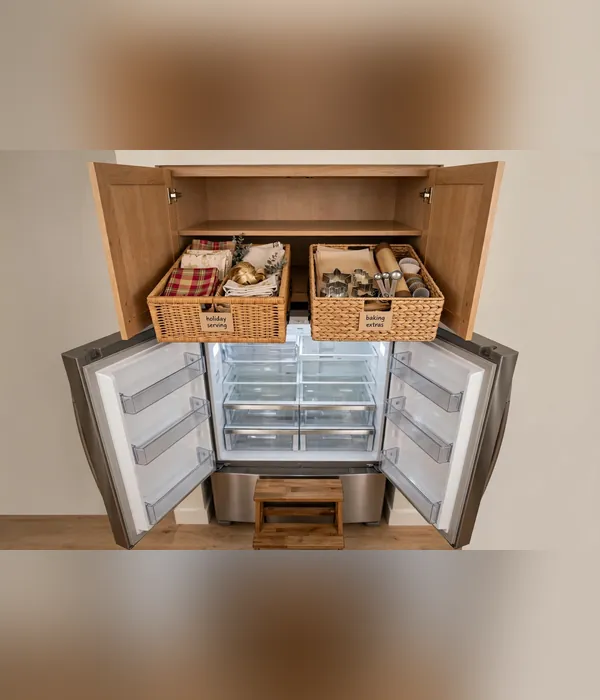
The cabinet above the fridge is 24 inches deep, deeper than any other upper, and almost everyone wastes it on whatever got shoved up there years ago. Reclaim it with labeled bins for the rarely used: the turkey roaster, the fondue set, holiday serving pieces, the twice-a-year blender.
The mechanism is matching access frequency to reach difficulty. Daily items belong between knee and shoulder; annual items belong where the step stool goes. Keep a sturdy two-step stool near the fridge, if retrieving means dragging a chair from another room, the cabinet reverts to a junk shelf, and keep each bin under 15 pounds.
Tips for best results: Label every bin on two sides, you read the cabinet from below at an angle. Tape a one-page inventory inside the door so you stop buying duplicates.
Watch out: The fridge top runs warm, store no chocolate, candles, or aerosols up there. Leave two inches of clearance above the fridge for ventilation. For narrow pantries with the same deep-and-forgotten problem, see narrow pantry storage.
19. Cabinet-Door Spice Racks: two dozen spices behind one door
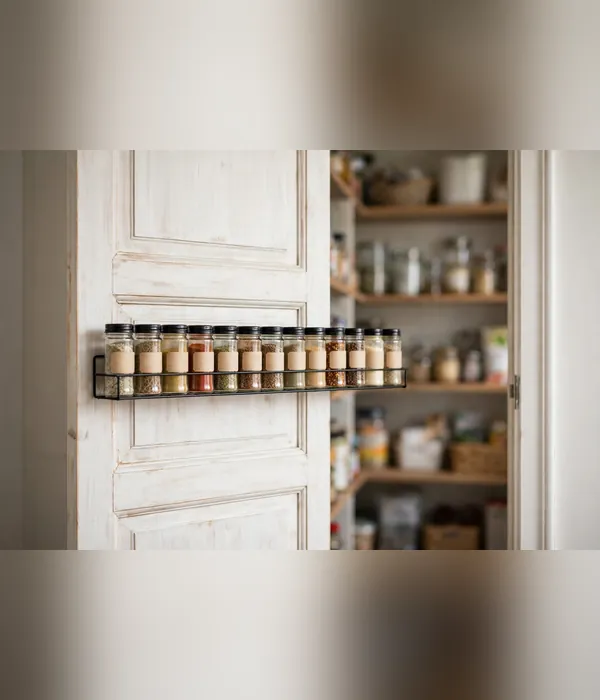
Spices die two deaths in small kitchens: buried in a drawer where you can’t see them, or colonizing the counter in a spinning tower. A single-row rack inside a pantry or upper cabinet door holds 12 to 24 standard 2.5-inch-deep jars in one visible row. Every label faces you the moment the door opens.
The mechanism is door-mounted single depth. One row deep means every jar is the front jar; the door’s swing brings the whole collection to you. This is the highest-density spice storage per square inch on this list, mount it on the pantry door nearest the stove, but not the oven-adjacent cabinet, where heat degrades flavor.
Where it works best:
- The pantry door, see spice storage ideas for the full spice system this belongs to
- Inside a 24-inch upper near the main prep zone
- Renters: adhesive single-row racks hold a dozen light jars if you degrease first
- Standardize jars to one size, mixed heights waste the row
- Decant bulk spices into the standard jars; keep refills above the fridge (point 18)
20. Sink-Front Tray: the four-inch false drawer that becomes a sponge tray
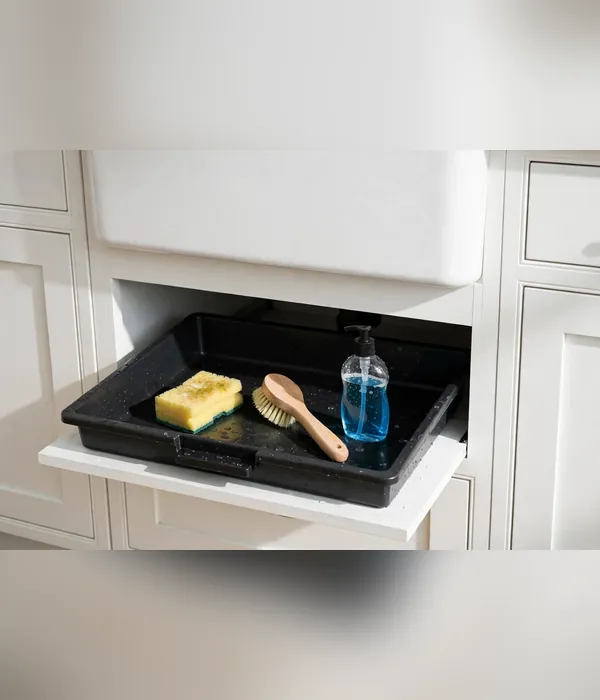
Under most sinks there’s a false drawer front, a fixed four-inch panel that exists only to look like a drawer. Tilt-out hinge kits convert it into a shallow tray that tips toward you. Sponges, brushes, and dish soap live inside, hidden, dripping into the tray instead of pooling on the counter.
The mechanism is a hinge retrofit on a fake front. The kits include two soft hinges and a plastic tray sized to standard false fronts; installation is a drill, twenty minutes, and no plumbing knowledge. Kits size to 11, 14, and 17-inch widths, measure your false front first, since odd sizes need the adjustable version.
Tips for best results: Line the tray with a washable mat, it lifts out for cleaning in seconds. If the false front is glued rather than screwed, score the paint line first so removal doesn’t chip the finish.
Watch out: Not renter-safe, you’re drilling into the cabinet face frame. The tray holds about two inches of depth, so decant tall soap into a short pump bottle.
21. Pull-Out Trash and Recycling: the cabinet that sorts for you
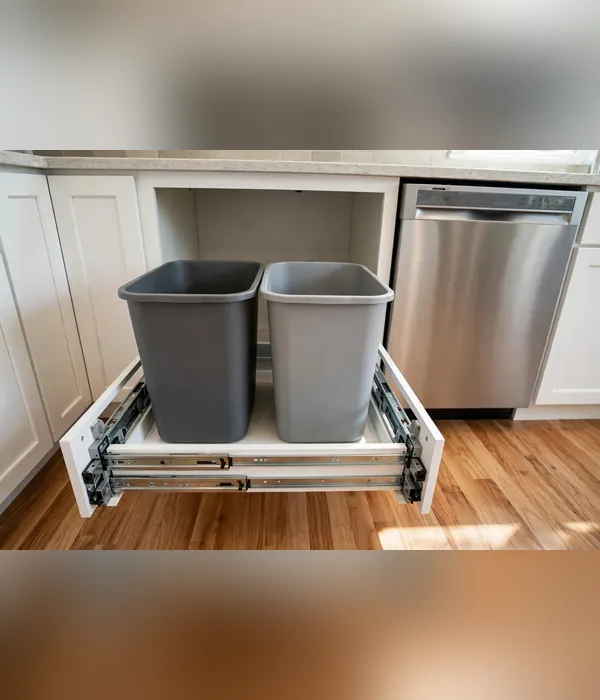
A freestanding trash can in a small kitchen eats two square feet of floor and collects grime around its base. A pull-out unit under the sink or in a base cabinet, typically a 35-quart bin on full-extension slides, hides the trash inside the cabinetry. Double-bin versions sort recycling in the same footprint.
The mechanism is a slide-mounted bin in existing cabinet volume. The 35-quart size fits standard 15-inch sink-base cabinets and holds a normal kitchen bag; full-extension slides bring the whole bin out for bag changes. Double 27-quart bins sort trash and recycling side by side in an 18-inch cabinet, and soft-close slides are worth the small premium.
Where it works best:
- The sink base, prep scraps go straight from board to bin
- An 18-inch base cabinet beside the dishwasher for the trash-plus-recycling double
- Renters: freestanding pull-out frames need no screws, the door-mount versions do
- Pair with the tension rod (point 13) above it, sprays hang, trash rolls, one cabinet does two jobs
- Line the cabinet floor with a washable mat; leaks happen
Conclusion
Twenty-one ideas, one rule underneath them all: measure the dead zones first, then buy the exact-fit solution. The gap beside the fridge, the backs of your doors, the toe-kick void, the cabinet above the fridge, that is where small kitchens hide their missing square footage.
Start here: the slim rolling gap cart (point 1). It wins on every axis that matters: typical price under $30, zero installation and fully renter-safe, fits the gap almost every kitchen already has, and turns five inches of dead air into four tiers of daily-use storage. No other single purchase returns this much space per dollar.
For the bigger kitchen-wide plan, see kitchen storage ideas, and for the fridge interior beside that new cart, fridge storage hacks.
Frequently Asked Questions (FAQ)
What small kitchen storage ideas work best for renters who can’t drill?
Stick to the no-screw tier: the rolling gap cart (point 1), over-sink rack (point 2), shelf risers (point 7), under-shelf baskets (point 8), the tension rod (point 13), and the in-drawer knife dock (point 17). If you use adhesive mounts, degrease with rubbing alcohol first and keep loads light, adhesive fails most often on greasy tile.
How do I measure my kitchen for organizers before buying?
Take the five measurements from the cheat sheet: cabinet interior width, depth, and shelf height; the fridge-side gap at top, middle, and bottom; under-sink pipe clearance and your tallest bottle; counter depth (usually 24 inches); and the above-fridge cabinet’s depth and height. Write them on your phone, returns are the hidden tax on unmeasured organizing.
Are magnetic knife strips safe in a house with kids?
If you mount them right, yes, and they’re safer than a drawer of loose knives. Mount the strip at least 16 inches above the counter and out of climbing reach, choose full-face magnets over hidden pucks, and test every knife’s hold first. If your kids climb, the in-drawer dock (point 17) in a latched drawer is the safer choice.
What’s the best way to store pots and pans in a tiny kitchen?
If you own fewer than six pieces, hang the daily drivers on a wall rail (point 11) and nest the rest, that combination clears a full base cabinet. If walls are off-limits, a nesting set with detachable handles (point 15) collapses everything into one pot’s footprint. Either way, stop stacking: stacked pans are where nonstick coatings go to die.
How much weight can inside-cabinet-door racks actually hold?
A screw-mounted two-tier spice rack holds five to eight pounds fully loaded, fine for spices, wraps, and lids, but not for cans or bottles. If your hinges already sag or squeak, fix them first, because added weight finds every weakness. Adhesive-mount racks top out around three to five pounds; use them for cling wrap and lids only.
Will an over-sink dish rack fit my sink and faucet?
If your sink is 24 to 33 inches wide and your faucet is under 15 inches tall with six inches of clear space around its base, yes. Measure the sink’s outer width and buy one inch wider so rails rest on the counter lip. Tall arc faucets and under-window sinks are the deal-breakers, test with a cardboard mock-up first.