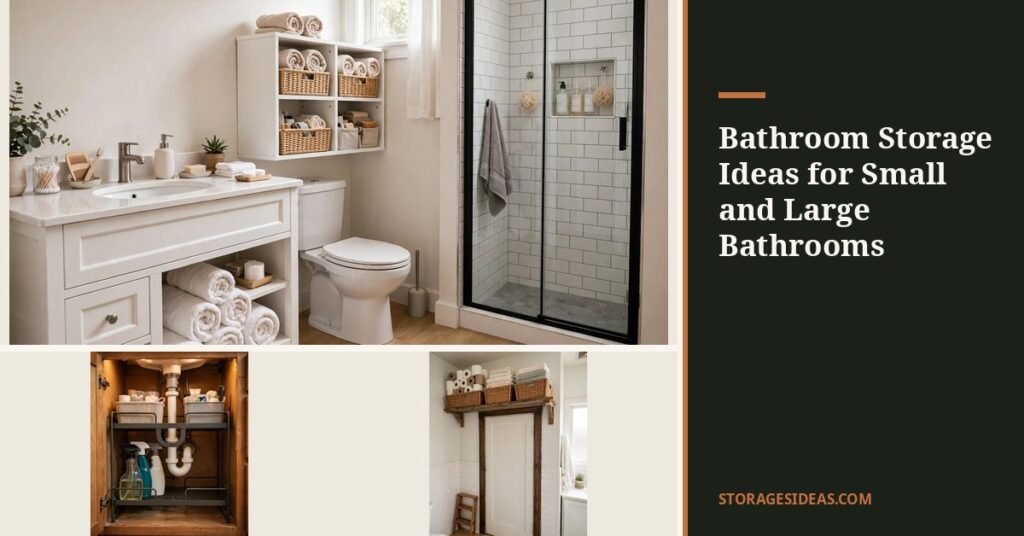
The standard American bathroom is 5 by 8 feet, 40 square feet total, and once you subtract the tub, the toilet, and the vanity, you are left with about 15 inches of usable counter space. That is the whole battlefield.
These bathroom storage ideas are built for exactly that reality: every one of the 30 works in a small bathroom, most scale up to large ones, and nothing here needs a renovation.
You will find over-toilet units that clear your tank lid, shower storage that holds 30 pounds without a single drilled hole, under-sink organizers that route around the pipes, and a linen system that fits a family of four’s towels into one narrow tower.
Measure first, this niche runs on inches, and start with whatever solves your single biggest daily annoyance. If your counter is always a cluttered mess, start in Group 1. If bottles fall in the shower every morning, start in Group 2.
Why Bathroom Storage Plays by Different Rules
A bathroom is the hardest room in the house to store things in, and it is not just the size. It is the only room where three enemies team up against you: moisture, heat, and tight clearances. Humidity warps particleboard, rusts chrome-plated steel, and, this one matters, degrades medications.
The FDA’s standing guidance is to store most medicines in a cool, dry place, because bathroom humidity and heat break down active ingredients; a medicine cabinet is literally the worst place in the house for pills.
Then there are the clearances: toilet tanks run 16 to 20 inches wide with the lid top sitting 27 to 32 inches off the floor, doors swing through a 21-inch arc minimum, and that 5×8-foot footprint gives you roughly 15 inches of elbow room around fixtures.
Supporting keywords like bathroom storage solutions and bathroom organization ideas all describe the same fix: stop fighting for floor space and start claiming the vertical and dead zones, over the toilet, inside the shower corner, the back of every door, the 6-inch strip beside the vanity.
Bathroom storage cheat sheet (save this):
- Over-toilet units: 23–26 in wide × 8–11 in deep × 60–68 in tall; match within 4 in of your tank width (16–20 in typical); leave room to lift the tank lid.
- Tension shower poles: 43.5–120 in adjustable (typical 47–121 in); choose 304 stainless steel, chrome-plated steel rusts in steam.
- Adhesive shower shelves: 10–30 lbs on smooth tile (clean with rubbing alcohol, cure per label); suction cups hold 1–3 lbs and fail in steam.
- Medicines: move them out of the bathroom to a cool, dry spot (59–86°F per FDA room-temperature guidance).
- Renter rule: tension, adhesive, and over-the-door = no damage; anything with screws needs landlord sign-off.
Vanity & Counter Storage
The vanity is where the day starts and where clutter multiplies fastest. These six ideas squeeze real capacity out of the counter, the cabinet, and the drawer, the three zones every bathroom has.
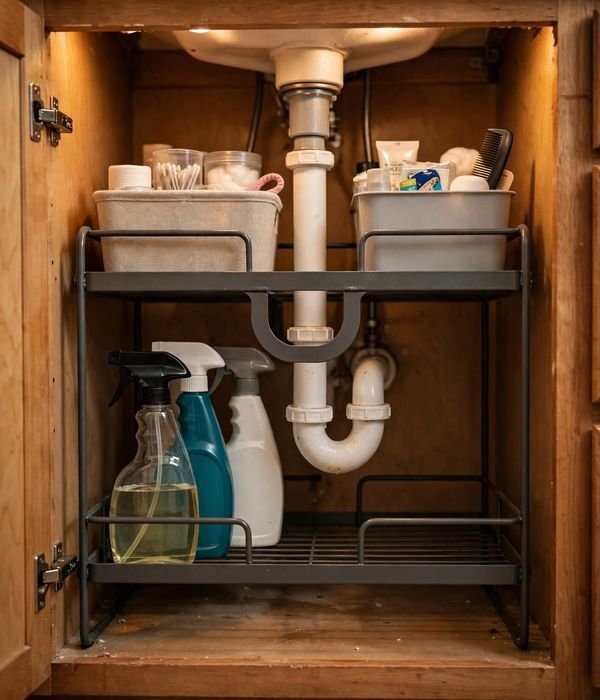
1. Under-Sink Stackable Organizer: Route Around the Pipes
The space under your sink looks unusable because the trap and supply lines eat the middle, but the zones to the left, right, and below them are wide open.
A standard 30-inch vanity gives you roughly 26 inches of interior width and 18 inches of depth, and a two-tier organizer with an open center or U-shaped cutout slides around the plumbing, turning one dark cavity into two sorted shelves: cleaning supplies below, daily toiletries above. You are converting dead air under the trap into a second floor.
What you can do with it:
- Park a pull-out tray on the lower tier for tall spray bottles
- Keep a lidded bin on the upper tier for first-aid and spare toiletries
- Store extra soap and toothpaste upright so low stock is always visible
- Slide a narrow bin along one side wall for hair tools
- Leave the trap area open so a plumber, or a leak, is never blocked
Tips for best results: Measure interior height first, most vanity cabinets are 20 to 22 inches tall, so two 10-inch tiers is the sweet spot. Choose coated steel or plastic over raw wood; under-sink cabinets see more moisture than any other cabinet in the house. Fully renter-safe.
For plumbing-zone layouts, see under-sink layout ideas and under-sink bathroom storage ideas.
2. Vanity Drawer Dividers: Give Every Item a Slot
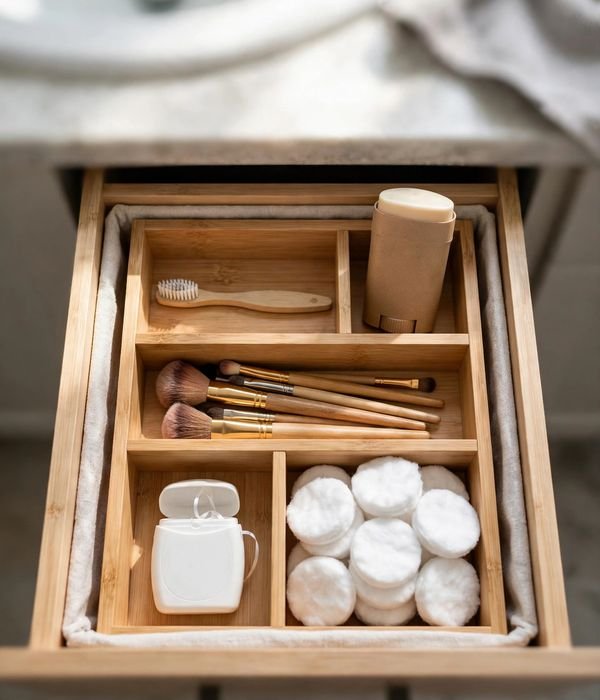
A vanity drawer without dividers is a junk drawer with better lighting. Spring-loaded or cut-to-fit dividers turn one wide drawer into six to eight compartments, and the payoff is time: you stop digging for the tweezers and start grabbing them.
Standard vanity drawers run 14 to 20 inches wide and 4 to 6 inches deep inside, so a 4-inch-deep bamboo or plastic divider set fits most without modification. This works because small items migrate, dividers are just walls that stop the migration.
What you can do with it:
- Give the front-left slot to the three things you touch every morning (toothbrush, deodorant, moisturizer)
- Corral makeup and brushes in one deep compartment so nothing rolls
- Dedicate a narrow slot to dental floss, nail clippers, and other small tools
- Keep medications OUT of this drawer (humidity, see point 23) and give the space to cotton rounds and bandages instead
- Use one compartment as the “landing zone” for items that otherwise live on the counter
Tips for best results: Cut-to-fit foam or bamboo dividers beat spring-loaded ones in drawers under 16 inches wide, where spring tension has nothing solid to push against. Wipe plastic dividers monthly, toothpaste dust builds up fast. Price band: under $20 for a full drawer set. Renters: fully removable, zero risk.
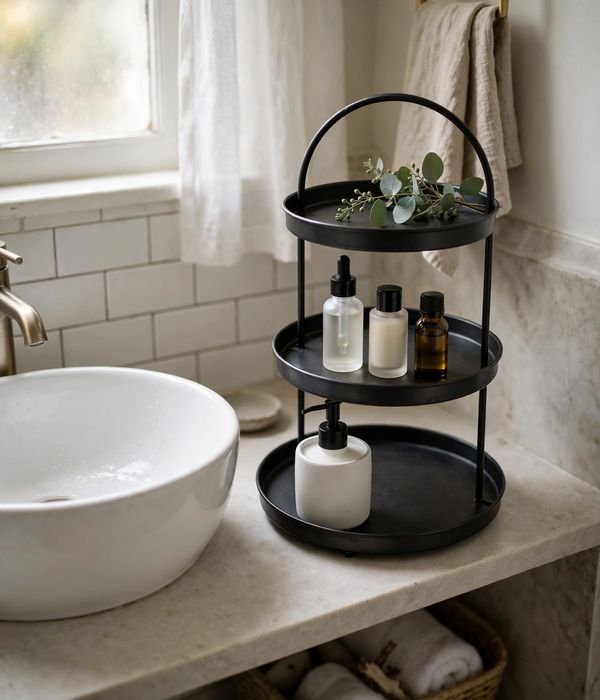
3. Tiered Countertop Tray: Go Vertical on 15 Inches
You have about 15 inches of counter. A two- or three-tier tray claims 8 inches of it and gives you back two extra surfaces, that is triple the landing space in the same footprint. The tiers work like stadium seating: the back row (tall bottles) stays visible over the front row (daily items), so nothing hides behind anything else.
Look for a tray with a 10- to 12-inch diameter base and a raised lip on each tier, because bathrooms are the one room where a bumped bottle can shatter a sink.
What you can do with it:
- Bottom tier: the soap dispenser, toothbrush holder, and whatever you use twice daily
- Middle tier: skincare and serums you use at night
- Top tier: the decorative stuff, a small plant, a candle, that makes the counter feel finished
- Rotate the whole tray instead of reaching behind bottles
- Wipe the base weekly; product drips collect under the tiers where you cannot see them
Tips for best results: Metal trays rust in bathroom humidity unless they are stainless or powder-coated, check before you buy. If your counter is truly tiny (under 12 inches of clear space), choose a two-tier corner unit instead of a round one; corners are otherwise dead space. Under $30 typical.
Pair with the spoke on keeping counters permanently clear: bathroom organization ideas.
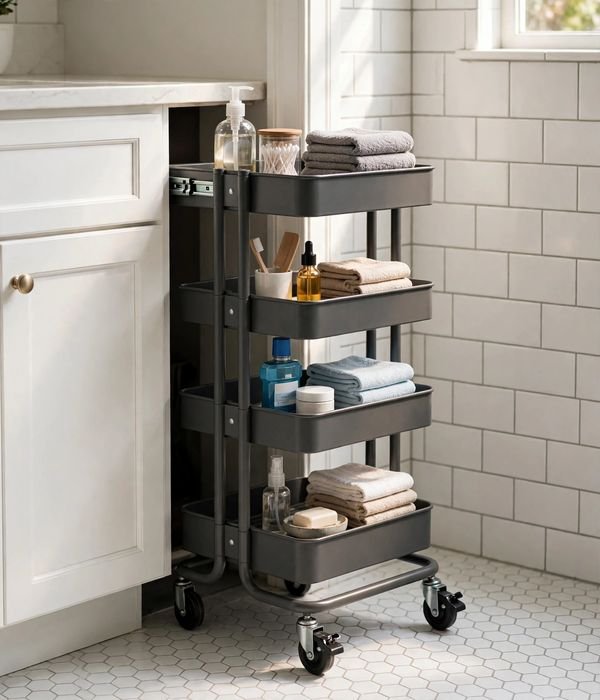
4. Slim Gap Cart: Claim the 6-Inch Strip Beside the Vanity
Almost every bathroom has a wasted strip between the vanity and the wall or toilet, usually 5 to 8 inches wide, running the full depth of the cabinet.
A slim rolling cart built for exactly that gap (typical: 6 to 7 inches wide, 15 to 18 inches deep, 25 to 32 inches tall with 3 to 4 tiers) slides in and out like a drawer you never had to install.
The wheels are the mechanism: the cart lives hidden and rolls out for full access, which beats a fixed shelf you cannot reach behind.
What you can do with it:
- Stock the top tier with daily toiletries for a zero-counter-clutter morning routine
- Use a middle tier for cleaning supplies, separate from anything that touches your skin
- Park spare toilet paper and tissues on the bottom tier
- Roll it out fully when you clean so you can wipe the floor strip underneath
- In a large bathroom, use two, one each side of the vanity, for symmetrical backstock
Tips for best results: Measure the gap at the floor AND at counter height, walls and vanities are rarely perfectly parallel, and a cart that fits at the top can wedge at the bottom. Locking casters matter on tile; a cart that drifts will drive you mad. Under $25 typical. Fully renter-safe.
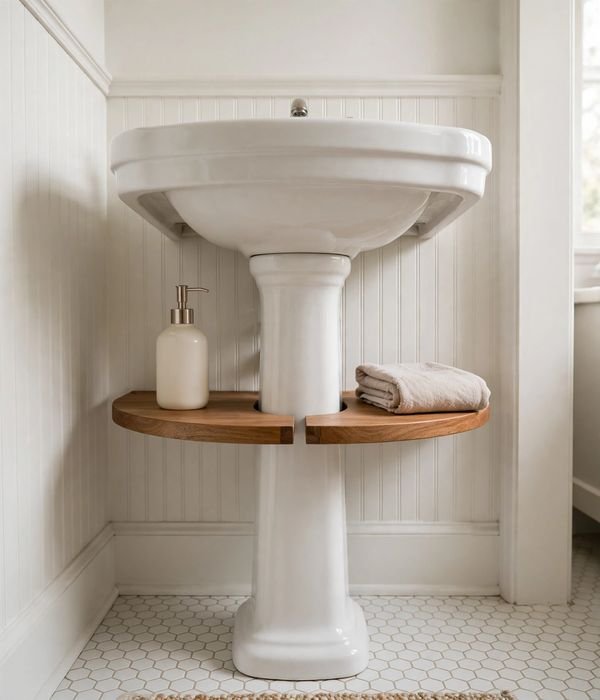
5. Pedestal Sink Shelf: A Counter Where There Isn’t One
A pedestal sink gives you zero counter and zero cabinet, the whole bathroom’s storage has to come from somewhere else.
A wrap-around pedestal shelf (typical: fits pedestals 7 to 9 inches wide at the base, shelf surface about 28 by 12 inches, split into two halves that join around the column) creates a counter out of thin air at exactly the height you need it.
It works because the pedestal itself becomes the support structure, no wall mounting, no floor footprint beyond what the sink already occupies.
What you can do with it:
- Stage your full morning routine on the shelf: soap, toothbrush, skincare in one zone
- Add a small basket on one half for shared items (guest soap, spare toothpaste)
- Keep the center clear so water splashes drain instead of pooling
- Pair with a tiered tray (point 3) on the shelf for two levels in a tiny footprint
- In a powder room, this plus one over-toilet shelf is often the entire storage plan
Tips for best results: Check your pedestal’s base width before ordering, most shelves fit 7- to 9-inch bases, and an oval or square pedestal needs a matching cutout. Choose a shelf with a raised edge; without it, everything slides off when the door slams. Plastic or sealed bamboo only, raw wood warps within months.
Under $30. Renter-safe, zero tools. A future spoke in this cluster covers no-cabinet bathrooms in more depth.
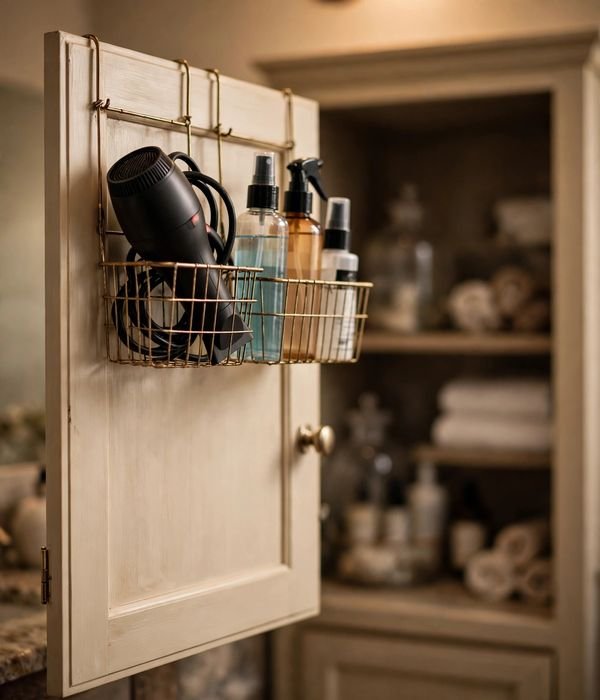
6. Cabinet-Door Baskets: The Back of the Door Is Free Real Estate
The inside of a vanity door is roughly 12 by 16 inches of flat, unused surface, and it swings out to meet you, which makes it the most accessible storage in the cabinet.
Slim wire or plastic baskets that hook over the door top (no screws) add two to three pockets exactly where your hand lands when you open the door. The mechanism is access: things stored here get used, things stored at the back of the cabinet get forgotten.
What you can do with it:
- Hang hair tools (dryer, straightener) in a heat-resistant pocket, off the counter, instantly reachable
- Store cleaning spray bottles upright in a deep basket so they never tip
- Keep spare sponges and scrub brushes in a ventilated wire basket that drains
- Use a shallow pocket for the items you grab mid-routine: contact solution, floss
- Leave the bottom of the door clear if your door has a soft-close hinge that needs clearance
Tips for best results: Over-the-door baskets add about 2 inches of depth, check that the door still closes without hitting the shelf or pipes inside. Adhesive-mounted versions hold 3 to 5 pounds per basket; over-door hooks hold more but need a door top at least 1/2 inch thick to grip.
Wipe wire baskets dry after mopping, standing water at the door bottom rusts cheap chrome. Under $15. Renter-safe with over-door or adhesive mounts.
Shower & Tub Storage
Shower storage fails for exactly two reasons: rust and gravity. Every idea here is chosen to beat one or both, 304 stainless steel instead of chrome, adhesive rated for steam instead of suction cups that quit in a week.
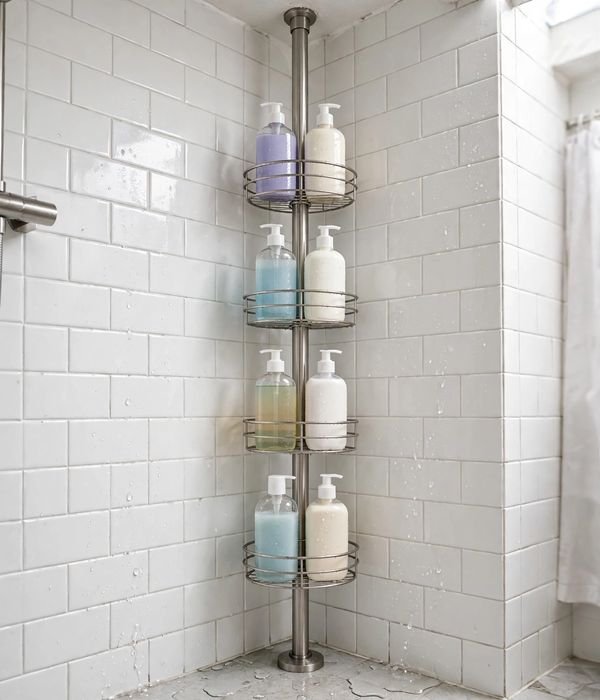
7. Tension-Pole Corner Caddy: Four Shelves, Zero Holes
A floor-to-ceiling tension pole turns the dead corner of your shower into four adjustable shelves with no drilling, no adhesive, and no damage, the single best renter shower upgrade that exists.
Poles adjust from about 43.5 to 120 inches (the common range is 47 to 121 inches), so one pole fits a standard 8-foot ceiling, a tub surround, or a low basement bathroom. Twist-to-tension installation takes under ten minutes, and each shelf typically holds 15 to 22 pounds.
The pole works because tension converts the ceiling and floor into the mount, the whole structure is the bracket.
Tips for best results: Buy 304 stainless steel, not chrome-plated steel, chrome looks identical on day one and rusts by month three in daily steam. Measure floor-to-ceiling at the exact corner spot; ceilings slope more than you think, and a pole 2 inches too short is useless. Keep shelf collars tightened, shelves creep down under heavy pump bottles.
Place the pole in the corner opposite the showerhead so bottles are not in the direct spray. Watch out: tension poles need a solid, flat ceiling, skip them on textured, sloped, or drop-tile ceilings, and re-check tension monthly for the first three months. Typical price band: $25–$45.
8. Adhesive Corner Shelves: A 30-Pound Hold Without Drilling
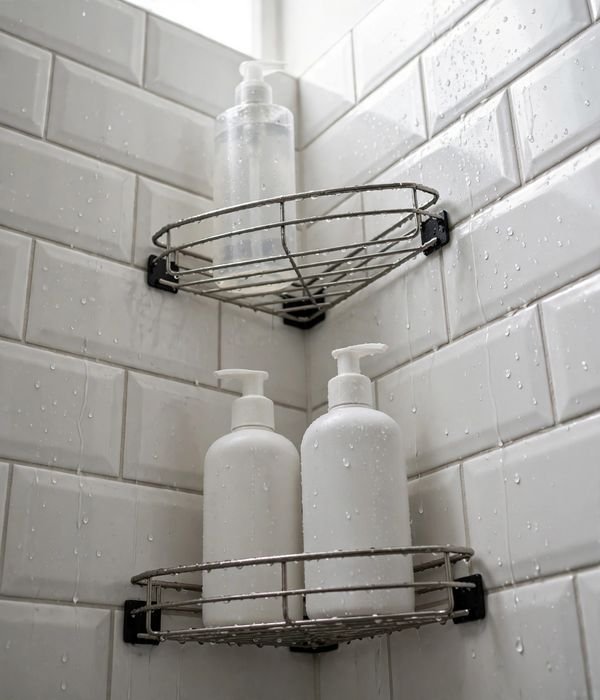
Adhesive-mounted corner shelves are the permanent-feeling answer for renters and anyone who hates the wobble of a tension pole. Two or three triangular shelves bond to smooth tile with waterproof adhesive pads rated at 10 to 30 pounds per shelf, enough for a family of full-size shampoo, conditioner, and body wash bottles.
The adhesive works by full-surface contact, which is why prep is everything: the bond is only as good as the tile underneath it.
Tips for best results: Clean the tile with rubbing alcohol and let it dry completely before sticking, soap scum is the number one cause of adhesive failure. Press each pad firmly for 30 seconds and wait the full cure time on the label (usually 24 hours) before loading a single bottle.
Choose shelves with open wire or slotted bases so water drains instead of pooling into soap scum. Watch out: adhesive needs smooth, non-porous tile or glass, it will not hold on textured tile, natural stone with pits, or grout lines. To remove, heat with a hair dryer and peel slowly; yanking can take grout with it.
Typical price band: $15–$30 for a 2–3 pack. For the full no-drill shower playbook: shower storage ideas without drilling.
9. Over-the-Showerhead Caddy: Hang It and Forget It
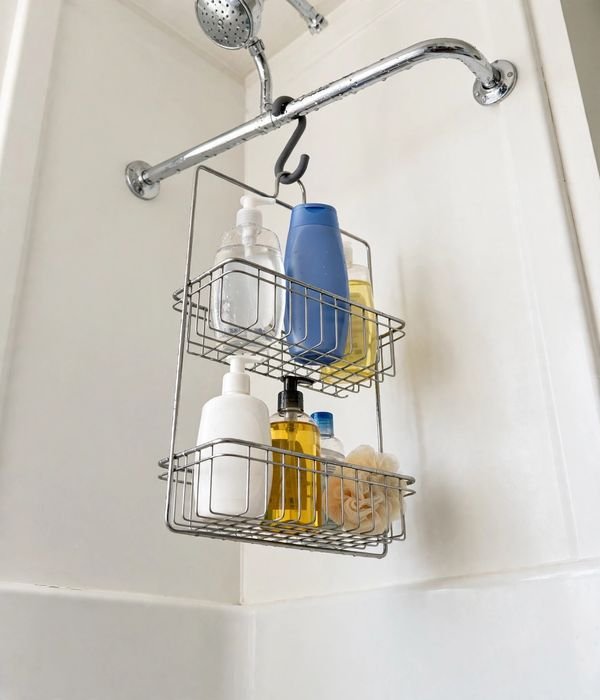
The simplest shower storage ever made: a wire basket that hangs from the shower arm. No installation, no adhesive, no tension, it hangs there the day it arrives and holds the four to six bottles a household actually uses daily.
Standard caddies are 10 to 14 inches wide with two tiers and fit shower arms 1/2 to 3/4 inch in diameter, which covers virtually every residential shower. It works because the shower arm is already the sturdiest anchor in the room.
Tips for best results: Choose a caddy with a rubber-coated hook, bare metal hooks scratch the shower arm’s finish and then rust at the scratch. Keep the load balanced left to right; an overloaded one side swings and bangs the tile.
Look for a rust-proof build (stainless or powder-coated aluminum), this is the wettest spot in the entire bathroom. Watch out: the top tier sits directly under the water stream on many showers, so store bar soap and razors on the lower tier and keep pump bottles up top where the stream rinses them clean. Under $20.
The definition of renter-safe.
10. Bath Tray Caddy: A Shelf Across the Tub
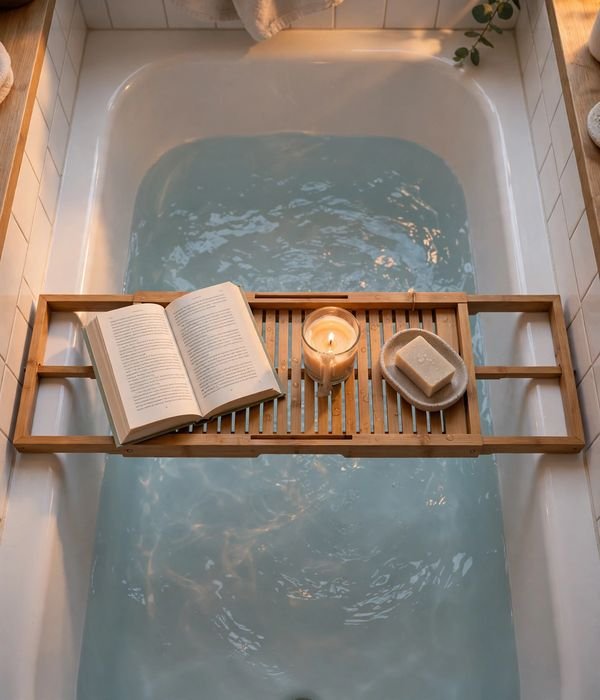
A bath tray spans the tub rim and hands you a stable shelf for everything a bath needs, book, candle, soap, a drink, without a single thing balancing on the tub edge. Standard trays extend 27 to 32 inches to fit most tub widths, with expandable sides and a raised lip.
The mechanism is spanning: the tray borrows the tub’s own width as its support, so it holds steady without clamps or suction.
Tips for best results: Measure your tub’s outer rim width before buying, alcove tubs run 27 to 30 inches, but clawfoot and soaking tubs vary wildly. Bamboo trays need oiling every few months in a steamy bathroom; sealed plastic or stainless trays are zero-maintenance.
Choose one with a book/tablet slot and a wine-glass cutout only if you will actually use them, otherwise they are just holes that collect water. Watch out: never stand on a bath tray or let kids treat it as a step; most are rated for 5 to 10 pounds of bath accessories, not body weight. Typical price band: $20–$40.
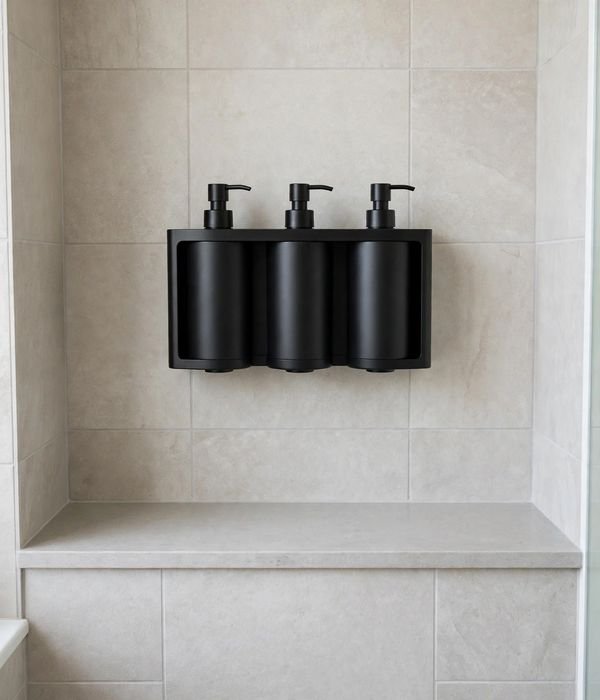
11. Wall-Mounted Dispensers: Get the Bottles Off the Ledge
A two- or three-chamber wall dispenser replaces six wobbly bottles with one slim unit, about 4 inches deep, 8 to 10 inches wide, holding 13 to 17 ounces per chamber. You press, you get shampoo, and the shower ledge stays empty forever.
Dispensers mount with waterproof adhesive or two small screws, and the chambers refill from bulk bottles, which cuts both clutter and plastic waste. The win is permanence: unlike a caddy, there is nothing to knock over, ever.
Tips for best results: Label each chamber the day you install it, unmarked dispensers cause daily “which one is conditioner” roulette. Choose a model with a see-through window or level indicator so refills never surprise you mid-shower.
Adhesive-mounted dispensers need the same rubbing-alcohol prep as adhesive shelves (point 8). Watch out: thick, natural, or sulfate-free formulas can clog narrow pump mechanisms, test with your actual products in week one, and pick a dispenser with wide-bore pumps if you use heavy conditioners. Typical price band: $20–$35.
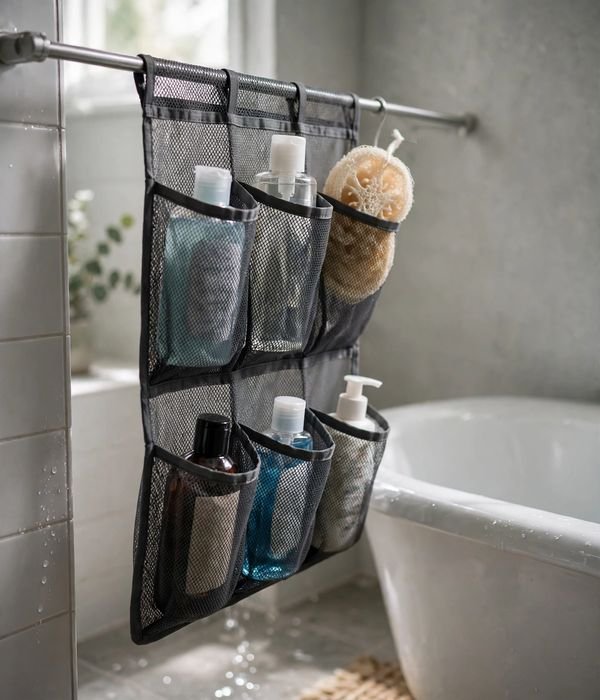
12. Hanging Mesh Organizer: The Renter’s Shower Closet
A hanging mesh pocket organizer, the kind with 6 to 10 quick-dry mesh pockets on a single hook, is the highest-capacity-per-dollar shower storage that exists, usually under $12. Hang it from a tension rod, an over-door hook, or the showerhead itself, and every family member gets their own pocket row.
Mesh is the mechanism: water drains straight through, air circulates, and nothing ever sits in a puddle growing mildew.
Tips for best results: Hang it where the shower spray does not hit it directly, inside the shower door or on the wall beside the tub keeps pockets drier and cleaner. Machine-wash the organizer monthly; mesh hides soap buildup until it smells.
Assign pockets by person, not by product type, “Mom’s row” beats “shampoo row” when four people share one shower. Watch out: cheap mesh organizers stretch under heavy bottles; keep each pocket to one or two standard bottles, and retire any organizer whose stitching pulls at the hanger. Under $12, fully renter-safe, and it packs flat for moving day.
Walls & Over-Toilet Storage
The wall above the toilet is the largest unused surface in most bathrooms, roughly 24 inches wide by 36 inches of vertical space doing absolutely nothing. These six ideas claim it, plus the other wall zones bathrooms waste.
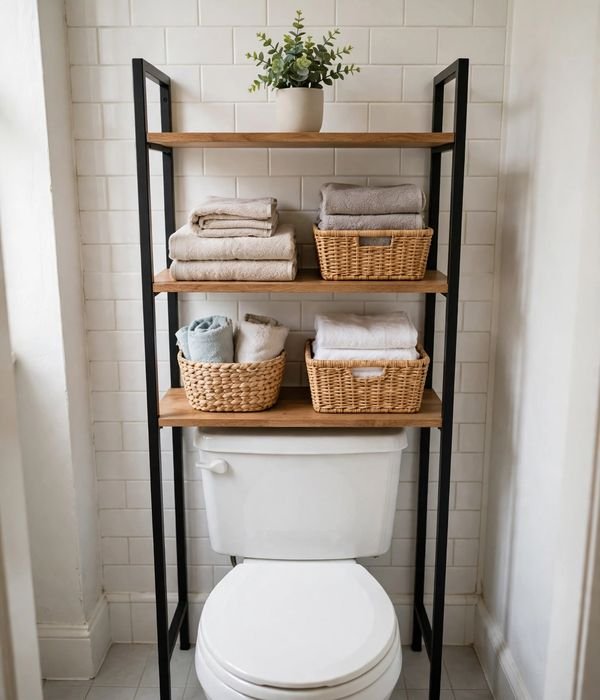
13. Over-the-Toilet Etagere: Three Shelves From Dead Air
Step one: measure your tank. Step two: buy the etagere.
Standard over-toilet units run 23 to 26 inches wide, 8 to 11 inches deep, and 60 to 68 inches tall, sized to straddle a 16- to 20-inch-wide tank with the bottom shelf clearing the tank lid (lid tops sit 27 to 32 inches off the floor, and you need room to lift the lid for maintenance).
Step three: anchor it to the wall, freestanding units tip forward when the top shelf is loaded. Done right, you gain three shelves of storage in zero floor footprint.
Tips for best results: Keep the unit’s width within 4 inches of your tank width in bathrooms under 40 square feet, wider units create hip-bump points in tight turns.
Store heavy items (bulk toilet paper, cleaning caddies) on the bottom shelf and light decor up top to keep the center of gravity low. Watch out: never skip the wall anchor, especially with kids in the house; a top-heavy etagere is a tip-over hazard. Typical price band: $30–$60.
Renters: use a tension-style or adhesive-anchored unit, or ask the landlord about two small screw holes, most approve. See also the dedicated spoke: over-the-toilet storage ideas.
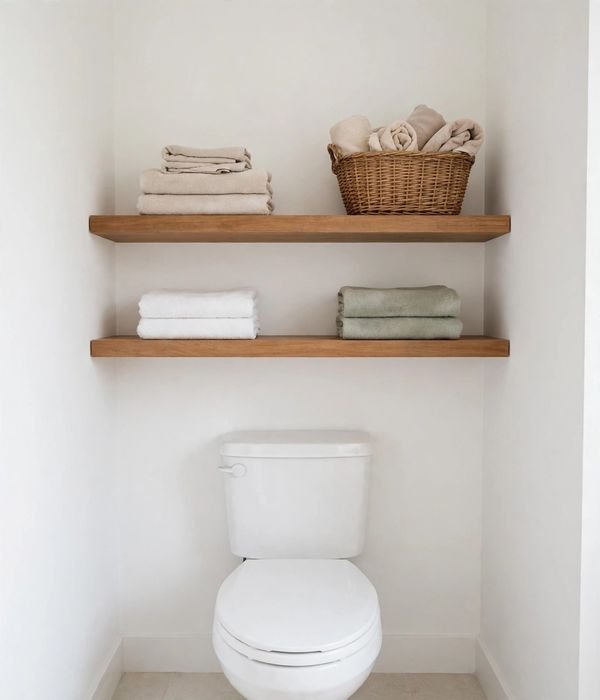
14. Floating Shelves Above the Toilet: Custom Height, Clean Look
Step one: sit on the closed toilet lid and check your head clearance, mount the lowest shelf at least 12 inches above the tank lid so you never bump it standing up. Step two: find the studs; a 24-inch shelf holding towels and baskets needs at least one stud or heavy-duty drywall anchors rated 25+ pounds.
Step three: install two shelves 10 to 12 inches apart, that spacing fits folded towels (about 9 inches tall when folded in thirds) with room to grab them. Step four: style back-to-front, tall items at the back.
Tips for best results: Wood-look shelves need a sealed finish in bathroom humidity, raw MDF swells and sags within a year.
Keep a small basket on one shelf for the “daily drawer overflow” that otherwise lands on the tank lid. Watch out: this one needs screws, so it is not renter-friendly without permission, adhesive shelves (point 8) are the renter alternative. Typical price band: $20–$40 per pair of shelves.
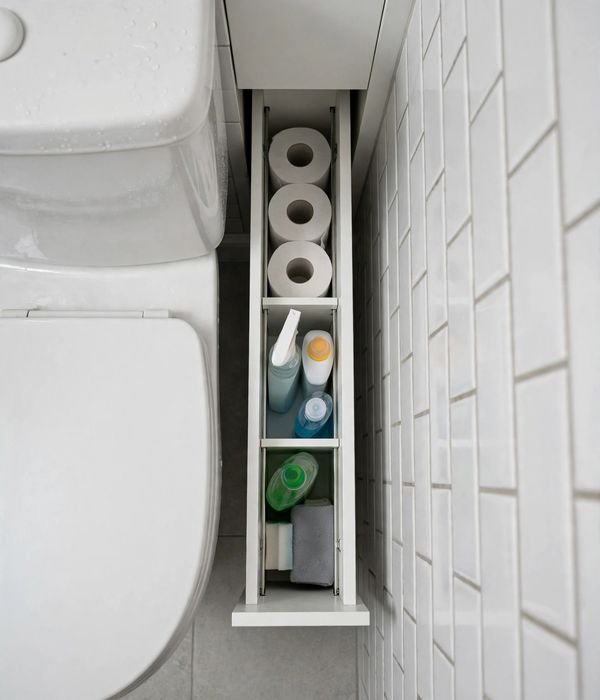
15. Slim Between-Fixture Cabinet: Fill the Toilet-to-Wall Gap
Step one: measure the gap between your toilet tank and the side wall, in many bathrooms it is 6 to 10 inches of dead space. Step two: find a slim freestanding cabinet that fits it (common sizes: 7 to 9 inches wide, 24 to 30 inches tall, with 2 to 3 shelves or a pull-out design).
Step three: slide it in and load it, it is the perfect depth for toilet paper rolls (about 5 inches in diameter), cleaning bottles, and the plunger you currently hide behind the toilet. Step four: if it wobbles, shim the base, tile floors are never level.
Tips for best results: A cabinet with a door looks tidier than open shelves for cleaning supplies; open shelves work better for toilet paper you grab daily.
Top it with a small plant or diffuser and the whole bathroom looks intentional. Watch out: leave at least 15 inches from the toilet’s centerline to the cabinet face, building code minimum for side clearance, so the cabinet never crowds the sitter. Typical price band: $25–$45. Renter-safe (freestanding).
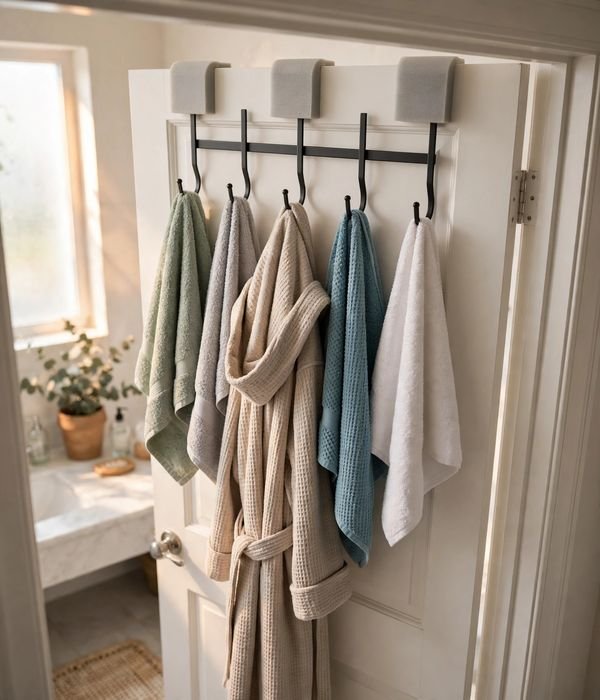
16. Over-the-Door Hook Rack: Five Hooks, No Screws
Step one: check your door thickness, most interior bathroom doors are 1-3/8 inches, and standard over-door racks fit 1-3/8 to 1-3/4 inches. Step two: hang the rack and close the door slowly, checking the top and side gaps, if it scrapes the frame, add the included felt pads or choose a slimmer profile.
Step three: assign hooks, bathrobe on the sturdiest, towels on the rest. Five hooks at roughly 4 inches apart hold a family’s daily towels without a single towel bar.
Tips for best results: Metal racks with foam backing beat bare wire, they do not rattle when the door moves and they protect the door finish.
Put the heaviest item (wet bathrobe, about 3 pounds) on the center hook to balance the load. Watch out: over-door racks can prevent a door from latching if the frame clearance is tight, test the latch before you load it up. Typical price band: $12–$25. Fully renter-safe and moves with you.
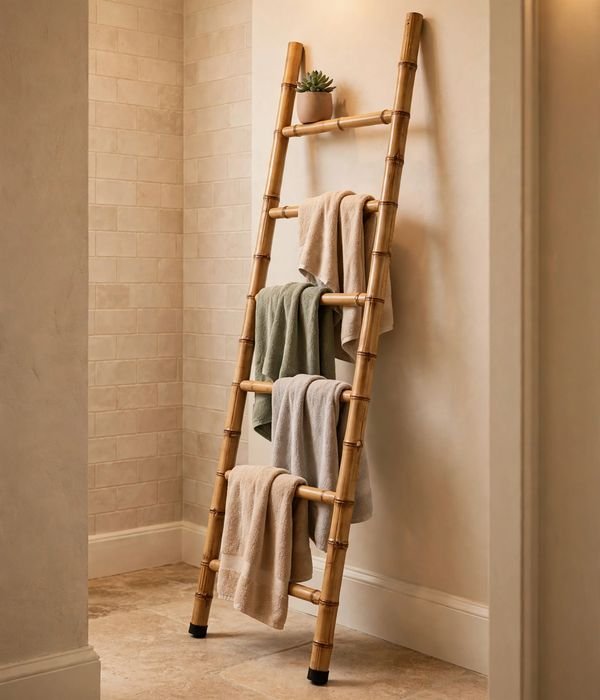
17. Leaning Towel Ladder: Towel Bar Plus Display Shelf
Step one: pick your spot, a ladder needs about 18 inches of wall width and leans at roughly a 10-degree angle, so the base sits 4 to 6 inches off the wall. Step two: choose a 5- to 6-foot ladder with 4 to 5 rungs; each rung holds one bath towel (folded over) or two hand towels.
Step three: lean, load, done, no mounting hardware at all. The ladder works because it turns one vertical strip of wall into five horizontal hanging bars, and the top rungs double as a display shelf for a plant or rolled washcloths.
Tips for best results: Bamboo or sealed wood handles humidity best; raw pine ladders warp.
Drape damp towels over two rungs instead of bunching on one, airflow is what dries them between uses. Watch out: leaning ladders can slide on slick tile, put rubber feet or a non-slip pad under the base, and keep it out of the main traffic path so nobody catches it with a hip. Typical price band: $30–$55. Renter-safe.
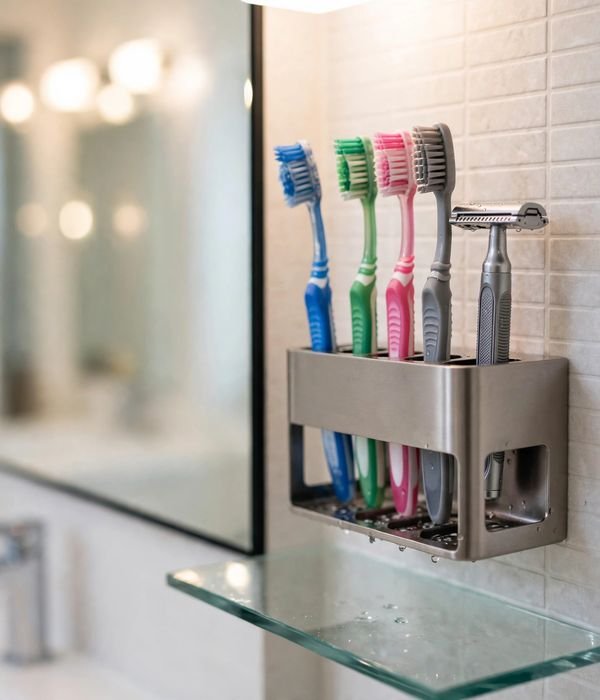
18. Adhesive Toothbrush & Razor Holders: Off the Counter, Off the Glass
Step one: pick the wall spot, beside the mirror at eye level, within arm’s reach of the sink. Step two: clean with rubbing alcohol, stick the holder, and wait the full cure time before loading (same rule as point 8, adhesive fails on soap scum, not on weight).
Step three: load it, a typical holder takes 4 toothbrushes plus a razor slot and a small cup. The counter space you reclaim is small but disproportionately valuable: toothbrush cups are the number one source of countertop grime rings.
Tips for best results: Choose a holder with drainage holes or an open bottom, enclosed cups grow mildew in a week. Stainless or BPA-free plastic both work; avoid chrome-plated metal (rust, again).
Mount razors blade-up in a dedicated slot, never loose in a cup. Watch out: keep the holder away from the direct splash zone of the faucet, constant soaking weakens even good adhesive over months. Under $15 for a set. Renter-safe.
Cabinet & Drawer Organization
Storage you cannot see still needs a system, otherwise cabinets become the place things go to disappear. These six ideas make the hidden zones work as hard as the visible ones.
19. Clear Stackable Bins: See Everything in the Linen Closet
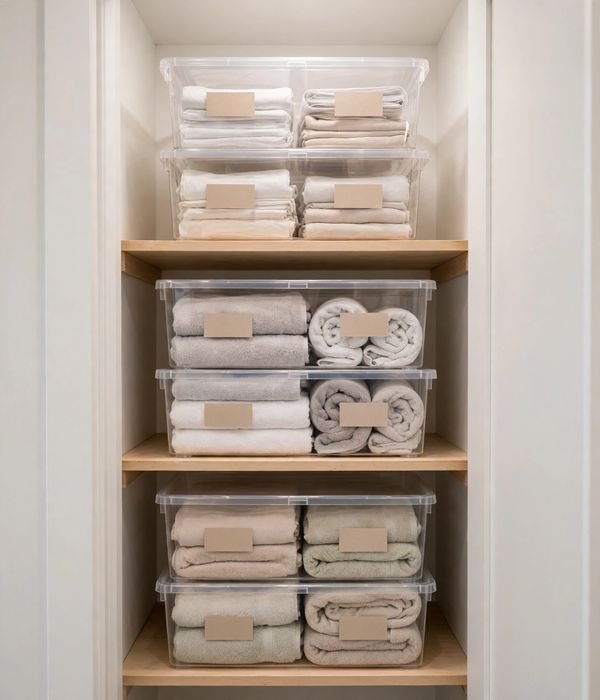
Opaque bins are where spare sheets go to be forgotten. Clear, stackable bins, the kind with lids, roughly 12 by 8 by 6 inches, turn a linen closet shelf into a visible inventory: you see the queen sheets, the spare pillowcases, the beach towels, without opening a thing.
Stack two high on a standard 12-inch-deep closet shelf, and label the short end facing out. The mechanism is visibility, you cannot overbuy what you can see.
What you can do with it:
- Dedicate one bin per sheet set (fitted + flat + two pillowcases fit in a 6-inch-tall bin)
- Keep a “guest ready” bin with fresh towels and a spare toothbrush set
- Store seasonal items (beach towels, holiday hand towels) in a top-shelf bin
- Use shallow bins for washcloths so they never avalanche
- Retire anything stained or threadbare the moment you decant, bins make the cull obvious
Tips for best results: Measure shelf depth before buying, bins that overhang the shelf edge catch on the door. Choose bins with latching lids if you stack three high; friction-fit lids slide. Under $25 for a set of four. This feeds into a full cabinet-organization system covered in a companion spoke.
20. Cabinet Turntable: Spin the Deep Shelf
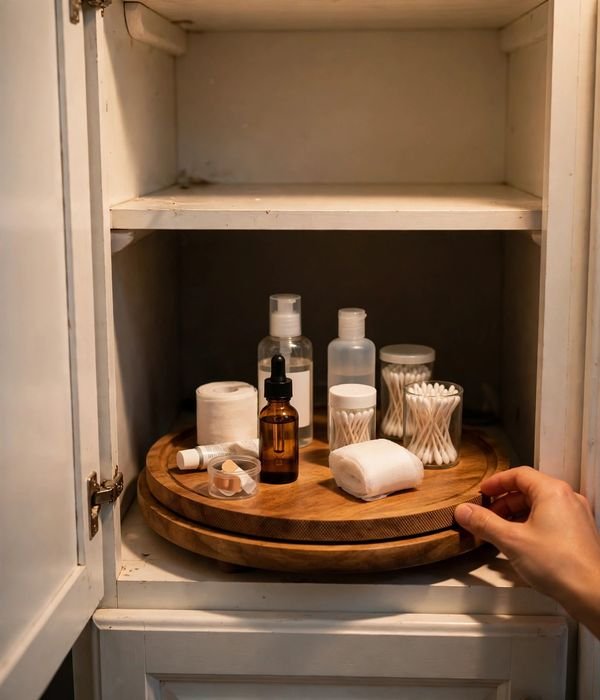
Deep bathroom cabinets, 18 to 22 inches, swallow bottles into a dark back row you never check. A 10- to 12-inch turntable (lazy susan) on that shelf brings the back row to you with one spin. It is the same mechanism as a corner kitchen cabinet, applied to the most frustrating shelf in the bathroom.
Raised-edge turntables keep tall bottles from tipping mid-spin.
What you can do with it:
- Load one turntable with all first-aid and medications-adjacent supplies (bandages, thermometers, saline, not humidity-sensitive pills, see point 23)
- Dedicate a second to cleaning supplies under the sink
- Group by person, one spin, everyone’s sunscreen and bug spray
- Use a two-tier turntable if the shelf height allows (needs 12+ inches of clearance)
- Wipe the base monthly; leaked products glue a turntable in place
Tips for best results: Non-skid surface matters more than looks, smooth plastic turntables let bottles slide and topple. Check the cabinet door swing: a 12-inch turntable needs the door fully open to spin freely. Under $15. Renter-safe.
21. Pull-Out Under-Sink Caddy: Slide, Don’t Reach
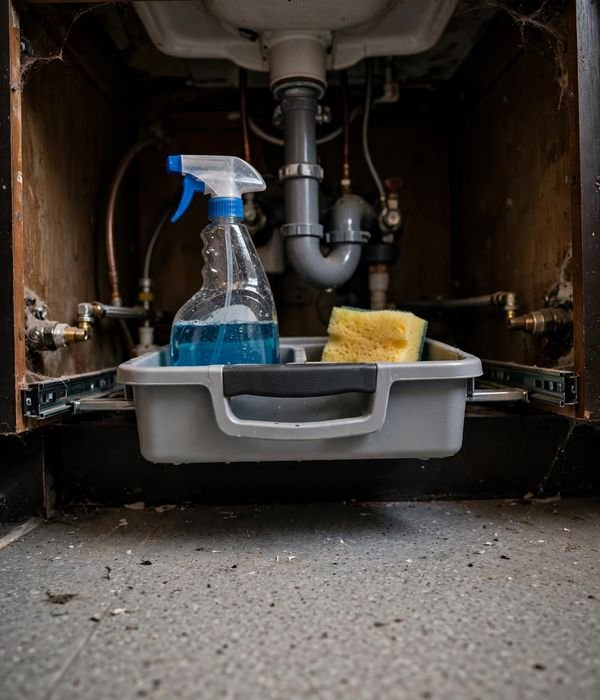
If the stackable organizer (point 1) is the structure, the pull-out caddy is the access, a handled tote or sliding drawer, roughly 10 by 14 inches, that glides out from under the sink on smooth rails or just a low-friction base. You pull, you grab the drain cleaner, you push it back.
No kneeling, no blind reaching past the trap. The handle is the whole trick: it converts a deep cabinet into a drawer without any installation.
What you can do with it:
- Keep all plumbing-adjacent supplies (plunger parts, drain snake, pipe tape) in one caddy
- Store daily cleaning spray and sponge where you can grab them one-handed
- Use a second caddy for hair tools with a heat-resistant liner
- Label the handle end so family members return it to the right cabinet
- Line the bottom with a washable mat, under-sink drips happen
Tips for best results: Measure around your pipes first, caddies come in 8-, 10-, and 12-inch widths, and the trap decides which fits. A caddy with a lid doubles as a dust cover in a cabinet that collects hair and lint. Under $20. Renter-safe. Pairs naturally with the pipe-zone spoke: under-sink bathroom storage ideas.
22. Over-the-Cabinet-Door Towel Bar: An Instant Extra Bar
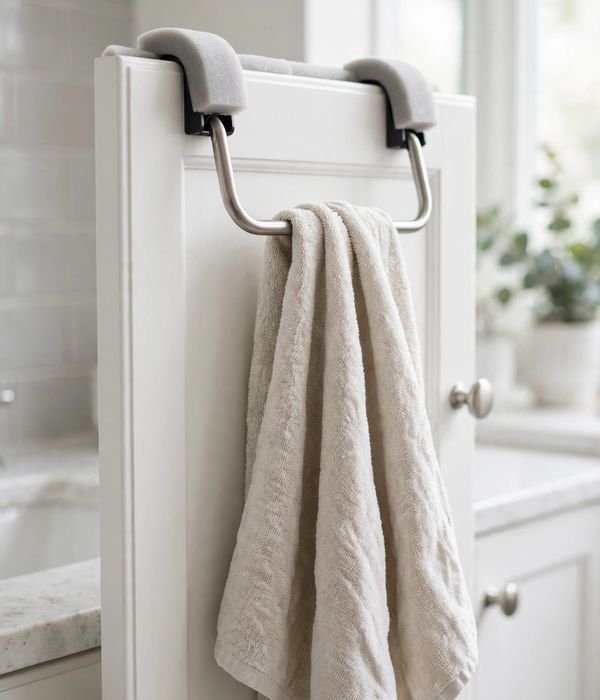
A bathroom with one towel bar and four people is a damp-towel crisis. An over-the-cabinet-door towel bar, a flat steel bar that hooks over any cabinet door 1/2 to 3/4 inch thick, adds a full second bar in ten seconds. Standard bars are 9 to 14 inches wide, perfect for hand towels and washcloths.
It works because the cabinet door is already a sturdy, unused vertical surface at exactly hand height.
What you can do with it:
- Hang the hand towel here and free the main bar for bath towels
- Dedicate it to washcloths, a family of four goes through them fast
- Use it inside the door for hidden drying (towels dry fine behind a closed door with airflow)
- Mount one on a linen closet door for overflow towel storage
- Keep it clear of the door’s soft-close mechanism so the door still shuts
Tips for best results: Foam-padded hooks protect the door finish and stop rattling. Check door thickness, older solid-wood doors can exceed 3/4 inch and need an adjustable model. Under $12. Renter-safe.
23. Medicine Relocation Station: Get Meds Out of the Humidity
This is the most important point in this guide, and it is about removing storage, not adding it. Bathroom humidity and heat degrade medications, the FDA advises storing most medicines in a cool, dry place at room temperature (59–86°F), and a steamy bathroom routinely exceeds both limits. Aspirin crumbles, capsules soften, and potency drops silently.
The fix: relocate daily and weekly meds to a bedroom drawer or hallway cabinet in a small lockable pouch or lidded bin, roughly 10 by 7 inches, with a weekly pill organizer inside.
What you can do with it:
- Move all daily prescriptions and vitamins to the new station this weekend
- Keep meds in original labeled bottles inside the pouch (never loose or unmarked)
- Store the station high or locked if kids visit, bathroom counters are within toddler reach
- Keep only bathroom-appropriate items in the old medicine cabinet: bandages, saline, thermometers
- Check labels for anything needing refrigeration (some insulins, eye drops), those were never bathroom items
Tips for best results: A small combination-lock pouch (under $20) solves humidity and child-safety in one move. Check expiry dates twice a year. Watch out: never store meds near the stove or above the dishwasher either, heat and steam are the same enemy. This is the rare storage upgrade that protects your health, not just your counter.
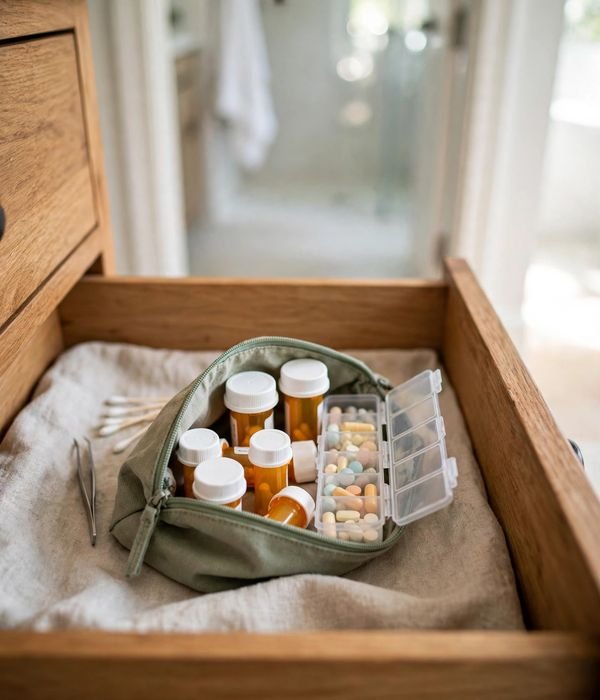
24. Labeled Bin System: One Label Prevents Ten Minutes of Searching
A label maker (or a roll of painter’s tape and a marker) is the cheapest organization tool in existence, under $15, and the highest ROI. Labeled bins work because they convert a private system into a household system: anyone can put the cotton balls back when the bin says COTTON BALLS.
In a bathroom shared by two or more people, unlabeled bins drift into junk bins within a month.
What you can do with it:
- Label every bin from points 19–21 the day you set them up
- Use broad categories (FIRST AID, DENTAL, HAIR) not micro-labels, micro-labels break the first time you buy a new product
- Label shelves too, not just bins, “ADULT TOWELS / KID TOWELS” ends the towel wars
- Re-label seasonally: sunscreen moves to the front bin in May, back in October
- Keep a few blank labels in the junk drawer for new bins
Tips for best results: A label maker with waterproof labels survives bathroom humidity; paper labels curl and fall off. Put labels on the short end of bins facing the door, that is the side you actually see. Under $15 total. A companion spoke covers the full budget version of this system with dollar-store finds.
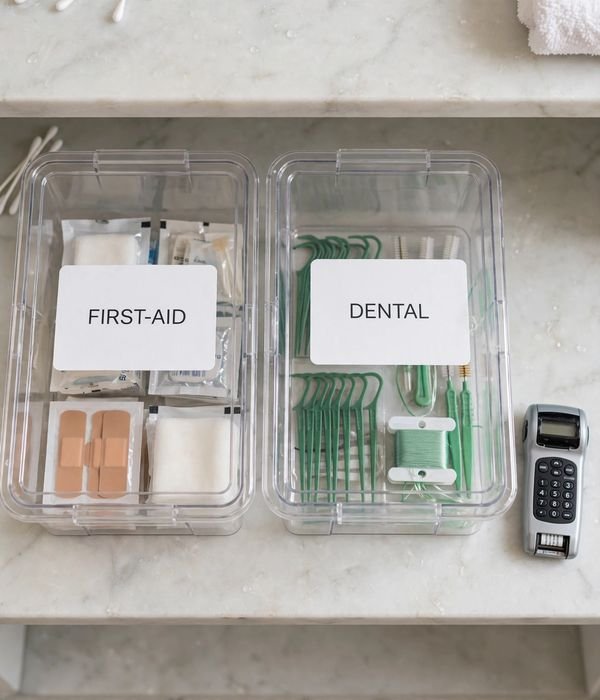
Linen & Backstock Storage
Towels and toilet paper are the two things a bathroom can never have enough of, and the two things that eat the most space. This group is about storing them smart.
25. Rolled Towels: The Hotel Fold That Saves 30 Percent
Fold a bath towel in thirds lengthwise, then roll it tight, it occupies roughly 30 percent less shelf volume than the same towel folded flat, and the roll will not topple when you pull the one beneath it. Hotels roll for exactly this reason: density plus stability.
A standard bath towel (27 by 52 inches) rolls to about a 6-inch diameter cylinder that fits a 12-inch-deep shelf two deep, or stands upright in a basket like files in a drawer.
Tips for best results: Roll washcloths and hand towels the same way and stand them upright in a divided basket, filed, not stacked, so you can see every color. Do not roll damp towels; they mildew faster rolled than flat.
Refresh the rolls every few months, a tight roll left for a year develops permanent creases. Watch out: rolling works for cotton and microfiber, not for thick bamboo towels, which spring open, fold those flat. Free, zero tools, works everywhere. The towel-specific spoke goes deeper: towel storage ideas for small bathrooms.
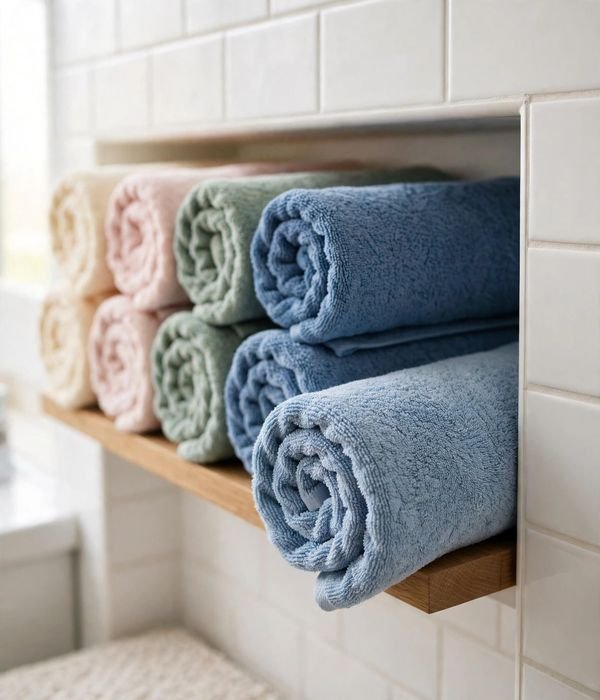
26. Towel Hooks Over Bars: Hooks Hold Twice the Towels
One towel bar holds one towel flat, or two bunched, which never dry. One row of four adhesive or screw-in hooks (spaced 6 to 8 inches apart) holds four towels with full airflow around each, in the same 24 inches of wall.
Hooks win on both capacity and drying: a bunched towel on a bar stays damp for hours and smells by day two; a towel on a hook dries in half the time. For a family bathroom, hooks are not a style choice, they are a mildew-prevention strategy.
Tips for best results: Mount hooks at 48 to 52 inches high so bath towels hang without pooling on the floor (a standard 52-inch-long bath towel needs the hook at 50+ inches). Give each person their own hook, assigned hooks end the “whose damp towel is this” debate.
Adhesive hooks hold 3 to 5 pounds each (plenty for a dry towel); screw-in hooks hold wet bathrobes too. Watch out: adhesive hooks need the same rubbing-alcohol prep and cure time as every other adhesive in this guide, steam is the enemy of a rushed bond. $10–$20 for a set of four.
Renters: adhesive hooks remove cleanly with the pull-tab.
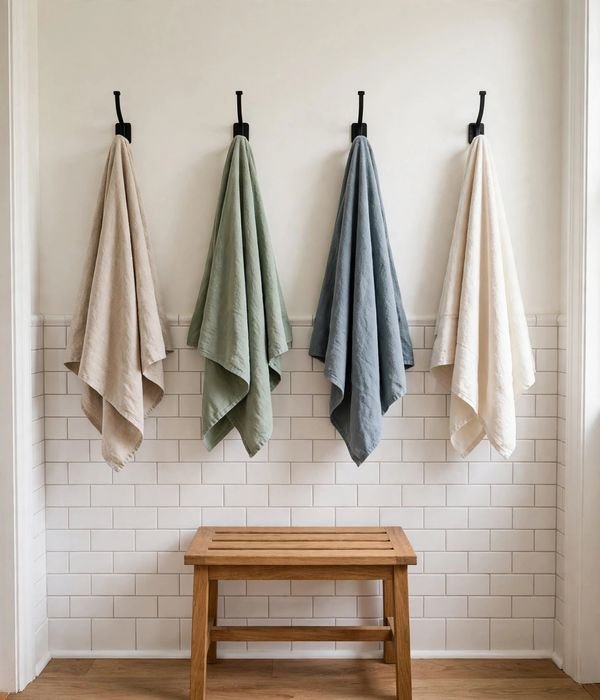
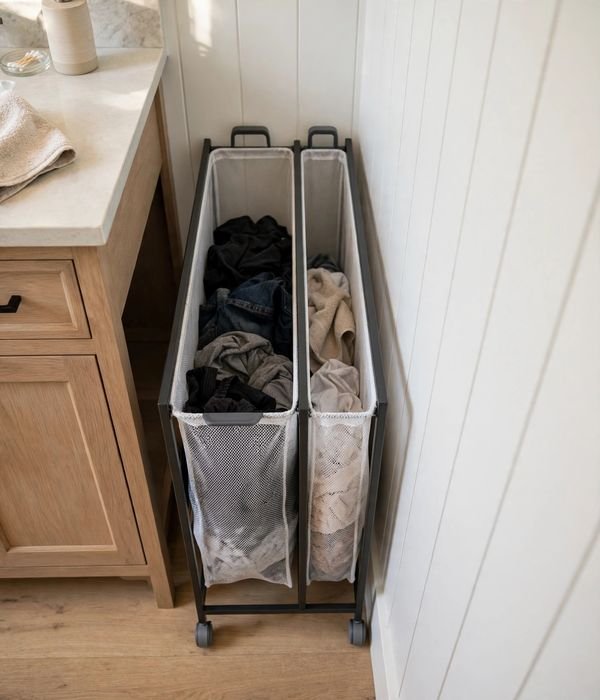
27. Slim Rolling Hamper: Sort Laundry in 8 Inches of Width
A two-compartment slim rolling hamper, typically 8 to 10 inches wide, 20 to 24 inches tall, slides into the gap between the washer area and the wall (or beside the vanity) and sorts lights from darks at the source.
The wheels matter: a hamper you can roll to the laundry room gets used; a hamper you have to carry gets ignored until clothes pile on the floor. Mesh or ventilated sides keep damp towels from mildewing between wash days.
Tips for best results: Two compartments minimum, sorting at drop-off saves the pre-wash sort entirely. Choose a hamper with removable bags so you carry the bag, not the whole frame, to the machines.
If the bathroom is truly tiny, a single-compartment slim hamper plus a hanging mesh bag for delicates covers it. Watch out: do not let wet towels sit more than two days, ventilated or not, mildew starts at about 48 hours in a humid bathroom. Typical price band: $25–$45. Renter-safe.
The laundry cluster extends this with more hamper and basket ideas.
28. Backstock Bin: One In, One Out for Bulk Buys
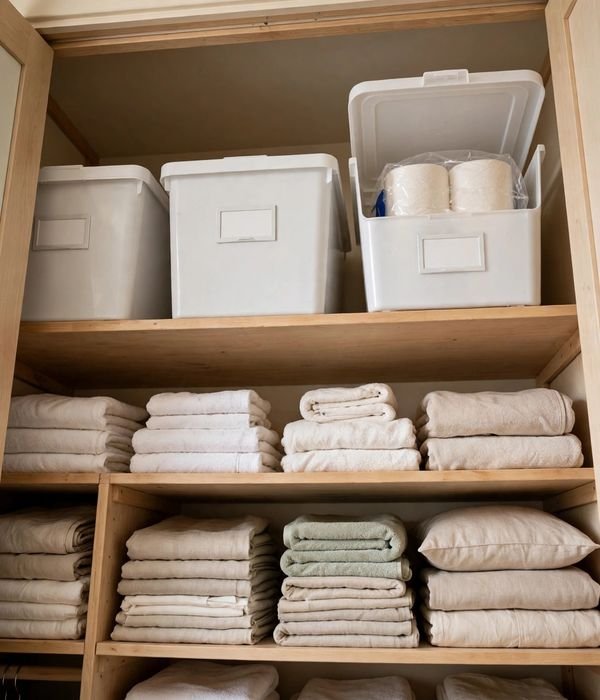
Bulk buying saves money only if the backstock has a home, otherwise twelve toilet paper rolls colonize the hallway. The rule is one bin per category (toilet paper, tissues, soap refills), sized to one bulk pack, stored on the highest shelf or the back of the linen closet.
When the bin is empty, you buy more; when it is full, you stop. The bin is a physical inventory cap, and it ends both overbuying and the “we’re out?!” surprise.
Tips for best results: A standard 12-roll toilet paper pack needs a bin roughly 16 by 12 by 12 inches, measure your top shelf before buying the bin. Decant travel-size items into a small “guest/away” pouch so backstock never migrates to the counter.
Date bulk cleaning refills with a marker, most lose potency after a year. Watch out: backstock belongs up high or in a closet, never under the sink where leaks ruin paper goods. Under $15 per bin. A companion spoke covers cleaning-supply storage for homes with no closet at all.
29. Over-the-Door Pocket Organizer: A Linen Closet on the Door
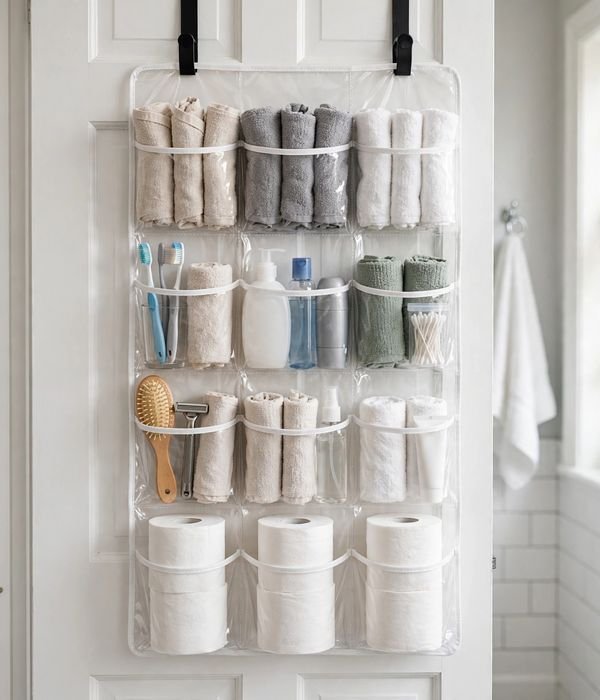
A 24-pocket over-the-door organizer (about 12 by 48 inches of clear vinyl pockets) turns any bathroom or closet door into a full linen station: washcloths, hand towels, toiletries, first-aid, spare toilet paper, each in its own visible pocket. Clear pockets are the mechanism, you see everything, so nothing expires or duplicates.
It holds the contents of roughly two linen-closet shelves with zero shelf space required.
Tips for best results: Assign the top rows to adult items and the bottom rows to kids’ items, little arms reach the bottom pockets. Use the deepest pockets for rolled washcloths and the shallow ones for flat items like bandage boxes.
Cut the organizer’s bottom strap if it drags on the floor, most are made to trim. Watch out: a fully loaded organizer weighs 10 to 15 pounds, make sure the door hinges are solid and the door still latches (same test as point 16). Under $12. Renter-safe, moves with you.
30. High-Shelf Backstock: Store the Backups Up High
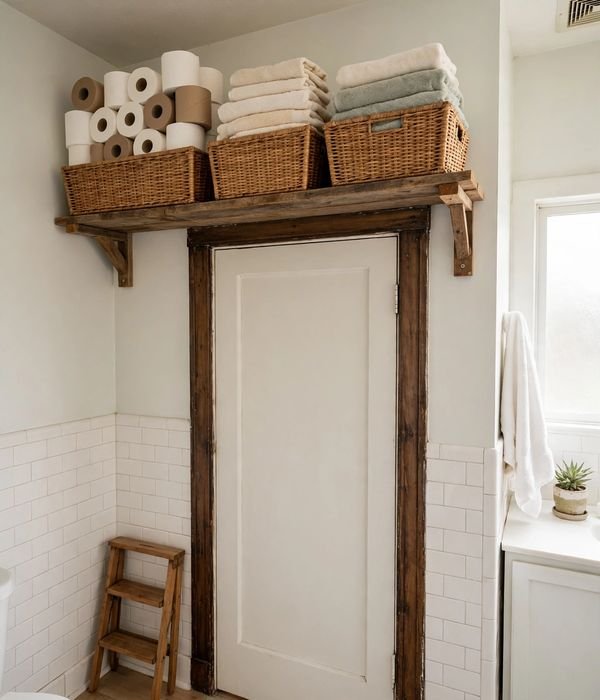
The shelf above the bathroom door, or the top 12 inches of any tall cabinet, is the most underused cubic foot in the house. It is perfect for backstock precisely because you reach it rarely: bulk toilet paper, spare towels, the backup shower curtain, seasonal items.
Install one 24- to 36-inch shelf 12 inches below the ceiling (above-door clearance is usually 4 to 6 inches, so mount the shelf on the wall beside or above the door frame, not on the door itself), and keep a small folding step stool in the linen closet for access.
Tips for best results: Store everything up here in labeled bins (point 24), unlabeled high shelves become mystery boxes within months.
Keep a written inventory on the inside of the cabinet door: “TOP SHELF: 12 TP, 4 towels, curtain rings.” Heaviest items go on wall-mounted shelves into studs, never on adhesive mounts. Watch out: this shelf is for backstock, not daily items, if you are climbing for something weekly, it lives too high. $15–$30 for a shelf and brackets (needs screws, get landlord approval if renting).
A budget refresh ties the whole bathroom together: low-budget bathroom makeover ideas.
Conclusion
Thirty ideas is a lot, but you do not need thirty, you need the three that fix your mornings.
If I had to name the best first upgrade for most bathrooms, it is the over-the-toilet etagere (point 13): it adds three shelves in zero floor space, it works in rentals and owned homes alike, and at $30–$60 it is the cheapest square footage you will ever buy.
Second place goes to the tension-pole shower caddy (point 7) for anyone whose shower is currently a bottle obstacle course. And the single most impactful move costs nothing: roll your towels (point 25) and move your medications out of the bathroom (point 23) this weekend.
Start with your biggest daily annoyance, measure twice before you buy anything, and remember the renter’s mantra that runs through this whole guide, tension, adhesive, and over-the-door first; screws only with permission. Small bathrooms reward the measurer. Now grab the tape measure and claim your 15 inches.
Frequently Asked Questions (FAQ)
How do I add storage to a very small bathroom without renovating?
Claim the zones the fixtures do not use: over the toilet (an etagere adds three shelves in zero floor space), the shower corner (a tension-pole caddy needs no drilling), the back of the door (hook racks and pocket organizers), and the 6-inch strip beside the vanity (a slim rolling cart).
If your bathroom is a 5×8-foot standard, these four zones together add the equivalent of a whole extra cabinet. For a full small-space playbook, see ideas, small bathroom storage ideas.
What is the best rust-proof material for shower storage?
304 stainless steel or aluminum. Chrome-plated steel looks identical on day one but the plating pits in daily steam and rusts within months, while 304 stainless and aluminum form their own protective oxide layer. Whatever the material, choose open or slotted shelves so water drains instead of pooling, standing water defeats even good materials over time.
Can I store medicines in the bathroom medicine cabinet?
You should not. The FDA advises storing most medications in a cool, dry place at room temperature (59–86°F), and bathrooms routinely exceed safe heat and humidity levels, moisture degrades active ingredients silently, so pills can lose potency before their expiry date.
Move daily meds to a bedroom drawer or hallway cabinet in a labeled, lockable pouch, and keep the bathroom cabinet for bandages and thermometers. If children visit, a lockable pouch solves child-safety at the same time.
How much weight can adhesive shower shelves actually hold?
On smooth, properly prepped tile, quality adhesive shelves hold 10 to 30 pounds per shelf, enough for full-size shampoo, conditioner, and body wash bottles. The prep is non-negotiable: clean with rubbing alcohol, press firmly for 30 seconds, and wait the full cure time (usually 24 hours) before loading.
Suction cups, by contrast, hold only 1–3 pounds and routinely fail in steam. Adhesive will not bond to textured tile, grout lines, or natural stone with pits.
Will an over-the-toilet storage unit fit my toilet?
Measure three things: tank width (typically 16–20 inches, keep the unit within 4 inches of it in small bathrooms), the tank lid’s top height (usually 27–32 inches off the floor, the unit’s bottom shelf must clear it with room to lift the lid), and the wall width available.
Standard units run 23–26 inches wide, 8–11 inches deep, and 60–68 inches tall. If the numbers work, anchor the unit to the wall, top-heavy etageres are a tip-over risk, especially with kids around. The dedicated guide has more: storage, over-the-toilet storage ideas.
What is the best way to store towels in a small bathroom?
Roll them, a rolled bath towel takes about 30 percent less shelf space than a folded one and will not topple the stack. Then hang daily-use towels on hooks, not bars: four hooks in 24 inches of wall hold four towels with full airflow, while one bar holds one towel flat.
Hooks dry towels in roughly half the time, which is what prevents the mildew smell. Give each person their own hook. More towel strategies: storage, towel storage ideas for small bathrooms.
How do I organize under a bathroom sink with pipes in the way?
Use organizers designed around the plumbing: a U-shaped or two-tier stackable unit that leaves the trap zone open, plus a pull-out caddy for the side zones. A standard 30-inch vanity gives you about 26 inches of interior width, measure the trap’s position and buy the organizer width that fits beside it.
Keep cleaning supplies low, daily toiletries high, and never block trap access (you will thank yourself during the first leak). Choose coated steel or plastic, under-sink cabinets are the dampest cabinets in the house.
Are over-the-door organizers renter-friendly?
Yes, they are among the most renter-friendly storage that exists. Over-door hook racks, pocket organizers, and towel bars hang on the door with no screws, no adhesive, and no marks; they move with you on moving day.
The only checks: confirm your door thickness (most interior doors are 1-3/8 inches), test that the door still latches with the rack on, and use the included felt pads so the rack does not scuff the frame. A companion spoke in this cluster is a full renter-friendly bathroom playbook.