Introduction
A small bedroom has enough working against it already. Limited floor space. Not enough storage. The permanent game of Tetris is arranging furniture when every inch counts. The last thing it needs is lighting that makes the problem worse, especially in compact homes where small apartment storage tricks already play a big role in making every inch count.
And yet, in most small bedrooms, that’s exactly what happens. Lighting gets treated as an afterthought, something to sort out after the bed is placed and the wardrobe is squeezed in. A floor lamp gets wedged into the only available corner. A table lamp ends up competing for space with a phone charger, a glass of water, and a growing stack of books on a bedside table the size of a postage stamp.
The result is a bedroom that feels dim, cramped, and never quite comfortable to be in.
Here’s what changes when you approach small bedroom lighting differently: the room feels bigger. Genuinely, visibly bigger. Because lighting isn’t just functional in a bedroom, it’s spatial. The right lighting reveals the full depth of a room, makes ceilings feel higher, softens hard edges, and creates a warmth that makes even the most compact space feel like somewhere you actually want to spend time.
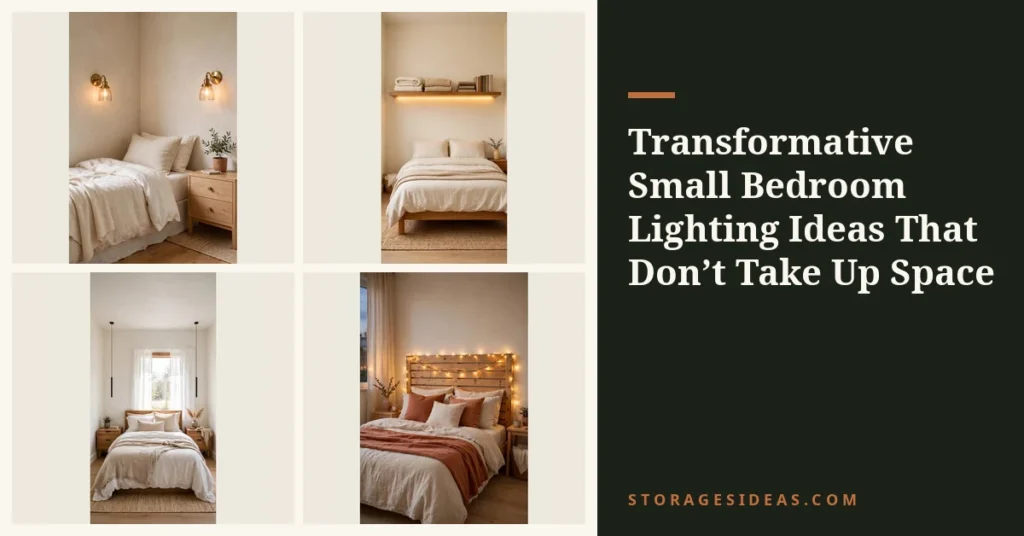
The good news is that the best small bedroom lighting ideas are specifically designed to work without claiming the floor space, the surface space, or the visual weight that a small room can’t afford to give up. These nine ideas are all practical, most are renter-friendly, and every single one makes a measurable difference.
Why Lighting Has an Outsized Effect in a Small Bedroom
Before diving into the ideas, it’s worth understanding why lighting is particularly impactful in a small bedroom, because the principle behind each idea will make more sense once you understand what’s actually happening visually.
Small rooms suffer from two lighting problems. The first is obvious: not enough light. The second is subtler but equally damaging: shadow. When a single overhead light is the only source in a small bedroom, it creates a bright center and progressively darker edges.
The corners, the areas under the bed, the wall beside the wardrobe, all in relative shadow. And shadow reads as a boundary. The eye interprets dark edges as walls closing in, which makes the room feel smaller than its actual dimensions.
The solution and the principle behind almost every idea in this guide is to move light off the ceiling and out toward the edges of the room. When the corners are lit, the full width of the room becomes visible. When light comes from multiple lower sources rather than one overhead fixture, the room feels layered and warm instead of flat and institutional. When walls are washed with light, they appear to recede, the room feels wider, taller, more generous.
None of this requires large, expensive, or space-consuming fixtures. It requires thoughtful placement. That’s what these small bedroom lighting ideas are about.
1. Wall-Mounted Bedside Lights Free the Bedside Table Completely
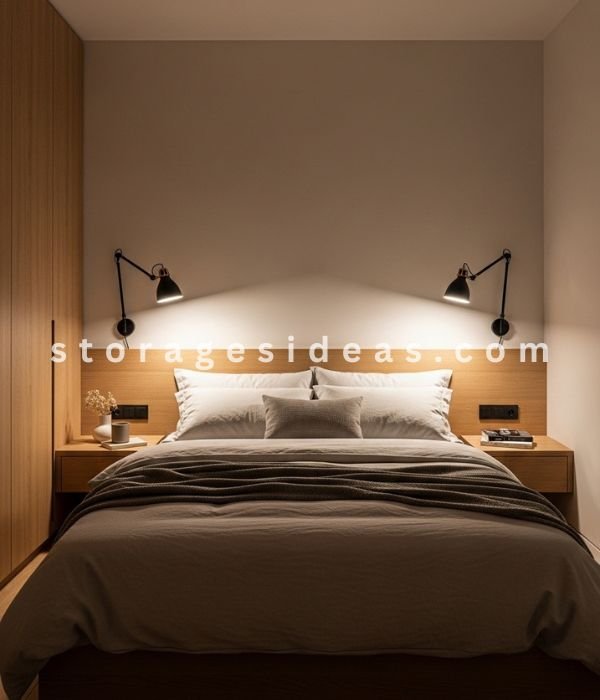
This is the single most impactful lighting change you can make in a small bedroom, and it costs less than most people expect. Replacing bedside table lamps with wall-mounted sconces fixed to the wall on either side of the bed, at reading height, immediately frees up every inch of the bedside table surface.
In a small bedroom, the bedside table surface is prime real estate, something often addressed with nightstand storage ideas that maximize function without adding bulk. A table lamp takes up a significant portion of it, leaving barely enough room for the practical items that actually need to be there. Remove the lamp, and the whole surface opens up to a phone, charger, book, and glass of water, all with room to spare.
Wall-mounted bedside lights also do something a table lamp can never do: they put the light exactly where reading requires it, directed downward over the pillow, adjustable to the right angle, close to the eye level of someone sitting up in bed.
Options for renters and owners alike:
- Plug-in wall sconces that require no wiring, the cable runs down the wall behind the bed and plugs into a standard socket, often hidden by the bedhead or a cord cover
- Battery-operated wall lights for a fully wire-free installation, rechargeable versions are widely available and surprisingly powerful.
- Hardwired sconces for permanent installations have a cleaner finish, require an electrician, but last indefinitely.
What to look for: An adjustable arm or swivel head so the light can be directed exactly where it’s needed. A dimmer function for the switch or the fitting itself, bright for reading, low for winding down.
This is the first recommendation in any honest guide to small bedroom lighting ideas, because it makes a bigger practical difference than almost anything else.
2. Recessed Ceiling Lights: Maximum Light, Zero Visual Bulk
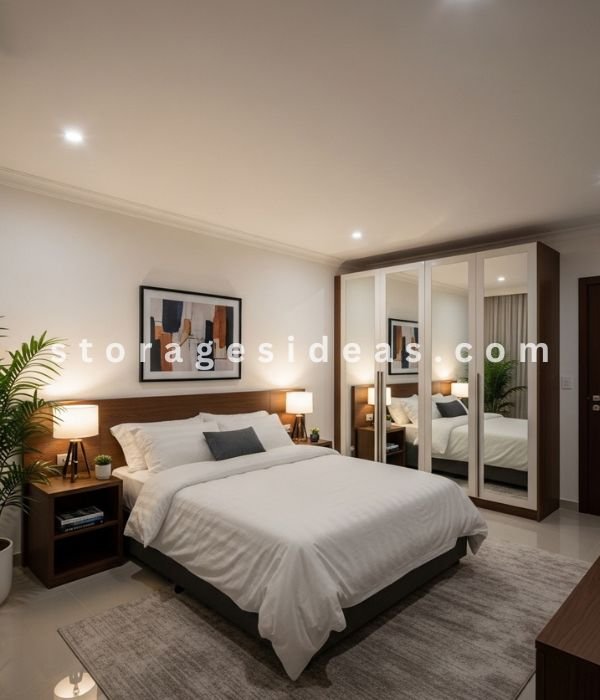
The standard ceiling fixture in most bedrooms, a pendant or a flush mount in the center of the ceiling, does a reasonable job of lighting the room but adds visual bulk and, in rooms with low ceilings, contributes to the sense of the ceiling pressing down.
Recessed downlights, by contrast, sit flush with the ceiling surface. They take up no visual space whatsoever. From below, you see a small ring and a light source, nothing more. The ceiling remains uninterrupted, which makes it read as higher and more expansive than it actually is.
A set of four recessed lights positioned toward the outer edges of the ceiling rather than clustered in the center lights the room from the perimeter inward, which illuminates the corners and removes the shadowy edges that make small rooms feel smaller.
Practical considerations:
- Recessed lighting requires installation not suitable for renters unless the landlord agrees
- Retrofit recessed LED kits are available for existing ceiling voids and are far less disruptive to install than traditional downlights.
- Always put recessed lights on a dimmer circuit, full brightness for getting dressed, and low for a relaxed evening atmosphere.
- Position toward the room’s edges, not the center, for the best spatial effect
Homeowners with a small bedroom are committed to improving it properly. Recessed lighting is one of the most transformative investments available.
3. LED Strip Lights Indirect Glow That Changes the Whole Room
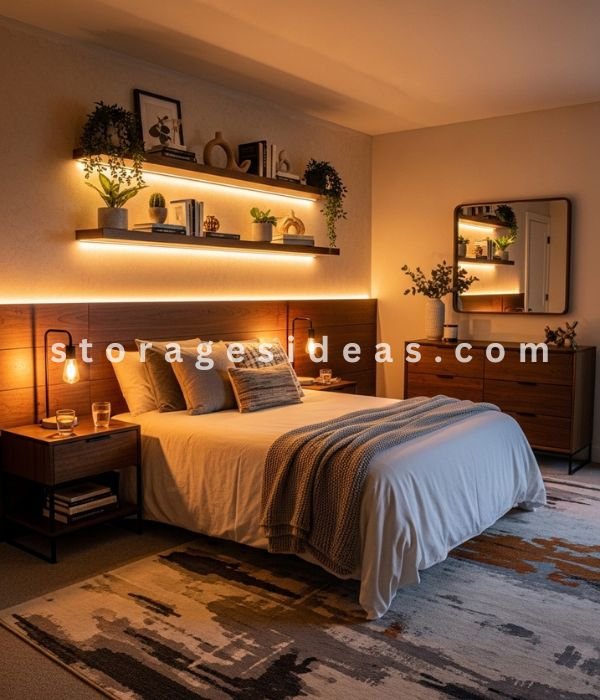
LED strip lighting is one of the most versatile and space-efficient of all small bedroom lighting ideas, and it’s one of the most underestimated. Installed invisibly behind a bedhead, along the underside of a floating shelf, or in a recess above a wardrobe, LED strip lights add a layer of warm ambient glow that no other light source replicates.
The effect is indirect light; the strip itself is hidden, and what you see is a soft, diffused glow emanating from behind or below a surface. This kind of light is exceptionally flattering in a bedroom. It adds depth and warmth without any visible light fitting, and it makes the room feel designed and considered in a way that a standard lamp never achieves.
Where LED strips work best in a small bedroom:
- Behind a wall-mounted bedhead or a floating headboard panel creates a halo of warm light around the bed that is genuinely beautiful in the evening
- Along the underside of floating bedside shelves or wall-mounted cabinets, lights the surface below without any visible fitting
- Above the top of a wardrobe, directed toward the ceiling, a soft uplighting effect that makes the ceiling feel higher
- Along the skirting board or beneath the bed frame for a subtle, atmospheric floor-level glow
- Inside a wardrobe or clothes cupboard, practical and surprisingly pleasing every time the door opens
Most LED strips are adhesive-backed, plug-in, and cuttable to length, making them fully renter-friendly and installable in minutes. Smart LED strips with app control allow color temperature and brightness adjustment from a phone, which is genuinely useful in a bedroom used at different times of day.
4. Pendant Lights Over the Bed Style and Function Without the Footprint
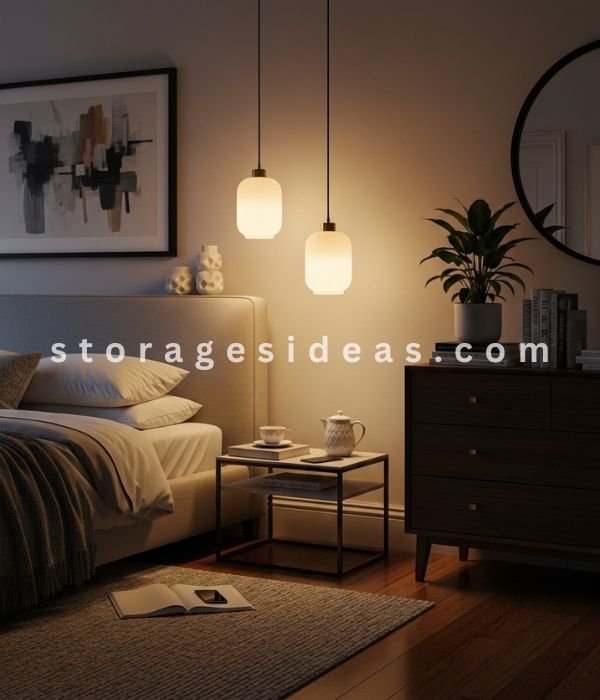
If wall-mounted sconces aren’t possible but table lamps aren’t working either, hanging pendant lights over each side of the bed is an elegant alternative that keeps the bedside surface completely clear while adding a design statement to the room.
A pair of slim pendant lights hung from the ceiling above the bedhead, at reading height, provides directional bedside illumination with no surface footprint at all. The pendants themselves become part of the room’s visual character, drawing the eye upward and contributing to the sense of ceiling height.
What works well as a bedroom pendant:
- Slim, minimal pendants with a small shade, nothing too large or heavy-looking in a small room
- Exposed bulb pendants for a clean, airy aesthetic that adds warmth without visual weight
- Fabric cord pendants with a small Edison bulb are warm, characterful, and inexpensive
- Adjustable-height pendants that can be lowered for reading and raised for ambient light
For renters: Plug-in pendant lights are widely available. They hang from a ceiling hook and plug into a wall socket, with the cord draped along the ceiling or wall for a tidier appearance. No electrician required.
The pendant-over-bed approach works especially well in bedrooms where the bedside tables are small, or wall-mounting isn’t possible, the light comes from above rather than from the surface, leaving the table free for everything else.
5. Practical Small Bedroom Lighting Ideas: The Clip-On and Clamp Light
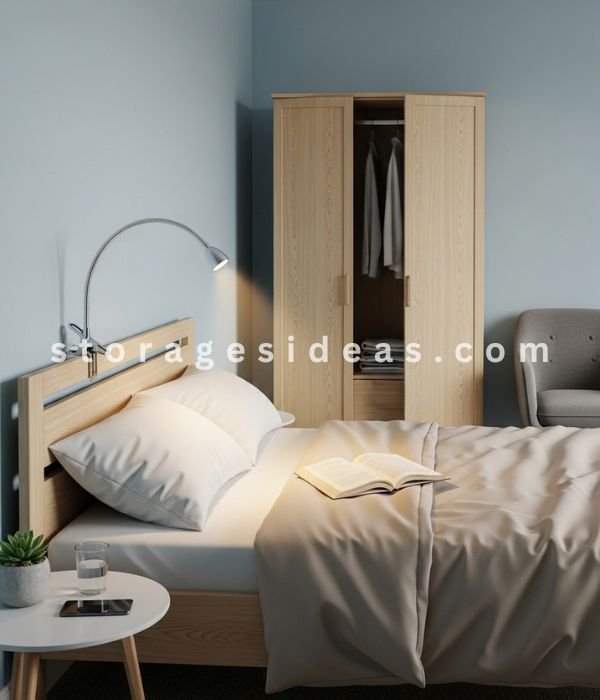
Sometimes the best solution is the simplest one. A clip-on or clamp reading light attached directly to the bedhead, a shelf edge, or the top of a book is one of the most practical and space-efficient bedside lighting solutions available. It takes up almost no space, costs very little, requires no installation, and puts light exactly where it’s needed.
Modern clip-on lights have come a long way from the awkward, plasticky designs of the past. Rechargeable, dimmable, with adjustable arms and color temperature settings, today’s clip lights are functional, well-designed, and surprisingly attractive. Some are small enough to be almost invisible when not in use.
Where clip lights work particularly well:
- Attached to a floating shelf above the bed provides a reading light without any additional furniture
- Clipped to the top of a slim bedhead panel, integrated and discreet
- On a thin wardrobe door or shelf edge, a useful accent or task lighting in tight spaces
- Attached to a desk or dressing table in a bedroom that doubles as a workspace
This is the most renter-friendly, budget-friendly, and space-friendly of all the small bedroom lighting ideas in this guide. If a small bedroom needs better bedside lighting immediately, with no installation, no cost, and no commitment, a clip light is the answer.
6. Floating Bedside Shelves with Integrated Lighting
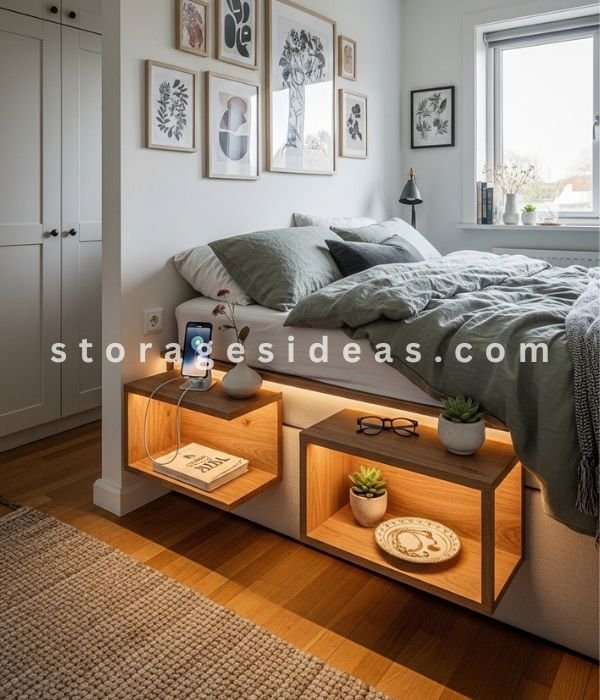
This idea combines two of the most common small bedroom problems, not enough bedside storage and not enough thoughtful lighting, into a single elegant solution. A floating shelf mounted beside or above the bed, with a small integrated light source beneath or behind it, replaces both the bedside table and the bedside lamp in one space-saving installation.
The shelf provides surface space for a nighttime essentials phone, charger, book, and a glass while taking up zero floor space. The light source beneath or behind it provides soft, directed bedside illumination. The result is a bedside setup that does everything a table-and-lamp combination does, in half the visual space and with a cleaner, more considered aesthetic.
How to achieve it:
- A floating timber shelf with an LED puck light or short LED strip underneath is inexpensive, DIY-friendly, and effective
- A wall-mounted shelf unit with a built-in reading light is available as a ready-made product in various styles
- A deep floating shelf with a small plug-in sconce mounted on the wall just above the shelf, and light as separate pieces that read as a single unit
The spatial benefit: No legs, no base, no floor footprint, a principle shared with hidden storage ideas that keep small bedrooms functional without visual clutter.
In a small bedroom where every square centimetre of floor space matters, a floating shelf with integrated lighting is genuinely one of the most space-efficient bedside solutions possible.
7. Wardrobe and Alcove Lighting Illuminating the Forgotten Corners
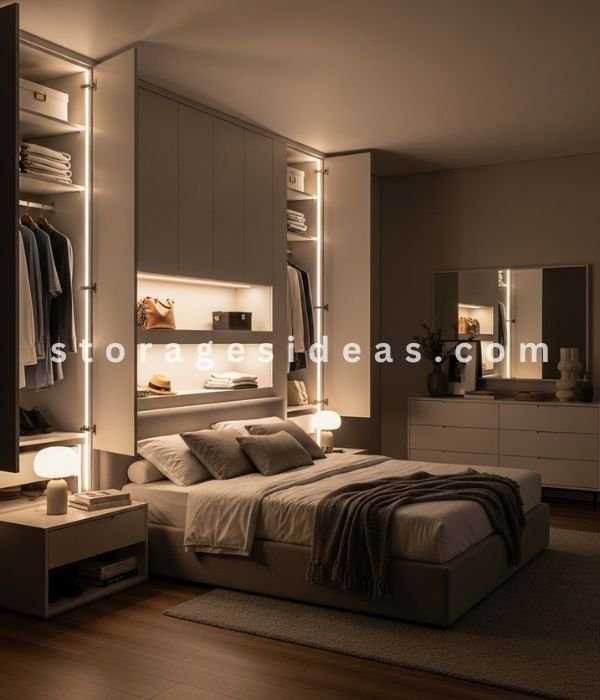
The corners and recesses of a small bedroom, the inside of wardrobes, the top of alcove shelving, and the space under a raised bed are almost always in shadow. And as established earlier, shadow in a small room reads as a boundary. Lighting these corners and recesses doesn’t just make them more functional; it makes the room feel larger by revealing its full extent.
Inside a wardrobe, proper lighting is both practical and transformative, especially when paired with small closet organization ideas that make every section easier to use. Being able to see everything clearly makes getting dressed faster, prevents the frustrated rummaging that accompanies a dark cupboard, and removes the daily low-level frustration of a bedroom that doesn’t work properly.
Simple ways to light corners and recesses in a small bedroom:
- Battery-operated motion-sensor LED lights inside wardrobes and cupboards activate on opening, require no wiring
- LED strip lights along the top rail inside a wardrobe, even, shadow-free illumination across all clothing
- A small LED spotlight directed into a dark alcove or recess, with battery-powered versions available
- Under-bed LED strips illuminate the floor beneath a raised bed, which makes the floor area feel larger, and the room feel more open.
- A small LED light inside a bedside cabinet or drawer is surprisingly useful, surprisingly pleasing.
These are small additions, inexpensive, quick to install, and completely renter-friendly. But cumulatively, lighting the dark corners of a small bedroom makes an enormous difference to how spacious and functional the room feels.
8. Mirrors and Light Working Together: The Multiplier Effect
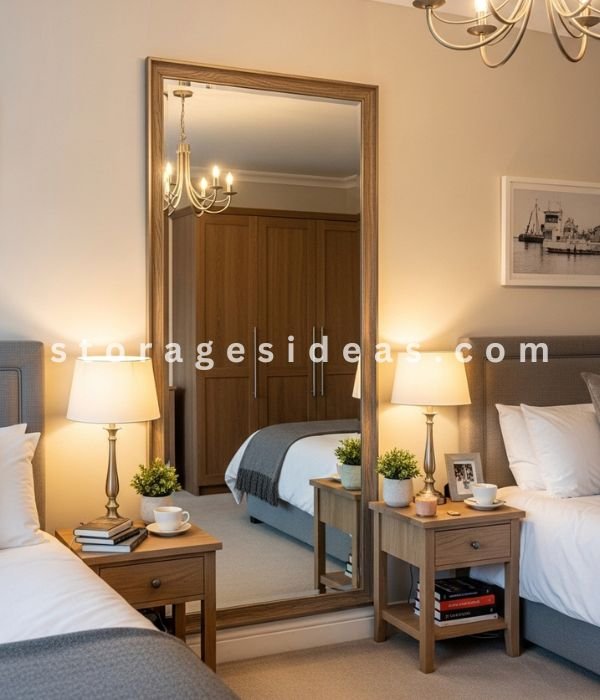
A well-placed mirror in a small bedroom doesn’t just show you your reflection, it doubles the apparent light in the room and makes the space feel significantly larger. Paired with thoughtful lighting, a mirror becomes one of the most powerful tools available in a small bedroom.
The principle is straightforward: a mirror reflects whatever light source is opposite or adjacent to it. A wall-mounted sconce beside a mirror reflects its own light back into the room, effectively doubling its output. A mirror positioned opposite a window bounces daylight deep into a dark bedroom. A mirrored wardrobe door on one wall reflects the entire room, including its light sources, back on itself, making the space feel twice as wide.
How to maximize the mirror-and-light combination:
- Mount a sconce or small wall light beside rather than above a mirror; the light falls more flatteringly and reflects more effectively than an overhead position
- Place a full-length mirror on the wall opposite the main window to maximize natural light during the day
- Use a mirrored bedside tray to reflect the glow of bedside lights back upward, a small trick that adds warmth and luminosity to the bedside area
- Consider a mirrored wardrobe door on one wall. It serves a practical function, doubles the perceived width of the room, and multiplies whatever light exists nearby.
Mirrors don’t cost much, take up no additional space (the wall was already there), and work continuously, all day and all evening, without any power consumption. In a small bedroom, they are among the most cost-effective light-enhancing tools available.
9. Dimmable Lighting and Warm Bulbs: The Detail That Ties Everything Together
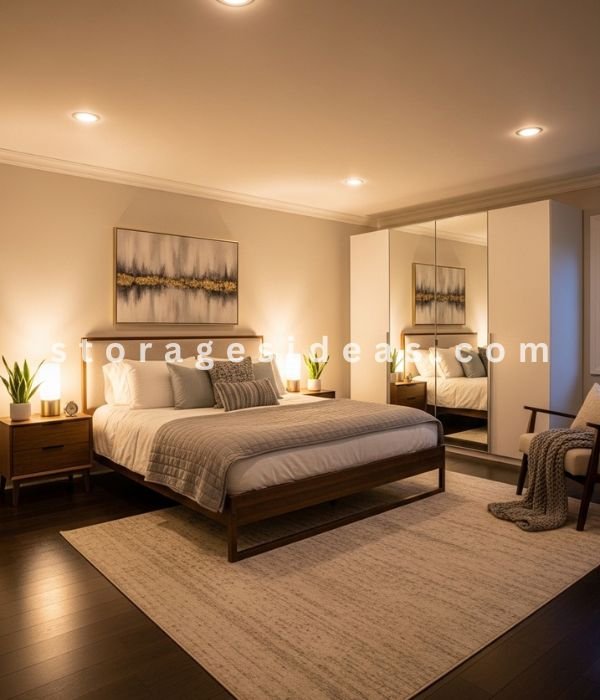
The final idea isn’t about a specific fitting or a particular placement; it’s about the quality and controllability of the light across every source in the bedroom. Because a small bedroom can have all the right lights in all the right places, and still feel wrong if the bulbs are the wrong temperature or the brightness can’t be adjusted.
Bedrooms need light that changes throughout the day. Brighter, cooler light in the morning helps with getting dressed and applying makeup. Warm, dimmed light in the evening signals to the body that it’s time to wind down and creates the cozy, intimate atmosphere that makes a small bedroom feel like a sanctuary rather than a box.
Bulb temperature guidelines for small bedrooms:
- 2700K–3000K warm white for the primary bedroom lighting, soft, flattering, and relaxing in the evening
- No higher than 3000K anywhere in the bedroom. Cooler light above this range makes the room feel clinical and disrupts sleep patterns
- High CRI (90+) bulbs for the truest, most flattering color rendering are particularly important near mirrors and dressing areas
Making every light source dimmable:
- Smart bulbs in ceiling fixtures are dimmable via app or voice control with no additional wiring
- Plug-in dimmer adapters between the socket and the lamp for any table or floor lamp
- LED strips with a dimmer controller built into the power supply
- Wall sconces and pendants wired to a dimmer switch are essential for any hardwired bedside lighting
When every light source in a small bedroom is warm-toned and dimmable, the room transforms at different times of day. That flexibility from bright and functional to low and restful is what makes a small bedroom feel genuinely liveable, not just adequately lit.
Conclusion
A small bedroom doesn’t need to feel small. It needs better lighting.
Not more, but better lighting. Lighting that moves off the ceiling and out toward the edges of the room. Lighting that frees up the surface space beside the bed instead of consuming it. Lighting that reveals the room’s corners and recesses instead of leaving them in shadow. Lighting that’s warm enough to feel restful in the evening and flexible enough to be useful in the morning.
These small bedroom lighting ideas all share one quality: they treat the bedroom’s limited space as a design constraint to work with rather than a problem to work around. Wall sconces instead of table lamps. Pendants instead of bulky floor lights. LED strips behind surfaces instead of freestanding lamps in corners. Each idea gives back space while simultaneously improving the quality of light in the room.
Start with the change that solves your biggest current frustration. If the bedside table is constantly overcrowded, consider wall-mounted sconces. If the room feels flat and dim in the evenings, install LED strips behind the bedhead. If the corners feel oppressive and close, a mirror positioned to reflect light back into the room. One well-chosen change leads naturally to the next, and the room improves with each one.
Small bedroom. Thoughtful light. A space that finally feels like it’s working with you.
Creating a comfortable bedroom environment relies heavily on well-planned lighting layers and placement, as outlined in home lighting guidance and design basics from IKEA.
Frequently Asked Questions (FAQ)
What is the best lighting for a small bedroom?
The best approach for a small bedroom is layered lighting, multiple sources at different heights rather than a single overhead fixture. Wall-mounted sconces beside the bed free up surface space while providing practical reading light. LED strips behind a bedhead or under shelves add a warm ambient glow. A dimmable ceiling light provides general illumination when needed. Together, these layers make the room feel larger, warmer, and more comfortable than any single light source can achieve alone.
How can I add bedside lighting without taking up table space?
Wall-mounted sconces are the most effective solution, as they fix to the wall at reading height on either side of the bed, providing excellent bedside light with zero surface footprint. Pendant lights hung from the ceiling above the bedhead work equally well. For a no-installation option, a clip-on reading light attached to the bedhead or a floating shelf gives directional bedside light without claiming any surface space at all.
Can lighting make a small bedroom look bigger?
Yes, significantly. Lighting that illuminates the corners and edges of a room removes the shadows that make boundaries feel closer. Uplighting directed toward the ceiling makes it feel higher. Mirrors used in combination with light sources reflect and multiply the light in the room, making the space feel more expansive. Warm, layered lighting consistently makes small bedrooms feel more spacious than a single bright overhead light.
What color temperature is best for a small bedroom?
Warm white at 2700K–3000K is the right choice for a bedroom. It creates a soft, relaxing atmosphere in the evenings and a flattering, comfortable light quality at any time of day. Avoid anything above 3500K in a bedroom. Cooler light makes the space feel clinical, disrupts the transition to sleep, and tends to emphasize the room’s limitations rather than softening them.
Are there good bedroom lighting ideas for renters who can’t drill into walls?
Yes, most of the ideas in this guide work without drilling. Plug-in wall sconces look like hardwired lights but connect to a standard socket. Battery-operated LED sconces require no wiring or plugs whatsoever. Clip-on reading lights attach to shelves or bedheads with no fixings. Adhesive-backed LED strips peel off without damaging walls. Plug-in pendant lights hang from a ceiling hook and connect to a socket. Renters have more lighting options than ever; almost any effect is achievable without permanent installation.
Want more ideas for making a small bedroom work harder? Browse our other articles on small space furniture, bedroom organization tips, and practical home décor ideas for compact living.