
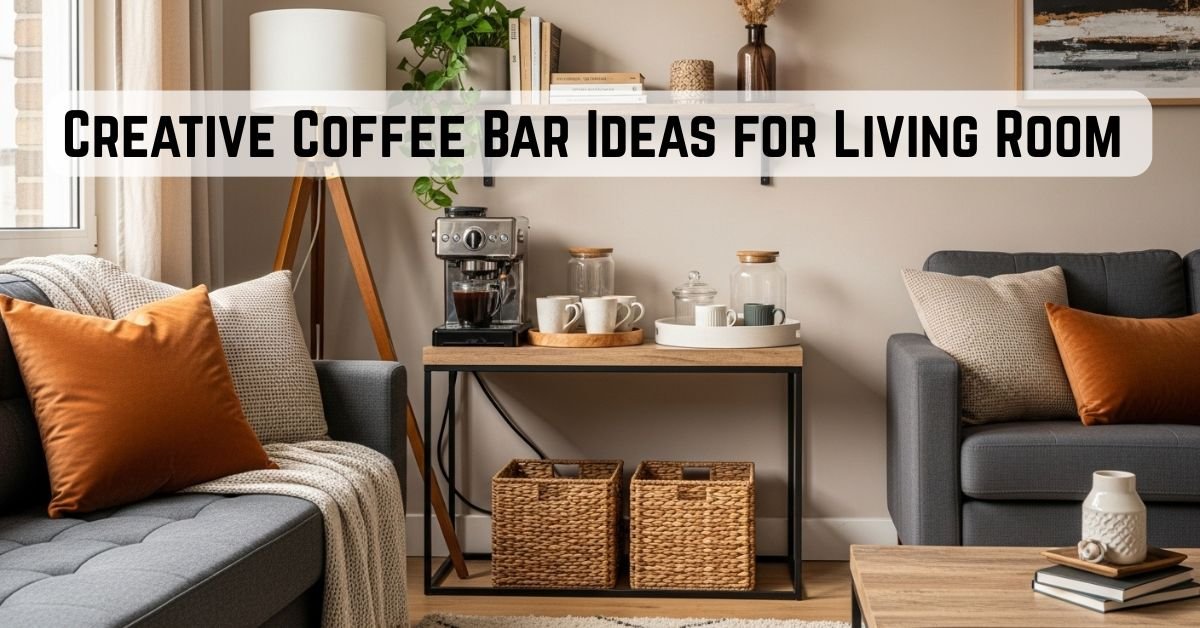
I didn’t think a coffee setup belonged in my living room.
It always felt like something that needed a dedicated space, like a kitchen counter or a full cabinet. My living room already felt “full,” so adding anything else seemed like a bad idea.
But at the same time, I kept noticing small moments.
Walking to the kitchen just for coffee. Leaving mugs on the table. Letting small things pile up because there wasn’t a proper spot for them.
That’s when it started to make sense.
The problem wasn’t space; it was how I was using it.
Once I started trying a few small coffee bar ideas for living room setups in corners I was already ignoring, everything shifted. The space didn’t feel tighter; it actually felt more organized and easier to use.
And that’s when I realized something simple.
A coffee bar doesn’t need space.
I had seen a similar shift before when I tested a few under bed storage ideas, and it made me realize how much unused space I had been overlooking.
It just needs the right spot.
Why Most Coffee Bar Setups Fail in Small Living Rooms
Most setups fail before they even start.
Not because the idea is bad, but because the setup doesn’t match the space.
I made that mistake early.
I tried to add a coffee bar the same way I saw online, bigger surface, more items, more styling. It looked good for a moment, but it didn’t last.
It felt out of place.
The living room isn’t designed like a kitchen. It’s shared, visible, and constantly in use. So anything that feels “added” instead of integrated stands out immediately.
There was another issue I didn’t notice at first.
No defined boundary.
Without a clear zone, the setup slowly spread. Cups moved. Items shifted. And within a few days, it stopped feeling like a coffee bar and started looking like clutter.
That’s when I changed how I approached it.
Instead of adding a setup, I started building around how I actually use the space.
Once I did that, even the smallest corner started working.
8 Small Coffee Bar Ideas for Living Room That Fit in Any Corner
1. The “Use What Already Exists” Corner Setup
I didn’t start by buying anything.
I started by removing things.
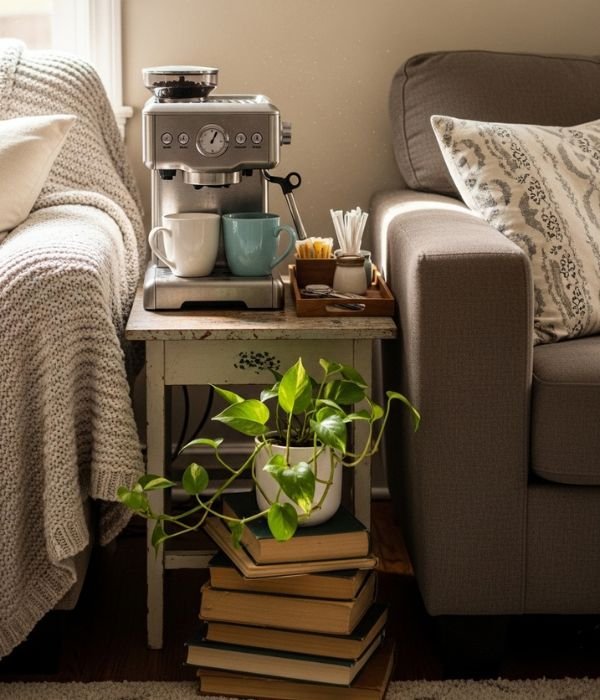
There was a corner next to my sofa that already had a small table, but it wasn’t doing anything useful. Just random items sitting there.
So I cleared it completely.
Not reorganized. Cleared.
Then I rebuilt it with intention:
- Coffee machine
- One tray
- Two mugs
That was enough.
What made this one of the most effective small coffee bar ideas for living room setups wasn’t the setup itself; it was the decision to stop treating that corner like a dumping space.
What changed:
The space didn’t feel “new.” It felt repurposed.
What to watch out for:
If you leave even a little room for random items, they’ll come back.
This only works if the space has a single purpose.
2. The “Depth Control” Slim Setup
I learned this the hard way.
Even a good setup can fail if it sticks out too much.
I once used a table that was just slightly deeper than it should have been. Not by much, but enough to interrupt movement.
That small detail made the whole area feel tight.
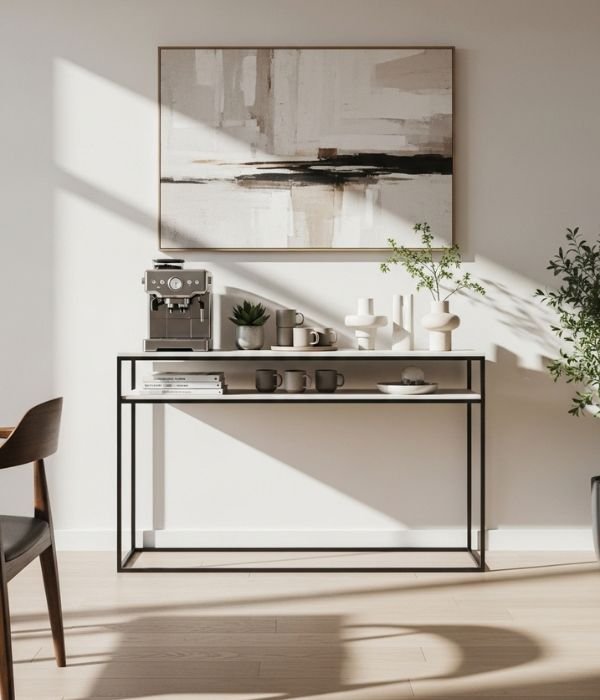
So I switched to a narrow surface (around 10–12 inches deep).
The difference was immediate.
Now the setup fits into the room instead of pushing into it.
This turned into one of those small coffee bar ideas for living room setups that work because it respects how people move through the space.
What I check now:
- Can I walk past it without adjusting my path?
- Does it visually “stick out”?
If yes, it’s too big.
Size isn’t the problem. Proportion is.
I started noticing this in other parts of my home too, and these small living room furniture and decor hacks show how even small size changes can affect how a space feels.
3. The “Two-Level Access” Shelf System
Flat setups didn’t work for me.
Everything ended up on one surface, and that surface filled up fast.
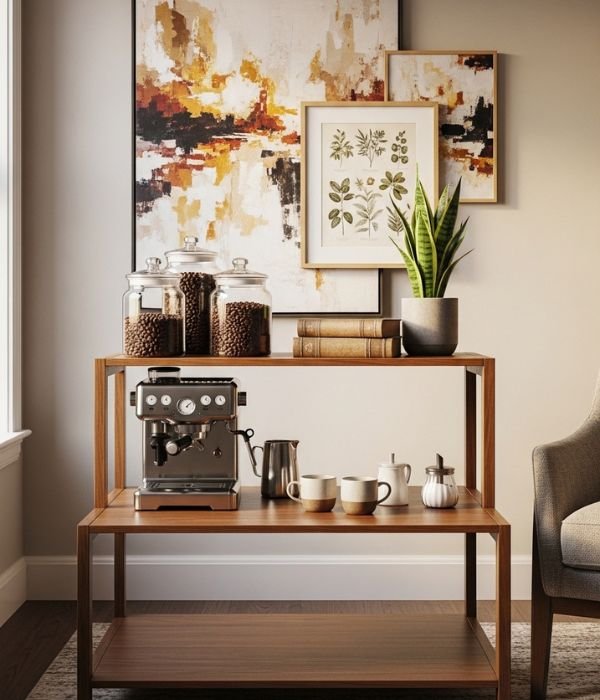
So I introduced levels.
Not for decoration. For separation.
- Lower level → daily use (machine, cups)
- Upper level → occasional items (extra mugs, jars)
This changed how I use the setup.
I stopped stacking things and started organizing by frequency.
That’s what made this one of the more practical small coffee bar ideas for living room use: it reduced friction.
What improved:
I no longer move things around just to access something else.
Mistake to avoid:
Mixing decor and function on the same level always leads to clutter.
Separation makes small setups feel bigger.
4. The “Movement-Friendly” Rolling Setup
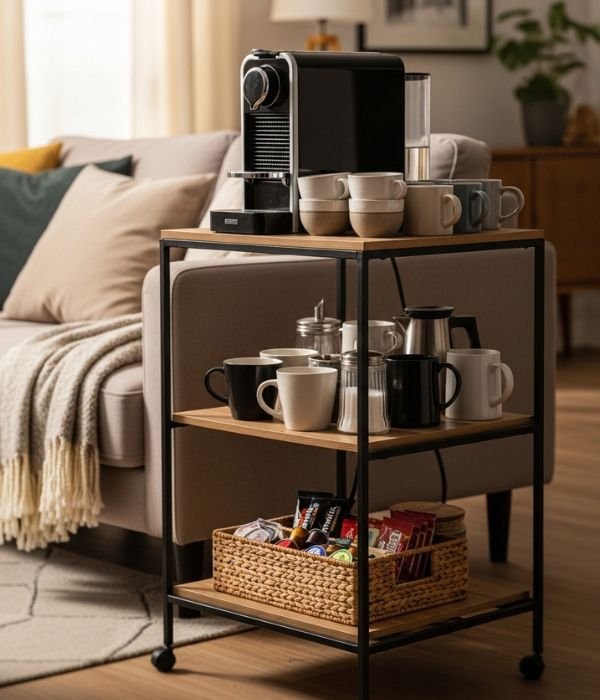
At first, I thought a coffee bar needed a fixed spot.
Something permanent.
But my living room doesn’t stay the same throughout the day. Sometimes I want more open space. Sometimes I need things closer.
That’s when I tried a rolling cart.
What made it work wasn’t just movement; it was control.
I could pull it closer when making coffee and move it away when I wanted the space clear again.
But I made a mistake early.
I overloaded it.
Too many items made it unstable and harder to use. So I simplified it.
- Top → daily essentials only
- Middle → cups
- Bottom → backup items
This turned into one of the most flexible small coffee bar ideas for living room setups because it adapts instead of staying in the way.
If your space changes throughout the day, your setup should too.
5. The “Defined Zone” Tray Method
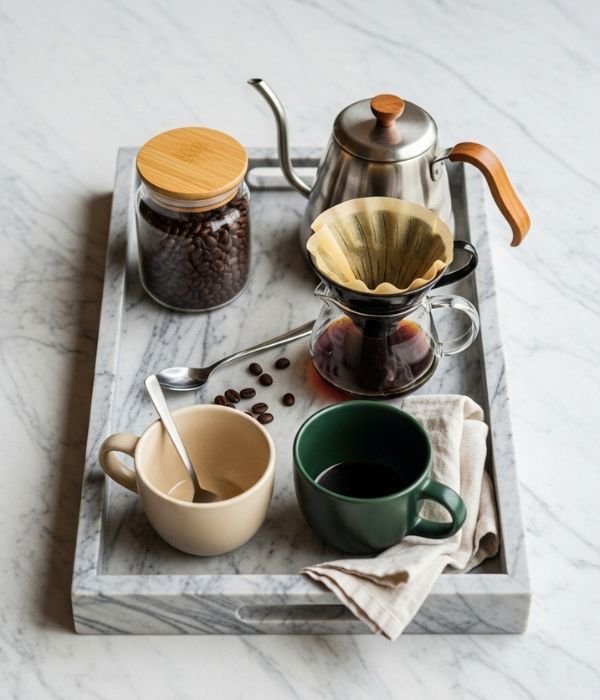
Before this, my coffee setup didn’t feel like a setup.
It felt scattered.
A cup on one side. A jar somewhere else. Nothing felt connected.
So I introduced a simple boundary, a tray.
That one change fixed the problem.
Now everything stays inside that space. Nothing drifts.
And more importantly, it looks intentional.
This became one of the simplest small coffee bar ideas for living room setups, but also one of the most effective.
What changed:
The area stopped looking like clutter and started looking like a setup.
What most people miss:
Without boundaries, small setups always spread.
A tray doesn’t store things; it controls them.
6. The “Visual Weight” Light Setup
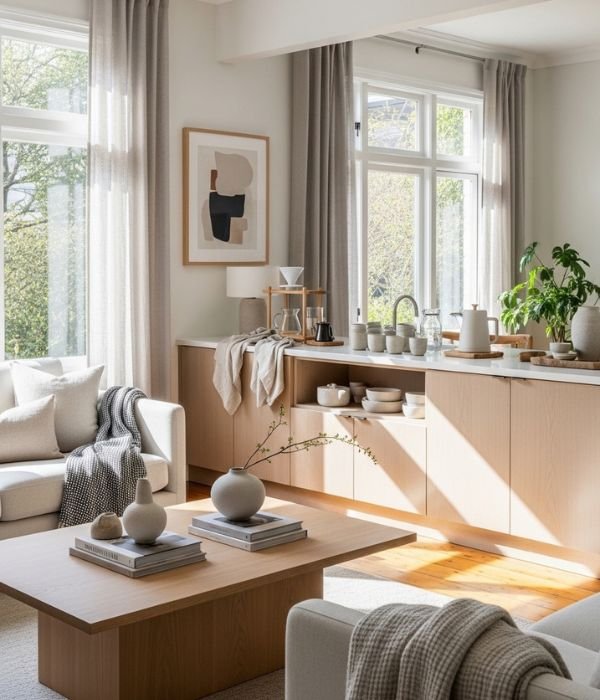
I had a setup that worked perfectly, but it still felt wrong.
The reason wasn’t a function. It was visual weight.
Dark tones. Too many textures. Strong contrast.
Even when clean, it made the corner feel heavy.
So I simplified it.
- Lighter tones
- Fewer items
- More spacing
I didn’t add anything new. I removed what wasn’t necessary.
That shift turned it into one of those small coffee bar ideas for living room setups that feel lighter without changing the structure.
What I noticed:
The room felt bigger even though nothing physically changed.
I later realized this isn’t just a visual preference; there’s actual reasoning behind it, and this explanation of how visual weight and light affect small spaces helped me understand why even small changes can shift how a room feels.
What I avoid now:
Anything that visually “pulls attention” too strongly.
In small spaces, how something looks matters as much as how it works.
7. The “Hidden When Not Needed” Cabinet Setup
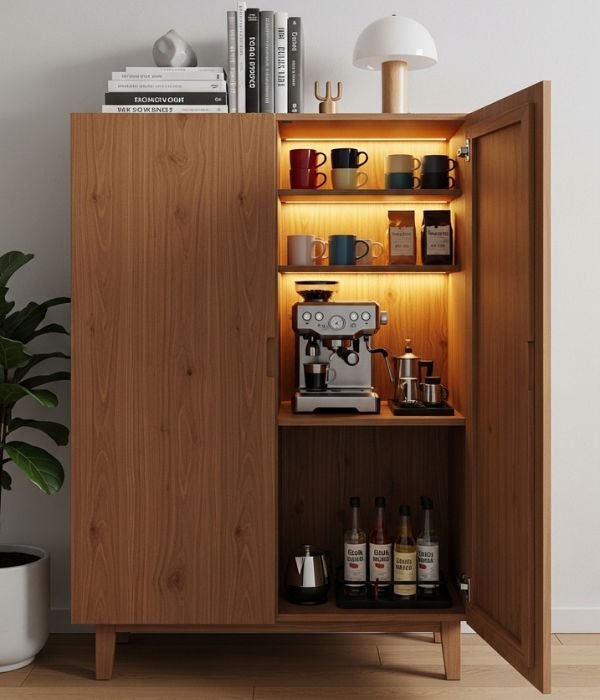
There were days I didn’t want to see the coffee setup at all.
Especially when the living room needed to feel clean and open.
That’s when I switched to a cabinet-based setup.
Everything stays inside. When I need it, I open it. When I don’t, it disappears.
But I made one important adjustment.
I kept the inside organized for quick access.
- The machine stays ready
- Cups within reach
- No stacking that slows things down
This became one of the most practical small coffee bar ideas for living room setups because it gives full control over visibility.
Mistake to avoid:
If it takes effort to open and use, you’ll stop using it.
Hidden storage only works if it’s easy.
8. The “Corner Flow” Setup That Feels Invisible
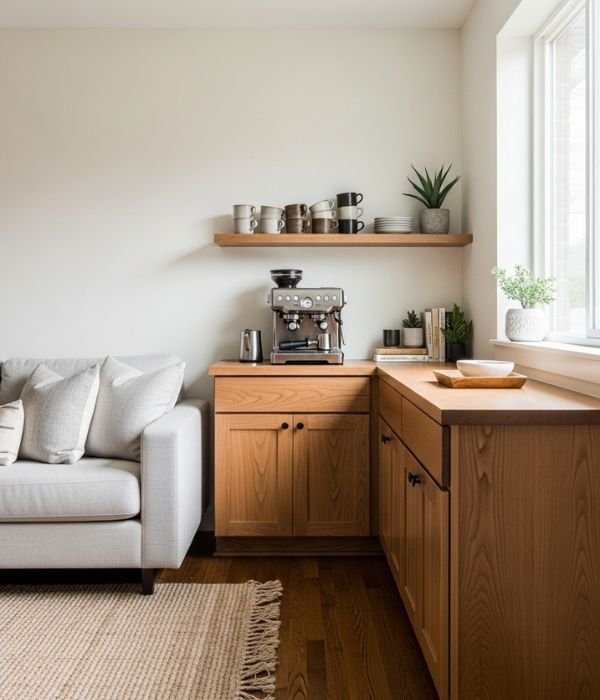
Not all corners are equal.
Some look empty, but they’re actually part of your movement path.
I made that mistake once.
I placed my setup in a corner that looked unused, but I kept bumping into it.
That’s when I realized something simple.
A good setup should fit into the flow, not interrupt it.
So I moved it to a corner that sits outside my walking path.
Now I barely notice it when moving around, but I use it every day.
This turned into one of the most sustainable small coffee bar ideas for living room spaces because it works without getting in the way.
Simple test I use now:
If I forget it’s there while walking, it’s placed correctly.
I’ve seen this work well in other layouts too, and these corner storage ideas show how the right placement can make even small areas feel more functional.
What Actually Makes a Small Coffee Bar Work
After trying different setups, I noticed a pattern.
The ones that worked weren’t the most stylish.
They were the ones that:
- Matched how I move around the room
- Didn’t interrupt existing space
- Stayed simple
- Had clear boundaries
But the biggest shift was this:
The setup worked when it felt like part of the room, not something added to it.
Final Thoughts
The best small coffee bar ideas for living room setups don’t come from copying designs; they come from understanding how your space actually works.
Once I stopped trying to build something that looked impressive and focused on something I would actually use every day, everything became easier to manage.
The setup didn’t need to be bigger or more detailed. It just needed to fit naturally into the space without interrupting it.
And that’s what made the difference.
That small corner I used to ignore is now part of my daily routine, not because it looks perfect, but because it works without effort.
