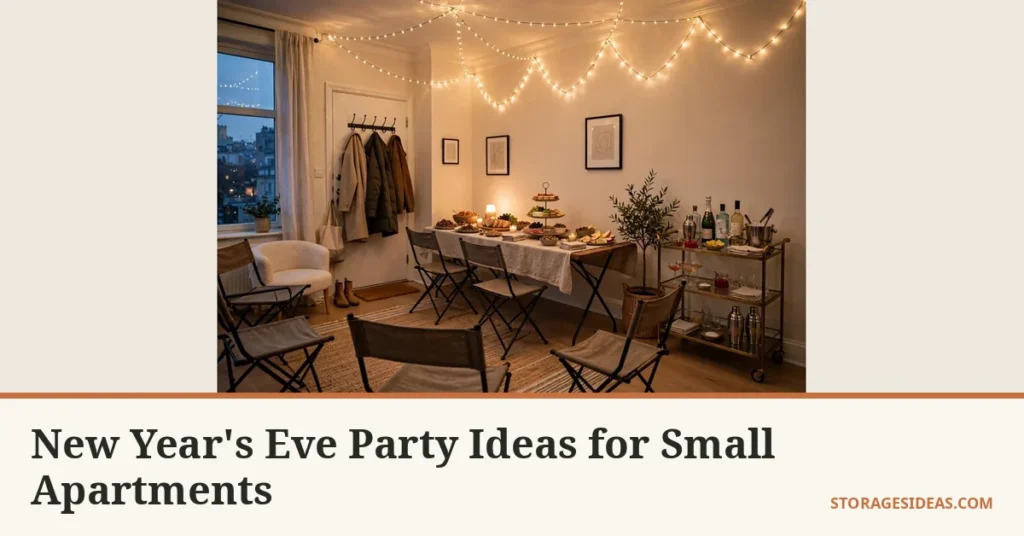
New Year’s Eve is six weeks out. If you are planning a new years eve party small apartment style, the clock matters as much as the floor plan.
You do not need a big living room. You need a plan that turns the rooms you already have into a party, one station at a time.
The guests arrive at 8, and by 9 your entryway is holding more coats than your closet holds jackets. What follows is a zone plan built around four areas: entry, table, living room, and one leftover corner.
Every idea fits a small apartment, needs zero drilling, and folds flat again by January 2.
Why a New Years Eve Party in a Small Apartment Works Better
Small rooms fill up fast, and on party night that is a feature, not a flaw. Ten guests in a 400-square-foot apartment feel like a crowd, so conversation and energy build on their own.
A big suburban living room needs decoration to feel alive. A small one needs traffic control, and that is cheaper.
The mechanism is simple: divide your apartment into zones and give each one a single job. The entry becomes the coat-and-shoe check.
One wall becomes the buffet. The living room stays clear for standing room. A corner becomes the drinks nook.
Guests move from zone to zone on instinct, so nobody stands in a clump by the kitchen counter.
Everything here follows the renter’s rule too. Adhesive strips hold lights up and come off clean in January. Over-door hooks carry the coat load with no screws.
Folding tables and chairs store flat in a closet gap the next morning. Measure your longest wall and your door thickness before you buy anything, and this whole apartment party setup lands under $200.
1. Put a 6-Foot Folding Table Against the Longest Wall: your instant buffet line
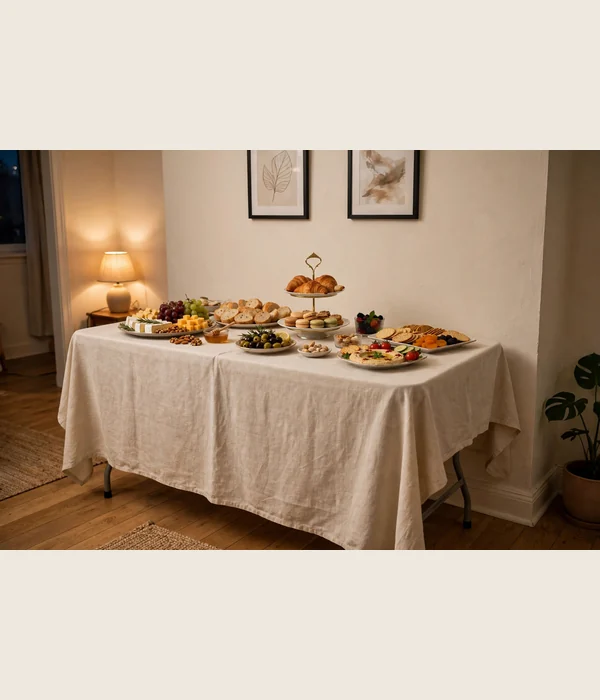
A standard 6-foot folding table measures 72 inches long, 30 wide, and 29 high. On party night it earns its keep as the buffet line rather than seating.
Pushed against your longest wall, it pulls food off the kitchen counters. Guests get one clear direction to travel: in at one end, out at the other.
That single traffic lane is what keeps a studio from turning into a scrum around the stove.
Shop for a resin-top table with a steel frame rated for at least 200 pounds. Resin wipes clean after sticky drinks, and the typical price band sits under $70.
If six feet will not clear your doorway, the 4-foot version (48 by 24 inches) fits a narrow alcove. Measure the open footprint and the folded thickness (usually under 3 inches) before you buy, so you know where it sleeps on January 2.
Where it works best:
- Against the longest uninterrupted wall, never floating mid-room where it blocks flow
- In a hallway-adjacent spot, so the kitchen-to-buffet restock run stays under 10 steps
- Covered with a 52-by-52-inch cloth on the 4-foot table or a 60-by-102 cloth on the 6-foot, with a 6-to-8-inch drop on each side
- Under a window, where daylight shots of the spread photograph well for your own recap
- With the short ends angled, so the line can start from the room’s main walking path
2. Stack the Buffet Vertically With a 3-Tier Serving Tray: three times the food in the same footprint
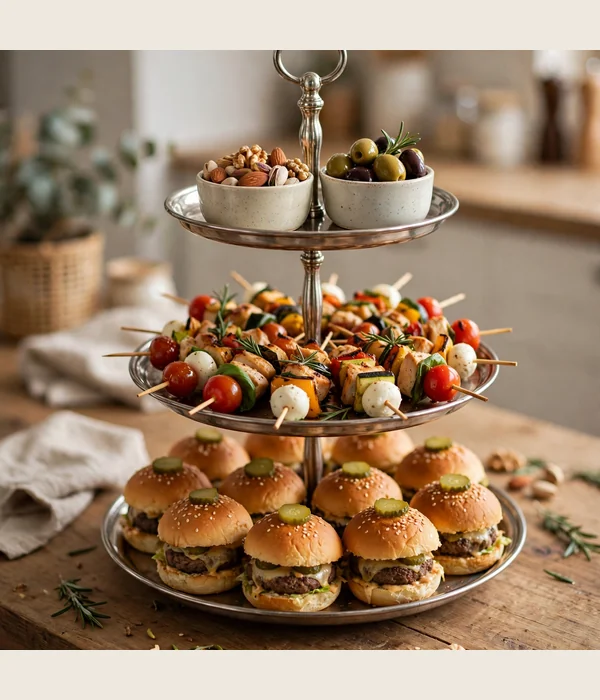
A 3-tier tray turns one 14-inch square of table into three serving surfaces. That is the difference between a buffet that fits and one that overflows onto the floor.
The bottom plate (usually 12 to 14 inches across) holds the heavy platters. The middle takes finger food, and the top carries the small stuff: nuts, olives, garnishes.
Guests see everything at once and serve themselves faster, so the line keeps moving.
Look for a metal or ceramic tray with a center rod that unscrews. A collapsible one stores flat in a cabinet the other 364 days, and the typical price band is $20 to $35.
Avoid plastic rods, which bow under a full bottom plate. Wash the plates by hand rather than twisting the rod, since torque on the center post is what loosens tiered trays over time.
Set it up in this order:
- Place the bottom plate first and load the heaviest dishes, so the tower stays bottom-heavy and stable.
- Put tall items (breadsticks, skewers) on the middle tier where heads will not knock them.
- Keep the top tier light: dips in small ramekins, chocolate, wrapped candies.
- Leave a 6-inch clear zone around the tower base for elbows and serving spoons.
- Test the spin (if it rotates) with full plates before guests arrive, not during the toast.
3. Roll a Bar Cart Into the Corner: a drink station that moves out of the way
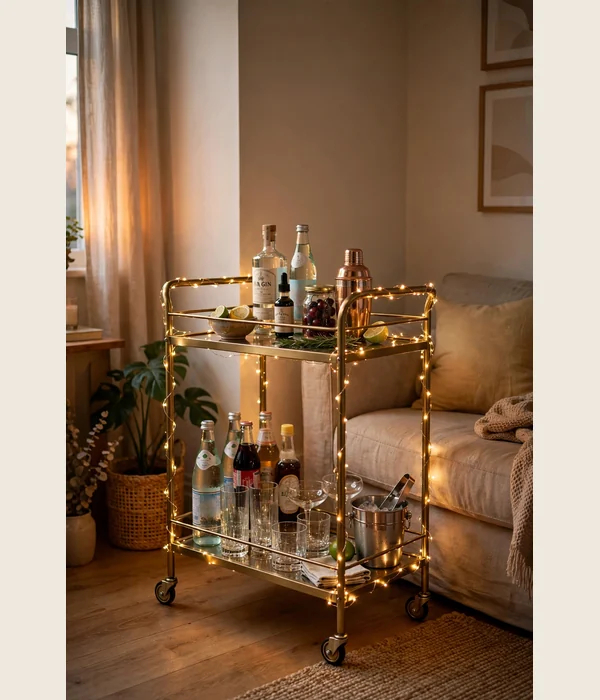
A two-tier bar cart, typically 30 inches high and 16 to 18 wide, holds bottles, mixers, and glassware in about two square feet of floor. The wheels are the point.
Roll it into the corner for the toast, wheel it beside the couch for the countdown, and park it in the hallway when the dance circle (optimistically) forms. No lifting, no re-carrying trays through a crowded room.
A cart also pulls a second shift earlier in the evening: park it by the door as the gift table during arrivals, then roll it to its drink-station post once the coats are hung.
Tips for best results: Stock the top tier with the 8 to 10 bottles and mixers you will actually use. Keep backup ice, napkins, and a spare opener below, plus a small trash bowl so empties never pile on the floor. Typical band: $40 to $80 for a metal-frame cart; check for locking casters.
Watch out: A cart loaded with full bottles can top 60 pounds, so push it, never pull it, through doorways. If your floors are hardwood, stick felt pads on the caster cups to stop rolling drift overnight. Skip glass-top carts in a packed room: one bumped elbow and you are sweeping at 11:45.
4. Hang an Over-Door Hook Rack by the Entry: the coat check that needs no closet
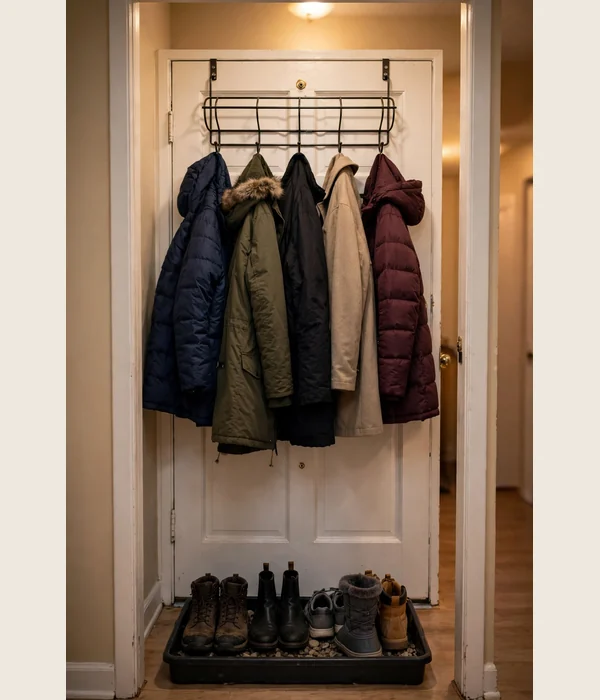
Ten guests bring roughly ten coats, and your entry closet holds maybe four. An over-door hook rack with 8 to 10 hooks solves the arithmetic in seconds.
It drapes over any interior door up to 1.8 inches thick, needs no tools, and carries up to 50 pounds of outerwear. That is the entire party’s coats on a surface you already own.
If you want the entry to look intentional rather than improvised, pair it with a few of these simple New Year decoration ideas on the wall beside it.
Buy a metal rack, not a fabric pocket organizer, for this job. Metal hooks hold a wet wool coat without sagging, and the rounded tips will not snag delicate fabrics.
The typical price band is $15 to $25. Check the clearance above your door first: you need about a quarter inch of gap between the door top and the frame for the hooks to seat.
Where it works best:
- On the inside of the entry door, so coats vanish from sight the moment guests step in
- On a bedroom or bathroom door if the entry door has a mirror or a tight swing
- Paired with a 28-to-30-inch boot tray (with a 1.5-inch lip) underneath for wet shoes
- Keep one hook for your own coat, so you are not digging at midnight
- Labeled by nothing at all: guests remember their hook by position, and it works
5. Set Up a Shoe Check-In Station: wet boots never make it past the mat
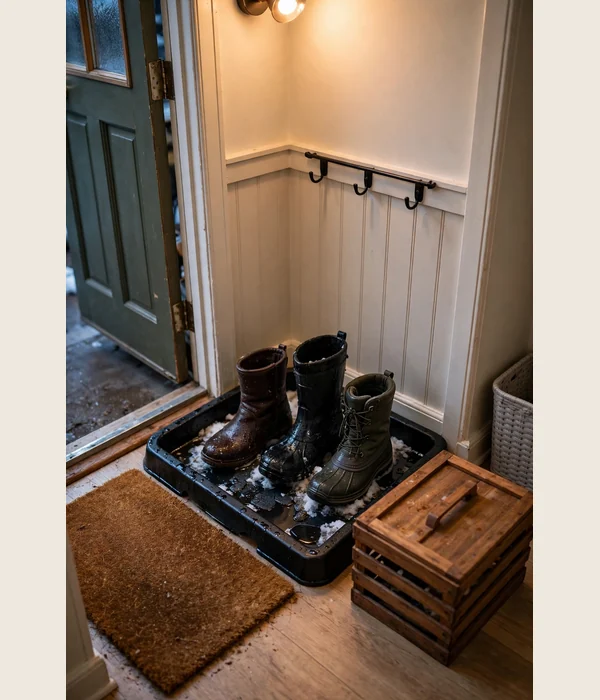
December weather means slush, and slush means your floors are ruined by 8:30 unless shoes stop at the door.
A 30-by-18-inch boot tray with a raised lip catches meltwater from four to six pairs, and a lidded crate beside it swallows the overflow. Total footprint: about three square feet of entryway.
Total cleanup saved: one mopped living room.
The tray needs a lip of at least 1 inch, or meltwater runs straight onto the floor. Rigid plastic trays (typical band $12 to $20) hose off in the tub afterward.
Pair the tray with a coir or rubber mat at the door itself, 24 by 36 inches minimum, so the first scrape happens before shoes even reach the tray.
Build it in this order:
- Lay the doormat outside-facing, with the long edge parallel to the door swing.
- Set the boot tray just inside, against the wall, so it never blocks the door’s arc.
- Put the overflow crate at the tray’s far end, lid off during the party.
- Drop a folded towel in the tray’s corner for drips between pairs.
- At 11 pm, slide the full crate into the bedroom closet so the entry stays clear for the midnight exit rush.
6. Borrow (or Buy) Folding Chairs That Store Flat: seating for ten in a closet gap
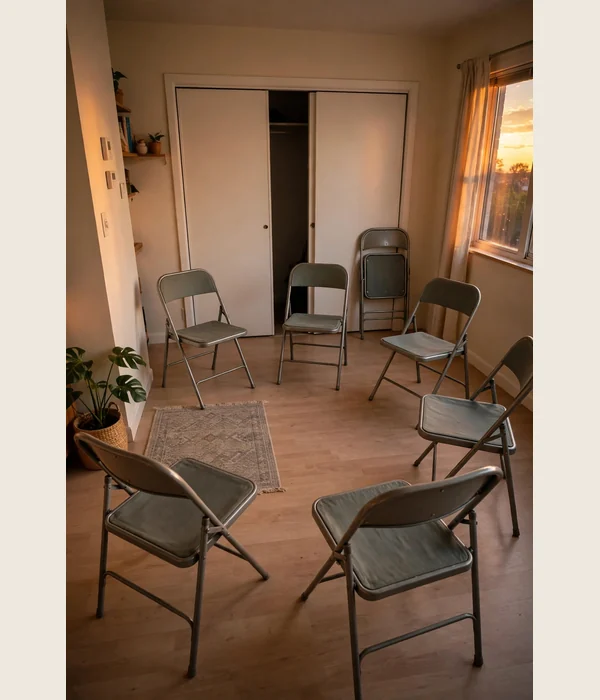
A standard metal folding chair folds to about 2.5 inches thick and weighs roughly 7 pounds. That means six of them lean in an 18-inch slice of closet floor.
That is a full party’s worth of seating hiding behind your winter coats. On the night, they ring the living room perimeter, leaving the center open for standing.
Anyone who wants a seat has one within three steps.
If borrowing, grab two more than your headcount: one always ends up holding the gift pile, and one becomes the plant stand you forgot you needed.
Tips for best results: Buy padded vinyl seats if anyone sits longer than an hour; bare metal gets cold and hard fast. Typical band: $25 to $35 per chair.
Borrow from a neighbor for a one-night need and return them wiped down. Leave 24 inches of knee room per chair against the wall.
Watch out: Cheap chairs rate for 200 pounds but flex at the limit, so trust the stamped frame rating, not the box. Never stack more than six high without a strap; a chair tower in a dark hallway is a midnight injury. If your floors scratch, check the foot caps before the party, not after.
7. String Fairy Lights Across the Ceiling: party lighting with zero outlets used
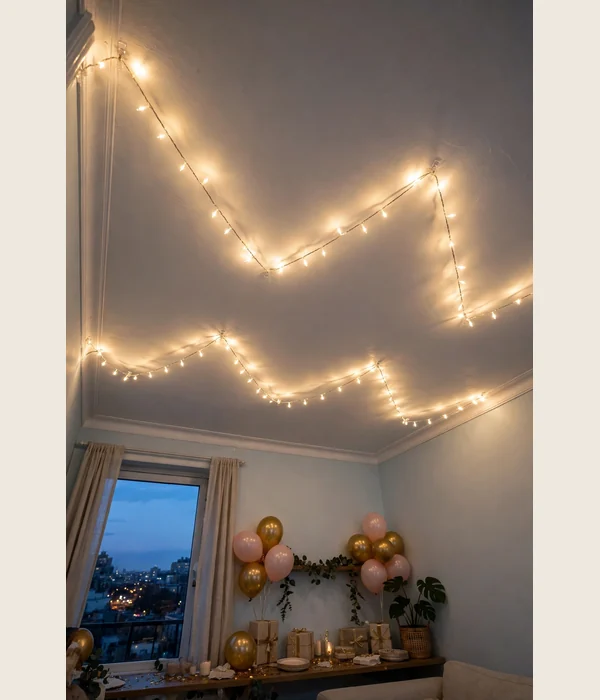
Overhead lighting makes a small apartment feel like an office. Fairy lights fix it for about ten dollars.
Two 33-foot battery strings, 100 LEDs each, span a 10-by-12-foot room in a loose zigzag. The warm white glow flatters every face in the room.
Battery power means no cords snaking across the floor and no outlet math. If you want the full glow-up treatment, these pair beautifully with classic New Year’s Eve decor like metallic garlands and a midnight balloon drop.
Hang them with medium adhesive strips and mini light clips. Each medium strip pair holds up to 3 pounds, and a full 33-foot string weighs a few ounces.
Clean the ceiling or wall spots with rubbing alcohol first, press each strip for 30 seconds, and wait an hour before hanging the lights.
Most battery strings run on 3 AA batteries and include a 6-hours-on, 18-hours-off timer, so set them at 5 pm and they light themselves.
Where it works best:
- Zigzagged across the living room ceiling, anchored at four to six points
- Draped along the top of a bookshelf or media console for a glowing backdrop
- Wrapped around the bar cart from point 3, so the drink station finds itself
- Twisted through a stair rail or curtain rod where ceiling access is awkward
- Doubled up (two strings, not one) anywhere you want photos to actually look warm
8. Deploy Storage Ottomans as Extra Seats: seating that hides the party supplies
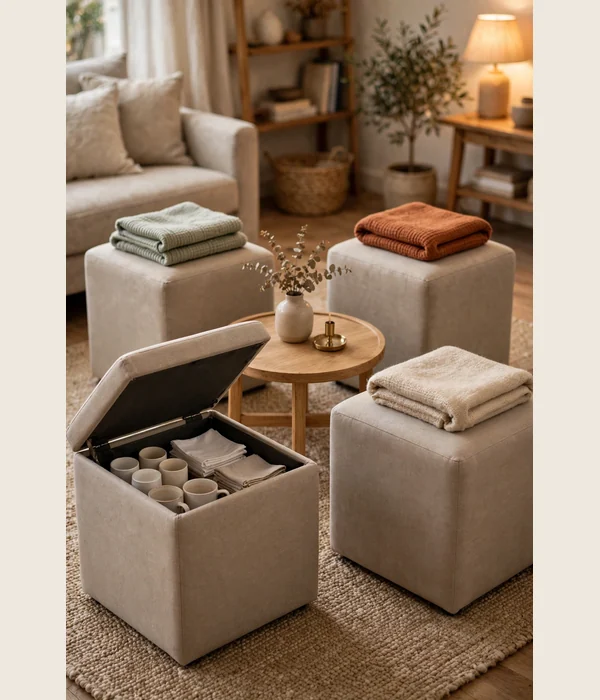
A 15-to-18-inch cube ottoman seats one adult. Most rate for 200 to 250 pounds, and the hollow inside swallows the things a small apartment has nowhere to put: spare champagne, a 12-pack of cups, the gift bags, the board games for after midnight.
Four cubes ringed around a coffee table add four seats and four hidden cabinets in about nine square feet. Typical price band is $25 to $45 per cube.
Buy cubes with a reinforced lid hinge, not a loose lift-off top. Loose lids slide off when someone sits down hard, and the midnight hour is exactly when that happens.
Faux leather wipes clean after spills; fabric cubes stain. If you already own one ottoman, buy the rest in the same size so they stack into a single tower in the closet afterward.
Roll them out in this order:
- Load each cube before the party: cups and napkins in one, bottles in another, games in a third.
- Place two cubes flanking the couch and two opposite, leaving a 30-inch walkway between pairs.
- Put a folded throw on each lid so they read as intentional seating, not storage.
- At midnight, the bottle cube opens right where the toast happens.
- Next morning, restack them in the closet: four cubes nest in about 20 inches of floor.
9. Open a Drop-Leaf Console Into a Dessert Table: a 12-inch-deep table becomes a 4-foot spread
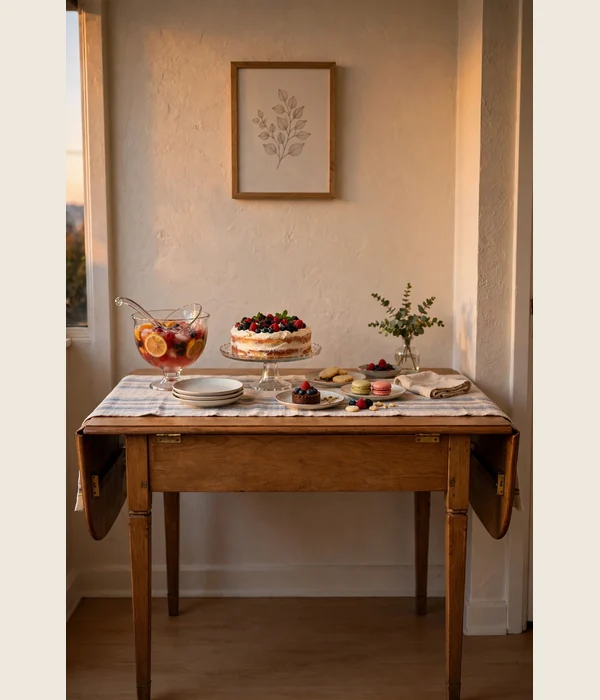
A drop-leaf console lives against the wall at 10 to 12 inches deep, holding keys and mail all year. On party night, flip both leaves up.
It becomes a 36-to-48-inch table, 30 inches high, perfect for the dessert course. Desserts go out at 10:30, after the buffet plates clear, so the table earns a second shift from furniture you already own.
If you do not own one, narrow console tables in this style run $60 to $120.
Tips for best results: Check the leaf locks before loading: a leaf that drifts down under a cake plate ruins the night. Put the heaviest items (the cake stand, the punch bowl) over the table’s center legs, not on the leaves. A washable runner down the middle protects the finish and catches crumbs, and it photographs well.
Watch out: Leaves typically rate for 20 to 30 pounds each: plenty for desserts, not for a leaning guest. Keep it against the wall where nobody can bump the unsupported side.
A 48-inch open console needs a 60-inch clear zone to walk around it. If the fit is tight, open only one leaf for a 24-inch half-table instead.
10. Claim One Corner as the Countdown Nook: champagne, flutes, and the midnight moment
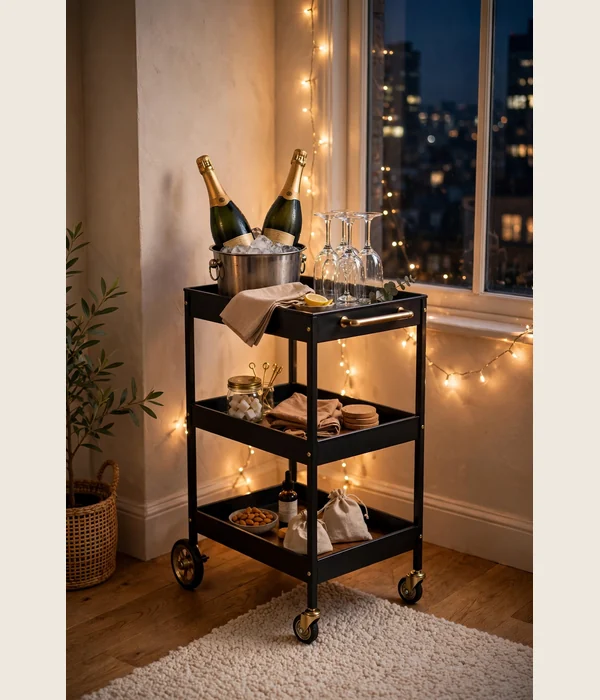
Every party needs a place where midnight happens. In a small apartment that is a corner, not a room.
A narrow rolling cart (14 to 16 inches wide) holds the champagne, a stack of 12 to 16 flutes, and a small ice bucket in about three square feet. Park it near the TV or the window with the best view, and the whole party drifts there naturally at 11:55.
For the rest of the evening’s plan, these tiny apartment New Year celebration ideas cover the games and countdown rituals that fill the hours before.
Chill the bottles in the fridge, not on the cart: a cart has no insulation and the ice bucket is for the open bottle only.
Count flutes at 2 per expected guest plus 4 spare, because someone always toasts twice and one always breaks. A cart with a raised rail edge stops bottles rolling off when the countdown gets lively.
Where it works best:
- In the corner with the best phone signal, since half the party video-calls family at midnight
- Beside the fairy-light glow from point 7, so the toast photos need no flash
- With the corkscrew tied to the cart handle on a ribbon, because it will vanish otherwise
- Stocked with one non-alcoholic sparkler option, clearly labeled, for designated drivers and kids
- Cleared by 12:30 into the kitchen, so the corner becomes the coat-retrieval lane for departures
Conclusion
Small-apartment hosting is a logistics game, and the zones above are the whole playbook. Coats at the door, food on the wall table, drinks that roll, light that flatters, and one corner reserved for midnight.
Do the measuring this weekend and the buying next week, and setup on the 31st takes under two hours. Your guests will remember the midnight toast, not the square footage.
Best first buy: the 6-foot folding table from point 1. Nothing else on this list does as much work per dollar: it is the buffet, the gift table, and the brunch surface on January 1.
It vanishes into a 3-inch closet gap for the other 364 days. If the budget only stretches to one purchase before the 31st, make it the table, then borrow the chairs.
Frequently Asked Questions (FAQ)
How many guests can I invite to a new years eve party small apartment gathering?
If your main living space is around 12 by 14 feet, plan for 8 to 12 guests standing, or 6 to 8 if everyone needs a seat. Count about 10 square feet per standing guest and 20 per seated one.
If your number lands above that, trim the list rather than the food: a comfortable 10 beats a cramped 15 every time.
How do I hang party lights without damaging my rental walls?
Use medium adhesive strip pairs with mini light clips: each pair holds up to 3 pounds, and a full fairy-light string weighs only ounces.
Clean each spot with rubbing alcohol, press the strip for 30 seconds, and wait an hour before hanging. At takedown, stretch the tab slowly toward the floor for a clean release.
If your paint is fresh (under 30 days), wait: uncured paint can peel.
Where do I put everyone’s coats if I have no entry closet?
Hang an over-door hook rack on the inside of your entry or bedroom door. Eight to 10 metal hooks carry the whole party’s coats with zero installation, and a boot tray underneath catches wet shoes.
If even that is full, designate one bed as the coat bed and cover it with a clean sheet first. Retrieve coats in reverse arrival order to avoid the midnight pile-dig.
Can I serve a full dinner with no dining table?
Yes, if you switch the format. A 6-foot folding table against the wall becomes a buffet, and guests eat from plates on laps, ottomans, and folding chairs.
Choose foods that need only a fork: skewers, sliders, grain bowls, and anything bite-size. Skip anything requiring a steak knife and a stable surface.
Dessert gets its own shift on the drop-leaf console at 10:30.
How do I keep drinks cold when my fridge is tiny?
Buy one bag of ice per 8 guests. Keep bottles in the bathtub or a large stockpot lined with a trash bag: it holds cold for 4 to 6 hours and drains straight down afterward.
Reserve the fridge for the champagne and perishables. Refill the ice bucket on the countdown cart once, at 11 pm, so the midnight pour is properly cold.
What should I do with all the decorations on January 1?
Take the lights down first while the adhesive tabs are fresh. Stretch each tab slowly and they release clean.
Coil each 33-foot string around a piece of cardboard so it does not tangle in storage. Fold the table and chairs flat, nest the ottomans, and roll the bar cart into its parking corner.
Everything on this list stores in under 30 minutes if you put it away slow but steady.