

There is one weekend a year when your linen closet suddenly stops making sense: the weekend you swap the light summer quilt for the winter duvet. This winter bedding storage plan starts right there, with the changeover itself, because the swap is the easiest moment to decide what stays, what goes into deep storage, and what lives within reach.
Do the swap when overnight lows dip below about 50 degrees and stay there for a full week. In most of the US that lands between mid-October and early November, which is why this guide is scheduled for early November. If a warm snap returns, keep one medium-weight blanket out as insurance instead of unpacking the whole summer stack again.
Below are 8 ideas that cover both halves of the job: sending summer bedding to long-term storage and finding a home for the winter blankets that multiply on every couch and chair. If your living room is the main blanket zone, our blanket storage ideas for the living room pairs well with this list.
Why Winter Bedding Storage Fails in a Regular Linen Closet
A winter bedding storage plan breaks for one simple reason: winter bedding is twice the volume of summer bedding, but the closet is the same size it was in July. A fluffy king comforter plus two wool throws plus a flannel sheet set can eat an entire 24-inch-wide linen closet shelf on their own.
The fix is to stop treating the swap as a one-for-one exchange. Summer bedding goes to compressed, long-term storage where air volume is the enemy. Winter bedding splits into two groups: the nightly rotation that lives within arm’s reach, and the deep-winter reserves that get packed away until the first real cold snap.
Measure first, before you buy a single bin. Check under-bed clearance (floor to frame, usually 6 to 8 inches), closet shelf depth (typically 12 inches), and wall space beside your bed or couch.
If your linen closet needs a full reset, our how to organize a linen closet walkthrough covers the shelving and folding system behind this article.
1. Jumbo Vacuum-Seal Bags: Shrink the Summer Stack to Flat Packs
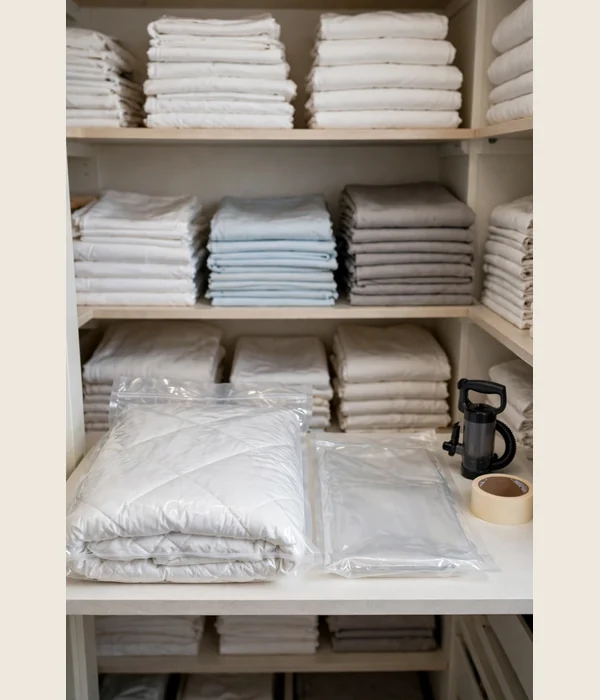
A king-size comforter starts life at roughly 60 liters of fluffy volume and comes out of a jumbo vacuum bag at about 15 liters. That is a 75 percent reduction, which turns the whole summer quilt collection into a few flat packs that slide onto one high closet shelf. For off-season storage, nothing beats it.
Buy the jumbo size, about 40 by 30 inches, plus one or two large bags around 32 by 24 inches for pillows. The double-zip seal and triple-seal valve hold the vacuum for months instead of weeks. A variety pack of six to eight typically costs under 20 dollars.
Fold the summer quilt loosely instead of stuffing it, lay it in the bag, and run the slider along both zips. Then attach a vacuum hose or the hand pump most packs include, suck the air out until the bag stops shrinking, and twist the valve cap shut. Label it so spring-you knows what is inside.
What you can do with it:
- One jumbo bag per big piece: a king comforter, a queen duvet, or two throws.
- Large bags for the soft extras: summer pillows, the light cotton blanket, and spare pillowcases.
- Stack them like books: compressed bags stand upright on a 12-inch-deep closet shelf without sliding.
- Shelf-height check: a compressed king bag is only 6 to 8 inches thick, fitting shelves a folded duvet never could.
- Keep the hand pump in the box: it re-seals bags after a mid-winter laundry refresh.
2. Long Under-Bed Bins: Hide the Winter Duvet Under Your Own Bed
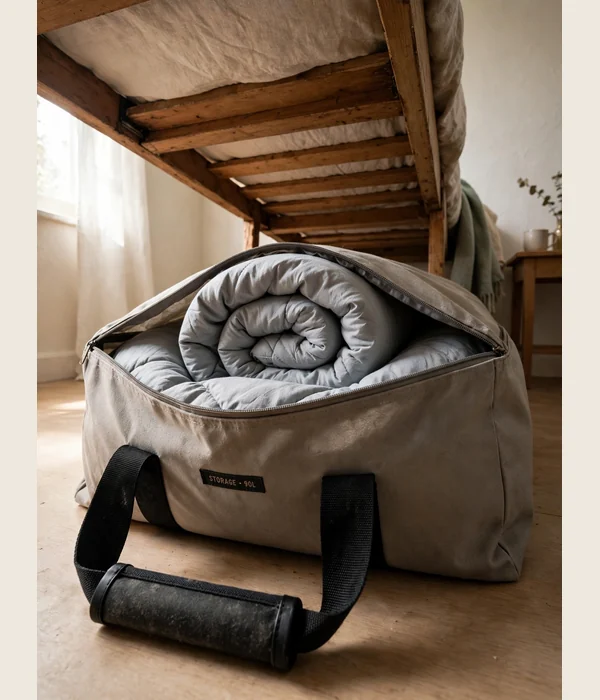
The dead space under your bed is the biggest unused volume in most bedrooms, and winter is when it earns its keep. A fabric under-bed bag around 39 by 20 by 7 inches holds about 95 liters, which swallows one folded queen duvet with room left for a flannel sheet set. A 4-pack typically costs 25 to 35 dollars.
Measure clearance before ordering: this is where people get burned. Platform beds often sit under 6 inches off the floor while many rolling bins need 6.7 inches. A set of 3-inch risers turns a 5-inch gap into an 8-inch one for under 15 dollars.
A queen bed is 80 inches long, so two 37-inch bins can slide in from each side and meet in the middle. Just check that no center support leg blocks the way first.
Tips for best results: Fold the duvet in thirds, then roll it: a roll slides into a low bag more easily. Toss in a cedar block or a dryer sheet to keep the inside fresh through the season. Label one bin winter and one summer, so the swap is just a bin exchange.
Watch out: Fabric bins do not stack, so keep them under the bed, not piled in a closet. Check how the wheels face in the photos: wheels on the short end roll out toward you, while wheels on the long side roll sideways, useless against a wall. Never store bedding on a basement floor; moisture wicks up through fabric.
3. Linen-Closet Shelf Baskets: Give Flannel Sheets a Labeled Home
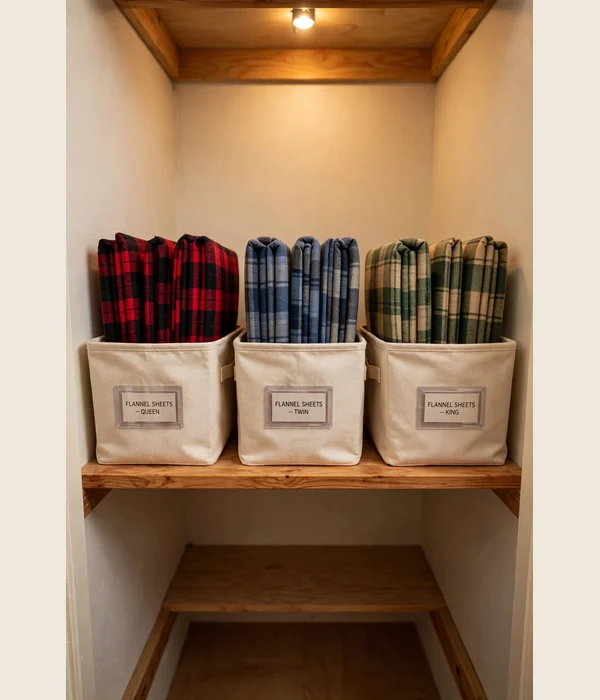
Flannel sheet sets are the quiet space hogs of the swap: one queen flannel set takes roughly twice the shelf room of a cotton set. Giving each set its own basket, around 15 by 12 by 12 inches, stops the avalanche when one pulled set drags three others with it. Canvas baskets breathe better than plastic, which stored bedding needs.
File-fold each set so it stands upright in the basket like a file folder, pillowcases tucked inside the folded fitted sheet. That way you see every set at a glance instead of digging through a stack. Clip-on label holders on the basket fronts turn the shelf into a system anyone in the house can follow.
A 4-pack of canvas baskets usually costs 20 to 30 dollars.
Measure your shelf depth before ordering: most linen closet shelves are 12 inches deep, so a 15-inch-wide basket fits with room to spare.
Where it works best:
- Standard 24-inch-wide reach-in linen closets with 12-inch-deep shelves.
- Hall closets where the whole family grabs their own bedding.
- Shelving above the washer and dryer for the just-washed rotation.
- Under-stair cupboards, where baskets keep sets clean and contained.
- Guest room closets, so visitors can find their own bedding without asking.
4. Wall-Leaning Blanket Ladder: Keep the Nightly Throws Within Reach
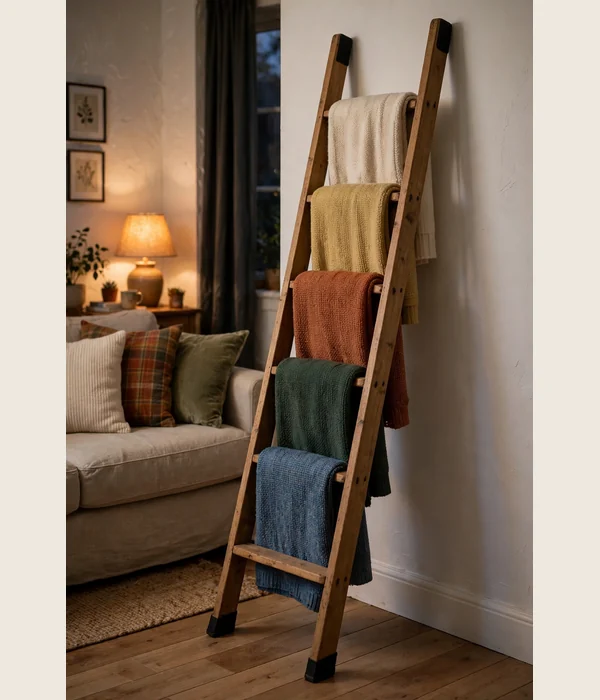
Winter means two or three throws in rotation: one on the couch, one on the bed, one in the reading chair. A 5-rung blanket ladder, 63 inches tall and 16 inches wide, holds five throws draped over its rungs and turns dead wall space into grab-and-go storage. It is the only method here that stores blankets while keeping them visible.
The leaning design needs no screws, which renters should love: the top edge rests against the wall and anti-slip foot pads keep it planted. Most wood models cost 30 to 45 dollars and assemble in about 15 minutes. Drape each throw folded in half so the rungs share the weight evenly.
Tips for best results: Park the ladder where the blankets get used, beside the couch or at the bedside, not across the room. Put the heaviest knit on the bottom rung so the ladder stays bottom-weighted. Fold throws to matching widths so you can grab one without unfolding the rest.
Watch out: Leaning ladders need a flat floor and a smooth wall section; they wobble on thick carpet. They are for throws and light quilts only, since a heavy comforter draped over the top can pull the ladder forward. If you have climbers, meaning toddlers or cats, add an anti-tip strap to the wall for a few dollars.
5. Storage Ottoman: Stash the Couch Blankets in the Seat
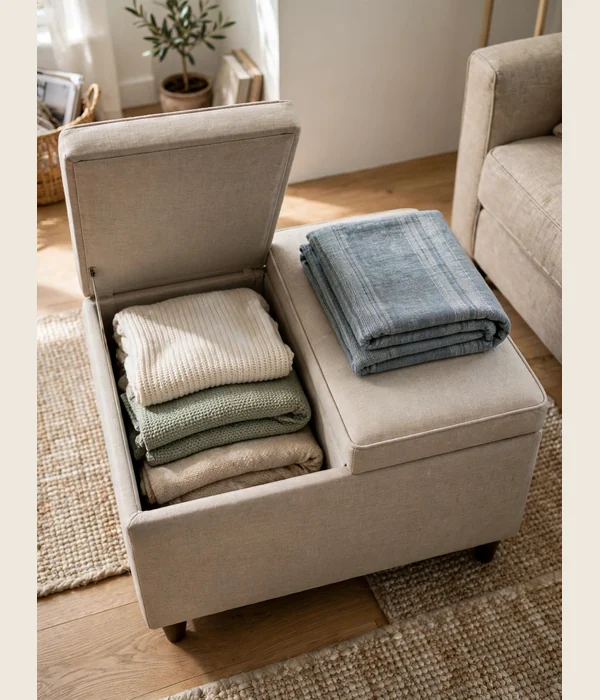
No room collects blankets faster than the couch, and a storage ottoman swallows them with no new visible clutter. A standard ottoman around 30 by 17 by 17 inches holds four to six throws, and most are rated for 250 to 300 pounds, so it doubles as a footrest or extra seat. Sturdy upholstered models run 40 to 80 dollars.
This works because the storage lives inside furniture already in the room. No new footprint, no new visual noise, just a lid that lifts.
It is the fastest method on this list for households where blankets migrate: toss the throw in, close the lid, and the living room resets in ten seconds. Look for a hinged lid that stays open on its own while you load it.
What you can do with it:
- Corral the couch rotation: the two or three throws the family actually uses.
- Stash the kids’ blankets in the play area so they stop living on the floor.
- Keep a spare throw by the front door for guests who run cold.
- Store the winter lap quilt in the bedroom ottoman at the foot of the bed.
- Hide the ugly-but-beloved electric blanket between uses.
6. Compression Straps: Cinch Wool Blankets Into Grab-and-Go Rolls
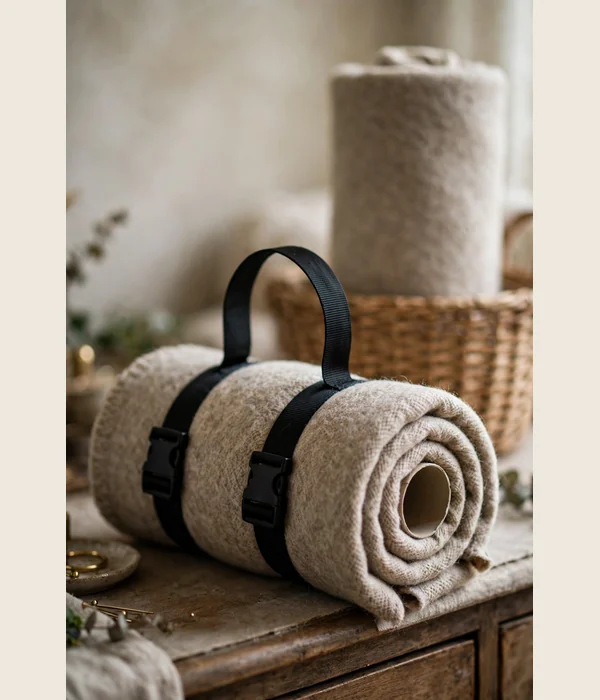
Wool blankets deserve better than a vacuum bag: months of vacuum pressure can felt the fibers and trap moisture. Compression straps are the wool-safe alternative. Roll the blanket tight, cinch two or three straps around it, and you get an 8-inch-diameter roll that stands upright in a basket, with a 4-pack of handled straps costing under 10 dollars.
Rolling squeezes out air without crushing fibers the way a vacuum does, and the built-in handles turn each roll into a grab-and-go unit for the couch, the car, or a cold guest room. Roll around a cardboard tube from a spent paper towel roll for the tightest result.
Tips for best results: Place straps at the thirds of the roll for even pressure, and buckle them snug but not strangling. Store wool rolls upright in an open basket or on a ventilated shelf, never sealed in plastic, since wool needs airflow. Tuck a cedar ring or a lavender sachet alongside each roll to discourage moths over the season.
Watch out: Straps compress but do not protect against dust, so this is for blankets in active rotation, not deep storage. Check moth-prone closets twice a season, since a dark undisturbed corner is exactly where moths settle.
If you keep a spare winter set for visitors, our guest room bedding storage ideas roundup covers the full guest setup.
7. Clip-On Shelf Dividers: Keep the Quilt Stack From Toppling
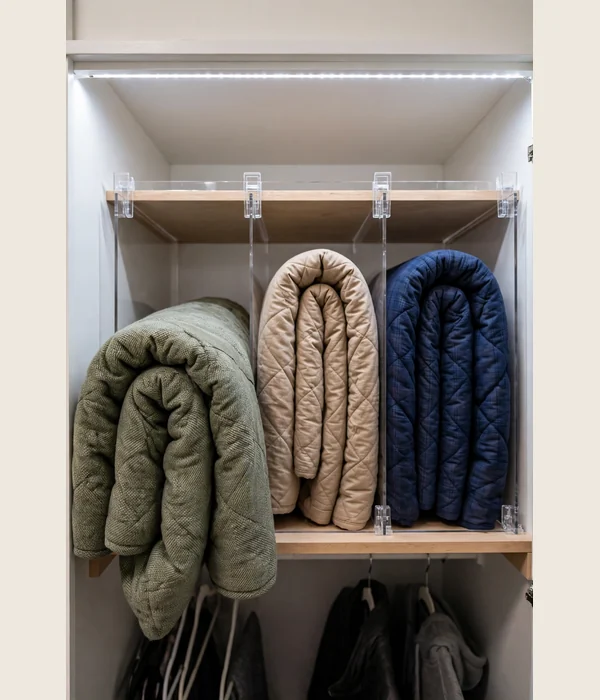
Stacked winter quilts have one fatal habit: they slide, so pulling the quilt leans the tower until it topples. Clip-on dividers fix this by turning one shelf into lanes: acrylic panels that grip 3/4-inch to 1-inch shelves and stand 14 inches tall, forming cubbies for two or three folded quilts each. A 6-pack typically costs 15 to 20 dollars.
The mechanism is pure geometry. A divider every 12 to 16 inches converts horizontal shelf space into vertical slots, so each quilt leans against a panel instead of against its neighbor. Fold quilts to a uniform width, about 12 inches, so they slide in and out without disturbing the rest of the lane.
No tools or screws needed, so renters can use them anywhere. They lift straight off when the season changes.
Where it works best:
- The high linen-closet shelf, where you reach up and pull quilts out blind.
- Deep bedroom closet shelves that otherwise become quilt avalanches.
- Guest room closets holding the off-season and spare sets.
- Under-stair cupboards with long, hard-to-organize shelves.
- Any shelf over 30 inches wide, where tall stacks lose their sideways support.
8. Foot-of-Bed Storage Bench: Run the Whole Swap From One Spot
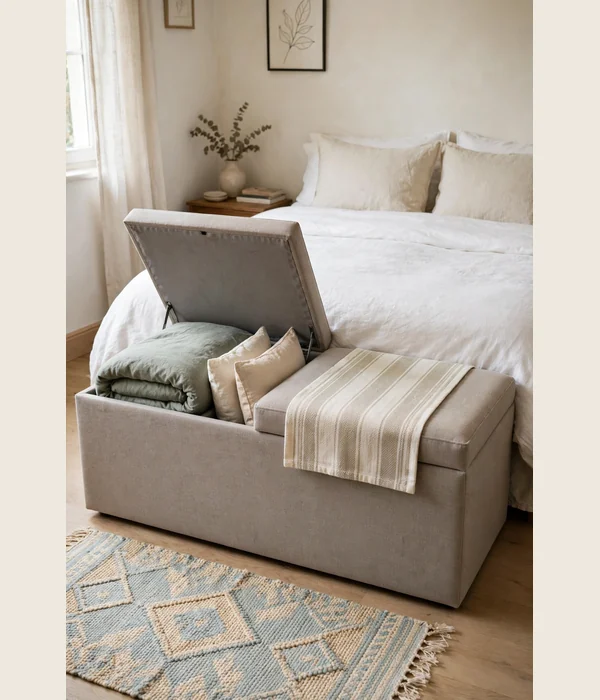
A storage bench at the foot of the bed, roughly 40 to 50 inches wide, 15 to 20 inches deep, and 15 to 18 inches tall, holds two duvets or six to eight folded blankets. It doubles as a seat for putting on shoes and a landing pad for tomorrow’s clothes. Prices run 60 to 150 dollars depending on upholstery.
Use it as the swap command center on changeover weekend: pile the summer bedding on top for sorting, pack the vacuum bags beside it, and load the winter set straight in. Once the swap is done, it holds the nightly extras, the spare pillows, and the throw that is always one chair away from where you need it.
Tips for best results: Measure the clearance at the foot of your bed first; you need about 24 inches of walkway beyond the bench or it becomes an obstacle. Choose a hinged lid with a soft-close or stay-open hinge so it does not slam on fingers. Lay a washable runner on top to protect the upholstery from daily use.
Watch out: A loaded bench gets heavy fast, so choose a solid frame over particleboard if you sit on it daily. Keep the heaviest items at the bottom so the bench stays stable with the lid open. In a small bedroom, a 40-inch bench fits a queen bed; save the 50-inch models for king beds with room to spare.
Conclusion
Do this first: buy a jumbo vacuum-bag variety pack and one set of under-bed bins, and do the actual swap on a single weekend. Those two purchases handle both directions of the changeover, the summer stack shrinking to flat packs and the winter duvet sliding out of sight under the bed, for roughly 50 dollars total.
Then add the daily-use pieces, the ladder or the ottoman, wherever blankets actually pile up in your house. Winter bedding storage is not about owning more containers. It is about giving every blanket a place that matches how often you touch it: compressed and out of the way for the off-season, within arm’s reach for the nightly rotation.
Frequently Asked Questions (FAQ)
When should I do the winter bedding swap?
Do it when overnight lows stay below about 50 degrees for a week, which in most of the US means mid-October to early November. If you swap too early and a warm snap hits, you will do the job twice. If your climate barely dips below 60, you may only need to swap the top layer, not the whole system.
Can I vacuum-seal a down comforter for the season?
Yes, if it is only for the season. Down and down-alternative comforters recover well from a few months of compression; pull the bag out 24 to 48 hours early and let it re-loft in air, or tumble on no heat for 20 minutes. If you are storing it for a year or more, use a breathable cotton storage bag instead.
How do I keep stored blankets from smelling musty?
Dry everything completely before packing, since even slight dampness turns musty in a sealed bag within weeks. Choose breathable containers for anything stored longer than a season, add a cedar block or lavender sachet, and avoid sealing wool in plastic. If a blanket does come out smelling stale, wash it and dry it fully before it goes back.
What if my bed has no under-bed clearance?
You still have options. Compressed vacuum bags slide onto high closet shelves or stand upright in a closet corner, and a storage ottoman or bench absorbs the daily-use blankets with no clearance needed. If you love the under-bed idea anyway, a set of 3-inch bed risers buys you the height for under 15 dollars.
How many winter blankets should I keep out in rotation?
If you use the couch and bed daily, keep two to three throws in active rotation per room and store the rest. More than that and the extras just become a laundry pile that never gets used. If guests visit often in winter, keep one spare set packed in the bench or ottoman rather than counted in your daily rotation.
Can I store summer bedding in the garage or attic?
If the space stays dry, yes, with protection: vacuum-sealed bags inside a lidded plastic tote survive most garages fine, since the double seal blocks dust and the tote blocks pests. Attics run hot in summer, which can weaken bag seals over time, so check them once mid-season. Skip damp basements unless you run a dehumidifier.