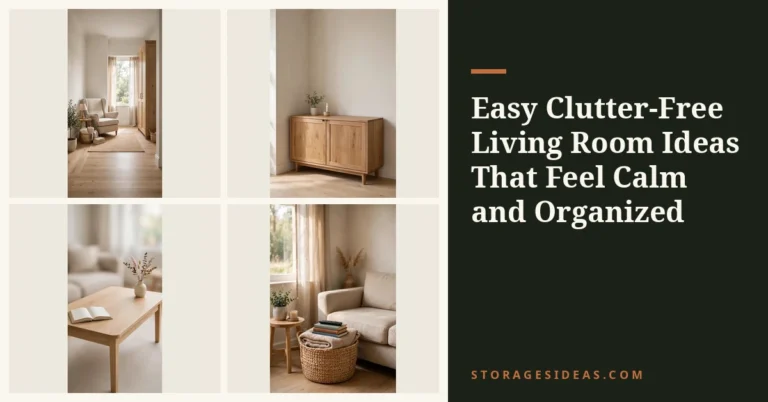
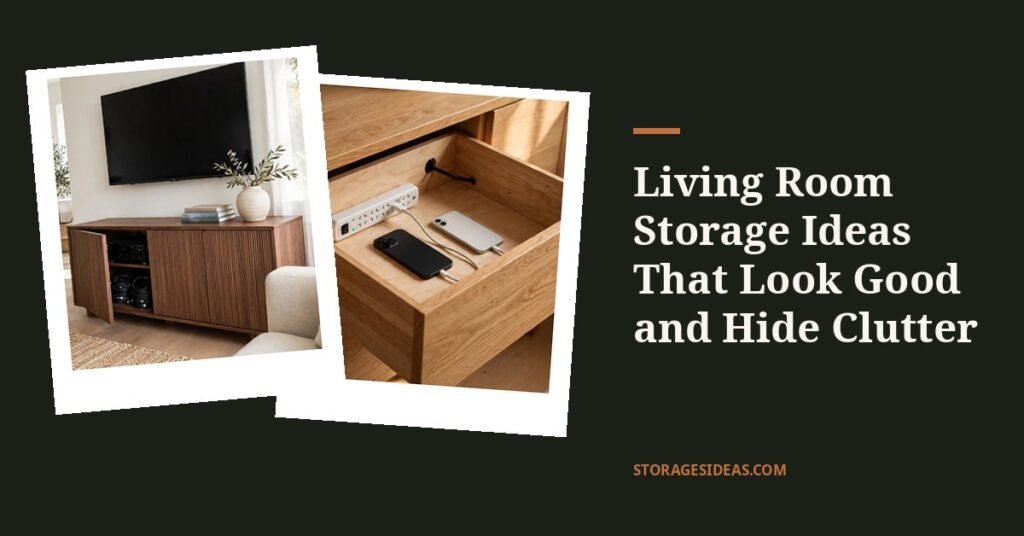
These living room storage ideas start from a simple rule: if it reads as a container, it loses.
Every idea below looks like decor, furniture, or architecture first, a console you’d buy for its lines, an ottoman you’d pick for the fabric, shelves that pass as styling, and only reveals its second job when you open a door, lift a lid, or pull a drawer.
That is the only kind of storage that survives in a room you actually live in, because anything ugly gets abandoned by February.
Across the 30 ideas you’ll find closed cabinets sized for real living rooms (12–16-inch-deep consoles that don’t swallow the floor), baskets sized by actual throw-blanket counts, dual-duty coffee tables and ottomans that hide 2–4 cubic feet each, wall storage with honest weight limits, and a final group that kills the cords, remotes, and daily pileups that make a room feel cluttered even when it’s technically tidy.
Nothing here needs a renovation. Most of it is renter-safe, and every price band is noted so you can plan the room in one shopping pass.
Why Closed Storage Wins the Living Room
The living room is the only room in the house where your storage is on permanent display, guests, cameras, and your own tired eyes at 9 p.m.
That is why the best living room storage solutions follow the 80/20 rule: aim for 80 percent closed storage (doors, drawers, lidded baskets) and 20 percent open styling (books, one plant, a framed photo). Open shelves display clutter; closed storage forgives it.
A room that is 80/20 closed reads as designed even when the baskets inside are chaos, because the eye stops at the door front.
The mechanism is sight lines. Clutter registers when the eye catches more than about seven distinct small objects in one glance, remotes, chargers, mail, toys, coasters, the dog’s leash. Close a door and that count drops to one surface.
Every point in this guide is engineered around that: depth specs that keep consoles from eating walkway space, capacities sized to what a living room actually stores (throws, not tools), and venting rules for the one closed cabinet that holds hot electronics. Design your room as 80 percent closed first; style the open 20 percent last.
Closed-storage cheat sheet (save this):
- The 80/20 rule: at least 4 of every 5 storage pieces should close (doors, drawers, lids).
- Console depth: 12–16 in deep is the living-room sweet spot; over 18 in eats walkway space in rooms under 200 sq ft.
- A “visual clutter unit” = one small loose object the eye catches; a closed door removes 5–10 units per glance.
- Ottoman capacity: 2–4 cu ft hides 2–3 throw blankets or a full toy reset.
- Electronics in closed cabinets: cut 2-in vent holes top and back, or leave the back panel off, heat kills boxes faster than dust.
- Renter rule: closed storage is inherently renter-friendly, freestanding pieces need zero holes; floating pieces need a stud.
Cabinets & Consoles
Cabinets do the heavy hiding, media gear, board games, the blanket overflow, the “drawer of everything.” Because they are furniture first, they set the room’s style while swallowing the mess. Keep every console 12–16 inches deep and the walkway survives.
1. Low Media Console With Doors: The 80/20 Rule in One Piece
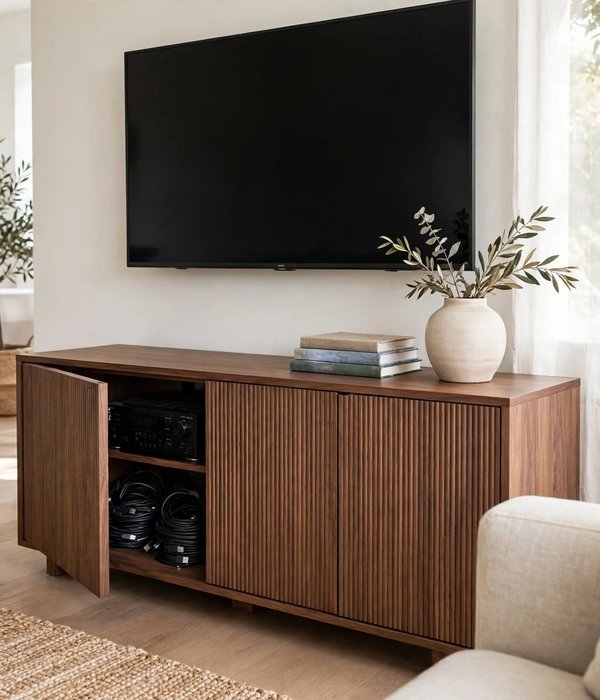
A low media console with solid doors is the single highest-impact piece in this guide, because the TV wall is where half your visual clutter lives. The mechanism is enclosure: behind closed doors the receiver, game console, stack of remotes, and rat’s nest of HDMI cables vanish, and the room drops 15-plus clutter units in one move.
Buy 14–16 inches deep, deeper juts past the walkway line in most 12-foot living rooms. Height 20–24 inches keeps a 55–65-inch screen at a comfortable sight line. Media venting is non-negotiable: receivers run hot, so choose a console with a slatted or mesh door, an open back panel, or drill two 2-inch vent holes top and back per bay.
Typical price band: $120–$300 for a 58–70-inch unit. Not for: rooms where the TV mounts on a shared bedroom wall, the sound still bleeds, doors or not.
Tips for best results:
- Measure the TV first: the console should be 6–12 in wider than the screen.
- Cable cutouts in the back panel are worth paying for, no holes, no sagging cords.
- Watch out: glass doors look closed but show clutter; choose solid, fluted, or mesh fronts.
2. Credenza With Mixed Open-and-Closed Bays: Style the Open 20 Percent
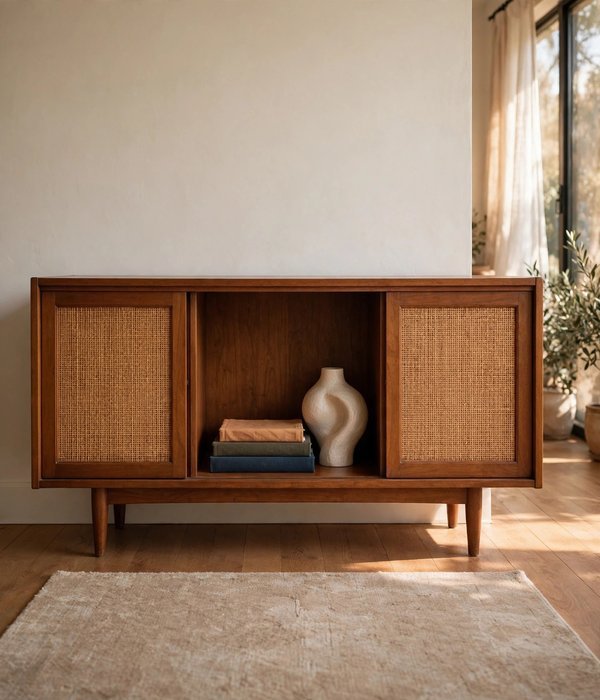
A credenza with one open shelf bay flanked by closed doors is the 80/20 rule bought off the shelf. The closed bays hide the junk, the open bay holds the styled 20 percent: two stacks of coffee-table books, one vase, done.
The open section works because it is curated by design, not by accident, one shelf forces discipline that five open shelves never will. Standard credenzas run 60–72 inches wide and 15–18 inches deep; keep to 16 inches max in rooms under 200 square feet.
Sliding doors are the small-room cheat: no swing arc into the walkway, though they hide only half the cabinet at a time. Typical price band: $150–$400. Renter-safe, freestanding, zero holes.
Tips for best results:
- Style the open bay with odd-numbered groupings (3 books, 1 object), it photographs calm.
- Put the closed bays closest to the TV side, where cables live.
- Watch out: an open bay collects dust fast; line it with a wipeable tray.
3. Corner Cabinet: Reclaim the Dead 24 Inches
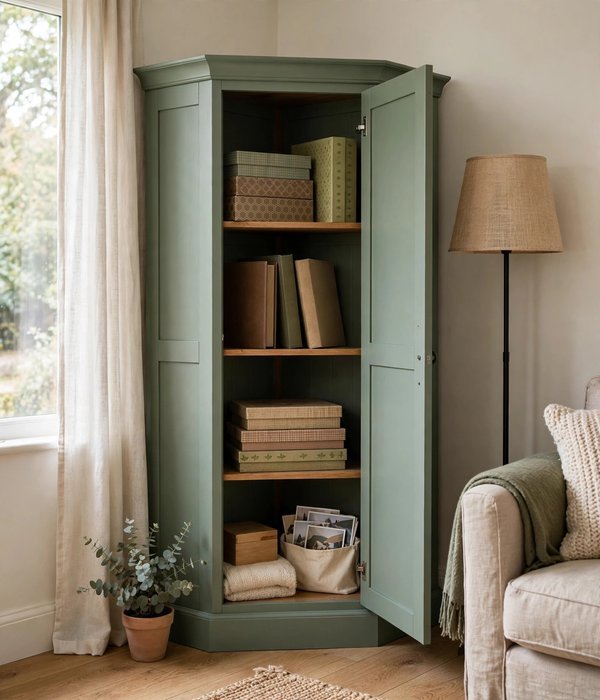
Corners waste roughly 2 square feet of floor each, and a diagonal corner cabinet converts one into the room’s best-hidden storage. The mechanism is geometry: a corner unit with a 24–30-inch face sits at 45 degrees and reaches where straight furniture can’t, hiding board games, photo albums, and the spare throw blankets.
Look for units 24–28 inches wide on each wall side, 12–14 inches deep at the face, with at least one adjustable shelf, fixed shelves waste vertical inches. A rotating (lazy Susan) insert in a deep corner cabinet doubles usable capacity because nothing gets lost in the back triangle. Typical price band: $80–$200.
Not for: rooms under 150 square feet, the diagonal cut eats the walkway instead.
Tips for best results:
- Measure both walls from the corner: you need 24 in clear on each.
- A soft-close door matters in a corner, slam doors bounce open at angles.
- Watch out: corner hinges wear faster; test the door swing fully before buying.
4. Low Window Bench Cabinet: The Sill You Can Sit On
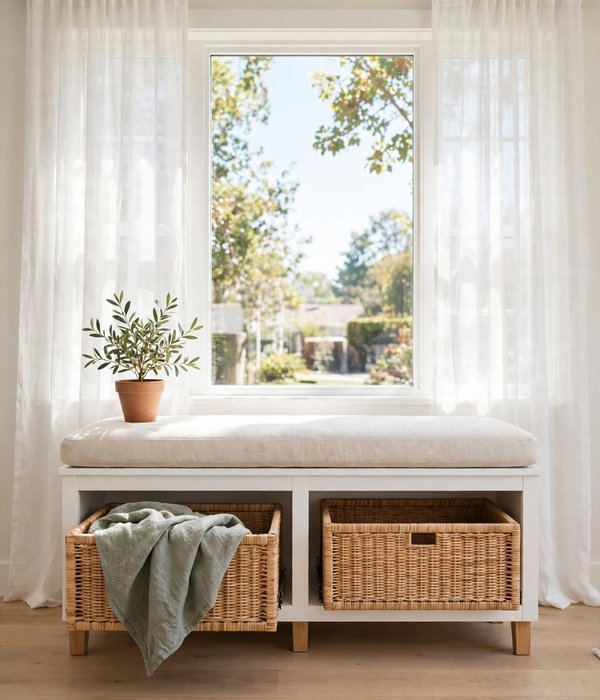
The space under a living room window is dead storage waiting to happen, and a low bench cabinet turns it into a seat, a shelf, and a hideaway in one. Height rule: stay at or below 30 inches total so the sill stays usable and the window reads uninterrupted.
Inside, 2–3 cubbies with pull-out bins hide toys, throws, and the dog’s gear; the top gets one long tray (not six small objects, the clutter rule). The mechanism is dual sight lines: guests see a window seat, you see 4–6 cubic feet of closed storage.
Measure the window width minus 4 inches for the fit, a hair of shadow gap reads custom. Typical price band: $100–$250 for 48–60-inch units. Renter flag: freestanding is fine; screwing it to the wall for tip-over safety needs a nod from the landlord.
Tips for best results:
- Choose a top that overhangs 1 in, it reads as a bench, not a box.
- Bins should be 10–12 in cubes; taller bins snag on the shelf above.
- Watch out: sun-bleached fabric bins look shabby by summer, use wipeable or UV-safe bins near windows.
5. Tall Cabinet With Doors: Vertical Storage That Reads as Architecture
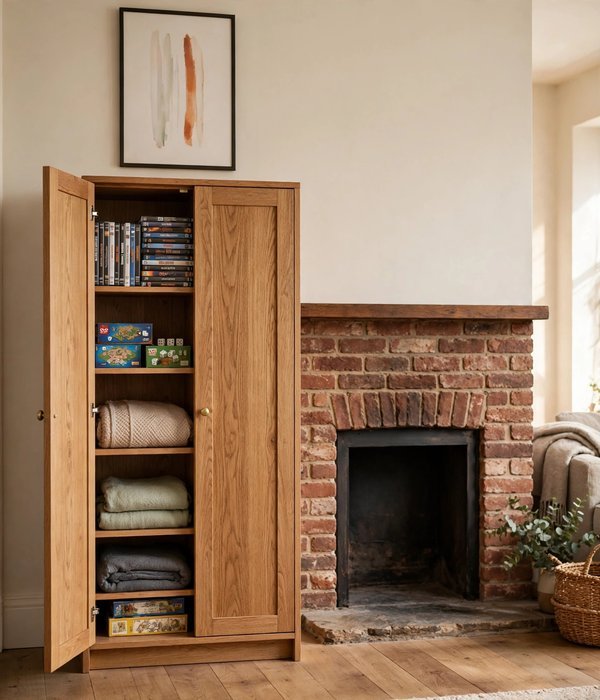
When floor space is gone, the only direction left is up, and a tall narrow cabinet with doors climbs 60–72 inches while eating just 4 square feet of floor.
The mechanism is vertical enclosure: five or six shelves behind two doors hide everything from DVDs to the vacuum attachments, and because the doors are full-height, the clutter count drops to one flat surface. Width 24–30 inches, depth 12–14 inches, deeper looks like a wardrobe, shallower can’t hold a folded throw.
Anchor it: anything over 48 inches tall needs an anti-tip strap, screwed to a stud if you own, adhesive furniture straps if you rent. Typical price band: $90–$220.
Where it works best:
- Beside the fireplace, filling the awkward 30-in gap to the wall.
- Flanking a TV console for symmetrical media storage.
- In the entry-living room threshold as a coat-and-bag cabinet.
- Behind a door swing that wastes a 24-in wall strip.
6. Inside-the-Door Organizers: The Cabinet’s Free Second Shelf
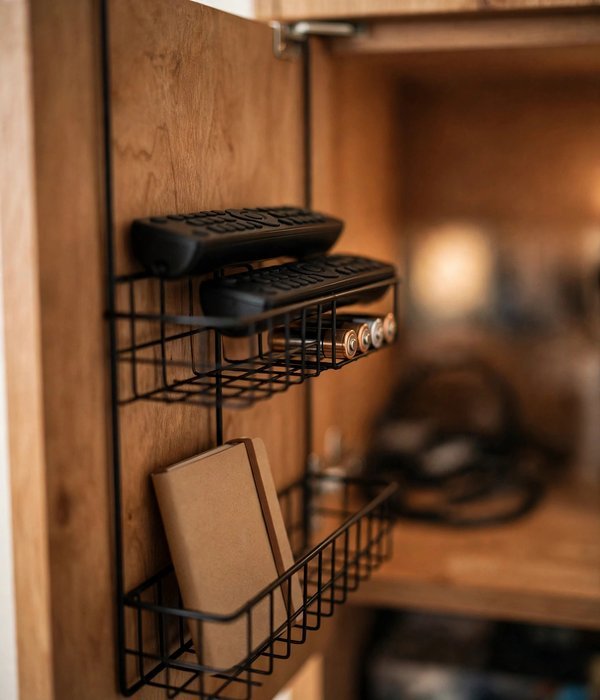
Every cabinet door is 12–20 inches of unused vertical surface, and slim inside-door racks turn it into a second shelf for the small things that otherwise scatter: batteries, tape measures, the universal remote manual, spare coasters. The mechanism is containment at the point of use, remotes live in the media cabinet instead of on the coffee table.
Buy racks under 3 inches deep so the door still closes with items loaded, and check the door’s weight: loaded racks add 3–5 pounds, fine for standard hinges, too much for cheap particle-board doors. Adhesive-mounted racks are the renter move; screw-mounted holds 2–3x more. Typical price band: $8–$25 per rack.
Where it works best:
- Media console doors, remotes and streaming sticks live here now.
- The blanket cabinet door, holds the throw-pillow inserts when covers are washed.
- A board-game cabinet door, dice trays and score pads stop migrating.
- Watch out: don’t mount on glass or mirrored doors, adhesives fail and screws crack.
Baskets, Bins & Soft Storage
Baskets are the living room’s quickest clutter fix, and its quickest clutter source, if they have no lids and no assigned contents. The rule that makes soft storage work: one basket, one job, sized to the actual contents. A basket that is too big becomes a junk drawer; sized right, it is a 30-second reset.
7. Lidded Seagrass Baskets for Throws: Sized by Blanket Count
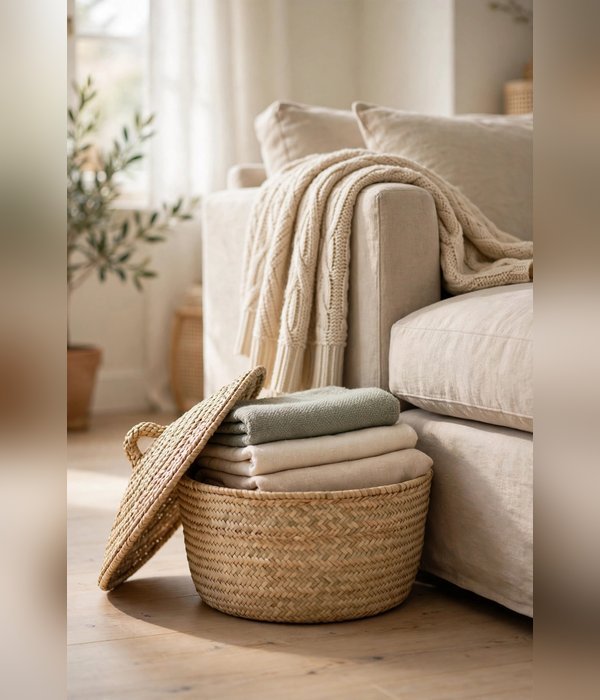
Throws multiply, two on the sofa, one on the chair, the “good” one folded somewhere, and a lidded basket sized to your actual blanket count ends the drift. The mechanism is a closed lid: folded throws read as texture; unfolded throws read as mess. Size it honestly: a 15×13×12-inch basket holds 2–3 folded throws; a 20×15×14-inch holds 4–5.
Seagrass or water hyacinth reads warm and hides lint; the lid is the difference between “styled” and “hamper.” Keep one basket per seating zone max, three baskets in a 150-square-foot room is just more furniture. Typical price band: $25–$60. Renter-safe, zero holes, moves with you.
Where it works best:
- Beside the sofa’s chaise end, the throw’s natural home.
- Next to the reading chair, holding the chair’s throw plus the current book.
- Under a console table in the entry-living threshold for guest wraps.
- Watch out: lidless “throw baskets” overflow by month two, the lid is the whole point.
8. The One-Lidded-Basket Toy Rule: Kid Clutter, Contained
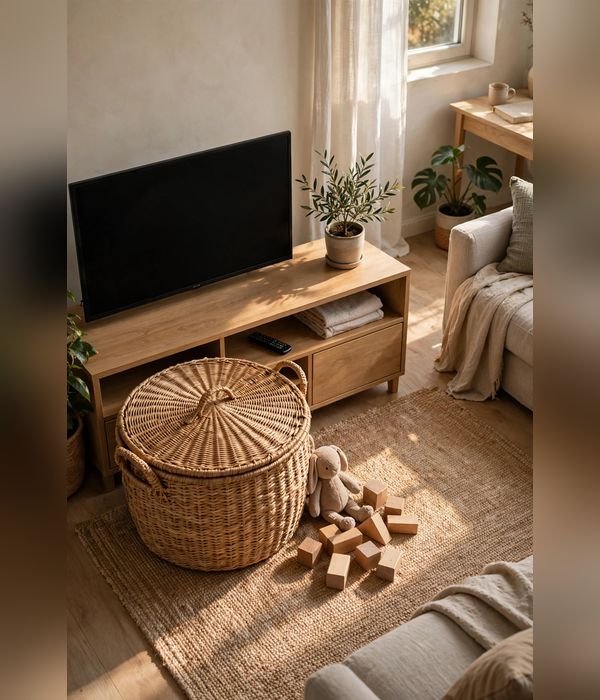
Toys colonize living rooms because they have no boundary, so give them exactly one. The one-lidded-basket rule: all living-room toys must fit in a single lidded basket (18–22 inches wide), and anything that doesn’t fit lives in the bedroom. The mechanism is a hard capacity ceiling: the basket, not your patience, decides what stays.
Kids learn the rule in a week because the constraint is physical, not parental. Choose a lidded, wipeable basket with handles, open bins become toy salad, fabric-only bins can’t be wiped after snack time. Rotate the contents monthly; stale toys get donated, which keeps the basket honest.
Typical price band: $20–$45. This pairs with the dog-toy version in dog toy storage ideas if the four-legged toys are the real invaders.
Where it works best:
- Beside the TV stand, toys migrate toward screens, so meet them there.
- Under the window bench from idea #4, if you bought one.
- In the corner by the reading chair for the “quiet toys” (puzzles, coloring).
- Not for: LEGO-scale collections, those need a lidded bin per set or a dedicated play table.
9. Fabric Bins in Cube Shelving: 13-Inch Uniformity
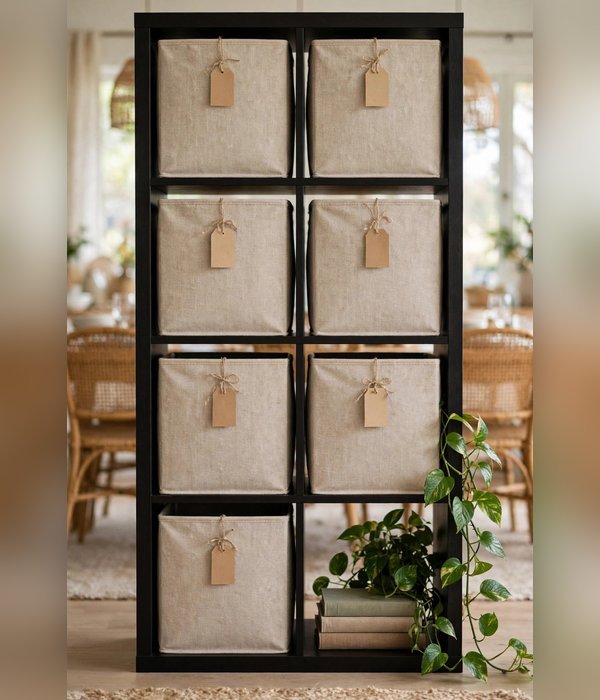
Cube shelving (the 13-inch-cube grid) only looks calm when every cube wears the same bin, mixed bins are visual static. The mechanism is uniformity: identical fabric bins turn 8–12 cubes of chaos into one rhythmic surface, and the eye reads rhythm as order.
Buy bins 12.5–13 inches cubed for standard grids; collapsible fabric bins at $8–$15 each are the budget sweet spot, rigid canvas at $15–$25 holds shape longer. Label the front of each bin (linens, remotes, dog gear, board games), labels turn a bin from a junk drawer into a system.
One open cube per unit max, for the styled 20 percent. Typical unit price band: $60–$150 for an 8-cube.
Where it works best:
- As a room divider in a studio, storage on both sides, sight line broken.
- Under a wall-mounted TV as a low, wide media wall.
- Beside a desk-in-the-living-room setup for office overflow.
- Watch out: cheap bins sag within a year; reinforce with a cardboard insert.
10. Woven Basket Under the Console: The Landing Strip
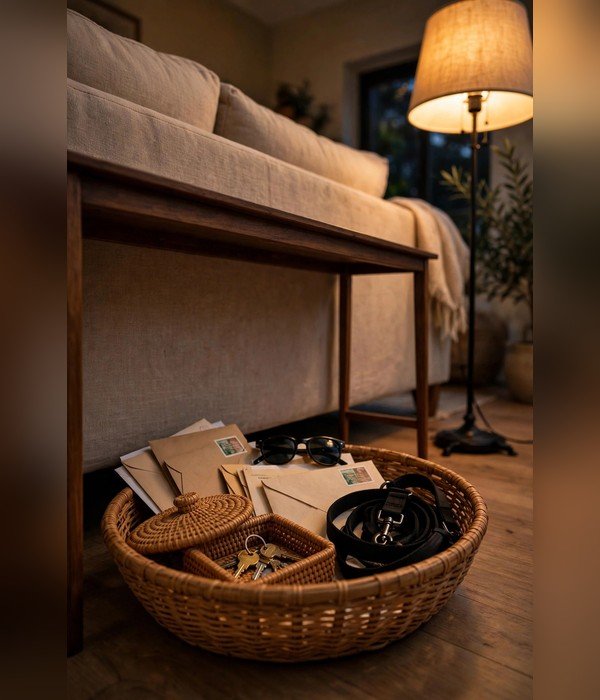
The console table behind the sofa (or in the entry zone) collects the daily drift, sunglasses, the dog leash, today’s mail. A single wide woven basket tucked under it is the landing strip: everything that would scatter across the top goes in the basket instead.
The mechanism is a designated drop zone with walls, loose items on a table spread; loose items in a basket stay. Size: the basket should fill 70–80 percent of the console’s under-shelf (typically 12×30 inches of footprint), shallow enough (10–12 inches tall) to slide under easily.
Add a small lidded tray inside the basket for keys and you have a two-tier system in one piece. Typical price band: $20–$40.
Where it works best:
- Under the sofa-back console, the room’s true front door.
- In the entry-living threshold under a narrow console.
- Beneath a wall-mounted drop-leaf table in a studio.
- Not for: anything that needs finding fast daily, the basket is a parking spot, not a filing cabinet.
11. Rolling Under-Sofa Drawers: The 4-Inch Dead Zone
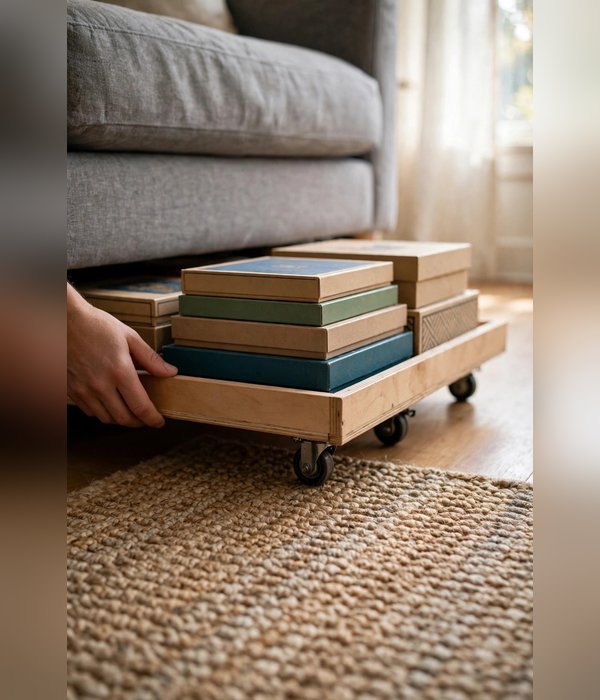
The gap under most sofas is 3.5–5 inches of pure dead space, and low rolling drawers convert it into hidden storage for the flat things: board games, wrapping paper, the spare laptop, seasonal throw-pillow covers.
The mechanism is clearance math: measure your sofa’s under-clearance first, buy drawers 0.5 inch shorter than the gap so they glide without scraping the rug. Standard units are 24–30 inches wide, 16–20 inches deep, 3–3.5 inches tall, with a dust lid. Casters are mandatory; dragging scratches floors and kills the habit.
Typical price band: $25–$50 per drawer, two per sofa max.
Where it works best:
- Under a sofa with 4+ in clearance, measure, don’t guess.
- Under a daybed or sleeper sofa for guest linens.
- Under a low platform bed in a studio’s sleep zone.
- Watch out: under 3.5 in of clearance, skip this, forced drawers jam and get abandoned.
12. Lidded Baskets on Top of Cabinets: The Dust-Free Upper Deck
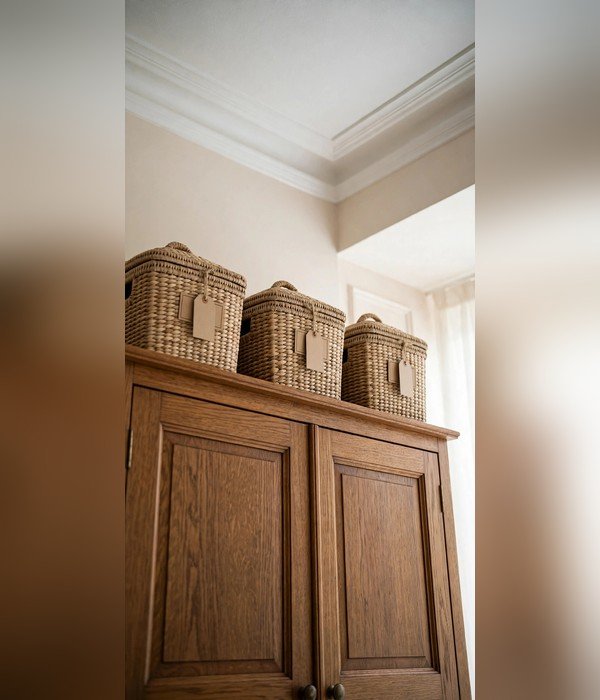
The top of a tall cabinet is 2–4 square feet of storage that collects dust and looks like a junk shelf, unless it wears matching lidded baskets. The mechanism is vertical completion: lidded baskets turn dead airspace into the archive tier (holiday decor, photo albums, the “someday” box) while reading as intentional styling from below.
Keep baskets 10–14 inches tall so they clear standard 8-foot ceilings with the cabinet; match the set (same weave, same lids) for the uniform-surface effect from idea #9. Label the side facing out, future you will thank present you. Typical price band: $15–$35 each.
Where it works best:
- Atop the tall cabinet from idea #5, the full vertical system.
- Above a wardrobe-style media cabinet in a small room.
- Over the entry closet in an open-plan living space.
- Not for: anything you need weekly, the archive tier is for quarterly access.
Coffee Tables, Ottomans & Dual-Duty
The coffee table zone is the room’s center stage, and its biggest clutter magnet. Dual-duty pieces win here because they hide storage inside the furniture the eye expects to see, so capacity arrives without adding a single extra object to the room.
13. Storage Ottoman as Coffee Table: 2–4 Cubic Feet of Invisible Capacity
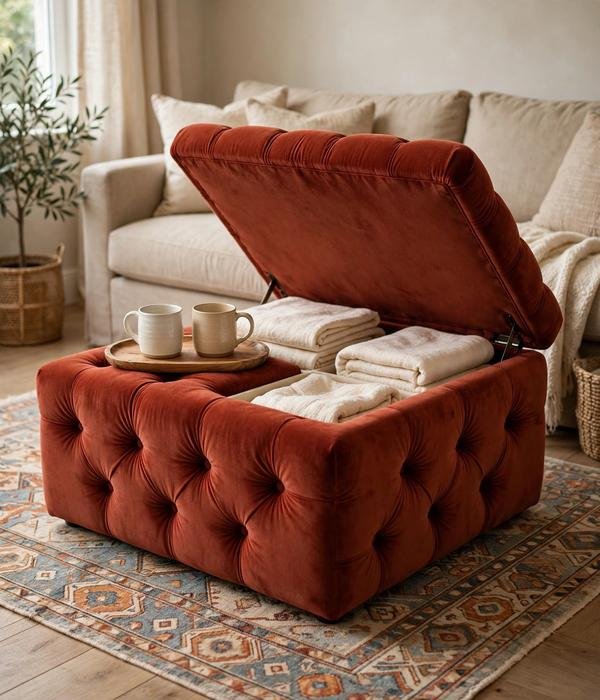
Swap the coffee table for a storage ottoman and you gain 2–4 cubic feet of hidden storage while the room loses a hard-edged object, the softest visual trade in this guide.
The mechanism is lid math: a 36×18×16-inch ottoman holds 2–3 folded throw blankets, the board-game overflow, or a full toy reset, and the tray on top still serves drinks. Buy firm-topped (a tray sits stable), hinged-lid (stays open while you load), and at least 16 inches tall, shorter ottomans are footrests with delusions. Typical price band: $70–$180.
Pair with sofa storage ideas for the full seating-zone system.
- Measure your seating: the ottoman should span 50–60 percent of the sofa’s width.
- Choose a hinged lid over a lift-off lid, lift-offs end up leaning against the wall.
- Test firmness: set a mug on it in the store (or check reviews for “tray-stable”).
- Assign it one job, blankets OR toys OR games, not all three.
- Renter-safe: zero installation, and it moves room to room.
14. Lift-Top Coffee Table: The Work-From-Sofa Engine
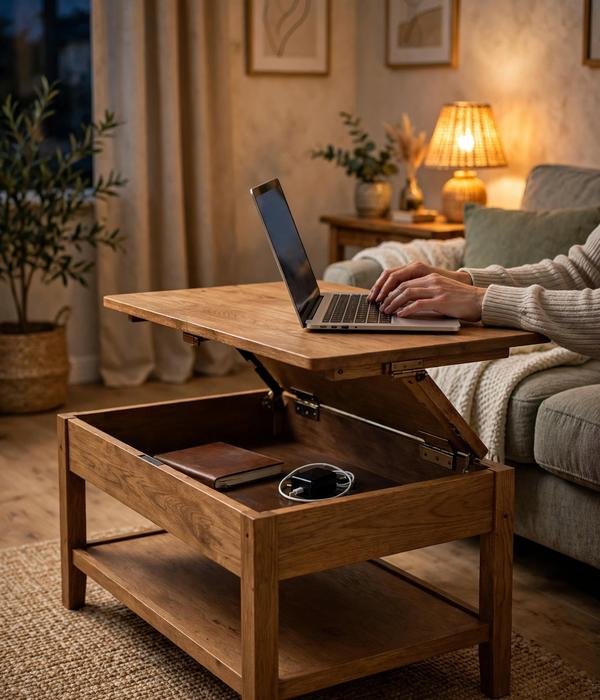
A lift-top coffee table raises its surface 6–10 inches toward the sofa, turning the living room into a laptop station, and the cavity underneath hides the laptop, charger, and notebooks when work ends. The mechanism is the disappearing office: open the top to work, close it and the room is a living room again.
Standard tops lift to 24–28 inches high (true table height); the storage well is typically 3–5 inches deep, sized for a 15-inch laptop plus a slim power strip. Check the hinge weight rating, cheap lifts sag within a year; look for 30+ pound lift mechanisms. Typical price band: $90–$200.
- Confirm the lift height clears your sofa seat (seat height + 8–10 in is the ergonomic target).
- Route the charger through a rear cable cutout so cords never drape.
- Store the laptop in a sleeve inside the well, crumbs and coffee are real.
- Keep the well under 5 in deep; deeper wells become junk drawers.
- Not for: households that eat full meals here, the lift top is a work surface, not a dining table.
15. Coffee Table With Drawers: The Remote and Coaster Drawer
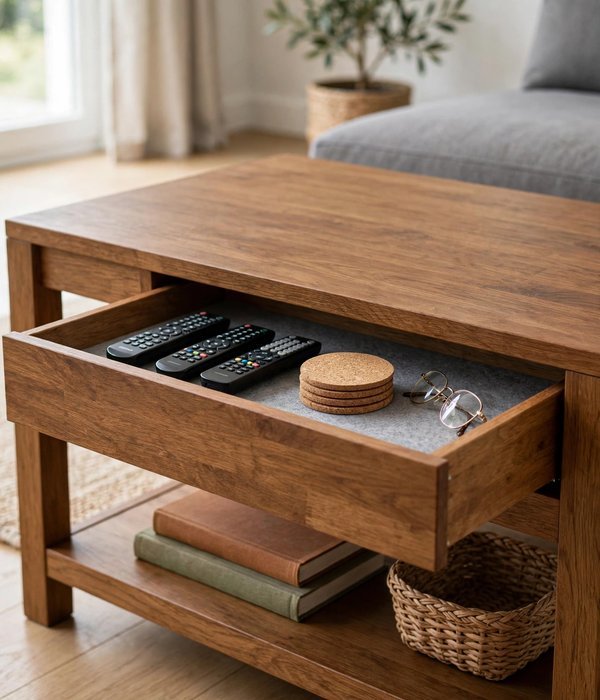
A coffee table with two shallow drawers ends the tabletop sprawl: remotes, coasters, the current crossword, reading glasses, everything that breeds on a flat surface gets a drawer. The mechanism is the 12-inch rule: anything used within arm’s reach of the sofa should live within 12 inches of it, not across the room.
Drawers 3–4 inches deep, full-width, on metal slides (wood-on-wood sticks in humid summers). The lower shelf still holds the styled 20 percent, two books, one basket. Typical price band: $80–$170.
For more table-first options, see coffee table storage ideas.
- Count your tabletop breeders first, remotes, glasses, notebooks, and buy drawer count to match.
- Line drawers with felt or cork: it stops the rattle and reads finished.
- Assign drawer 1 to daily (remotes), drawer 2 to weekly (chargers, notebooks).
- Keep one coaster set in the drawer, not on the table, the table stays clear.
- Watch out: drawers under 3 in deep won’t hold a standard remote upright.
16. Sofa-Back Console Table: The Behind-the-Scenes Shelf
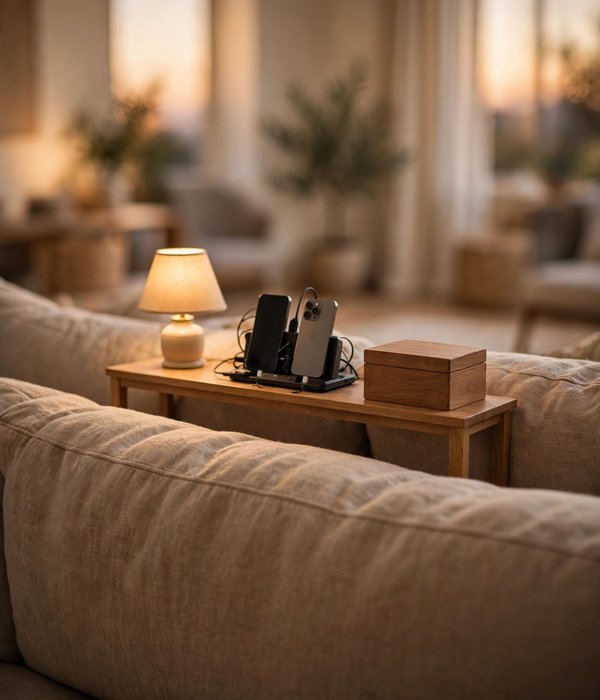
A narrow console table behind the sofa (8–12 inches deep, sofa height) creates a shelf the room barely registers, and that shelf is prime real estate for lamps, a charging drawer, and a lidded catch-all for the daily pile.
The mechanism is backstage storage: it faces away from the room’s sight lines, so even a working lamp and a charging cable read as background. Buy 10–12 inches deep for stability (8 inches tips when someone leans), height within 2 inches of the sofa back. Typical price band: $50–$120.
Renter-safe, freestanding.
- Measure the sofa back height first; the console should sit level with it, not tower.
- Anchor it if the sofa is light, a bumped console spills lamps.
- Put the charging setup at the far end, away from the main walkway side.
- One lamp max; two lamps on a 10-in-deep console is a domino risk.
- Style the remaining length with a single low tray, never loose small objects.
17. Nesting Tables With a Storage Tier: Small Tables, Big Job
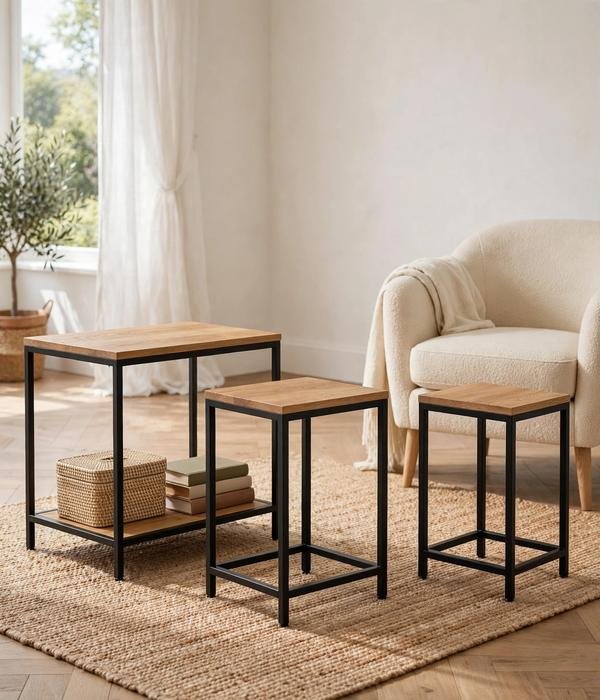
Nesting tables pull apart for guests and tuck together for daily life, and the lower tier of the large table is a hidden shelf for the current book stack, a lidded remote box, or the puzzle in progress.
The mechanism is expandable surface with built-in parking: you get guest seating surfaces without a second furniture piece, and the clutter has a home tier. Buy a set where the large table’s lower tier clears 6+ inches (enough for a lidded box) and the small table tucks fully underneath, half-nested sets snag shins.
Typical price band: $60–$130 for a set of two or three.
- Measure your “guest mode”, two extra surfaces cover most living rooms.
- Put a felt pad under the small table’s top edge; nesting scratches show fast.
- Use the lower tier for one category (books OR games), not a mix.
- Tuck them fully nested daily, half-out tables read as clutter.
- Not for: rooms where toddlers roam, light nesting tables tip.
18. Storage Poufs: The Footrest That Swallows the Mess
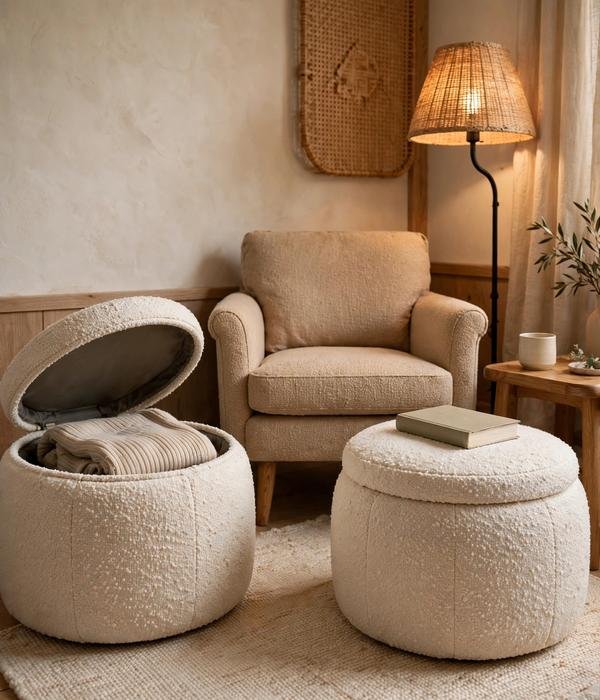
A storage pouf is the ottoman’s smaller sibling: 16–18 inches round, a lift-off or zip top, and 1–1.5 cubic feet inside for the throw, the kids’ headphones, or the dog’s living-room toys. The mechanism is distributed hiding, two poufs flanking a chair hide as much as one ottoman while doubling as extra seats for guests.
Buy with a structured (not slouchy) wall so the lid actually closes, and a wipeable cover, poufs live at spill height. Typical price band: $30–$70 each. This is the small-room answer to idea #13.
- Buy two, not one, a single pouf looks lost; a pair looks intentional.
- Assign each pouf one job (throws / kid gear) and label the inside lid.
- Choose a lid that stays put when sat on, zip tops beat loose lids.
- Keep total pouf footprint under 4 sq ft in rooms under 150 sq ft.
- Renter-safe and pet-note: claws shred woven poufs; choose tight-weave or faux leather with pets.
Walls, Shelves & Corners
Walls are free square footage, but only if the shelves are mounted right and loaded honestly. This group is about vertical storage that stays up, stays level, and doesn’t rain books at 2 a.m.
Floating-shelf weight cheat sheet (save this):
- Stud-mounted (2+ studs, 2.5-in screws): 30–50 lb per 36-in shelf, books are safe.
- Drywall anchors (toggle bolts): 10–15 lb per shelf, decor and paperbacks only.
- Adhesive strips: 3–5 lb per set, frames and tiny plants, nothing more.
- Stud finder rule: studs run 16 in apart; if your shelf is 24 in+, it should hit two studs.
- Renter rule: adhesive or lean-to shelving only, unless the lease says otherwise.
19. Stud-Mounted Floating Shelves for Books: The Library Wall
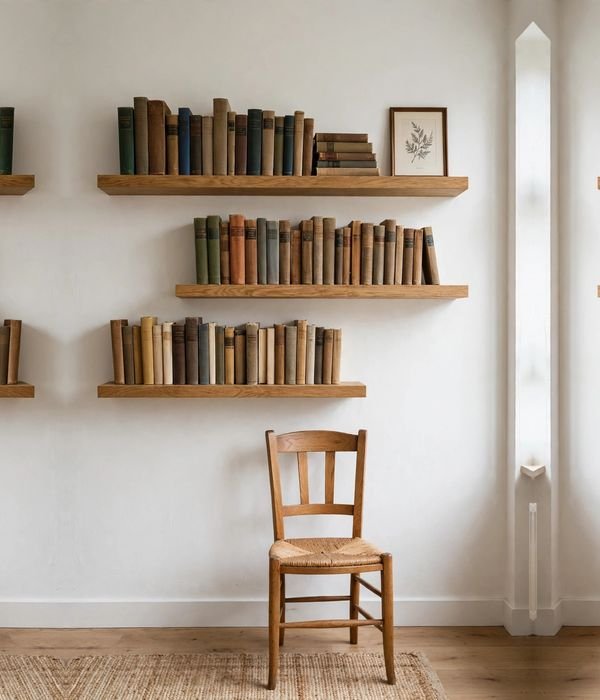
A run of stud-mounted floating shelves turns a blank wall into a library that holds 30–50 pounds per shelf, real books, not just decor.
The mechanism is load transfer: screws into two studs carry the weight into the wall framing, which is why these shelves can hold a row of hardcovers that would rip adhesive mounts off in a week. Buy 8–10 inches deep (fits most books), 24–36 inches long (hits two studs at 16-inch spacing), with a hidden metal bracket rated 30+ pounds.
Stagger two or three shelves 12–14 inches apart vertically, tighter spacing wastes the look, wider wastes the wall. Typical price band: $25–$60 per shelf.
Tips for best results:
- Find studs with a finder, then confirm with a finish nail, finders lie on plaster.
- Load heaviest books over the bracket points, not mid-span.
- Watch out: a 36-in shelf of hardcovers weighs 40+ lb, never trust drywall anchors for books.
20. Picture Ledge Shelves: Shallow Display, Zero Commitment

Picture ledges, 3–4-inch-deep rails, hold framed photos, small art, and tiny plants in overlapping layers that look styled with zero effort. The mechanism is lean, not hang: frames rest on the ledge, so you rearrange by sliding, never re-hammering.
That makes them the renter’s gallery wall, one ledge, six frames, infinite rearrangement, and the whole display changes in minutes when seasons or photos change. Mount with two screws into one stud (or heavy-duty adhesive strips for under 5 pounds total), 48–60 inches long for a real gallery feel. Typical price band: $15–$35 per ledge.
Tips for best results:
- Overlap frames front-to-back, layering is what makes ledges look designed.
- Keep the front lip 1+ in tall; shallow lips drop frames during door slams.
- Watch out: total load is the limit, six frames plus a plant can pass 10 lb fast.
21. Corner Floating Shelves: The 90-Degree Reclaim
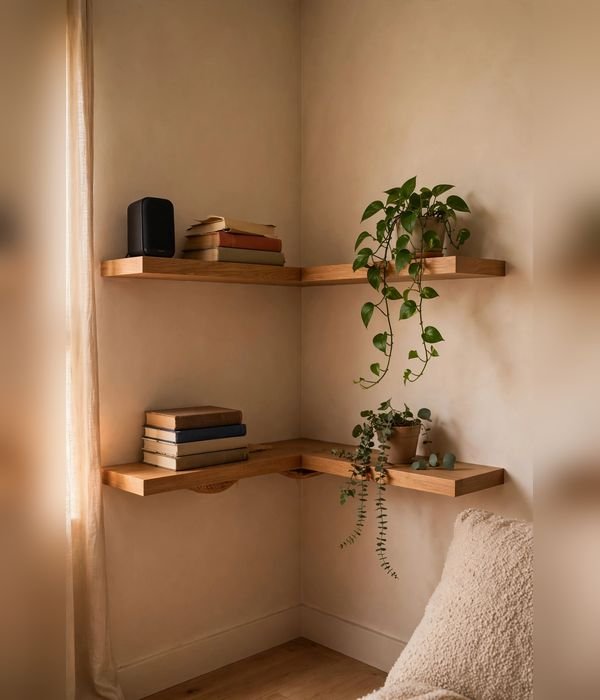
Corners defeat standard shelves, a corner floating shelf wraps the 90-degree turn and converts dead air into display-and-store space for plants, books, and the speaker. The mechanism is the L-bracket into two walls: anchored on both faces, a corner shelf carries more per inch than a straight shelf and can’t be bumped off-center.
Buy quarter-round or L-shaped shelves 10–12 inches per side; mount each side into a stud for book loads, or use the pair for lighter decor on anchors. Two stacked corners (18 inches apart) make a full vertical vignette. Typical price band: $20–$45 per shelf.
Tips for best results:
- Mount the lower shelf at 48–54 in, reachable, visible, out of head-bump range.
- Use corners for the speaker or diffuser, sound and scent project better from corners.
- Watch out: measure both walls’ stud positions before buying, corner studs don’t always align.
22. Wall Cabinets Above the Sofa: The Kitchen-Cabinet Hack
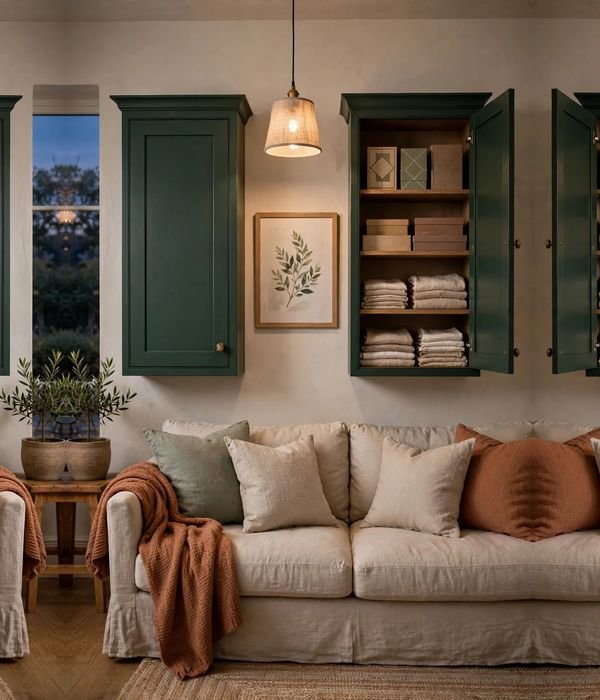
Standard 12-inch-deep kitchen wall cabinets, mounted 18–24 inches above the sofa back, are the highest-capacity wall storage in this guide, each 30-inch cabinet hides 3+ cubic feet behind a door. The mechanism is borrowed infrastructure: kitchen cabinets are engineered for heavy loads, come with adjustable shelves, and cost half what “living room” wall cabinets do.
Mount into studs with a French cleat or the cabinet’s rail system, never drywall anchors at this weight. Paint or reface to match the room; raw oak kitchen cabinets read “renovation in progress.” Typical price band: $60–$140 per 30-inch cabinet. For a deeper dive, see living room cabinet ideas.
Tips for best results:
- Keep cabinet bottoms 18+ in above the sofa back, lower and tall guests bump heads.
- Soft-close hinges are worth the $10 upgrade per door.
- Watch out: check what’s in the wall first, plumbing and electrical run through living room walls too.
23. Tall Narrow Bookcase in the Dead Corner: The 12-Inch Tower
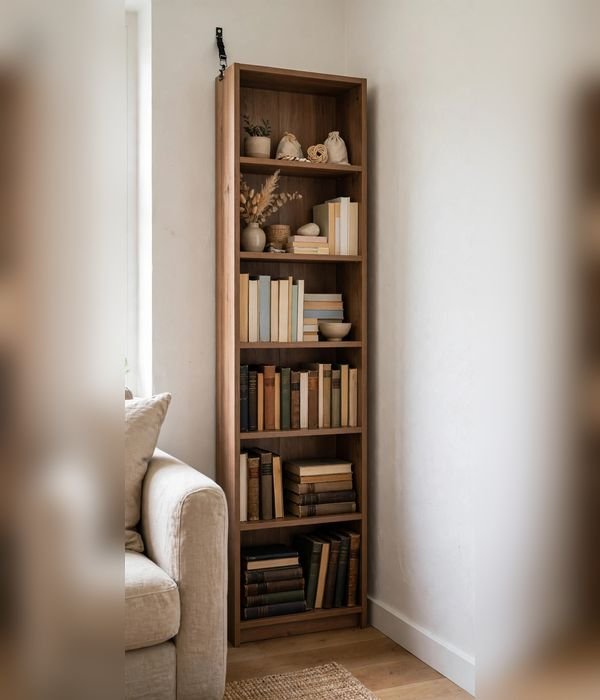
The 12-inch gap between the sofa arm and the wall, or the strip beside the fireplace, fits a tall narrow bookcase, 12 inches deep, 18–24 inches wide, 60–72 inches tall, that holds a surprising 6–8 shelves of books, games, and baskets.
The mechanism is the filler-strip reclaim: rooms are full of 12–18-inch gaps too narrow for furniture and too wide to ignore, and a tower built to that exact width converts one into a library column. Buy adjustable shelves (fixed shelves waste 2–3 inches each), and anchor anything over 48 inches tall. Typical price band: $50–$110.
Tips for best results:
- Measure the gap at floor, middle, and top, old walls lean, and 12 in can become 11.
- Put books low (weight stabilizes) and light decor high.
- Watch out: a 72-in tower on carpet needs a wider base or wall anchor, carpet lean is real.
24. Radiator Cover Console: Hide the Eyesore, Gain a Shelf
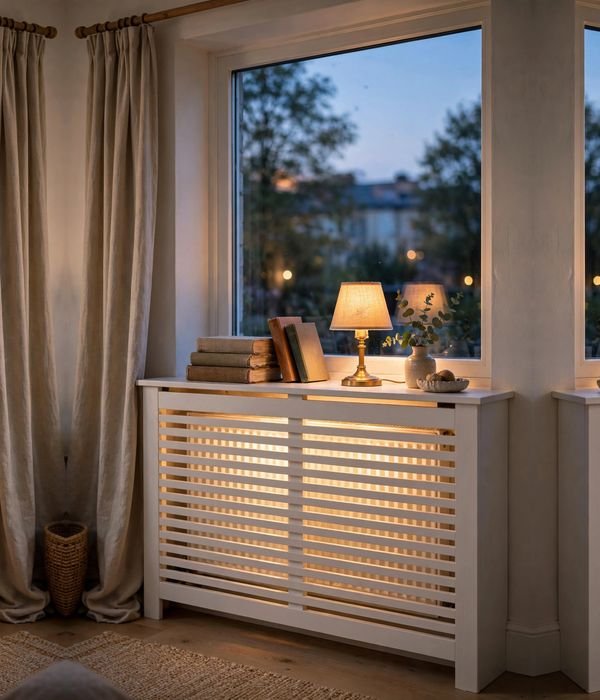
An ugly radiator eats a 4-foot wall and ruins every photo, a radiator cover console hides it behind a slatted front while adding a 12–14-inch-deep shelf on top for books and a lamp. The mechanism is convection-safe enclosure: slats or mesh let heat escape upward while the eye sees furniture.
Clearance rules matter: leave 2 inches of air above and 1 inch on the sides of the radiator, and never block the bleed valve, covers need a removable top or access panel for maintenance. Buy to your radiator’s exact length plus 4 inches; standard covers run 36–60 inches. Typical price band: $80–$180.
Not for: steam radiators that run extremely hot, check surface temps before enclosing.
Tips for best results:
- Choose slats over solid fronts, solid fronts trap heat and warp.
- The top shelf holds 10–15 lb max; it’s a display shelf, not a bookcase.
- Watch out: never store candles, electronics, or anything meltable on top.
Cords, Remotes & the Daily Clutter
A room can have perfect cabinets and still feel cluttered, because the feeling of clutter comes from the small daily drift: cords, remotes, mail, chargers. This group kills the drift at the source, so the storage you built in Groups 1–4 actually gets to shine.
25. Vented Cable Management Box: The Router Graveyard, Buried
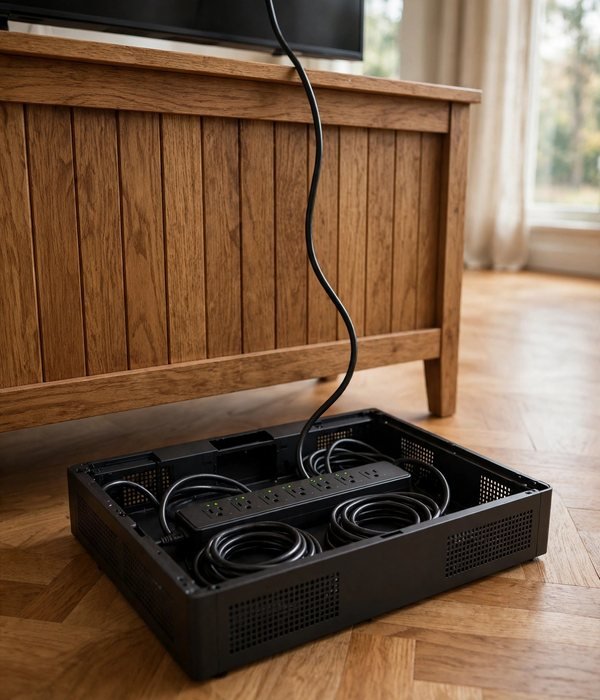
The power strip behind the TV stand sprouts 6–10 cords that read as pure chaos, a vented cable box swallows the strip, the adapters, and the slack, leaving one clean surface. The mechanism is single-object substitution: ten visible cords become one matte box.
Buy vented (heat kills routers and strips, solid boxes trap it), sized to your strip plus 2 inches each side (standard boxes are 12–16 inches long, 5–6 inches wide, 5 inches tall). Cut or use the side slots for cord entry; coil slack with Velcro ties inside. Typical price band: $15–$35.
Check that your router’s signal survives the box, metal boxes block Wi-Fi; wood and plastic don’t.
Where it works best:
- Behind the media console, the cord capital of the house.
- On the sofa-back console from idea #16, hiding the charging strip.
- Beside the reading chair for the lamp + phone charger pair.
- Watch out: never bury a strip under fabric or in a sealed box, heat + dust is a fire risk.
26. Cord Raceway Along the Baseboard: The Invisible Highway
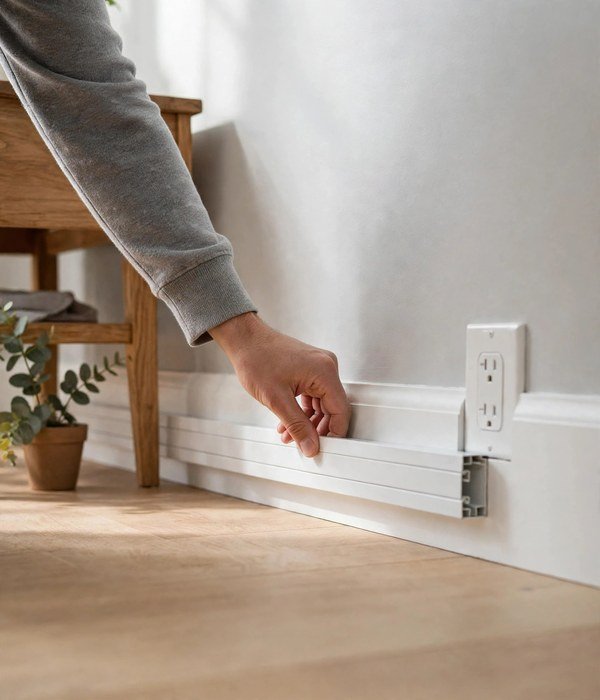
Cords that cross the floor to reach an outlet are trip hazards and visual static, an adhesive cord raceway runs them along the baseboard, painted to match, and they vanish. The mechanism is edge routing: the eye ignores the wall-floor junction, so cords placed exactly there drop out of sight.
Buy 1-inch-wide raceways for 2–3 cords (lamp + charger), 1.5-inch for TV runs; paintable PVC blends best. Clean the baseboard with rubbing alcohol first, press adhesive sections for 30 seconds, and let them cure an hour before loading cords. Typical price band: $12–$25 for a 6-foot kit.
Renter gold, peels off clean with heat from a hair dryer.
Where it works best:
- From the sofa-back console to the nearest outlet, the charging run.
- Along the TV wall down to the floor outlet, the HDMI highway.
- Behind the reading chair for the lamp cord.
- Not for: high-heat cords (space heaters), those need open air, not a channel.
27. Armrest Remote Caddy: Remotes Live Here Now
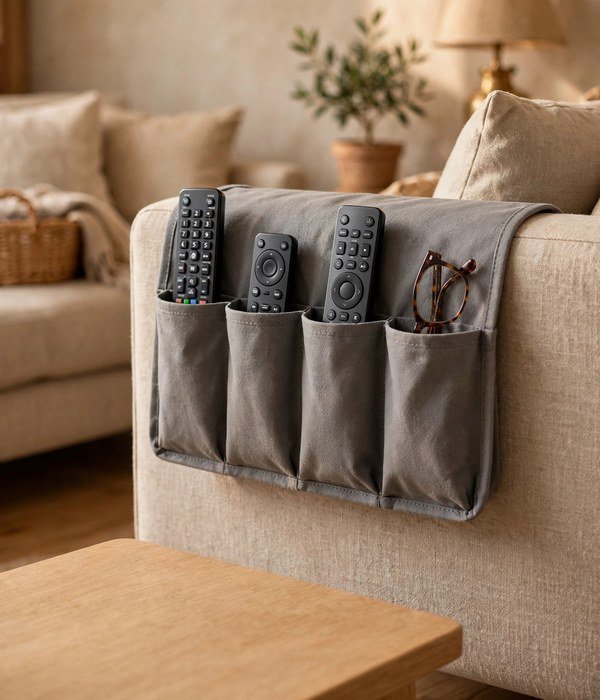
Remotes migrate, couch cushions, coffee table, under the chair, because they have no home. An armrest caddy (a structured sleeve that drapes over the sofa arm with 3–5 pockets) gives every remote a slot. The mechanism is proximity storage: remotes live where hands already are, so the coffee table stays clear and the “where’s the remote” hunt ends.
Buy structured canvas or leather with a weighted or non-slip inner panel, floppy caddies slide off the arm. Count your remotes first: TV + streaming + soundbar + fan = four pockets minimum. Typical price band: $12–$28.
Where it works best:
- On the dominant-hand arm of the main TV-watching seat.
- On a recliner arm for the reader’s glasses + remote + phone.
- Doubled as a bedside caddy in a studio’s sleep zone.
- Watch out: overloading the outer pocket tips the caddy, remotes only, not tablets.
28. The Mail Tray Rule: Paper Gets One Tray, Then It Leaves
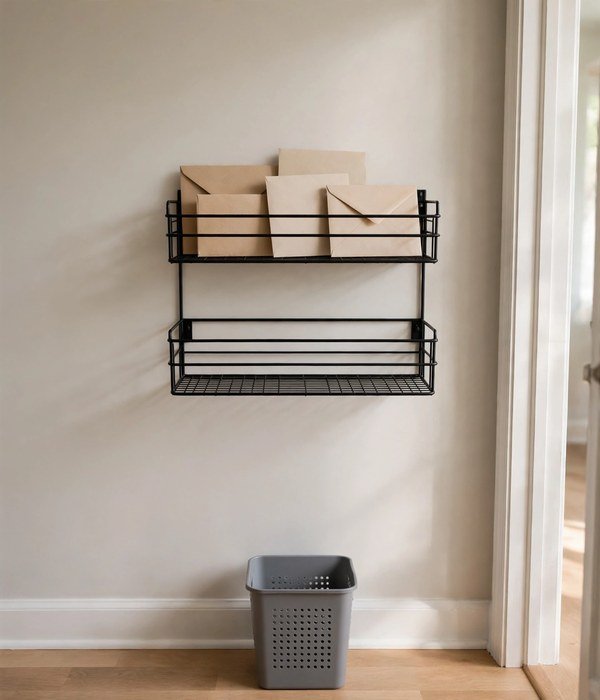
Mail is the living room’s slowest flood, today’s pile becomes next month’s archaeology. The rule: one wall-mounted or console-top tray, 12×9 inches, and anything that doesn’t fit gets filed, recycled, or shredded today. The mechanism is a physical inbox with a hard ceiling: the tray’s size is the system, not your willpower.
Mount it by the room’s entry point (or set it on the console from idea #10’s zone) so mail lands there first, not on the coffee table. Add a tiny shred pile, junk mail dies on arrival. Typical price band: $15–$30 for a wall-mounted two-tier tray.
Where it works best:
- By the front door in an open-plan living room, mail’s true entry point.
- On the sofa-back console, next to the basket landing strip.
- Inside the entry closet door if the living room has no foyer.
- Not for: households that get packages daily, add a separate package drop spot by the door.
29. The Lidded Catch-All Tray: The 5-Minute Reset Station
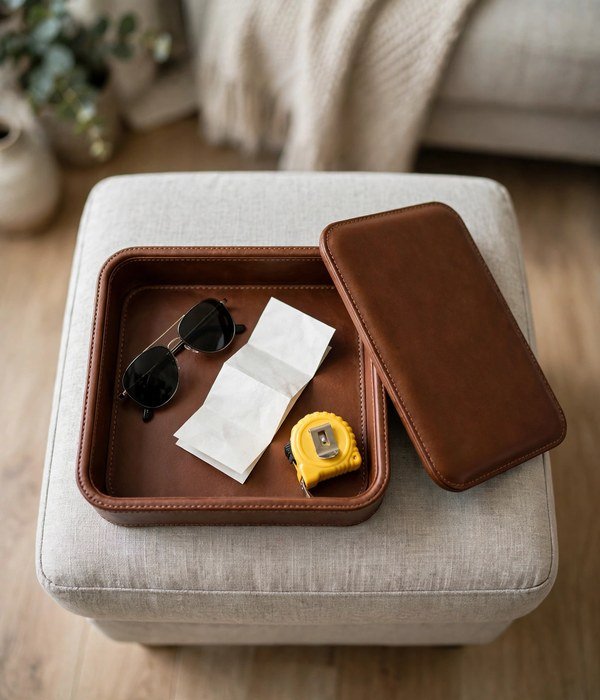
Even with perfect systems, daily life deposits stuff, the sunglasses, the kid’s permission slip, the tape measure from hanging a frame. A single lidded tray (14×10 inches) on the console or ottoman tray is the sanctioned parking spot, and the 5-minute nightly reset empties it: everything in the tray goes home, the tray closes, the room resets.
The mechanism is bounded imperfection: one allowed messy spot, emptied on schedule, beats ten “I’ll deal with it” piles. A lid matters, an open tray is just a prettier pile. Typical price band: $20–$40 for a lidded leather or wood tray.
Where it works best:
- On the ottoman tray from idea #13, the room’s center.
- On the sofa-back console for the daily drift.
- By the reading chair for glasses, bookmarks, and the current pen.
- Pair with the calm-room method in clutter-free living room ideas.
30. In-Cabinet Charging Drawer: Cords Retire Behind Closed Doors
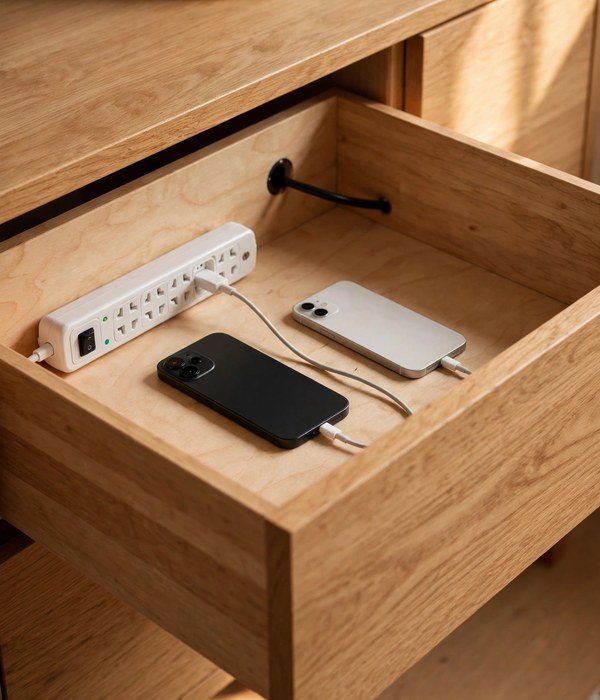
Phone chargers breed on every flat surface, an in-cabinet charging drawer (a console drawer fitted with a power strip and cable cutouts) retires the whole brood behind a closed door. The mechanism is hidden infrastructure: devices charge inside furniture, so counters and tables stay cord-free.
Drill a 1.5-inch cable port in the drawer’s back panel, mount a 3-outlet strip inside with adhesive, and add a heat check, strips in closed drawers need the drawer cracked or a vent hole if chargers run warm. Use a smart strip with auto-off for overnight charging. Typical price band: $25–$50 for strip + port kit.
Renter flag: drilling the drawer needs landlord approval, use a no-drill cable pass (adhesive grommet) instead.
Where it works best:
- In the media console’s top drawer, the whole family’s devices in one place.
- In the sofa-back console drawer from idea #16.
- In a cube-shelf bin retrofitted as a charging cubby.
- Watch out: never charge damaged or swollen batteries in an enclosed drawer, that’s a fire rule, not a suggestion.
Conclusion
Thirty ideas is a lot, so here is the short version. If your living room feels cluttered, it is almost never a space problem; it is a closed-storage ratio problem. Walk your room and count: for every open surface holding small loose things, you need a door, drawer, or lid.
Most living rooms I would fix need exactly three moves: a low console with doors on the TV wall (idea #1), a storage ottoman or lift-top in the center (ideas #13–14), and a vented cable box plus a remote home to kill the daily drift (ideas #25, #27).
That trio alone takes most rooms from “lived-in chaos” to “designed” in one weekend.
Best-looking win: the low media console with solid doors. It is the only piece that simultaneously hides the room’s worst clutter zone (cables, boxes, remotes), anchors the TV wall visually, and reads as pure furniture. Buy it 14–16 inches deep, vent the electronics bays, and let everything else in this guide orbit around it.
For the room-by-room versions of this system, work down through living room cabinet ideas, apartment living room storage ideas, built-in shelves ideas for the living room, coffee table storage ideas, sofa storage ideas, and living room storage mistakes, plus the small-room companion in small living room storage ideas.
Frequently Asked Questions (FAQ)
How do I hide clutter in my living room without buying all new furniture?
If your furniture is fine and the clutter is the problem, start with containment, not replacement: add inside-door organizers to existing cabinets, put lidded baskets on open shelves, and give cords a cable box. If the furniture itself is the clutter source (open shelving everywhere), then one closed console on the TV wall buys the biggest visible change per dollar.
What are the best living room storage ideas for a small apartment?
If you are under 200 square feet, prioritize dual-duty and vertical: a storage ottoman instead of a coffee table, a tall narrow bookcase in a dead corner, wall cabinets above the sofa, and under-sofa rolling drawers.
If floor space is truly zero, work the walls and doors, floating shelves, over-door racks, and inside-cabinet organizers add capacity without a single new footprint.
How much closed storage does a living room actually need?
If you follow the 80/20 rule, aim for at least four closed pieces (doors, drawers, lidded baskets) for every open display surface. If your room currently feels cluttered, count the small loose objects in one glance, over seven means you need more doors, not more organizing. Most 150–250-square-foot living rooms hit calm with 3–4 closed pieces total.
Are storage ottomans actually comfortable as coffee tables?
If you buy firm-topped and tray-stable, yes, a 36×18×16-inch ottoman with a tray serves drinks as steadily as a table. If you buy soft and slouchy, no, mugs tip and the lid never quite closes. Test firmness before buying, and choose a hinged lid so it stays open while you load blankets.
How do I store blankets in the living room without it looking messy?
If you have 2–3 throws, one lidded basket sized 15×13×12 inches beside the sofa keeps them folded and textured, not draped and messy. If you have 4–5, size up to 20×15×14 inches or split across two zones. The lid is the difference, lidless throw baskets overflow and read as laundry by month two.
What’s the safest way to hide TV cords and a router?
If the gear sits behind a console, use a vented cable box sized to the power strip plus 2 inches per side, never a sealed box, since heat kills electronics and trapped dust is a fire risk. If cords run along the wall, an adhesive raceway on the baseboard hides them and peels off clean for renters.
Metal boxes block Wi-Fi, so choose wood or plastic for the router.
Can I mount floating shelves in a rental apartment?
If your lease allows small holes, mount into studs with 2.5-inch screws and fill on move-out, most landlords accept this. If holes are banned, use adhesive-mounted ledges rated for the actual load (3–5 pounds per set), or go freestanding with a lean-to ladder shelf. Never hang book-weight loads on adhesive mounts, whatever the packaging claims.