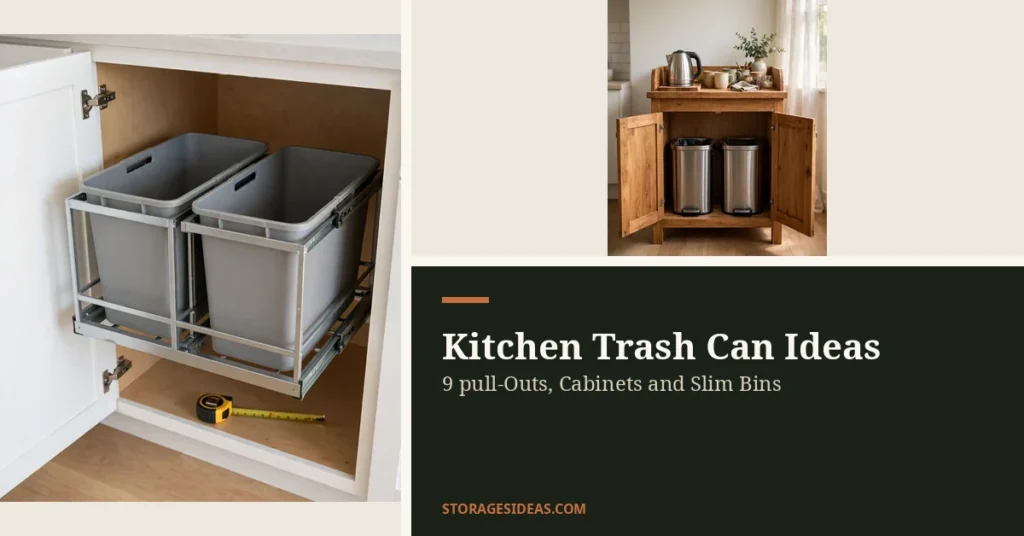
Start with the tape measure. Every indoor trash can idea here lives or dies by three numbers: your cabinet opening width, the clear height under your counter or pipes, and the can’s own width. Measure those before you shop and you will not end up with a bin that sticks out.
These nine ideas are grouped by type: pull-out kits that hide bins inside a base cabinet, freestanding cabinets that turn a 13-gallon can into furniture, and slim bins that fit gaps under 11 inches wide. Each one includes the exact sizes and price bands to look for, so you can buy once and install once.
Why indoor trash can ideas start with three measurements
A cabinet opening is not the same as the cabinet width. A 15-inch base cabinet with a face frame leaves about 13.5 inches of clear opening, so a 14.5-inch pull-out kit will not slide in. Measure the opening with the door open, then measure depth to the back wall and height to the lowest pipe or shelf.
Width is only half the story. A standard 13-gallon step can runs 12 to 17 inches wide, but slim models come in under 11 inches, narrow enough for the gap beside a fridge. Under a counter, lid clearance matters too: a butterfly lid needs several inches of headroom to open, while a step can needs foot room in front.
If you recycle, decide now whether it gets its own bin or a split compartment, since that choice changes the footprint. For placement and cleaning routines, see our complete guide trash can placement and cleaning guide. Every idea below assumes a 24-inch-deep base cabinet and tall kitchen bags unless noted.
1. Double Pull-Out Kit: two bins inside one base cabinet
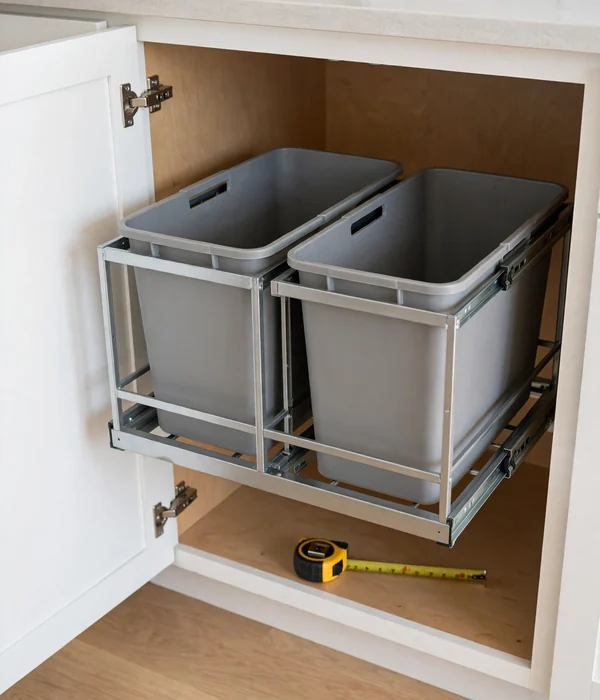
A double pull-out kit turns one standard base cabinet into a hidden trash station with separate bins for garbage and recycling. Most kits carry two 35-quart bins, which is 8.75 gallons each, enough for a household of three or four to go several days between emptying. The frame runs about 14.5 inches wide, 22.25 inches deep and 19 inches tall.
It needs a cabinet opening at least 14.5 inches wide and 19.25 inches tall, so a 15- or 18-inch base cabinet works. Full-extension ball-bearing slides carry 90 to 120 pounds, and soft-close versions shut without slamming. Budget roughly $90 to $240 depending on the brand and slide quality.
Measure the opening, not the cabinet face. Face frames eat about 1.5 inches of width, and a garbage disposal can steal the depth you need under the sink. A kit ordered for the wrong opening is an expensive return.
- Measure interior width, depth and height with the cabinet door open and compare all three to the kit’s minimums.
- Screw the frame to the cabinet floor with the included hardware, keeping it level front to back.
- Mount the cabinet door to the kit’s brackets so the door pulls both bins out with it.
- Drop in the bins, load bags, and test the slides with a full bin before you put the tools away.
2. Single-Bin Under-Sink Pull-Out: trash where the mess happens
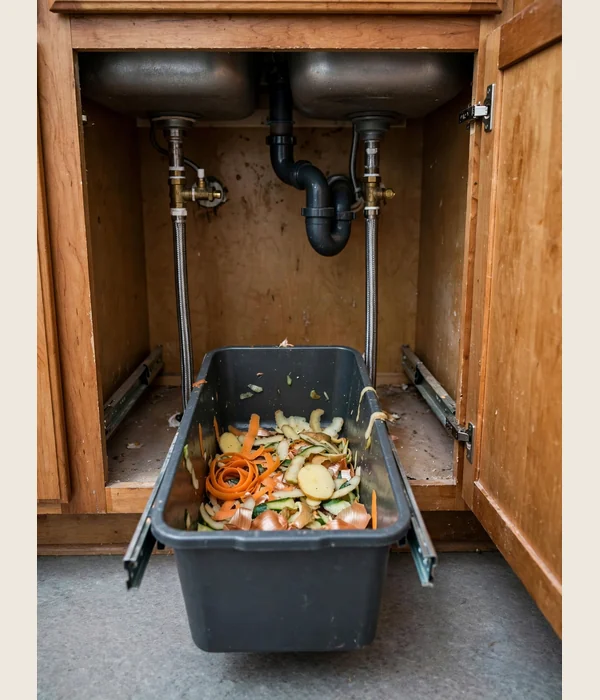
Most kitchen mess is made at the sink, so a single-bin pull-out puts the trash exactly where peelings, coffee grounds and packaging land. These kits run one 27- to 35-quart bin, about 7 to 8.75 gallons, on a slide-out frame. The frame mounts to the cabinet floor or screws to the back of the door.
Because supply lines and the drain eat the middle of the cabinet, pick a kit rated for a 15-inch opening. Confirm at least 19 inches of clear height under the lowest pipe before you order. Kits run roughly $60 to $150.
Skip this spot if the cabinet already holds a water filter or an instant-hot tank. In that case, put the single pull-out in the cabinet next to the sink instead.
What you can do with it:
- Toss vegetable peelings straight in while you prep at the sink.
- Park a small compost pail on the rear of the tray if the pipes leave room.
- Hang a door-mounted caddy for extra trash bags and twist ties.
- Stick a charcoal deodorizer inside the door to control sink-area smells.
- Pick a floor-mounted frame, since it works around more plumbing layouts.
- Line the bin with a tall kitchen bag and change it before food scraps sit more than a day.
3. Pull-Out Trash and Recycling Splitter: sort at the source
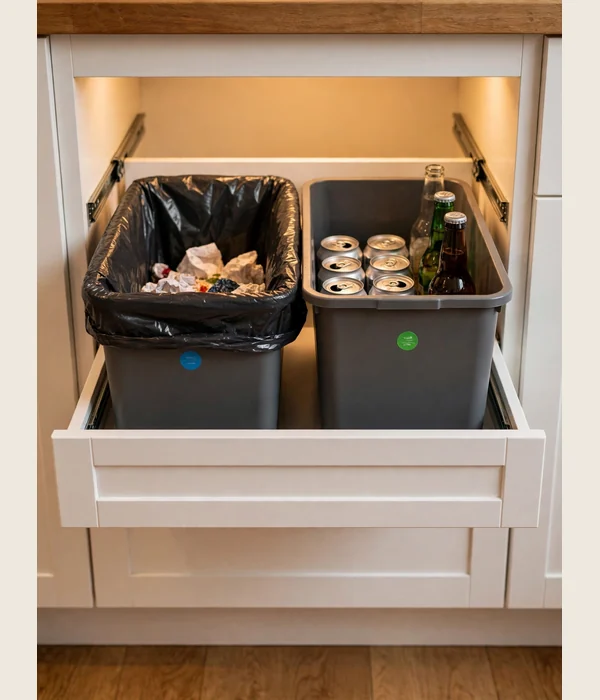
A splitter kit gives you the double-bin setup of point one in a single cabinet, with one bin for trash and the other for cans and bottles. Sizes match the double kits: two 27- to 35-quart bins in a 15- or 18-inch opening, full-extension slides, and door-mount brackets so one pull opens both.
The real win is sorting at the source. Nobody digs through a mixed bag when the divider is right there in the cabinet. Budget about $90 to $240, the same as a double kit.
One caution: a splitter only works if everyone in the house knows which bin is which. Label both bins on day one and the habit forms fast.
What you can do with it:
- Put trash in front and recycling in back, since trash gets emptied more often.
- Label each bin with a peel-and-stick tag so guests sort correctly.
- Line the recycling bin with a bag too, since it still collects sticky residue.
- Keep a folded-box flattener or scissors on the shelf above for cartons.
- Empty both bins on the same day so the rhythm sticks.
For sorting rules and what actually gets recycled curbside, see recycling storage ideas for kitchens and garages.
4. Tilt-Out Wooden Trash Cabinet: a 13-gallon can dressed as furniture
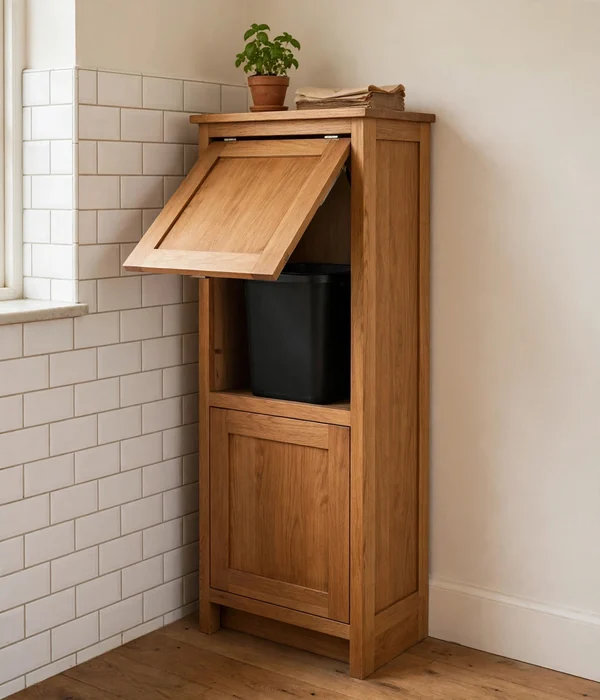
A tilt-out cabinet hides a standard 13-gallon tall kitchen can behind a hinged door that swings out when you push the top edge. Most models measure about 19 inches wide, 17 inches deep and 36 inches tall, so the bin slides in upright with the lid on. The top gives you a small shelf for paper towels or spare bags.
Solid wood and MDF versions run about $100 to $200. Ventilation matters here: trash sealed in a wooden box smells fast, so pick a model with vent slots or plan to empty on a strict schedule.
Never store cleaning chemicals in the same cabinet as the trash can. Keep them under the sink in a separate latched caddy, away from food waste. MDF costs less than solid wood but swells when wet, so wipe spills right away.
- Buy the trash can first and confirm it clears the cabinet’s interior width and height.
- Assemble the cabinet on a flat floor, following the dowel and cam-lock order in the manual.
- Hang the tilt door on its hinges and check that it swings without scraping the bin.
- Set the can inside, add a charcoal deodorizer behind it, and test the tilt with a full bag.
5. Hideaway Cabinet With a Working Top: trash below, storage above
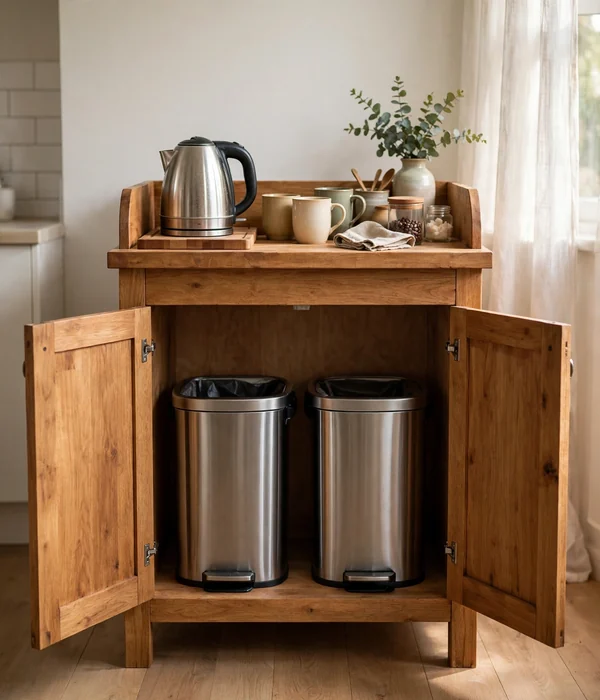
This is the tilt-out cabinet’s taller cousin: a freestanding unit about 24 to 36 inches wide with a trash compartment on the bottom and usable shelving or a countertop surface on top. The trash section swallows one or two 13-gallon cans behind doors, while the top becomes extra prep space, a coffee station or a home for small appliances.
In a small kitchen it does double duty, which is why it earns the floor space. Expect $150 to $300 for solid builds, more for hardwood.
Renters take note: it needs no screws in your cabinets, since it stands on its own. That makes it one of the few hidden-trash options that works in a rental. Measure the spot twice, since these units get heavy once loaded.
What you can do with it:
- Stash the 13-gallon can and a spare roll of bags in the bottom compartment.
- Keep the countertop clear for meal prep or a toaster oven.
- Use the middle shelf for cleaning caddies and dish soap refills.
- Add adhesive LED pucks inside the trash section so you can see the bag.
- Place it against a wall near the dining area to shorten cleanup trips.
- Wipe the trash compartment monthly, since enclosed bins trap odors fast.
6. Narrow Freestanding Bin Cabinet: the apartment-corner solution
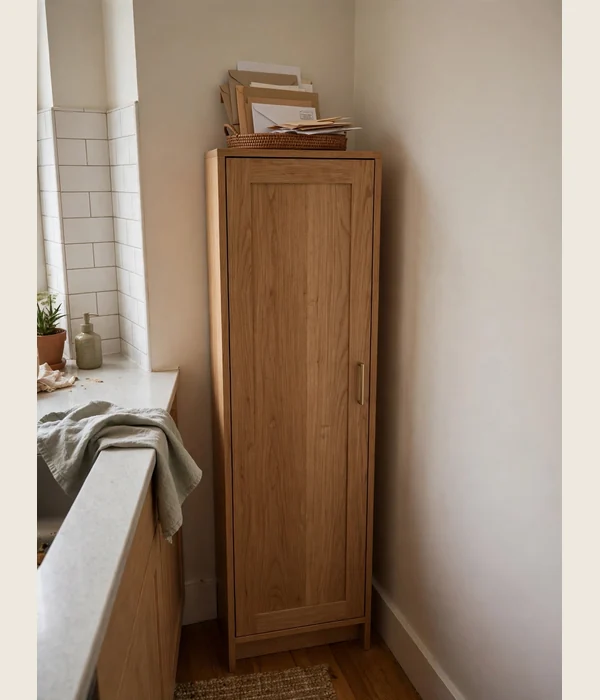
When no cabinet has a spare opening, a narrow freestanding bin cabinet claims a corner. These run 12 to 15 inches wide and about 30 inches tall, sized to hold a single 8- to 13-gallon can behind a door. The flat top doubles as a landing spot for groceries, and it needs no screws and no installation.
That makes it the easiest win in this list. Measure your corner first: 14 inches of wall space is all it asks. Typical price is $70 to $160.
Small enclosed bins smell first, so empty on schedule and wipe the interior weekly with a mild cleaner. In homes with pets, a latch or magnetic catch keeps curious noses out of the bin.
What you can do with it:
- Tuck it between the counter and the wall where a full can would block traffic.
- Top it with a tray to corral mail or hold the fruit bowl.
- Line the interior with a washable mat for easy wipe-downs.
- Keep a stack of spare bags inside so swaps take ten seconds.
- Choose a model with a magnetic catch so the door stays shut in busy kitchens.
- Take food scraps out daily in warm months to keep fruit flies away.
7. Slim Motion-Sensor Can: hands-free trash under 11 inches wide
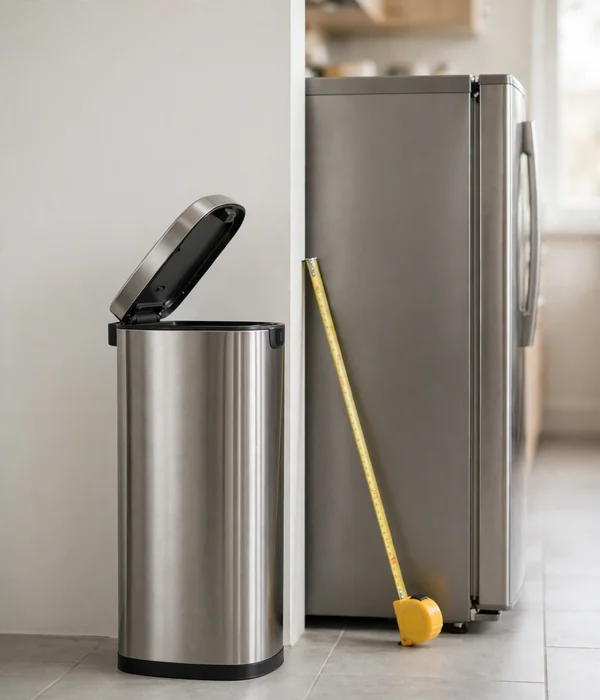
A slim sensor can gives you full 13-gallon capacity in a body about 10.4 inches wide, 16.3 inches deep and 22.6 inches tall. That is narrow enough to slide beside the fridge or into the gap between the counter and the wall.
The infrared sensor opens the lid when your hand passes within about 6 inches, so raw chicken and fish scraps go in without touching anything. Wipe the sensor window monthly, since a grease film dulls it over time.
Most models run on four D batteries for up to a year, and many include an activated-carbon odor filter. Budget roughly $60 to $120. Keep it out of direct sunlight: strong light on the sensor window causes phantom openings, and a lid that flaps all day kills the batteries.
- Insert the batteries and switch the can on, then place it where the sensor sees your approach.
- Seat the carbon odor filter in its slot under the lid.
- Line the can with a standard 13-gallon tall kitchen bag and tuck the excess under the retainer ring.
- Test the sensor with a wave and check the lid closes fully every time, since a lid left ajar defeats the odor seal.
8. Slim Dual-Compartment Step Can: trash and recycling side by side
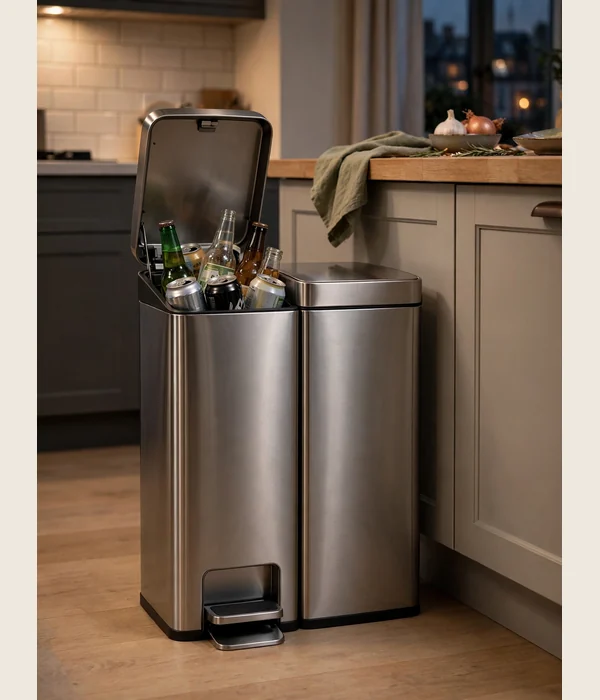
A dual-compartment step can splits about 16 gallons into two 8-gallon halves, each with its own bag and lid, in a body roughly 22 inches wide and 12 inches deep. Two foot pedals open each side hands-free, which matters when your hands are full of a cutting board.
It stands against a wall or at the end of a counter run, and both lids close on soft-close hinges so smells stay put. Typical price runs $80 to $150 for stainless models.
Both lids need to close fully to hold smells in. If a lid starts sitting crooked, the bag is overfilled or the hinge needs a wipe. Stainless shows fingerprints, so pick a smudge-resistant finish if that bothers you.
What you can do with it:
- Dedicate the left bin to trash and the right to cans and bottles.
- Use color-coded bags so everyone in the house sorts without thinking.
- Slide it to the end of the counter nearest the door you carry recycling out of.
- Wipe the pedals and lid edges weekly to keep the soft-close mechanism smooth.
- Keep a small stack of extra bags clipped inside one compartment for fast swaps.
- Check what your hauler actually accepts in recycling storage ideas for kitchens and garages before you sort.
9. Extra-Slim Under-Counter Bin: the gap-filler can
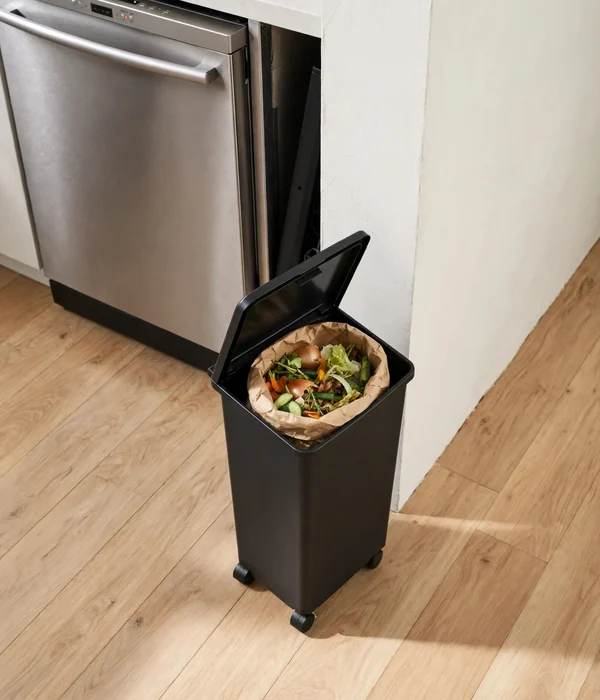
Some kitchens have a dead strip of floor between the counter and the dishwasher or wall, too narrow for a standard can. An extra-slim bin fills it: about 8 gallons of capacity in a body roughly 9 inches wide and 18 inches deep, sized to slip into that gap and roll out on small casters.
It works as a dedicated food-scrap bin or a backup trash can for heavy prep days. Most cost $30 to $60, and the best ones have a tight-sealing lid since food scraps smell fast.
Do not use it for sharp or heavy items like glass jars and full bottles. The thin walls and small casters are built for light scraps, not heavy loads. Lock the casters once it is parked so it does not drift.
What you can do with it:
- Roll it out for holiday cooking and tuck it away after.
- Dedicate it to food scraps and line it with compostable bags.
- Keep it beside the dishwasher as a pre-rinse scrap catcher.
- Choose a lidded model so smells stay sealed between empties.
- Empty it every day or two, since small bins fill fast in a busy kitchen.
Wipe the casters every few months so hair and grit do not jam the wheels.
Conclusion
Nine ways to make the trash disappear, and they all start with the same three numbers. Pull-outs hide the most in the least space, freestanding cabinets add furniture and storage, and slim bins rescue the gaps no cabinet will take.
Best first buy: the double pull-out kit from point one. It hides both trash and recycling inside a cabinet you already own, the install takes under an hour with basic tools, and at roughly $90 to $240 it is the cheapest way to clear a freestanding can off your kitchen floor for good.
Frequently Asked Questions (FAQ)
What indoor trash can ideas fit a 15-inch base cabinet?
If your cabinet has a 15-inch opening, then a single-bin pull-out is the safe pick, since double kits need at least 14.5 inches of clear width and face frames can eat into that. Measure the interior opening with the door open. If it reads 14.5 inches or more, a double 35-quart kit fits.
Will a pull-out trash kit work under my sink?
If your plumbing runs down the center of the cabinet, then choose a floor-mounted kit with a narrow frame that straddles the pipes, and confirm 19 inches of clear height under the lowest pipe. If a disposal fills the space, then a door-mounted single bin on the side wall usually fits better.
How do I keep a hidden trash cabinet from smelling?
If the cabinet has no airflow, then odors build fast, so put an activated-carbon deodorizer inside the door and empty on a fixed schedule, not when the bins look full. Wipe the interior monthly with a mild cleaner. If smells persist, then a lid is not sealing or a bin is overfilled.
Can I install a pull-out kit in a rental kitchen?
If your lease bans permanent changes, then skip kits that screw into the cabinet floor and pick a freestanding tilt-out or narrow bin cabinet instead, since those need no tools. Some pull-out kits mount to the door only with removable brackets. If you do drill, then save the screws and fill the holes before moving out.
Why does my motion-sensor can keep opening on its own?
If the sensor faces a walkway, then foot traffic triggers it, so turn the can so the sensor window faces a wall or corner. Bright sunlight confuses infrared sensors too. If it still opens on its own, then wipe the sensor window and replace the batteries.
Do slim cans fit standard 13-gallon trash bags?
If the can is marketed as 13 gallons, then standard tall kitchen bags fit, and most slim models include a retainer ring that tucks the excess neatly. Extra-slim 8-gallon bins need smaller bags. If the bag overhangs badly, then size down one bag size for a snug fit.
How often should I empty an indoor trash and recycling setup?
If your household cooks most days, then empty the trash every two to three days and the recycling weekly, even if neither bin looks full. Enclosed bins smell faster than open ones. If food scraps are in the mix, then daily emptying keeps odors and pests away.